


I watched my EA execute its 47th trade of the day on a $100,000 FTMO challenge account.

James Mitchell
Analista de Trading Sénior
☕ 11 min de lectura
Lo que aprenderás:
- 1The Big Lie About "Best" Prop Firm EAs
- 2The US Regulatory Gray Zone (It's Getting Darker)
- 3Non-Negotiable Features Your EA Must Have
- 4Decoding Firm Rules & EA Restrictions (2025 Update)
- 5Building vs. Buying: The Only Path That Works
- 6The Hidden Layer: Broker & Platform Limits
- 7Future-Proofing for 2026 and Beyond
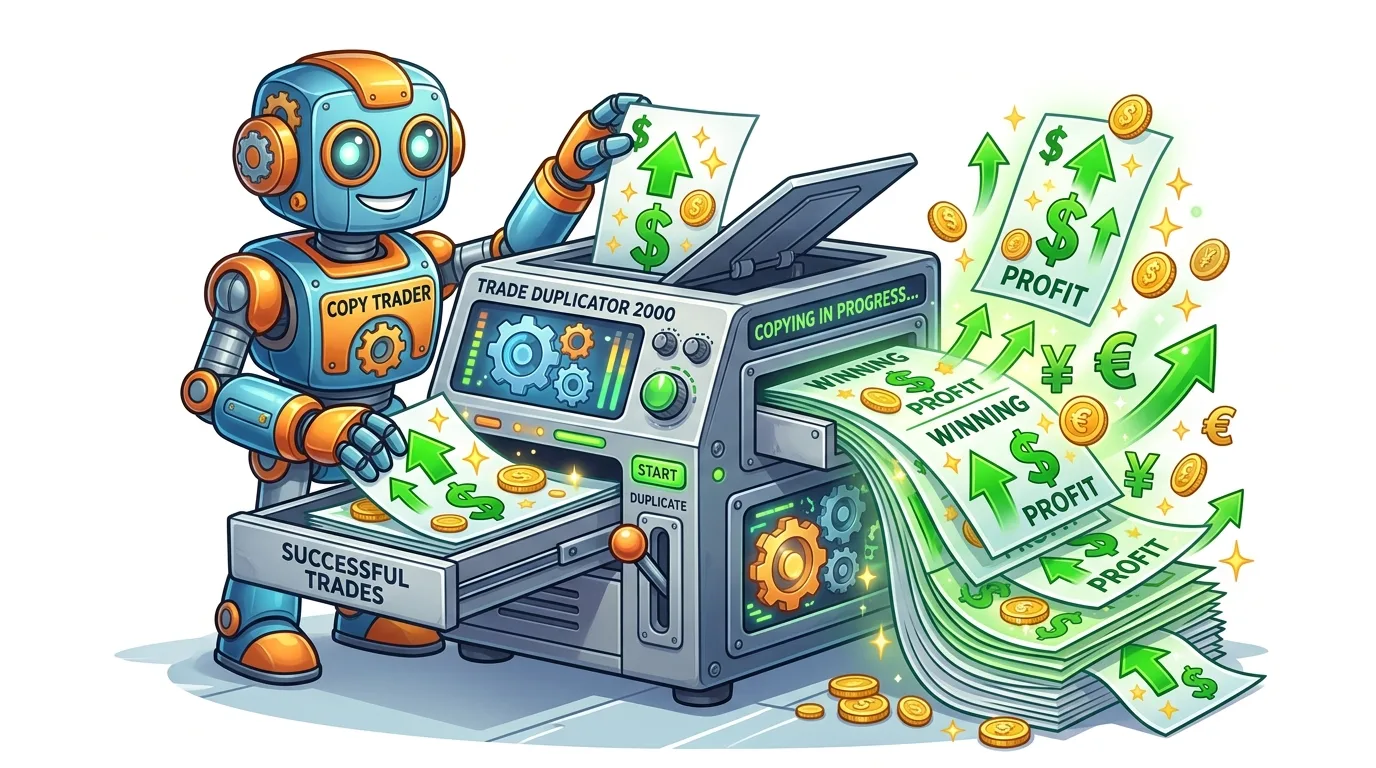
I watched my EA execute its 47th trade of the day on a $100,000 FTMO challenge account. The screen was a blur of green pips, the equity curve a beautiful 45-degree ramp. I was up $4,200 in six hours. Then, at 8:30 AM EST, the Non-Farm Payrolls hit. My bot, programmed to ignore news, kept trading. Slippage of 15 pips on a market order. Then 22. A margin call warning flashed. Ninety seconds later, the account was dead. I'd passed the profit target but violated the 5% daily loss rule I'd forgotten to code for. That $289 evaluation fee was gone. This is the brutal reality of chasing the 'best' prop firm forex EA. It's not about the code. It's about surviving their rules.
Let's cut through the marketing. You're searching for a magic box that prints money while you sleep, funded by someone else's capital. I get it. I bought that dream, too. The truth is, the 'best' prop firm forex EA isn't a single product you can buy. It's a system you build around the firm's unique - and often predatory - rulebook.
Most vendors sell you a strategy that worked in backtests on a retail broker. Prop firms aren't retail brokers. Their servers, liquidity, and rules are designed to make you fail. That slick EA that scalps 2 pips per trade? It'll get murdered by the 1-second execution delays some firms intentionally add to 'simulated' environments. The one that martingales? It'll hit the max daily loss before it can recover.
Here's the raw numbers they don't want you to know: Over 90% of all prop firm challenges fail. Less than 1% of traders ever see a consistent payout, and the average successful payout is less than $4,000. Your EA isn't just fighting the market; it's fighting a business model that profits from your failure.

Warning: Many 'funded' accounts are not live trading. The firm is often just simulating your trades against their own risk model. Your profits and losses are internal bookkeeping entries until you request a payout. This was the core of the CFTC's case against My Forex Funds.
The real question isn't 'what's the best EA?' It's 'what EA can consistently pass a specific firm's gauntlet?' That requires understanding two things: the firm's hard rules (drawdown, daily loss, news restrictions) and their soft rules (slippage models, server latency).

💡 Consejo de Winston
A professor once told me, 'The market is a mechanism for transferring wealth from the impatient to the patient.' With prop firm EAs, wealth is transferred from the over-leveraged to the risk-averse. Code patience and paranoia.
Trading with a prop firm from the US feels like walking a tightrope without a net. They're legal, but barely. Most operate in a gap between regulations. They're not brokers, so the CFTC and NFA don't directly oversee them as client-facing entities. They call themselves 'evaluation programs' or 'educational services.' It's a clever dodge.
But the winds are changing, fast. The CFTC is now sniffing around, asking if firms offering futures trading should be classified as Commodity Trading Advisors (CTAs). That would force registration, audits, and real capital requirements. The 2024-2025 amendments to Rule 4.7 are tightening portfolio rules. The My Forex Funds case, even though dismissed on a technicality, exposed the industry's dirty laundry: simulated accounts disguised as live, artificial slippage, and payout obstacles.
What does this mean for your EA?
- Rule Compliance is Non-Negotiable: Your EA must enforce the firm's rules internally, not rely on the platform. If their rule is 'no trading 5 minutes before major news,' your EA needs a calendar filter. I learned this the hard way with a scalping strategy that got flagged for 'overly aggressive' trading during the London open, a vague rule I hadn't coded for.
- Risk Protocols are King: The CFTC mandates risk management for any firm touching futures. Your EA needs hard-coded stop-losses, sane position sizing (I never risk more than 0.5% per trade on a challenge), and maximum daily loss logic. This isn't just good practice; it's becoming a legal requirement for the firms themselves.
- Payouts are the Real Test: An EA is useless if it can't get you paid. With increased KYC/AML checks, your trading behavior must be clean and consistent. Erratic, EA-generated trading can trigger manual reviews and frozen withdrawals.
You're not just coding for the charts. You're coding for a compliance officer you'll never meet.
“The 'best' prop firm forex EA isn't a product you buy. It's a system you build around the firm's unique - and often predatory - rulebook.”
Forget fancy indicators. The 'best' prop firm forex EA is boring and paranoid. It's a risk-management robot first, a signal generator second. Here’s what it absolutely must do.
Hard Rule Enforcement
Your EA must be the strictest risk manager in the room. It needs to:
- Calculate position size based on the account's current balance and a fixed risk percentage. Never use a static lot size. I use a position size calculator logic baked right into the code.
- Track daily and overall drawdown in REAL-TIME. It should stop all trading the moment you're within 0.2% of the limit, not after the next losing trade.
- Enforce banned trading periods (e.g., news, weekends, holidays).
Execution and Slippage Survival
Prop firm servers can be slow. Their spreads can widen artificially. Your EA must be built for worst-case execution.
- Use limit orders, not market orders, whenever possible. A market order during a volatile spike is a death sentence.
- Have a maximum acceptable slippage parameter. If the fill price is worse than X pips from the requested price, it should cancel the order and retry or skip the trade.
- Include a 'server ping check' to avoid trading if latency is too high.

Pro Tip: Code a 'heartbeat' log. Your EA should write a timestamp to a file every minute. If the firm claims your EA crashed and caused a rule violation, you have proof it was running. I've used this to overturn a failed challenge.
Adaptability
No single strategy works forever. The best EAs have a modular design. You should be able to switch the core logic (e.g., from a trend-following MACD indicator crossover to a mean-reversion RSI strategy) without rewriting the entire risk framework. This lets you adapt when a firm's 'simulated' market starts behaving oddly, which they often do.
One of my most successful prop firm EAs for swing trading majors like EUR/USD is just a simple breakout system wrapped in an ironclad risk shell. The strategy is 10% of the code. The rule-enforcement and error-handling is the other 90%.
Firm policies on EAs are a minefield. They say 'EAs allowed,' but the fine print tells a different story. Here’s a breakdown of what you're really up against.
| Firm Type | Typical EA Policy | The Hidden Catch |
|---|---|---|
| "EA-Friendly" | "All strategies welcome!" | They'll allow it, but their execution environment has 500ms+ latency and random spread widening that specifically breaks fast scalpers. |
| "Assistive Only" (e.g., For Traders) | EAs can assist your decisions. | Fully autonomous bots are prohibited. Your EA can set orders, but you must 'initiate' the trade cycle. They monitor for repetitive, pattern-like behavior. |
| "No Copy Trading" | You can use your EA. | You cannot use the SAME EA license/script on multiple funded accounts. They fingerprint EAs and will ban you for 'shared strategy' violations. |
| "No Hyperactive EAs" | No latency arbitrage, front-running. | They'll classify any EA that places more than 50 trades a day as 'hyperactive' and subject to review. Your scalping strategy is dead on arrival. |
The 2025 Shift: After the regulatory warnings, firms are terrified of being seen as hosting 'gambling bots.' Your EA must produce trading that looks human and rational. A grid trader placing 200 orders an hour on XAU/USD will get your account terminated, even if it's profitable.
My mistake? I used a modified version of my personal EA on a challenge with a top-rated firm like one you'd read about in an Exness review. It passed the challenge. On the funded account, they flagged it for 'irregular trading activity' - it traded during Asian session low liquidity, which their rules didn't forbid but their 'risk team' deemed undesirable. No violation, just a closed account. The $2,100 profit I had? Gone.
You need to study the firm's enforcement history on forums, not just their written rules.
💡 Consejo de Winston
Backtest your EA on the firm's demo server for at least a month. The only thing more expensive than a failed challenge is a funded account blown by an untested script.

“You're not just coding for the charts. You're coding for a compliance officer you'll never meet.”
You have two options: buy a 'black box' EA from a vendor or build/commission your own. I've done both. One works; the other is a donation.
Buying a Pre-Made EA: It's a lottery ticket. The vendor has zero incentive to make it work for your chosen prop firm. Their backtests are on ideal retail broker data. They won't adapt it for Firm X's 4% max trailing drawdown rule. When it fails, they'll blame your settings or the market. I wasted over $1,200 on 'prop firm ready' EAs before I admitted this.
Building/Commissioning: This is the only viable path. You have two sub-options:
- Learn to Code (MQL4/5): This is what I did. The learning curve is steep, but the control is absolute. You can tweak every parameter, add a filter for a specific firm's weird 'volatility shutdown' period, and truly understand what your robot is doing.
- Hire a Coder with Prop Firm Experience: This is expensive but can be worth it. The key is to provide the exact specification document. You are the strategist and risk manager; they are the engineer. Your spec must include:
- The exact prop firm's rule set (copy-paste from their website).
- Your exact trading strategy logic (e.g., "Enter long when the 50 EMA crosses above 200 EMA on H1, but only if the spread on EUR/USD is under 1.5 pips").
- The non-negotiable risk features from the previous section.
- A testing protocol (e.g., "Must pass a 3-month backtest and a 2-week demo on the prop firm's servers").

Example: My current EA spec for a popular firm includes this line: "IF (AccountEquity / StartingBalance) < 0.97 THEN CloseAllOrders(); StopAllTrading(); // 3% hard stop." This protects me before I ever hit their official 5% margin call level.
The 'best' prop firm forex EA is a custom-built tool for a specific job. It's a key made for one lock.

Your prop firm account is often just a label on top of a real broker's infrastructure. Firms commonly use large brokers like those in our IC Markets review or Pepperstone review for their underlying liquidity. This adds another layer of rules your EA must obey.
use is a Trap: US retail brokers are capped at 50:1 use. Prop firms offer 100:1, 200:1, even 500:1. This is not a gift. It's a quicker way to blow up. Your EA's position sizing must be aware of the REAL use being used. Just because you can trade 10 lots on a $10k account doesn't mean you should. My EA's max use usage is 10:1, even if the firm offers 100:1.
Platform Quirks: Most firms use MT4/MT5. But their server builds can be old. Some MQL4 functions behave differently. You must test your EA on THEIR demo server. An EA that works perfectly on my local XM review MT4 install failed to place orders on a prop firm's server because of a different build number.
The Prop Firm Dashboard: This is the final boss. Your EA trades on MT5, but the firm monitors your drawdown on their own dashboard, which might update on a 1-minute delay. Your EA might think it's at 4.8% drawdown, but their dashboard, due to a price feed lag, shows 5.1% and fails you. There's no coding fix for this. You must build in a massive buffer. If their max drawdown is 10%, my EA is programmed to shut down at 8%.
This is why integration with tools that manage risk directly on the platform is becoming essential. You need every layer of protection you can get.
💡 Consejo de Winston
If you wouldn't feel comfortable explaining every line of your EA's logic to the firm's risk team during a withdrawal review, it's not ready. Understand your own tool.
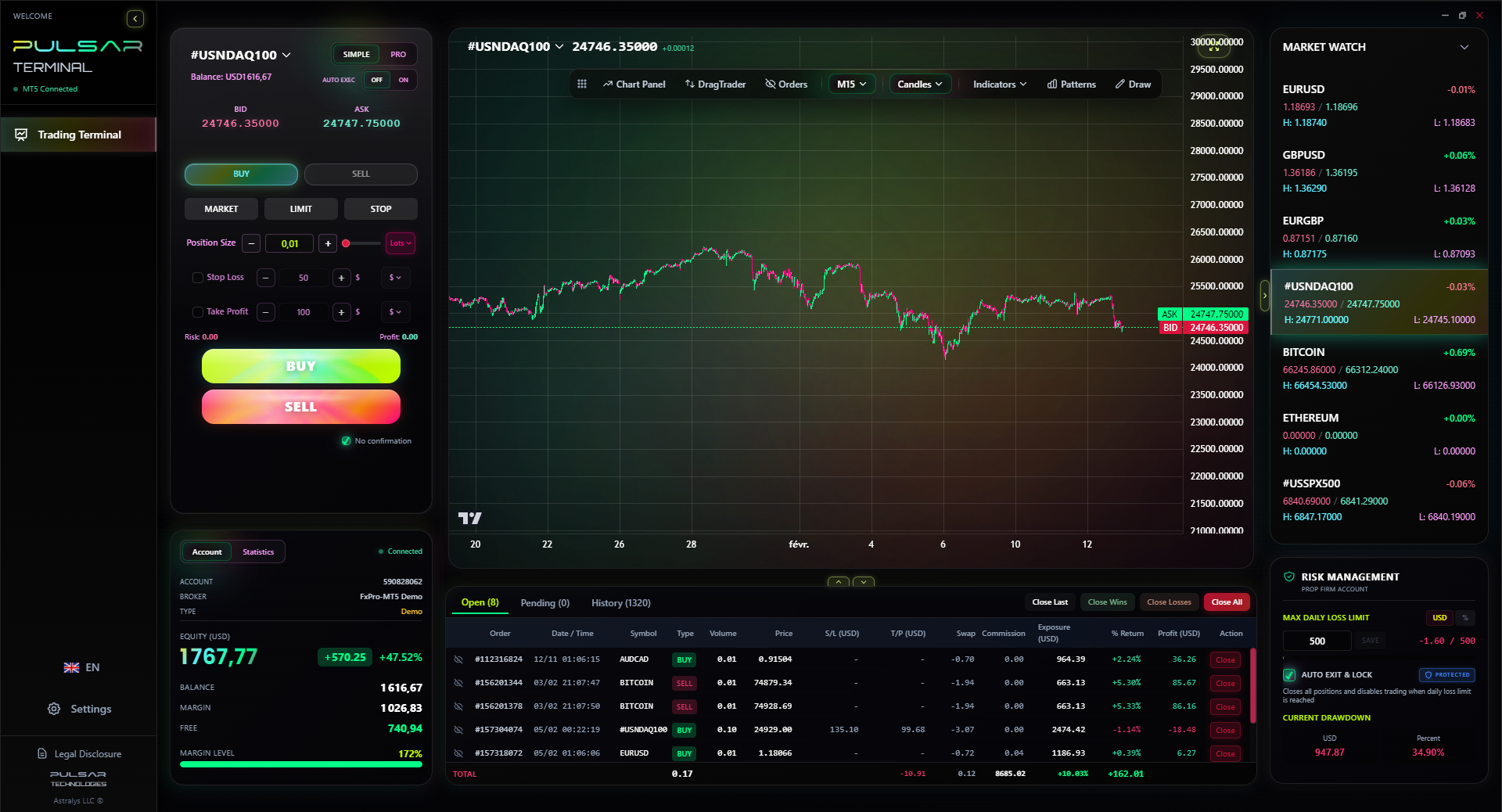
Managing the complex daily loss and trailing drawdown rules of a prop firm is where most EAs fail, which is why tools like Pulsar Terminal that automate these protections directly on your MT5 chart are becoming non-negotiable for serious traders.
Pulsar Terminal
La herramienta MT5 todo-en-uno: órdenes drag-and-drop, multi-TP/SL, trailing stop, grid trading, Volume Profile y protección prop firm. Usado por más de 1.000 traders diariamente.
“The goal is no longer just to pass a challenge. It's to build a track record so clean you survive the industry's transition into a regulated space.”
The prop firm industry is heading for a shake-up. 2026 predictions include mandatory licensing, CTA classification in the US, and standardized rules. Your EA needs to be built for this stricter world.
- Transparency Logging: Your EA should generate a daily trade log that matches the prop firm's statement: entry time, price, exit time, price, pip gain/loss, reason for exit. This is your audit trail if they question your strategy.
- News Filter Sophistication: Basic time-based filters won't cut it. Integrate a volatility spike detector. If the average true range (ATR) expands by 300% in 5 minutes, your EA should pause trading, regardless of the news calendar.
- Strategy Diversity Module: The hybrid firm/regulated broker models coming will likely allow more realistic trading. Consider an EA that can switch between a low-frequency trend mode and a higher-frequency mean-reversion mode based on market conditions, making your activity look more like a professional, adaptable trader.
- Ethical AI Avoidance: As firms implement AI to detect 'bot-like' behavior, your EA needs some randomness - variable trade sizes (within your risk limit), random delays between signal and order submission (e.g., 100-500ms). Make it look human.
The goal is no longer just to pass a challenge. It's to build a track record so clean and professional that you survive the industry's transition into a regulated space. The EA that does that isn't a 'profit maximizer.' It's a 'risk minimizer and rule follower.' That's the only kind of 'best' that lasts.
FAQ
Q1Can I use any EA I find online for a prop firm challenge?
Technically, maybe. Successfully? Almost certainly not. Off-the-shelf EAs are not designed for the specific, often harsh rules of prop firm evaluations (daily loss limits, trailing drawdown, news restrictions). Using one is a great way to lose your evaluation fee.
Q2Are prop firms that allow EAs more legitimate?
Not necessarily. 'Allowing EAs' is a marketing tactic to attract more customers. Legitimacy comes from transparent payout practices, clear rules, and a track record of paying traders. Some of the most restrictive firms are actually more sustainable because they enforce risk management that protects both you and them.
Q3What's the most common way an EA fails a prop firm challenge?
Violating the maximum daily loss rule. An EA might have a great long-term strategy, but a string of losses in a single session can hit that limit (often around 5%) before the strategy has a chance to recover. The EA must track this internally and stop trading before the firm's system does.
Q4Do I need to disclose to the prop firm that I'm using an EA?
You must read their Terms of Service. Some require disclosure; others don't care as long as you follow the rules. However, their risk systems will detect automated trading patterns. It's always better to be transparent if their rules ask for it to avoid account termination later.
Q5Is it legal to use an EA with a US-based prop firm?
The legality isn't about the EA; it's about the firm's structure. Using an EA is generally permitted by the firm's rules. However, the firm itself operates in a regulatory gray area. Your legal protection as a trader is very limited compared to using an NFA-regulated broker directly.
Q6What's a reasonable budget to get a custom EA built for prop firms?
For a strong, custom-coded EA with all the necessary risk features from a competent developer, expect to pay between $1,500 and $5,000 USD. Cheap coders will deliver cheap, unreliable code. Remember, you're investing in the tool to access potentially large capital. Don't skimp.
Q7Can my EA trade during high-impact news events if the firm allows it?
Just because you can doesn't mean you should. Most EAs are calibrated for normal market conditions. News volatility can cause massive slippage, widening spreads, and failed orders, which can trigger multiple rule violations instantly. The safest EAs have a mandatory 'news off' switch.
Lección del Prof. Winston
Puntos clave:
- ✓Success rate is under 10%; code for survival, not just profits.
- ✓Hard-code all prop firm rules with a 20% safety buffer.
- ✓Assume 'funded' accounts are simulated until proven otherwise.
- ✓Custom-built EAs are the only viable long-term path.
- ✓Future-proof with transparency logs and volatility filters.
¿Te resultó útil este artículo?
Haz clic en una estrella
Análisis Trading Semanal
Análisis y estrategias semanales gratis. Sin spam.
Sobre el autor
James Mitchell
Analista de Trading Sénior
Con sede en Nueva York y más de 9 años de experiencia en trading. Se enfoca en pares USD principales, desafíos de prop firms y el panorama regulatorio estadounidense.
Comentarios
Aviso de riesgo
El trading de instrumentos financieros conlleva un riesgo significativo y puede no ser adecuado para todos los inversores. El rendimiento pasado no garantiza resultados futuros. Este contenido tiene fines educativos únicamente y no debe considerarse asesoramiento de inversión. Siempre realice su propia investigación antes de operar.
También te puede interesar

Cara Trading Forex Sukses: 7 Prinsip dari Trader Profesional
Cara trading forex sukses dengan 7 prinsip trader pro: manajemen modal, disiplin, journal trading, backtest. Data nyata, bukan janji profit palsu.
Jam Trading Forex Terbaik untuk Trader Indonesia: Panduan Lengkap dengan Tabel Waktu
Panduan jam trading forex untuk trader Indonesia. Tabel 4 sesi dunia, jam emas 20:00-00:00, sesi mana yang harus dihindari. Data akurat + tips dari trader berpengalaman.
Top 5 Sàn Forex Uy Tín Nhất 2026: Review Jujur dari Trader Indonesia
Top 5 sàn forex uy tín 2026 untuk trader Indonesia. Review jujur: spread, deposit, withdraw, dukungan lokal. Exness, XM, IC Markets & lebih.
Obtener Pulsar Terminal
Todas estas calculadoras están integradas en Pulsar Terminal con datos en tiempo real de su cuenta MT5.
Obtener Pulsar Terminal