


Let's cut through the noise.

David van der Merwe
Trader de Mercados Emergentes ·  South Africa
☕ 11 min de lectura
Lo que aprenderás:
- 1The Fundamental Split: Betting vs Trading
- 2Risk & Reward: The Math That Doesn't Lie
- 3The Real Costs for South African Traders
- 4Regulation & Safety: Your Money in a South African Context
- 5Which One is Actually Right for You?
- 6How to Start Trading (The Right Way) in South Africa
- 7The Final Verdict From Someone Who's Been There
Let's cut through the noise. Most articles on the difference between binary options and forex trading are written by people who've never risked their own money. They'll tell you it's about 'fixed vs variable risk' and leave it there. I'm telling you it's the difference between learning a craft and playing a rigged carnival game. I've lost money on both sides of this fence in my 12 years trading from Johannesburg. This isn't theory. This is a post-mortem of my own mistakes and a clear map for any South African trying to navigate this space without getting cleaned out.
The core difference between binary options and forex isn't just technical. It's philosophical. One is a short-term bet with a known expiry. The other is a trade in a continuous market.
With binary options, you're answering a yes/no question: "Will EUR/USD be above 1.0850 in 15 minutes?" You put down, say, R1000. If you're right, you might get back R1800 (an 80% payout). If you're wrong, you lose the entire R1000. That's it. Game over. The outcome is binary - win or lose - and the profit is fixed. There's no scaling out, no adjusting stops, no riding a trend. Time's up.
Forex is different. You buy or sell a currency pair, like USD/ZAR or EUR/USD. Your profit or loss isn't fixed. It grows or shrinks with every pip the market moves. You can get out whenever you want. You can take partial profits, move your stop loss to breakeven, or add to a winning position. The market doesn't just switch off on you. This flexibility is what allows for actual strategy, not just prediction.
I learned this the hard way early on. I took a R5,000 binary trade on Gold, sure it would spike on some news. I was directionally correct! Gold went up. But it took 17 minutes to make its move. My option expired at 15 minutes. I lost everything because I was two minutes too early. In forex, with the same view, I could have just held the position. The difference between binary options and forex trading, in practice, is often the difference between being right and getting paid for being right.

Warning: Binary options platforms are masters of UI/UX. The one-click trading, the exciting sounds, the instant gratification - it's designed to feel like a game. This triggers dopamine, not discipline. Forex platforms like MT5 can feel complex, but that complexity is the space where risk management lives.

💡 Consejo de Winston
If a trading platform looks more like a video game arcade than a Bloomberg terminal, your money is the prize they're designed to win.
Let's talk numbers, because this is where the rubber meets the road. The advertised payout for binary options is usually between 70% and 95%. Sounds okay, right? You win more often than you lose. Here's the hidden math they don't show you.
If you win 55% of your trades (which is excellent), and you get an 80% payout, you're still losing money over time. Let's say you do 100 trades of R100 each.
- 55 wins: 55 x R80 profit = R4,400
- 45 losses: 45 x R100 loss = R4,500 Net result: -R100
You have to win at a significantly higher rate just to break even, often around 60% or more, depending on the payout. The odds are structurally stacked against you. It's a negative expectancy game.
Forex is different. Your risk isn't fixed by a timer. You control it with your stop-loss order. Your reward isn't capped by a payout percentage. It's capped only by the market's movement. This creates positive expectancy potential.
The use Factor
This is huge. In South Africa, forex brokers like Khwezi Trade or iFX Brokers offer use up to 1:500 for retail clients (though the FSCA is always reviewing this). This means with R2,000 margin, you can control a R1,000,000 position. This amplifies both gains and losses per pip definition.
Binary options don't use explicit use, but the all-or-nothing nature acts like 100% use on your trade stake. You're always risking 100% of the capital allocated to that specific 'bet'.

Example: In 2019, I used a 1:100 use on a USD/ZAR trade. I bought at 14.50 with a 20-pip stop (R2000 risk on a mini lot). The pair ran to 14.90. My profit wasn't capped at 80%. It was 400 pips, or R4000 on that R2000 risk. A 200% return on risk. In a binary, the best I could have hoped for was an 80% return on my stake, if I even picked the correct expiry.
“The difference between binary options and forex is the difference between being right and getting paid for being right.”
You don't pay fees, you pay spreads, commissions, and swaps. Understanding this is critical for your bottom line.
Binary Options Costs: The cost is baked into the payout. If the true odds of an event are 50/50, a fair payout would be 100%. They offer 80%. That 20% difference is their built-in profit margin, or 'house edge.' It's invisible but always there.
Forex Trading Costs: These are transparent but you must manage them.
- The Spread: This is the difference between the buy and sell price. It's your immediate cost to enter a trade. For a major pair like EUR/USD, a good raw spread from a broker like Tickmill can be 0.1 pips, plus a commission. On a standard account with Exness, it might be 1.0 pips with no commission.
- Commissions: Charged per lot traded. Tickmill charges $3 per side per 100k lot. On a R15,000 account, this matters.
- Swap Fees: Interest for holding a position overnight. Can be positive or negative. Holding a USD/ZAR buy position (going long USD against ZAR) often incurs a negative swap because of South Africa's higher interest rates. This can eat into profits on longer-term swing trading positions.
Local Broker Context: A broker like Khwezi Trade (FSCA regulated) might offer spreads from 0.4 pips on USD/ZAR with a ZAR 500 minimum deposit. An international broker like XM might offer a $5 minimum but you'll pay currency conversion from ZAR to USD. Always factor in that bank conversion fee, it can be 2-3%.
I once made a R1500 profit on a week of scalping strategy trades, only to realize my bank charged me R450 in international payment fees for my withdrawals. The devil's in the details.
This is the most important section for any South African trader. The regulatory landscape defines your protection.
The Financial Sector Conduct Authority (FSCA) is our watchdog. They're not perfect, but they're what we have.
Forex Regulation: It's solid. To operate here, a forex broker must have an FSP (Financial Services Provider) license. This means they must keep client funds in segregated bank accounts (your money separate from the company's money), meet capital adequacy requirements, and adhere to fair practice rules. Brokers like IG, AvaTrade, and the local Khwezi Trade are FSCA-licensed. You can verify any broker's license number on the FSCA website. This is non-negotiable.
Binary Options Regulation: Here's the minefield. Binary options are legal in South Africa. But, and this is a massive but, the FSCA has repeatedly warned the public against unlicensed binary options operators. They've named and shamed platforms like 'Binary Options Investment' and 'IQ Option' (yes, the huge one) for operating without authorization.

Pro Tip: If a binary options platform is not on the FSCA's list of authorized financial services providers, you have zero protection. If they disappear with your money, you have no recourse. The FSCA has no jurisdiction over an offshore company in Cyprus or the Seychelles.
I learned this through panic. In 2017, I had R8,000 stuck in an offshore binary platform when they 'experienced technical difficulties' during a withdrawal. My emails went unanswered. The FSCA's response was, "We warned you." That R8,000 was an expensive lesson in regulatory jurisdiction. With my FSCA-regulated forex broker, withdrawals hit my FNB account within 24 hours.
💡 Consejo de Winston
Your first R10,000 in the markets is tuition, not investment capital. The goal is to learn, not to earn. If you preserve most of it, you've graduated with honours.
“Binary options offer the illusion of simplicity but hide a mathematical trap. Forex is hard work, but that work can actually lead somewhere.”
This isn't about which is better. It's about which one aligns with your goals, psychology, and commitment level.
Consider Binary Options ONLY if:
- You have a very small amount of capital you are willing to lose entirely for the experience (think R500-R1000, not your savings).
- You want to practice making very short-term market predictions with immediate feedback.
- You understand it is gambling with a structural disadvantage, like betting on a horse, not investing.
Consider Forex Trading if:
- You want to develop a real, transferable skill in financial markets.
- You are prepared to learn about economics, chart analysis, and, crucially, risk management.
- You have the patience for trades to develop over hours, days, or weeks.
- You want the potential for uncapped returns on successful trends.
- You value the security of trading with a regulated entity that holds your money in a real bank.
For most South Africans starting out, forex is the more sensible path. The learning curve is steeper, but you're learning to drive a car, not just pressing the accelerator on a slot machine. The skills you build analyzing USD/ZAR or using the RSI indicator on a forex chart are real. They can be applied to other markets later.
The brutal truth? Binary options are a distraction for 95% of people. They offer the illusion of simplicity but hide a mathematical trap. Forex is hard work. It requires a position size calculator, a trading journal, and the discipline to follow a plan even when it's boring. But that hard work can actually lead somewhere.
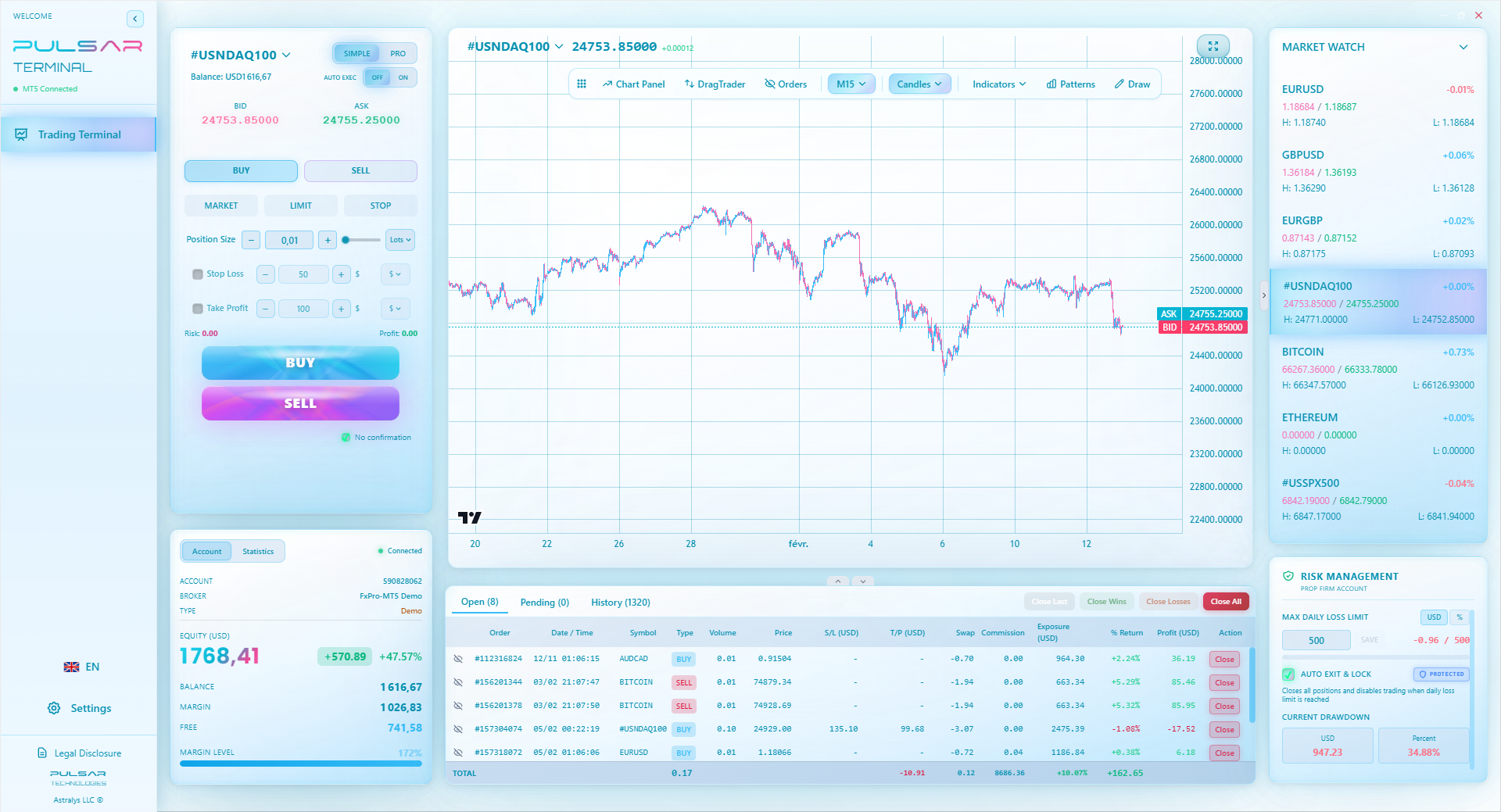
Managing complex forex trades with multiple take-profit levels is where most fail, but tools like Pulsar Terminal automate this directly on your MT5 charts.
Pulsar Terminal
La herramienta MT5 todo-en-uno: órdenes drag-and-drop, multi-TP/SL, trailing stop, grid trading, Volume Profile y protección prop firm. Usado por más de 1.000 traders diariamente.
If you've decided forex is the path, here's how to begin without lighting your money on fire.
- Education First, Money Last: Don't deposit a cent for at least a month. Use a demo account. Learn the MT5 platform. Understand what a spread definition is, what a margin call feels like (in demo!), and how orders work. Babypips.com is a free, fantastic starting resource.
- Pick an FSCA-Regulated Broker: This is your first real decision. Compare them. Look at:
- Minimum deposit (Khwezi Trade: ZAR 500, Exness: $10)
- Spreads on the pairs you care about (USD/ZAR, EUR/USD)
- Deposit/Withdrawal methods (Local EFT? How long?)
- Platform (Most offer MT4/MT5, which is standard).
- Start Absurdly Small: When you go live, start with a micro account if possible. Risk no more than 1% of your account per trade. On a R5,000 account, that's R50. Yes, it feels tiny. That's the point. You are paying for an education, not buying a Lamborghini.
- Develop a Simple Strategy: Don't try to use 10 indicators. Pick one major pair, like EUR/USD. Learn its personality. Use a simple strategy combining price action and one oscillator like the MACD indicator. Backtest it on demo, then trade it on live with your tiny risk for 100 trades. Keep a journal.
- Manage Your South African Reality: Be aware of load-shedding. Have a UPS for your router and monitor. Know that market volatility often spikes during local market open (9am SAST) and when US data is released (often 3:30pm SAST).
My first profitable month came after 9 months of consistent losses. I started with R10,000. I blew my first R2,000 in two weeks by over-leveraging. I then religiously risked R100 per trade (1% of the remaining R8k). It was boring. It was slow. But by month 9, I had grown that R8k back to R10,500. The gain wasn't the story. The fact that I had stopped the bleeding and developed a repeatable process was the win.
“Your first profitable month in forex isn't about the money. It's about proving you can follow a plan when it's boring.”
The difference between binary options and forex trading is the difference between a scratch card and a small business.
One offers a quick, addictive hit with a predictable long-term outcome: loss. The other offers a difficult, often frustrating journey with an uncertain outcome, but one where your skill, discipline, and psychology directly influence your results.
For the aspiring South African trader, the choice should be clear. Put in the hard yards with forex. Embrace the complexity. Get an FSCA-regulated broker. Learn to use a proper platform like MT5 with tools that help you manage risk, not just place bets.
I wish someone had shaken me by the shoulders in 2015 and told me to stop chasing the 5-minute binary thrill and to instead learn how to read a daily chart on USD/ZAR. That binary options phase cost me over R40,000 in total - money that, if I'd invested it in my forex education and started with proper risk management, would have compounded into real capital by now.
Your capital and your time are precious. Invest them in the market that allows you to grow, not just gamble.
💡 Consejo de Winston
The FSCA's warning list is the most valuable free tool for a South African trader. Check it before you deposit, not after you've been scammed.
FAQ
Q1Is binary options trading illegal in South Africa?
No, it's not illegal. It's a regulated activity. However, the major risk is that many platforms offering binary options to South Africans are NOT regulated by the FSCA. Trading with these unlicensed offshore entities is extremely risky, as you have no legal protection if they refuse a withdrawal or go bankrupt.
Q2Can I make a living trading binary options?
The mathematical structure of binary options (the built-in house edge) makes it statistically almost impossible to be profitable long-term, even with a good win rate. It's designed for short-term entertainment, not sustainable income. Forex, while extremely difficult, at least provides a framework where skill and discipline can lead to long-term profitability.
Q3Which is easier for a complete beginner?
Binary options are easier to start. The platforms are simple, the choice is basic (up/down), and you get an instant result. Forex has a steeper initial learning curve. However, 'easier to start' does not mean 'easier to succeed at.' In fact, the simplicity of binaries is what leads beginners to lose money faster without learning anything useful.
Q4What's the minimum amount I need to start forex trading in South Africa?
You can start with very little. Brokers like XM or Exness have minimum deposits as low as $5-$10 (roughly R90-R180). However, I strongly advise starting with at least R2,000-R5,000. This allows you to trade micro lots and practice proper risk management (risking 1% or less per trade) without your account being wiped out by a few bad trades or fees.
Q5Do I pay tax on forex trading profits in South Africa?
Yes. The South African Revenue Service (SARS) views forex trading profits as income if you're trading frequently (seen as a revenue-generating activity). You need to declare this profit in your annual tax return. Keep careful records of all your trades, deposits, and withdrawals. It's not a tax-free hobby.
Q6Are there any good binary options brokers regulated by the FSCA?
The FSCA-licensed landscape for pure binary options brokers is very sparse and not commonly used by retail traders. The FSCA's warnings have largely driven reputable providers away from offering this product prominently to the South African public. Your safest bet is to assume any binary platform aggressively marketing to you is not under FSCA protection.
Lección del Prof. Winston
Puntos clave:
- ✓Binary options have a structural 'house edge' requiring a >60% win rate just to break even.
- ✓Forex costs are transparent (spread, commission, swap) and can be managed.
- ✓Only trade with FSCA-regulated brokers; verify their license number.
- ✓Start live forex trading risking no more than 1% of your capital per trade.
¿Te resultó útil este artículo?
Haz clic en una estrella
Análisis Trading Semanal
Análisis y estrategias semanales gratis. Sin spam.
Sobre el autor
David van der Merwe
Trader de Mercados Emergentes
Trader con sede en Johannesburgo con 11 años en divisas de mercados emergentes. Especialista en pares ZAR, trading regulado por la FSCA y análisis del mercado sudafricano.
Comentarios
Aviso de riesgo
El trading de instrumentos financieros conlleva un riesgo significativo y puede no ser adecuado para todos los inversores. El rendimiento pasado no garantiza resultados futuros. Este contenido tiene fines educativos únicamente y no debe considerarse asesoramiento de inversión. Siempre realice su propia investigación antes de operar.
También te puede interesar

Cara Trading Forex Sukses: 7 Prinsip dari Trader Profesional
Cara trading forex sukses dengan 7 prinsip trader pro: manajemen modal, disiplin, journal trading, backtest. Data nyata, bukan janji profit palsu.
Jam Trading Forex Terbaik untuk Trader Indonesia: Panduan Lengkap dengan Tabel Waktu
Panduan jam trading forex untuk trader Indonesia. Tabel 4 sesi dunia, jam emas 20:00-00:00, sesi mana yang harus dihindari. Data akurat + tips dari trader berpengalaman.
Top 5 Sàn Forex Uy Tín Nhất 2026: Review Jujur dari Trader Indonesia
Top 5 sàn forex uy tín 2026 untuk trader Indonesia. Review jujur: spread, deposit, withdraw, dukungan lokal. Exness, XM, IC Markets & lebih.
Obtener Pulsar Terminal
Todas estas calculadoras están integradas en Pulsar Terminal con datos en tiempo real de su cuenta MT5.
Obtener Pulsar Terminal