


You're probably wondering if you can really make it as a forex trader in South Africa.

David van der Merwe
Trader de Mercados Emergentes ·  South Africa
☕ 12 min de lectura
Lo que aprenderás:
- 1The South African Forex Scene: More Than Just Rand Volatility
- 2Meet the Traders: The Real Stories Behind the Names
- 3How They Trade: ZAR Pairs and Global Markets
- 4The Real Costs: What They Don't Show You on Instagram
- 5Pitfalls to Avoid: Lessons from My Mistakes
- 6Building Your Own Approach: Start Here, Not on Instagram
- 7Essential Tools and Resources for the SA Trader
- 8The Path Forward: Your Journey Starts Now
You're probably wondering if you can really make it as a forex trader in South Africa. The short answer is yes, but it's not about chasing fame or get-rich-quick schemes. It's about understanding a unique market, playing by the FSCA's rules, and learning from the few who've actually done it. I've traded the ZAR pairs for over a decade, and I'll tell you straight: the local trading scene is a mix of genuine skill, loud marketing, and some painful lessons. Let's look past the social media hype and talk about what it really takes, who the real players are, and how you can build a sustainable approach without blowing your account.
Trading forex from South Africa isn't just about the USD/ZAR pair, though that's where most locals start (and often get burned). We have the largest retail forex market in Africa, and it's growing fast. But with that growth comes noise. A lot of it.
You've got the real, regulated professionals quietly managing money, and then you've got the 'gurus' selling courses on Instagram. The key difference? One group is accountable to the Financial Sector Conduct Authority (FSCA), and the other isn't. The FSCA is our watchdog. Since 2021, they've capped use for retail traders at 30:1 to protect people from themselves. It's a good rule, honestly. I remember trading at 100:1 early on and watching a R5,000 account vanish in two bad trades on GBP/JPY. That use cap would have saved me.

Warning: If a 'trader' is pushing you to use an offshore broker for 'unlimited use,' run. You're giving up all the FSCA's client money protection rules. It's not worth the risk.
The ZAR is a commodity currency, meaning it dances to the tune of gold, platinum, and global risk sentiment. A bad day on the JSE or a shift in US interest rates can send it reeling. This volatility is a double-edged sword: opportunity for the prepared, a trap for the emotional. You need a broker that can handle these moves without freezing. I've had good experiences with the local operations of IC Markets review and Pepperstone review for their execution during local news events.

💡 Consejo de Winston
The market doesn't care about your nationality, your opinion, or your need for profit. It only responds to price. Trade what you see, not what you believe.
Let's talk about the famous forex traders in South Africa. I'm not going to list every social media personality. Instead, I'll focus on a few archetypes and what you can actually learn from them.
The Quiet Fund Manager
This is the professional you rarely hear about. They might run a small hedge fund or a managed account service for high-net-worth individuals. Their edge isn't flashy signals; it's risk management, deep macroeconomic analysis of SA fundamentals, and relationships with liquidity providers. They trade size, but their yearly goal might be a steady 15-20%, not 100% monthly. Their existence proves you can make a real career here, but it's a marathon, not a sprint.
The Educator (The Good Kind)
A few traders have built reputable businesses around education. They're often FSCA-registered as financial service providers. Their courses focus on the foundations: understanding pip definition, how to use a position size calculator, and building a trading plan. They make their money from teaching, not from your trading profits. This is a legitimate model. I paid for a mentorship like this early on. It cost me R15,000, but it saved me ten times that in avoided mistakes by drilling proper risk management into me.
The Social Media Phenomenon
Here's where you need sharp discernment. For every genuine trader sharing insights, there are ten selling a dream. The hallmarks? Lamborghinis in thumbnails, promises of 'secret indicators,' and pressure to join expensive signal groups. Remember, if their trading system was so infallibly profitable, they wouldn't need to sell it for R2,999. I got caught up in this early on, buying a 'golden scalping system' that was just a repackaged Moving Average crossover. Lost R8,000 testing it live before I admitted it was junk.
A real story: I once took a trade alongside a signal from a very famous local 'guru.' His call was long EUR/USD based on 'institutional order flow.' I used my own scalping strategy setup for entry but followed his direction. The trade hit stop loss. He later posted a screenshot of a profitable trade on the same pair, but the timestamp was from a different, more favorable hour. Lesson learned: trust your own analysis, not someone else's screenshot.
“The use cap would have saved me from watching a R5,000 account vanish in two bad trades.”
Trading the Rand is a different beast. The famous forex traders in South Africa who are successful understand its unique drivers.
USD/ZAR (The Big One): This is all about interest rate differentials (SA vs. US), commodity prices, and local political risk. It's highly sensitive to SARB announcements and budget speeches. The spread can be wide, often 50-100 pips on a standard account, so you need a real move to make it work. This is a swing trading pair, not for scalping. I once held a USD/ZAR short for three weeks in 2020, riding a wave of Rand strength on a gold rally. Entry at 16.85, exit at 15.40. The patience paid off, but the daily swap charges (financing) ate into the profit more than I'd anticipated.
EUR/ZAR & GBP/ZAR: These offer alternative plays. Sometimes the story isn't the Rand, but Eurozone politics or Brexit drama affecting the cross. Liquidity is lower, so mind the spread definition.
The Smart Move: Trading Majors from SA Many successful local traders actually focus less on ZAR pairs and more on the liquid majors like EUR/USD guide or XAU/USD guide (Gold). The costs are lower, the charts are cleaner, and you're not emotionally tied to local news. You can apply pure technical analysis or global macro ideas. My most consistent profits have come from EUR/USD, not from trying to outguess the SARB.

Pro Tip: Use the SA market open (7 AM CAT) to your advantage. Often, the first hour sees a surge in ZAR pair volatility as local banks and funds come online. It can set the tone for the day, even for global pairs.
Let's get brutally honest about money. Those flashy car videos never show the brokerage statement with all the fees deducted. Here’s what it really costs to trade from SA.
Spreads & Commissions: This is your main cost. On USD/ZAR, expect 50-100 pips spread on a standard account. On an ECN account from a broker like Exness review or IC Markets, you might get 15-25 pips plus a commission. For EUR/USD, you can get under 1 pip.
Financing Costs (Swap): Holding a ZAR pair overnight costs money. If you're short USD/ZAR (betting on a stronger Rand), you're borrowing USD to buy ZAR. The interest rate differential will usually work against you, as US rates are often higher. This can be a silent account killer for long-term positions.
The Tax Question: SARS sees trading profits as income if you're an individual. There's no specific 'forex tax' category. You declare your net profit (total gains minus total losses, minus allowable expenses like data subscriptions) as part of your taxable income. Keep careful records. I use a simple spreadsheet logging every trade, date, profit/loss, and broker fee. When my accountant asks, it's all there.
Minimum Deposits: They vary wildly. Some global brokers like XM have a $5 minimum. Local FSCA-regulated entities might require R2,000 or more. My advice? Start with the smallest amount you can that still lets you trade sensible position sizes. Never deposit 'hope money' – money you can't afford to lose.
| Cost Type | ZAR Pair Example (USD/ZAR) | Major Pair Example (EUR/USD) |
|---|---|---|
| Typical Spread | 50 - 100 pips (Standard) | 0.7 - 1.5 pips (Standard) |
| Overnight Financing | Can be high (costly) | Usually minimal |
| Market Impact | High (less liquid) | Low (highly liquid) |
A real number from my journal: In a month where I made R12,000 in gross profit on various trades, my total costs (spreads, commissions, swaps) were R1,850. That's over 15% of my profits gone to costs. It forces you to be very selective with your trades.
💡 Consejo de Winston
A 50-pip stop loss on EUR/USD is a disciplined exit. The same 50 pips on USD/ZAR is just market noise. Adjust your strategy to the pair's personality.
“Trade the chart, not the headline.”
Looking at famous forex traders in South Africa, it's easy to see the success. I want to show you the potholes they (and I) hit along the way.
1. Overleveraging the Rand: The 30:1 FSCA limit is there for a reason. Before that, I saw guys use 400:1 on USD/ZAR. A 25-pip move (nothing for that pair) could wipe them out. Even at 30:1, a 100-pip move is a 3% change in your account. Use a position size calculator for every single trade. No exceptions.
2. Trading on Local Emotion: When a negative political headline hits, the instinct is to short the Rand immediately. But often, the market has already priced it in. I've entered frantic sells only to watch the pair reverse as overseas buyers saw value. Trade the chart, not the headline.
3. Ignoring Global Sessions: The Rand can be sleepy during Asia session, then explode when London opens. If you only trade 9-5 SA time, you're missing the catalysts. Set price alerts for key levels instead of staring at the screen.
4. Chasing Prop Firm Hype: Prop firm challenges are popular. They promise you a funded account if you pass a profit target with limited drawdown. The secret? Their rules are designed for you to fail. The daily loss limits are incredibly tight. I failed two of these challenges before realizing my normal, profitable swing trading style didn't fit their restrictive, scalping-focused model. It was a R1,600 lesson in reading the fine print.
The biggest pitfall is comparing your beginning to someone else's highlight reel. Your journey is your own. Focus on consistency over celebrity.
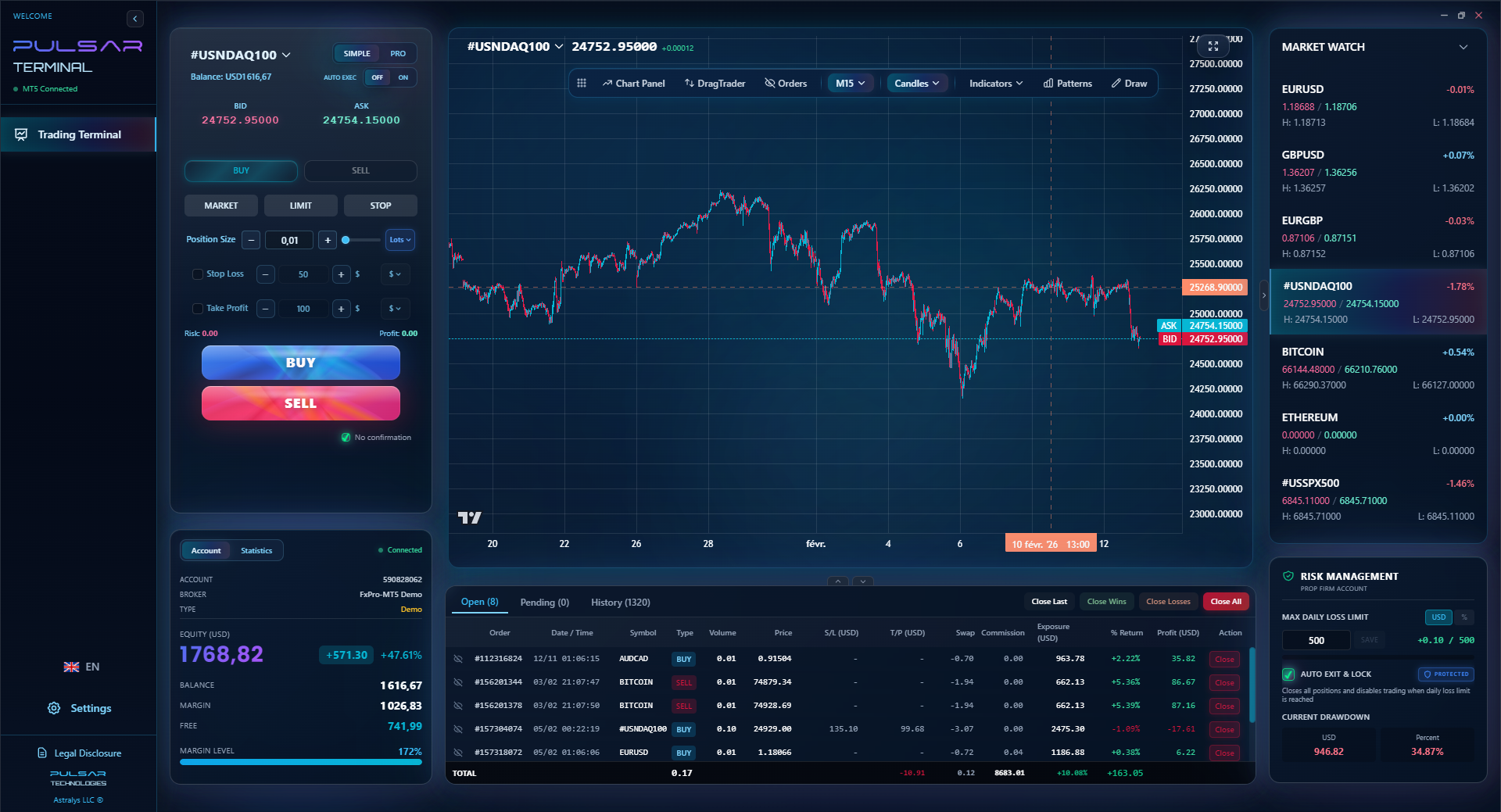
Managing a prop firm challenge requires iron-clad discipline on daily loss limits, a task perfectly suited for automation with a tool like Pulsar Terminal on your MT5.
Pulsar Terminal
La herramienta MT5 todo-en-uno: órdenes drag-and-drop, multi-TP/SL, trailing stop, grid trading, Volume Profile y protección prop firm. Usado por más de 1.000 traders diariamente.
Forget copying someone else's trades. Your goal is to build a system that fits your psychology, schedule, and risk tolerance.
Step 1: Education, Not Inspiration. Learn the mechanics. What is a margin call? How does the MACD indicator actually work? Use free resources first. Babypips.com is still the best free school. Don't buy a course until you know the basics and can ask intelligent questions about it.
Step 2: Choose Your Battlefield. Will you focus on the volatile ZAR pairs or the more stable majors? I recommend beginners start with EUR/USD on a demo account. The lower spreads and predictable liquidity let you focus on learning price action without the noise of local volatility.
Step 3: Develop a Simple, Testable Strategy. Pick one or two indicators. Maybe price action with the RSI indicator for confluence. Define your rules with absolute clarity: "I will only buy EUR/USD if price is above the 200-day moving average on the 4-hour chart AND the 1-hour RSI crosses above 30 from oversold." Then backtest it. Not for 10 trades, for 100. Keep a journal.
Step 4: Risk Management is Your Job #1. Decide that no single trade will ever risk more than 1% of your account. Write it down. Stick to it. This single rule is what separates the survivors from the stories of those famous forex traders in South Africa who blew up. Use stop-losses every time. No 'hoping' it will come back.

Example: You have a R10,000 account. 1% risk is R100. You want to short USD/ZAR at 18.50 with a stop loss at 18.70. That's a 200 pip risk. How much can you trade? R100 / 200 pips = R0.50 per pip. On USD/ZAR, 1 standard lot is roughly $10 per pip (complex with ZAR, but close). So you'd trade a micro lot (0.01), which is about $0.10 per pip, or roughly R1.80 per pip. You'd need to adjust the position down further. This math is non-negotiable.
“Risk management is what separates the survivors from the stories of those who blew up.”
You don't need expensive software to start. You need reliable, cost-effective tools.
Trading Platform: Most brokers offer MT4 or MT5. MT5 is better, offering more timeframes and built-in economic calendar. It's the industry standard for a reason.
Charting & Analysis: Your broker's platform is enough to start. As you grow, you might want advanced tools for volume analysis or faster order management. This is where a platform companion can make a difference, helping you execute complex strategies without manual hassle.
News & Data: For global news, Forex Factory is free. For SA-specific data, follow the SARB website for interest rate decisions and Stats SA for inflation/employment numbers. The timing of these releases is when the ZAR pairs are most active.
Community (Choose Wisely): Find a small, serious Discord group or forum where traders share analysis, not screenshots of profits. Avoid the groups filled with moon emojis and 'to the moon!' chants. Look for discussions about risk, psychology, and trade post-mortems.
Broker Choice: This is critical. Regulated is non-negotiable. Check the FSCA's website to verify a broker's license. Look for low, transparent costs and a platform that doesn't freeze. Read our detailed reviews like XM review to see how they perform under real trading conditions. Your broker is your gateway to the market; don't pick one based on a bonus offer.
💡 Consejo de Winston
Your first R10,000 profit will teach you less about trading than your first R2,000 loss. Study your losses like a forensic scientist.
So, what's the takeaway from looking at the famous forex traders in South Africa? Their fame is irrelevant. Their discipline, risk management, and deep market understanding are what matter.
Your path won't be linear. You'll have winning streaks that make you feel invincible, and losing streaks that make you question everything. I've been there. After my best month ever (up 22%), I gave half of it back the next month by breaking my own rules and overtrading.
Start small. Start slow. Treat your first year as a paid internship where the tuition is the money you might lose. Your goal for Year 1 isn't profit; it's survival and education. Learn to read price action. Learn to manage your emotions. Learn to keep that journal.
The South African market is full of opportunity, but it demands respect. It's not a casino. It's a professional undertaking. Regulate yourself before the FSCA has to, manage your risk like your financial life depends on it (because it does), and focus on the process, not the payout. Do that consistently, and you won't need to chase fame. You'll be building something much more valuable: sustainable skill.
FAQ
Q1Who is the most successful forex trader in South Africa?
The truly 'most successful' are likely unknown fund managers who don't seek public fame. Among public figures, success is often measured by longevity and legitimate educational contribution, not social media followers. Look for individuals with a verifiable, multi-year track record who are FSCA-registered if they offer financial services.
Q2Is forex trading legal and taxable in South Africa?
Yes, it's completely legal when using an FSCA-licensed broker. Regarding tax, SARS treats trading profits as income for individuals. You must declare your net profit (gains minus losses and expenses) in your annual tax return. Keep detailed records of all trades, deposits, and withdrawals.
Q3What is the best ZAR pair to trade for beginners?
Honestly, beginners should avoid ZAR pairs initially. The high spreads and volatility are punishing. Start with a major pair like EUR/USD where costs are low and liquidity is high. Once you have a solid, profitable strategy, then consider adding USD/ZAR with a very small position size to understand its unique rhythm.
Q4Can I use international brokers as a South African?
You can, but you must be extremely cautious. If the broker is not licensed by the FSCA, you have no local legal recourse if something goes wrong (like the broker collapsing). Your client funds may not be segregated as required by SA law. It's generally safer to use the South African entity of a major international broker that holds an FSCA license.
Q5How much money do I need to start forex trading in South Africa?
You can start with very little. Some brokers allow deposits as low as $5 (roughly R90). However, to trade properly with sensible risk management, a more realistic starting amount is R2,000 - R5,000. This allows you to trade micro lots and absorb the inevitable losses while learning without blowing your account on a few bad trades.
Q6What's the biggest mistake new SA traders make?
Two tied for first: 1) Overleveraging, especially on USD/ZAR, turning a small normal move into an account-destroying loss. 2) Trading based on local news emotion instead of a predefined technical or fundamental strategy. They see a bad headline, rush to short the Rand, and often get caught in a 'sell the rumor, buy the news' reversal.
Lección del Prof. Winston
Puntos clave:
- ✓FSCA's 30:1 use cap is a protective gift, not a limit.
- ✓Real costs (spreads, swaps) can eat over 15% of your profits.
- ✓USD/ZAR average spreads are 50-100 pips; EUR/USD are under 1.5.
- ✓Never risk more than 1% of your capital on a single trade.
¿Te resultó útil este artículo?
Haz clic en una estrella
Análisis Trading Semanal
Análisis y estrategias semanales gratis. Sin spam.
Sobre el autor
David van der Merwe
Trader de Mercados Emergentes
Trader con sede en Johannesburgo con 11 años en divisas de mercados emergentes. Especialista en pares ZAR, trading regulado por la FSCA y análisis del mercado sudafricano.
Comentarios
Aviso de riesgo
El trading de instrumentos financieros conlleva un riesgo significativo y puede no ser adecuado para todos los inversores. El rendimiento pasado no garantiza resultados futuros. Este contenido tiene fines educativos únicamente y no debe considerarse asesoramiento de inversión. Siempre realice su propia investigación antes de operar.
También te puede interesar

Cara Trading Forex Sukses: 7 Prinsip dari Trader Profesional
Cara trading forex sukses dengan 7 prinsip trader pro: manajemen modal, disiplin, journal trading, backtest. Data nyata, bukan janji profit palsu.
Jam Trading Forex Terbaik untuk Trader Indonesia: Panduan Lengkap dengan Tabel Waktu
Panduan jam trading forex untuk trader Indonesia. Tabel 4 sesi dunia, jam emas 20:00-00:00, sesi mana yang harus dihindari. Data akurat + tips dari trader berpengalaman.
Top 5 Sàn Forex Uy Tín Nhất 2026: Review Jujur dari Trader Indonesia
Top 5 sàn forex uy tín 2026 untuk trader Indonesia. Review jujur: spread, deposit, withdraw, dukungan lokal. Exness, XM, IC Markets & lebih.
Obtener Pulsar Terminal
Todas estas calculadoras están integradas en Pulsar Terminal con datos en tiempo real de su cuenta MT5.
Obtener Pulsar Terminal