


Ever looked at a chart, seen a price pull back, and wondered 'how far will it go before it turns?' That's the exact question Fibonacci tools are built to answer.

Olumide Adeyemi
Pionero del Trading en África Occidental ·  Nigeria
☕ 10 min de lectura
Lo que aprenderás:
- 1What is Fibonacci Forex, Really?
- 2Setting Up Your Fibonacci Tools in Nigeria
- 3Trading Fibonacci Retracements: Practical Strategies
- 4Finding Profit Targets with Fibonacci Extensions
- 5Common Fibonacci Mistakes Nigerian Traders Make (I've Made Them All)
- 6Building a Complete Nigerian Trading Plan with Fibonacci
Ever looked at a chart, seen a price pull back, and wondered 'how far will it go before it turns?' That's the exact question Fibonacci tools are built to answer. Here in Nigeria, with our unique market rhythms and the ever-present USD/NGN dance, these ancient ratios can be your secret weapon. But let's be honest, most tutorials make it look like magic. I'm here to show you the real, gritty, practical side of Fibonacci forex trading - the wins, the losses, and how to actually make it work with your broker.
Forget the complex math history. In trading, Fibonacci is just a set of ratios - 23.6%, 38.2%, 50%, 61.8%, and 78.6% - that traders believe price respects during moves. The core idea is simple: after a strong price move (up or down), the market will often retrace a portion of that move before continuing in the original direction. Those Fibonacci levels act like potential support or resistance zones where the retracement might stop.
It's not a crystal ball. It's a probability tool. Think of it like recognizing common patterns in football. You know that after a certain type of pass, there's a higher chance of a shot on goal. Fibonacci levels are similar; they highlight areas on the chart where the probability of a reaction increases. The 61.8% level, often called the 'golden ratio,' is the star of the show. In my experience, it's where price finds support or resistance more often than not, especially on the higher timeframes like the 4-hour or daily chart.

Example: If USD/NGN rallies from 1500 to 1600 (a 100 Naira move), a 61.8% retracement would be a pullback to 1538.2. That's the level you'd watch for buyers to potentially step back in.
Why does it work? Honestly, nobody knows for sure. Some say it's a self-fulfilling prophecy because so many traders watch these levels. Others point to natural mathematical patterns. For us as traders, the 'why' matters less than the 'how.' The key is that when enough market participants are looking at the same levels, those levels become important. You can learn more about identifying key levels using tools like the Volume Profile to see where big money is active.

💡 Consejo de Winston
The market doesn't read your Fibonacci lines. Always wait for price action confirmation - a rejection candle or a momentum shift - before committing your capital. A level is just a level until price respects it.
Choosing Your Platform
For most Nigerian traders, this starts with MetaTrader 4 or 5. It's the standard, and brokers like Exness, IC Markets, and XM all offer it. The Fibonacci Retracement tool is built right in. On MT4/5, you'll find it in the drawing tools menu - it looks like a grid with a percent sign. Click it, then click on the chart at the start of a major swing (the low of a rally or the high of a drop) and drag it to the end of that swing.
The Right Way to Draw
This is where most people mess up. You must draw from swing point to swing point. In an uptrend, click on the significant LOW, then drag to the significant HIGH. The tool will then project the retracement levels below the price. For a downtrend, click on the HIGH and drag to the LOW. Getting this direction wrong will give you completely useless levels. I've done it myself, more than once, and wondered why my trade immediately went against me.
Nigerian Market Nuances
Our market can be volatile, especially with Naira pairs. On highly volatile days, price might blow straight through the 38.2% level and head for the 61.8%. I often use a wider position size calculator setting for Naira pairs to account for this extra movement. Also, pay attention to local liquidity. During Lagos trading hours, you might get cleaner reactions on USD/NGN or GBP/NGN at these Fib levels compared to when the market is quiet.

Warning: Never force a Fibonacci tool onto a messy, sideways chart. It only works well when there's a clear, impulsive price move to measure. If the price action looks like a bowl of spaghetti, put the Fib tool away and wait for a clearer trend.
“A Fibonacci level alone is okay. A Fibonacci level stacked with another form of confirmation is where the real edge lies.”
The Basic Pullback Trade
This is your bread and butter. Wait for a strong, clear impulse move. Let's say EUR/USD shoots up 150 pips. Price then starts to pull back. You draw your Fib from the low to the high of that move. Now, you wait for price to approach a key level - I focus on the 50% and 61.8% zones. Don't just buy or sell the second price touches the line. Look for a confirmation candle pattern, like a bullish engulfing at the 61.8% support in an uptrend, or a bearish pin bar at the 61.8% resistance in a downtrend.
Here's a real trade I took on GBP/USD last quarter. The pair rallied from 1.2600 to 1.2800. It pulled back. I drew my Fib, saw a nice bullish hammer candle form right on the 61.8% level at 1.2672. I entered long with a stop loss just below the 78.6% level at 1.2650. My take-profit target was the previous high at 1.2800. It worked perfectly that time, netting about 128 pips. But it doesn't always.
Using Confluences (This is the Secret)
A Fibonacci level alone is okay. A Fibonacci level with another form of confirmation is powerful. This is called confluence. Look for these to stack the odds in your favor:
- Fibonacci + Horizontal Support/Resistance: If the 61.8% retracement level lines up with a previous price swing high or low that acted as support/resistance, that zone is much stronger.
- Fibonacci + Moving Average: A key moving average like the 50 or 200-period EMA often coincides with a Fib level during a pullback.
- Fibonacci + Trend Line: A pullback that finds support at both a Fib level and an ascending trendline is a high-probability setup.
Managing the Trade
Your stop loss should go beyond the next Fib level, typically beyond the 78.6%. If price goes there, your thesis (that the pullback is over) is likely wrong. For take profits, common targets are the previous swing high (for longs) or low (for shorts), or you can use Fibonacci extensions, which we'll talk about next. This approach is a core part of successful swing trading.
Retracements tell you where to enter. Extensions tell you where to exit. They project where price might go after the pullback is over and the original trend resumes. The most common extension levels are 127.2%, 161.8%, and 261.8%.
Here’s how you use it. After the impulse move (Wave 1) and the pullback (Wave 2), you project extensions from the start of Wave 1 to the top of Wave 1, but you anchor the tool at the end of Wave 2 (the end of the pullback). The tool then shows you where Wave 3 might end.
| Extension Level | Typical Meaning |
|---|---|
| 127.2% | A common, conservative target. Price often tests here. |
| 161.8% | The "golden" extension. This is where strong trends often pause or reverse. |
| 261.8% | A target for parabolic, news-driven moves. |
I used this on a XAU/USD (Gold) trade recently. Gold rallied from $1980 to $2050 (Wave 1), pulled back to $2015 (Wave 2, which was near the 50% Fib retrace). I projected extensions. The 161.8% extension level was at $2088. I set my take-profit there. Price rocketed up and hit $2089 before pulling back sharply. It was almost eerie. You can study more setups like this in our dedicated XAU/USD guide.

Pro Tip: For a more aggressive approach, take partial profits at the 127.2% extension and move your stop loss to breakeven. Let the rest of the position ride to the 161.8% level. This locks in some profit and removes risk from the trade. Managing multiple take-profit levels manually is a hassle, which is why many pros use tools that automate it.
💡 Consejo de Winston
In volatile markets like ours, treat the 50%-61.8% zone as a single decision area. Placing orders in the middle of this zone, rather than at a precise line, will improve your fill rate and reduce stop-outs from noise.
“If you have 15 different Fib grids on your chart, you've got none. You're just creating noise.”
Let's get vulnerable. I've blown up accounts learning this stuff, so you don't have to.
1. Treating Fib Levels as Hard Lines. Price will rarely reverse exactly at 61.8%. It usually forms a reaction around that zone. Give it a few pips of breathing room, especially with Naira pairs where the spread can be wider. Thinking of it as a 'zone' rather than a 'line' changed my trading.
2. Drawing on Every Tiny Wiggles. If you have 15 different Fib grids on your chart, you've got none. You're just creating noise. Only draw on the most significant, clean swings on your chosen timeframe. For day trading, that might be the 1-hour chart swings. For swing trading, use the daily chart.
3. Ignoring the Overall Trend. Fibonacci is a trend-following tool. Drawing a retracement in a strong downtrend and then trying to buy at the 38.2% level is fighting the market. Always trade in the direction of the higher timeframe trend. The Fib level just gives you a better entry.
4. No Confirmation. My biggest, most expensive mistake. I'd see price approaching the 61.8% level, get excited, and market order in. Then price would slice right through it. Now, I never enter without a confirming price action signal or momentum divergence on an indicator like the RSI indicator. Wait for the market to show its hand.
5. Misplacing Stops. Placing your stop loss right on the other side of the Fib level is asking to get stopped out by market noise. Place it a sensible distance beyond the level, considering the pair's average volatility. A tool like a position size calculator will help you size your trade appropriately for that wider stop.
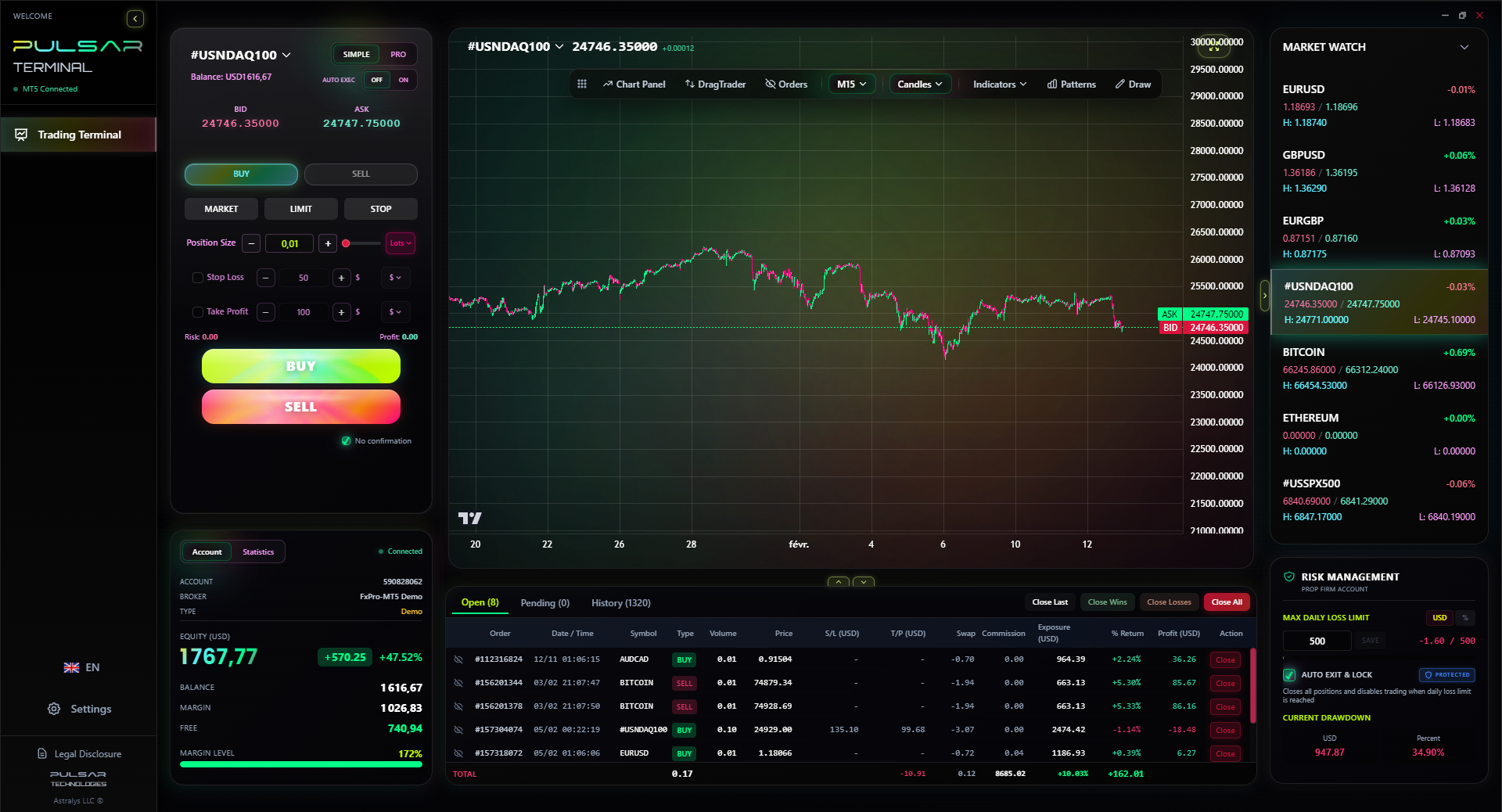
Managing multiple take-profit levels at different Fibonacci extensions is a core strategy, and Pulsar Terminal automates this with its multi-TP/SL and partial closure features directly on your MT5 chart.
Pulsar Terminal
La herramienta MT5 todo-en-uno: órdenes drag-and-drop, multi-TP/SL, trailing stop, grid trading, Volume Profile y protección prop firm. Usado por más de 1.000 traders diariamente.
Fibonacci isn't a standalone system. It's a brilliant piece of your trading engine. Here's how to build it into your routine.
Step 1: Find the Trend. Use a simple method. Is price above the 200-period moving average on the daily chart? Uptrend. Below? Downtrend. For Naira pairs, also keep an eye on fundamental CBN news that can dictate the primary trend.
Step 2: Wait for the Impulse and Pullback. In an uptrend, wait for a strong green candle rally, then wait for it to start pulling back. Patience is key.
Step 3: Draw Your Fib and Find Confluence. Draw the retracement tool. Now, scan for confluence. Does the 61.8% level align with a previous support zone? Does it meet a rising trendline? The more confluences, the higher your trade grade.
Step 4: Define Your Risk. Before you enter, know your exit. Where is your stop loss (beyond the next Fib or support zone)? Where is your take profit (previous high or a Fib extension level)? Use this to calculate your position size so you're never risking more than 1-2% of your account. This is non-negotiable to avoid a margin call.
Step 5: Execute and Manage. Place your entry order, or wait for your candle confirmation and enter manually. Once in profit, consider moving your stop to breakeven to eliminate risk. If you're scalping, your process will be faster, but the principles are the same.
For Nigerian traders, I recommend starting on the 4-hour chart with major pairs like EUR/USD or GBP/USD before touching the more volatile USD/NGN. The principles are identical, but the majors give you cleaner, more textbook examples to learn from. You can apply the same confluence hunting to EUR/USD as detailed in our EUR/USD guide.
FAQ
Q1Is Fibonacci trading legal in Nigeria?
Yes, absolutely. Forex trading is legal for individuals in Nigeria. Using Fibonacci tools is just a method of technical analysis. There are no laws against it. You do need to be aware that the CBN restricts using official banking channels to fund speculative forex accounts, so you'll typically fund an international broker using other payment methods. Any profits you make are subject to a 10% capital gains tax with the FIRS.
Q2What is the most important Fibonacci level?
The 61.8% retracement level is widely considered the most significant. It's the 'golden ratio' and acts as a major support/resistance zone. In strong trends, the 38.2% level can also hold. However, the 50% level (which isn't a true Fibonacci number but is included in the tool) is also incredibly important psychologically and often acts as a key battleground.
Q3Can I use Fibonacci for scalping in Nigeria?
You can, but it's trickier. On very short timeframes like the 1-minute or 5-minute chart, price noise can overwhelm the Fib signals. If you want to scalp with Fib, use it on a slightly higher timeframe like the 15-minute chart to identify the main pullback zone, then use a lower timeframe for your precise entry. Be mindful of spreads - using a broker with tight spreads like Pepperstone on their Razor account is crucial for scalping.
Q4Do Fibonacci levels work on USD/NGN?
They do, but often in a 'wilder' fashion. Due to higher volatility and sometimes lower liquidity, USD/NGN may respect the broader Fib zones (like the area between 50% and 61.8%) rather than the exact line. Always use wider stops and consider the fundamental CBN context, which can override any technical level.
Q5What's the difference between Fibonacci retracement and extension?
Retracement measures how deep a pullback might go within an existing move. It's for finding entries. Extension projects how far the next leg of a trend might go after the pullback is over. It's for setting profit targets. You use retracement first, and if that trade sets up, you then use extension to plan your exit.
Q6How do I know which swing points to use for drawing?
Use the most obvious, significant highs and lows on your chosen timeframe. If you have to squint and debate whether it's a swing point, it's probably not significant enough. The best swings are those where price clearly reversed direction, creating a distinct 'V' or 'A' shape on the chart. Start on the daily chart for practice - the swings are clearer.
Lección del Prof. Winston
Puntos clave:
- ✓Always draw Fib from swing low to high in uptrends, high to low in downtrends.
- ✓The 61.8% level is your primary focus, but the 50% level is a powerful psychological magnet.
- ✓Never trade a Fib level without a price action confirmation signal.
- ✓Use extensions (127.2%, 161.8%) to set logical profit targets, not arbitrary numbers.
¿Te resultó útil este artículo?
Haz clic en una estrella
Análisis Trading Semanal
Análisis y estrategias semanales gratis. Sin spam.
Sobre el autor
Olumide Adeyemi
Pionero del Trading en África Occidental
Uno de los educadores de trading forex más activos de Nigeria. 8 años de experiencia operando desde Lagos. Especialista en estrategias de bajo capital y desafíos de prop firms para traders africanos.
Comentarios
Aviso de riesgo
El trading de instrumentos financieros conlleva un riesgo significativo y puede no ser adecuado para todos los inversores. El rendimiento pasado no garantiza resultados futuros. Este contenido tiene fines educativos únicamente y no debe considerarse asesoramiento de inversión. Siempre realice su propia investigación antes de operar.
También te puede interesar

Cara Trading Forex Sukses: 7 Prinsip dari Trader Profesional
Cara trading forex sukses dengan 7 prinsip trader pro: manajemen modal, disiplin, journal trading, backtest. Data nyata, bukan janji profit palsu.
Jam Trading Forex Terbaik untuk Trader Indonesia: Panduan Lengkap dengan Tabel Waktu
Panduan jam trading forex untuk trader Indonesia. Tabel 4 sesi dunia, jam emas 20:00-00:00, sesi mana yang harus dihindari. Data akurat + tips dari trader berpengalaman.
Top 5 Sàn Forex Uy Tín Nhất 2026: Review Jujur dari Trader Indonesia
Top 5 sàn forex uy tín 2026 untuk trader Indonesia. Review jujur: spread, deposit, withdraw, dukungan lokal. Exness, XM, IC Markets & lebih.
Obtener Pulsar Terminal
Todas estas calculadoras están integradas en Pulsar Terminal con datos en tiempo real de su cuenta MT5.
Obtener Pulsar Terminal