


I was staring at a client's trade confirmation in late 2024.

David van der Merwe
Trader de Mercados Emergentes ·  South Africa
☕ 11 min de lectura
Lo que aprenderás:
I was staring at a client's trade confirmation in late 2024. He'd bought $10,000 worth of EUR/USD through his FNB platform. The entry looked fine, but the effective spread he paid was a gut punch: 0.376%. That's 3.76 pips on a major pair. On a dedicated broker, that trade would have cost him 0.1 pips, maybe 0.2. That's the 'FNB forex number' they don't advertise - the hidden cost of convenience. For South Africans, FNB is the first port of call for anything money-related. But when it comes to active forex trading or even savvy international transfers, treating it like a broker is a fast way to bleed capital. Let's strip away the branding and look at the real numbers.
First, let's kill a common misconception. FNB is not a forex broker in the way you and I think of one. You won't find MetaTrader 5, one-click trading, or advanced charting on their app. What they offer is a foreign exchange service, primarily designed for two things: international payments (sending money overseas for tuition, property, imports) and holding foreign currency in what they call a Global Account.
Their 'trading' function is a basic buy/sell overlay on top of this service. It's built for someone who needs euros for a holiday next month, not for someone trying to scalp the GBP/ZAR on a 15-minute chart. The platform is buried within online banking, the spreads are wide (more on that later), and the order types are limited. I've had students come to me confused, thinking because they can buy USD on the FNB app, they're ready to trade. They're not. They're just ready to pay a premium.

Warning: Using FNB for active trading is like using a cargo ship for a speedboat race. It's built for a different purpose - bulk, slow movement of value - not for the rapid, precise executions you need.
The real value of FNB's forex lies in its integration with your local banking and its compliance muscle. They handle all the SARB reporting for you when you use your discretionary allowance. For moving large, legitimate sums overseas with all the paperwork sorted, they're a solid option. For trying to make money from currency fluctuations? Look elsewhere. Understanding this distinction is the first step to not overpaying. If you're serious about trading, your journey starts with finding a proper FSCA-regulated broker.

💡 Consejo de Winston
The spread isn't just a cost, it's a headwind. A 3-pip spread means you need the market to move 3 pips in your favor before you even start earning. That's a 60% higher hurdle than a 1.8-pip spread. Choose your battlefield wisely.
This is where the rubber meets the road. FNB makes money on forex through a combination of commissions and the spread (the difference between the buy and sell price they quote you). They're not transparent about the spread margin, but we can piece it together from user reports and their stated fees.
Sending Money Overseas
For an international wire transfer over R10,000, FNB charges a 0.55% commission (min R275, max R550). On top of that, they add a margin to the interbank exchange rate. This margin isn't a fixed fee; it's a percentage baked into the rate you see. Reports and my own checks put this between 2% and 4.5%. Let's do the math no one at the bank will do for you.
You want to send R500,000 to the UK for a property deposit.
- Commission: 0.55% of R500,000 = R2,750 (hits the max cap of R550? No, that's for the commission component only – the max is R550, so you pay R550).
- Exchange Rate Margin: Let's use a conservative 3%. On R500,000, that's R15,000 lost in the rate.
- Total Cost: R550 + R15,000 = R15,550. That's 3.1% of your money, gone before it leaves South Africa. For a single transaction.

Example: Sending R200,000. Commission: R275 (0.55%, min fee). Margin (2.5%): R5,000. Total cost: R5,275. You've just lost over 2.6% instantly.
The 'Trading' Spreads
This is the killer for aspiring traders. In June 2024, a user reported an effective spread of 0.376% on a $100,000 EUR/USD transaction. On a standard lot (100,000 units), a 0.376% spread equals 3.76 pips. Compare that to a broker like IC Markets, where the raw spread on EUR/USD is often 0.1 pips. Your trade is down R750 (at 3.76 pips) versus R20 (at 0.1 pips) the moment you click buy. You have to make 3.76 pips of profit just to break even. In a scalping strategy, that's an impossible hurdle.
Their Foreign Currency Account (FCA) has no monthly fee, which is good. But moving money in and out of it for trading still incurs those same costly spreads. It's a holding pen, not a trading account.
“FNB's forex service is a safe, compliant corridor for your money, with the bank taking a toll for providing it.”
Let's put the numbers on the table so you can see the difference in black and white. This isn't a slight against FNB; it's about using the right tool for the job.
| Feature | FNB Forex Services | Specialized FSCA Broker (e.g., IC Markets, Pepperstone) |
|---|---|---|
| Primary Purpose | International Payments, Currency Holding | Active Speculative Trading |
| Typical EUR/USD Spread | ~3 pips (0.3%) | 0.1 - 1.2 pips (0.01% - 0.12%) |
| Commission on Trades | Often built into spread | As low as $3.50 per 100k lot (raw spread + commission) |
| Platform | FNB Online Banking / App | MetaTrader 4/5, cTrader, Proprietary Platforms |
| Order Types | Basic Market Orders | Limit, Stop, Trailing Stop, Breakeven, etc. |
| Charting & Analysis | Minimal or None | Advanced, with dozens of indicators like the MACD |
| Minimum Deposit | Linked to your bank account | Can be as low as $10 (≈R180) |
| use | Not offered for speculation | Up to 1:30 for retail clients under FSCA rules |
| SARB Allowance Compliance | Handled automatically | You are responsible for tracking your annual R1m/R10m limits |
See the divide? The broker's entire business is built for you to trade efficiently. FNB's is built to move your money safely and in compliance, for a fee. I made this mistake early on. I used my bank's platform for my first dozen trades, thinking 'a pip is a pip.' I was profitable on 6 of those trades, but my net result was negative because the spreads ate all my gains. It was a brutal, expensive lesson. The moment I switched to a proper broker with tighter spreads, my swing trading strategy actually started to work as backtests said it should.

Pro Tip: Use FNB for what it's good at: managing your SARB allowances and moving large, documented sums. Use a regulated broker for trading. Open a broker account, fund it with a portion of your discretionary allowance, and keep your trading capital separate from your banking capital.
Whether you use FNB or a broker in Mauritius, if you're a South African resident, you live under SARB's exchange control. Ignoring this is a great way to get your accounts frozen. FNB's big advantage is they manage this for you on their platform. When you use a foreign broker, the onus is on you.
Here’s the cheat sheet you need:
- Single Discretionary Allowance (SDA): R1 million per calendar year. No tax clearance needed. This is your 'get out of jail free' card for funding trading accounts, travel, online subscriptions. Track this religiously.
- Foreign Investment Allowance (FIA): R10 million per year. Requires a Tax Compliance Status (TCS) PIN from SARS. This is for bigger moves - investing in offshore stocks, property.
- The 30-Day Rule: Buy forex for a trip and come back with leftover cash? You have 30 days to sell it back to an authorized dealer like FNB. Don't let it sit in a drawer.
- The New October 2025 Wrinkle: SARB Circular 16/2025 threw a spanner in the works. Now, if you're paying royalties or fees to a non-resident (think: software license, consulting fee), the bank must check the recipient's SARS tax status before sending the money. This makes FNB's compliance role even more critical for business payments.
I keep a simple spreadsheet: date, amount in ZAR, amount in foreign currency, purpose. Every January 1st, it resets. If you're trading with a foreign broker, you're likely using your SDA to fund the account. That's legal. Just be prepared to show your records if SARS ever asks. A proper broker will give you clear statements to make this easy.
💡 Consejo de Winston
Your annual R1m discretionary allowance is your trading oxygen. Don't blow it all in January on one 'sure thing.' Meter it out. A disciplined trader with R100,000 has more chances than a reckless one who's already used his R1m.
“The real FNB forex number is a 3-pip effective spread on majors - a cost that makes consistent profitability almost mathematically impossible for a retail trader.”
After all this broker talk, I'm not saying close your FNB Global Account. It has specific, powerful uses where it's the best tool available.
- Executing Your SARB Allowances: This is its prime function. You've decided to send R800,000 to your IC Markets account? Do it through FNB. They'll ensure the paperwork (BoP reporting) is filed correctly with SARB. It's seamless.
- The FNB Global Account for Hedging: This is a smart play. Let's say you're a freelancer paid in USD. You can have clients pay into your USD Global Account. You hold the dollars, shielding yourself from a sudden ZAR crash. When the rand is weak, you convert chunks to ZAR for living expenses. You're effectively running a personal mini hedge fund. No monthly fees make this viable.
- Large, Legitimate International Payments: Paying for university overseas, buying a property, settling an invoice for imported goods. For these, the compliance and security FNB provides are worth the fee premium. The 0.55% commission is often less stressful than figuring out SWIFT codes and intermediary banks yourself.
- The Travel Card: The USD, GBP, or EUR debit cards linked to Global Accounts are excellent for travel. Load them up before you go, and you're spending foreign currency directly, avoiding dynamic currency conversion (DCC) scams at foreign ATMs.
The through-line here is certainty and compliance over cost. When the absolute priority is moving money legally and without hassle, FNB excels. When the priority is cost-efficient execution to preserve your trading edge, it fails.
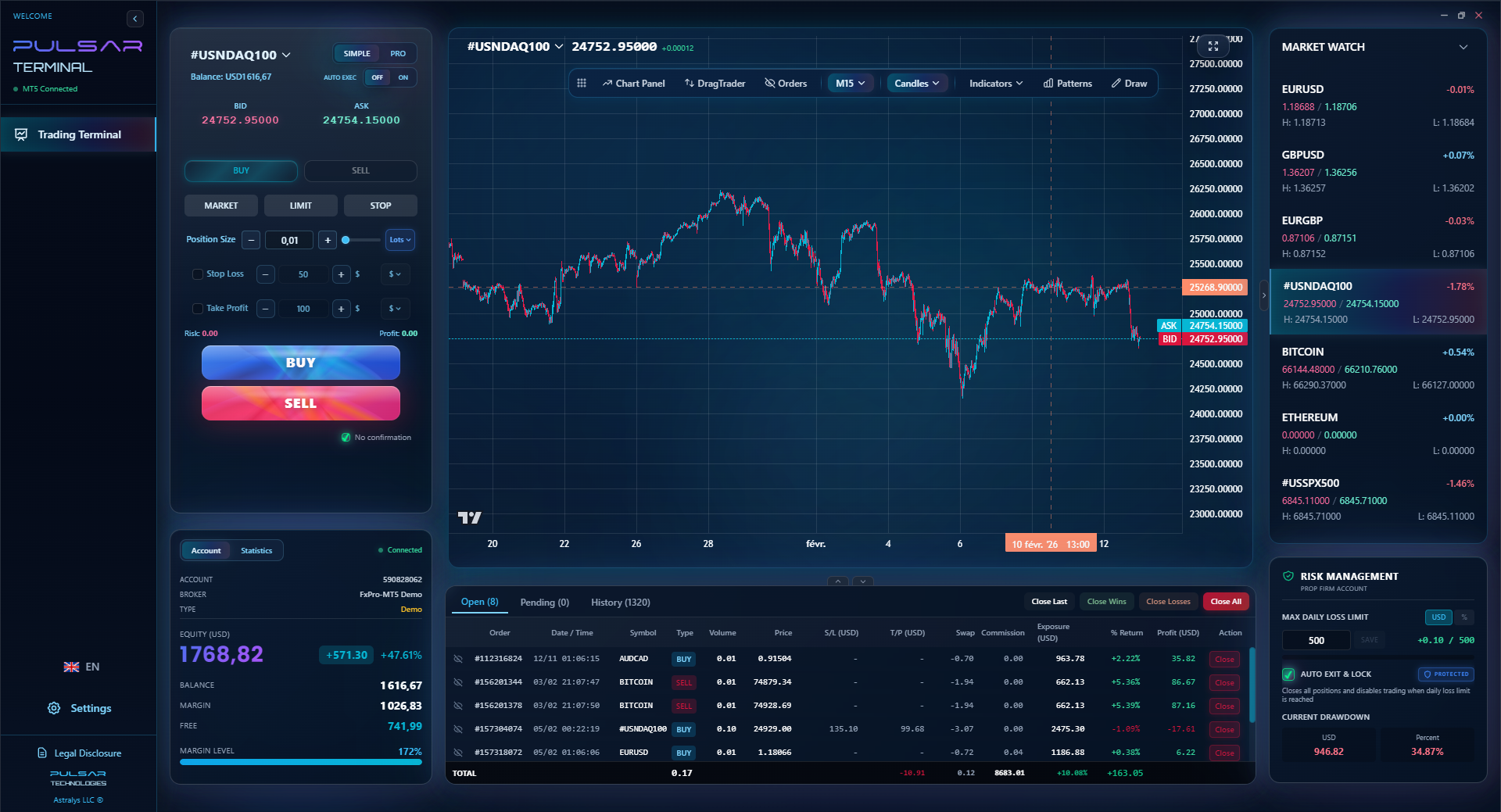
Once you're on a proper broker platform like MT5, managing complex trades with multiple take-profits and trailing stops is where a tool like Pulsar Terminal turns manual hassle into automated precision.
Pulsar Terminal
La herramienta MT5 todo-en-uno: órdenes drag-and-drop, multi-TP/SL, trailing stop, grid trading, Volume Profile y protección prop firm. Usado por más de 1.000 traders diariamente.
Your path forward depends on your goals.
If you want to trade forex professionally:
- Choose an FSCA-Regulated Broker: This is non-negotiable for peace of mind. IC Markets, XM, and Pepperstone all have strong local presence and regulation. Their spreads are lower, platforms are professional, and they offer use (capped at 1:30 for majors).
- Fund It Using Your SDA: Use FNB to send your chosen amount (start small!) to your new broker. Keep the FNB confirmation as your proof of using your allowance.
- Learn the Platform: Don't just jump in. Spend a week on a demo account learning MetaTrader 5. Understand how to set a stop-loss, a take-profit, and what a margin call really means. Use a position size calculator for every single trade.
- Withdraw Profits Back to FNB: When you withdraw profits, the broker will send USD (or another currency) back to your FNB Global Account. You then convert it to ZAR. FNB will again handle the SARB reporting for the inbound flow.
If you just need cheaper international payments: Specialist money transfer services like Wise (formerly TransferWise) or CurrencyFair often beat FNB's total cost (commission + margin). They show you the mid-market rate and take a small, transparent fee. For sending money to family or paying for services abroad, compare their final delivery amount against FNB's quote. You'll often save 1-2%. FNB is convenient, but convenience has a price.
The bottom line? Separate your banking brain from your trading brain. FNB is your compliance and funding hub. Your broker is your trading cockpit. Trying to merge them leaves you overpaying and underperforming.
“Separate your banking brain from your trading brain. FNB is your compliance hub. Your broker is your trading cockpit.”
So, what's the definitive FNB forex number? It's not a single digit. It's a range that represents the cost of integrated, compliant banking.
- For international transfers: A total cost of 2.5% to 5% when you factor in the commission and the hidden exchange rate margin.
- For forex 'trading': An effective spread of 3 pips or more on major pairs, a cost structure that makes consistent retail profitability almost mathematically impossible.
FNB isn't evil. It's just not a trading firm. It's a bank. Its forex service is designed to be a safe, compliant corridor for your money to move across borders, with the bank taking a toll for providing that corridor and assuming the regulatory burden.
Your takeaway should be this: Embrace the separation. Use FNB as your on-ramp and off-ramp to the global financial system. Use its Global Account to hold currency and manage your SARB allowances flawlessly. Then, take the money you want to risk and put it in a platform built for the fight - where the cost of entry isn't a 3-pip handicap. That's how you build a sustainable South African trading operation. I learned this the expensive way so you don't have to. Now, your only job is to execute the split.
FAQ
Q1Can I legally trade forex using FNB?
Yes, but it's a terrible idea for active trading. You can buy and sell currencies through their platform, but the spreads are extremely wide (3+ pips on EUR/USD) compared to dedicated brokers (often under 1 pip). You'll use your Single Discretionary Allowance (R1m per year) to fund it. It's legal, but it's like racing a family sedan on a track - you're at a huge disadvantage from the start.
Q2What is the FNB forex number for sending R100,000 overseas?
You'll pay a R275 commission (0.55%, minimum fee) plus an exchange rate margin of roughly 2-4.5%. Using a 3% margin as an example, that's R3,000. Your total cost would be around R3,275, meaning only R96,725 of your money actually gets sent. Always ask for the final delivery amount in the foreign currency before confirming.
Q3Is the FNB Global Account good for traders?
As a holding account, yes. It's excellent for receiving foreign currency profits from your broker or holding USD if you earn income abroad. It has no monthly fees. It is NOT a trading account. Do not try to trade from it using FNB's platform due to the high costs.
Q4How do I fund an international forex broker from South Africa?
Use your Single Discretionary Allowance (R1m per year). Initiate an international payment from your FNB account to the broker's client money bank account. Select 'Investment' as the purpose. FNB will handle the SARB reporting. Keep the payment confirmation as your record. Start with a small test amount first.
Q5What's cheaper for sending money abroad: FNB or Wise?
For most personal transfers, Wise (or similar services like CurrencyFair) is significantly cheaper. FNB's combined commission and exchange margin often totals 3-5%. Wise typically charges a small transparent fee (e.g., 0.5%) and uses the real mid-market rate. Always compare the final amount the recipient will get before deciding.
Q6Does FNB offer use for forex trading?
No. FNB does not offer speculative use on currency trades. You can only buy currency with the full amount in your account. For leveraged trading (up to 1:30 on majors for retail clients), you must use an FSCA-regulated forex broker.
Q7I got a tax clearance for my R10m allowance. Should I use it for trading?
I would strongly advise against using your Foreign Investment Allowance (FIA) for high-risk retail forex trading. The FIA is designed for long-term offshore investments (shares, property, ETFs). The volatility and risk in daily trading mean you could lose this capital quickly. Use your smaller, no-clearance-required Single Discretionary Allowance (R1m) for trading experiments.
Lección del Prof. Winston
Puntos clave:
- ✓FNB's effective forex spread is ~3 pips, vs. <1 pip at real brokers.
- ✓International transfer total costs can hit 5% (commission + margin).
- ✓Use FNB for SARB compliance & large payments, not active trading.
- ✓Fund a real broker with your annual R1m discretionary allowance.
¿Te resultó útil este artículo?
Haz clic en una estrella
Análisis Trading Semanal
Análisis y estrategias semanales gratis. Sin spam.
Sobre el autor
David van der Merwe
Trader de Mercados Emergentes
Trader con sede en Johannesburgo con 11 años en divisas de mercados emergentes. Especialista en pares ZAR, trading regulado por la FSCA y análisis del mercado sudafricano.
Comentarios
Aviso de riesgo
El trading de instrumentos financieros conlleva un riesgo significativo y puede no ser adecuado para todos los inversores. El rendimiento pasado no garantiza resultados futuros. Este contenido tiene fines educativos únicamente y no debe considerarse asesoramiento de inversión. Siempre realice su propia investigación antes de operar.
También te puede interesar

Cara Trading Forex Sukses: 7 Prinsip dari Trader Profesional
Cara trading forex sukses dengan 7 prinsip trader pro: manajemen modal, disiplin, journal trading, backtest. Data nyata, bukan janji profit palsu.
Jam Trading Forex Terbaik untuk Trader Indonesia: Panduan Lengkap dengan Tabel Waktu
Panduan jam trading forex untuk trader Indonesia. Tabel 4 sesi dunia, jam emas 20:00-00:00, sesi mana yang harus dihindari. Data akurat + tips dari trader berpengalaman.
Top 5 Sàn Forex Uy Tín Nhất 2026: Review Jujur dari Trader Indonesia
Top 5 sàn forex uy tín 2026 untuk trader Indonesia. Review jujur: spread, deposit, withdraw, dukungan lokal. Exness, XM, IC Markets & lebih.
Obtener Pulsar Terminal
Todas estas calculadoras están integradas en Pulsar Terminal con datos en tiempo real de su cuenta MT5.
Obtener Pulsar Terminal