


You're in Abuja, you've seen the flashy Instagram ads, and you're wondering if dropping fifty or a hundred thousand Naira on a forex academy is the key to unlocking financial freedom.

Olumide Adeyemi
Pionero del Trading en África Occidental ·  Nigeria
☕ 10 min de lectura
Lo que aprenderás:
- 1What You're Actually Paying For
- 2The Stuff They Probably Won't Teach You (But Should)
- 3Can You Learn This for Free? A Realistic Comparison
- 4Red Flags and Green Lights: Picking a Place in Abuja
- 5The Self-Directed Path: Your Abuja Trading Blueprint
- 6Finding Your Tribe in Abuja (For Free)
- 7Final Call: Should You Enroll in a Forex Academy in Abuja?
You're in Abuja, you've seen the flashy Instagram ads, and you're wondering if dropping fifty or a hundred thousand Naira on a forex academy is the key to unlocking financial freedom. I get it. The promise is tempting, especially when the naira is doing its own thing and side hustles feel more like necessities. But before you pay for that 'diploma,' let's have a real talk. What are you actually buying? Is it worth the price of a decent laptop, or is it just expensive motivation? I've been trading for over a decade, and I've seen what works and what's just a fancy sales pitch. Let's break down the forex academy scene in Abuja, not from a brochure, but from the perspective of someone who's placed the trades.
Let's cut through the marketing. A typical forex academy in Abuja offering an 11-hour 'Forex Trading Diploma' for around NGN 55,913 isn't selling a secret formula. You're paying for three main things: structured time, basic information aggregation, and, most importantly, access to a community.
First, the structure. For many new traders, the hardest part is knowing where to start. An academy course forces you to sit down for those hours. They'll cover the absolute basics: what a pip definition is, how to read a candlestick, what use means. This is information you can find for free on YouTube, but having it in a scheduled class can help with discipline.
Second, the community. This is often the real value. Being in a room (or Zoom call) with other people from Abuja who are on the same journey can be incredibly motivating. You can share broker experiences (like which ones have smooth P2P deposits), discuss strategies, and keep each other accountable. The instructor, if they're a genuine trader, can offer real-time insights.

Warning: The big red flag is when the 'academy' is really just a front for a broker's introducing broker (IB) scheme or a signal-selling service. Their goal isn't to make you an independent trader; it's to make you a dependent client. Always ask: are they teaching me to fish, or just selling me fish every day?
I paid for a similar course early in my career. The best thing I got out of it wasn't a strategy, but a trading buddy. We still talk markets today. The worst thing was a complicated 'guaranteed profit' indicator they pushed in week three. I lost $200 testing it before I threw it out.

💡 Consejo de Winston
If an educator's main selling point is their luxury car, not their trade journal, your money is better spent on a quality economics textbook.
“The big red flag is when the 'academy' is really just a front for a broker's introducing broker (IB) scheme.”
Here's the uncomfortable truth. Most local academies focus heavily on technical analysis - drawing lines on charts, looking for patterns. That's useful, but it's only half the battle, especially for a Nigerian trader. The 'hidden curriculum,' the stuff that actually determines if you keep your capital, often gets glossed over.
Nigerian-Specific Realities
They might not spend enough time on how to fund your account reliably. With the CBN's restrictions, using official forex windows is a no-go. You need to understand the ins and outs of broker-provided local bank transfers and P2P options. Which brokers make this easiest? From my experience, brokers like Exness and XM have pretty solid local payment corridors.
Then there's tax. You're liable for a 10% capital gains tax on your profits. Full stop. An academy that doesn't mention this is doing you a disservice. You need to factor that into your profit targets and record-keeping from day one.
Psychology & Risk Management
This is the core of trading, yet it's often a single lecture. They'll tell you 'don't be greedy' but won't teach you how to build a rock-solid risk management plan. They won't force you to use a position size calculator for every single trade. They might not explain what a margin call feels like when it's happening to you.
I learned this the hard way. Early on, I nailed a few trades on USD/NGN pairs (when they were available) and felt invincible. I tripled my position size without adjusting my stop-loss. A sudden volatility spike wiped out two weeks of profits in an hour. That lesson cost me more than any academy fee ever could.
“An academy that doesn't mention the 10% capital gains tax is doing you a disservice.”
Absolutely, you can. The question is whether you will. Let's compare.
| Resource | Cost | Pros | Cons |
|---|---|---|---|
| Abuja Forex Academy (Paid) | ~NGN 56,000 | Structured schedule, direct Q&A, local community & network, potentially curated material. | High cost, quality varies wildly, risk of biased promotion, pace may be too fast/slow. |
| Online Courses (e.g., Udemy, Babypips) | NGN 5,000 - 15,000 | Self-paced, often very complete, taught by global professionals, one-time fee. | No local context, no Abuja-specific community, requires high self-discipline. |
| YouTube & Blogs (Free) | $0 | Vast amount of information, learn from world-class traders, completely free. | Overwhelming, no structure, high misinformation risk, no accountability. |
| Broker Education (Free) | $0 | Tailored to their platform, often includes webinars. | Heavily biased towards their services, can be superficial. |
The free path is viable, but it demands extreme self-direction. I built my initial knowledge from free resources. I spent months on Babypips' school (which is excellent), then supplemented with specific videos on concepts like the MACD indicator and RSI indicator. The downside? It took me longer, and I had to filter through a lot of junk to find the gems.

Pro Tip: Hybrid approach. Use free resources (Babypips is mandatory reading) to learn the absolute basics for 2-3 weeks. Then, if you still feel lost, consider a short, focused course. You'll get much more value because you'll know the right questions to ask.
“An academy that doesn't mention the 10% capital gains tax is doing you a disservice.”
If you decide to go the academy route, you need to be a detective. Don't just look at their success stories; investigate.
Ask these questions:
- Can I see a detailed curriculum? It should cover risk management and psychology in depth, not just indicators.
- What is the instructor's verifiable trading track record? Ask for a long-term, audited statement (like a Myfxbook link). If they only show screenshot wins, walk away.
- What's the post-course support? Do you get access to a community forum or occasional check-ins?
- Is there a focus on specific brokers or tools? A mild focus is okay (they have to teach on something), but a heavy push is a major red flag.
- What's the refund policy? Reputable educators often have a short trial period.
A green light: An academy that talks openly about losses, emphasizes position size calculators, and teaches you how to develop your own journaling process. They should be tools-agnostic, explaining concepts you can apply on MetaTrader, TradingView, or any platform.
A massive red flag: Any academy or 'mentor' that promises guaranteed returns, downplays risk, or pressures you to start with a large amount of capital. I once sat in on a session where the 'guru' said, "With my signals, you can turn NGN 100,000 into NGN 500,000 in three months." That room was full of hope, but I knew it was full of future loss stories.
💡 Consejo de Winston
The most valuable line you'll ever draw on a chart is your stop-loss. No academy diploma teaches you the courage to place it.
“The psychological lessons from risking real money, even small amounts, are more valuable than any lecture.”
Whether you pay for a course or not, your end goal is the same: a personalized, written trading plan. This is your blueprint. An academy might give you a template, but you have to fill it with your own rules. Here’s what you need to build, step-by-step.
1. Education Phase (Weeks 1-4):
- Free Resource: Complete the Babypips.com 'School of Pipsology.' It's non-negotiable.
- Focus: Understand currency pairs, how quotes work, basic scalping strategy vs. swing trading concepts, and most importantly, how use and margin work.
2. Simulation Phase (Weeks 5-8):
- Action: Open a demo account with a reputable broker like IC Markets or Pepperstone. Don't chase profit. Your goal is to test your understanding and get used to the platform.
- Task: Practice executing trades, setting stop-loss and take-profit orders, and using a position size calculator for every single idea. Journal every trade: why you took it, your emotion, the outcome.
3. Strategy Development & Backtesting (Weeks 9-12):
- Focus: Choose one or two instruments to specialize in. For many Nigerians, EUR/USD and XAU/USD (Gold) are popular due to their liquidity and clear sessions.
- Action: Learn one simple strategy thoroughly. For example, a price action strategy using support/resistance. Backtest it on your demo account for at least 50 trades. What's your win rate? Your average win vs. average loss?
This self-built plan forces you to engage with the material. It's harder than sitting in a class, but the knowledge sticks because you had to figure it out.
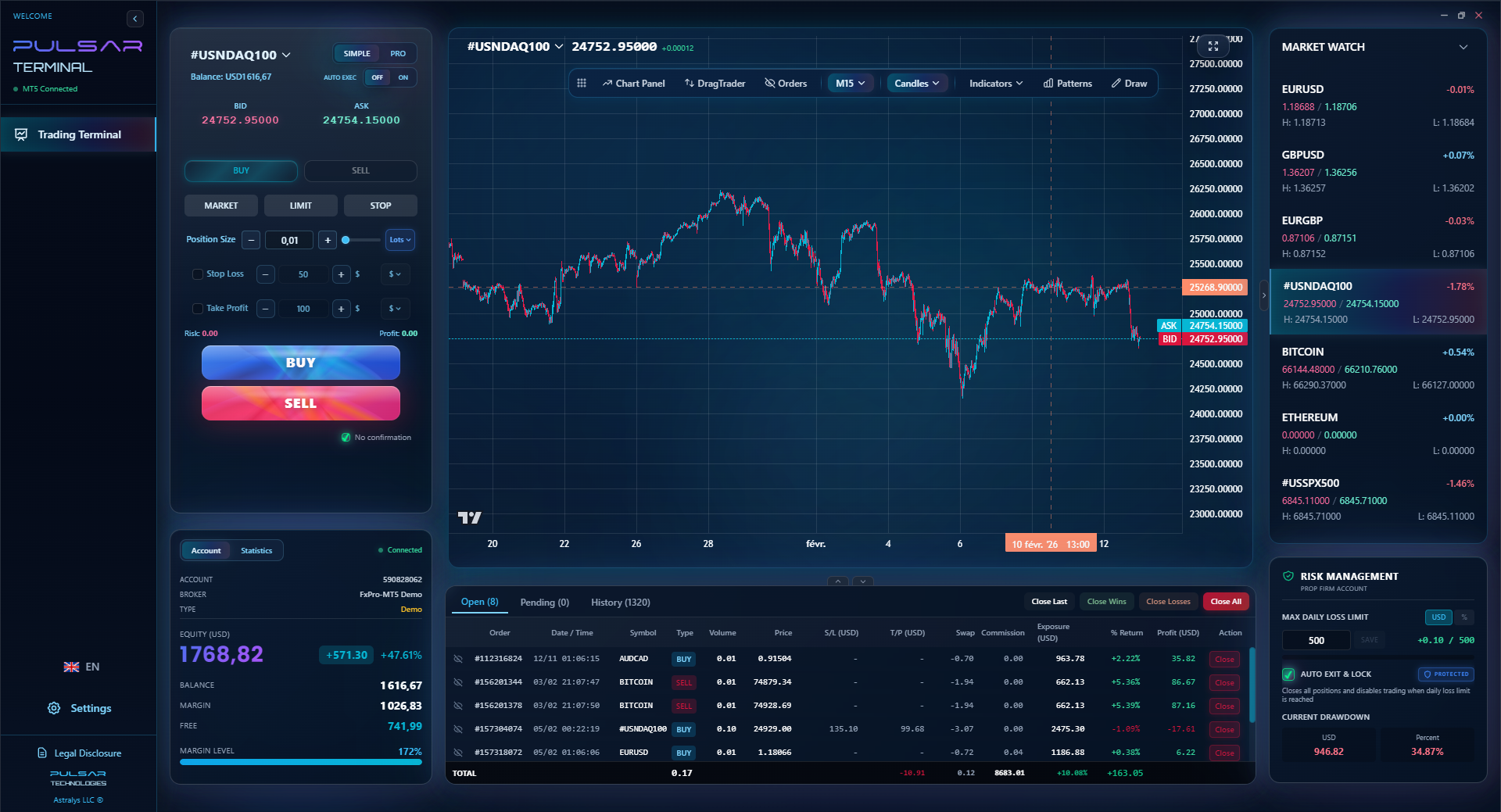
When you're building and testing your personal trading plan, having the right tools to execute it precisely is half the battle.
Pulsar Terminal
La herramienta MT5 todo-en-uno: órdenes drag-and-drop, multi-TP/SL, trailing stop, grid trading, Volume Profile y protección prop firm. Usado por más de 1.000 traders diariamente.
“The psychological lessons from risking real money, even small amounts, are more valuable than any lecture.”
One of the biggest draws of a forex academy in Abuja is the community. The good news? You can find or build this for little to no cost.
Look for these spaces:
- Legitimate Trading Forums & Discord Servers: Seek out groups focused on education and discussion, not signal shouting. Some are global but have African or Nigerian channels.
- LinkedIn: Connect with other serious Nigerian traders. Engage with their content thoughtfully. You'd be surprised how many are willing to have a genuine conversation.
- Local Meetups: Check platforms like Meetup.com for finance or investment groups in Abuja. Sometimes the best connections happen offline.
- Broker Seminars: Reputable international brokers like the ones we've mentioned occasionally host online webinars. These can be good for learning and you might meet other attendees in the chat.
The key is to be a contributor, not just a taker. Share a useful article you read, ask thoughtful questions about a chart setup, post a trade idea (with a clear rationale) for constructive criticism. This is how you build a real network, not just a contact list from a paid course.
Pro Tip: Start your own journal in a public but low-key way, like a private Twitter account or a blog. Document your learning process, your mistakes, your small wins. You'll attract people on a similar path, and the act of writing will clarify your own thinking.
💡 Consejo de Winston
Treat the cost of an academy like a trade. What's your risk (the fee) versus your potential reward (the knowledge)? Would your trading plan allow such a wide stop?
“Invest in your knowledge, but be ruthless about the return on that investment.”
So, after all this, should you spend NGN 55,913 on that diploma? My honest, nuanced answer: it depends, but probably not as your first step.
Consider it ONLY if:
- You have already consumed the free basics and feel stuck in applying them.
- You have vetted the academy thoroughly and confirmed the instructor is a legitimate, transparent trader (not just a marketer).
- You are an extrovert who craves the structure and local network and you believe that environment is worth the premium.
- You view the fee as a payment for accelerated networking and mentorship, not for magical knowledge.
For 95% of beginners starting out, the smarter path is this:
- Dedicate 1-2 months to rigorous self-study using free, high-quality resources.
- Paper trade diligently on a demo account.
- Use a fraction of that academy money (say, NGN 10,000-20,000) to open a micro live account. The psychological lessons from risking real money, even small amounts, are more valuable than any lecture.
- Use the remaining NGN 35,000+ as protective trading capital. It's your buffer, your risk management fund.
, no academy can give you discipline or emotional control. That comes from you, from placing trades, from taking losses, and from getting back up. The best education often happens between your ears and in your trade journal, not necessarily in a classroom in Wuse or Garki. Invest in your knowledge, but be ruthless about the return on that investment.
FAQ
Q1Is forex trading legal in Nigeria and Abuja?
Yes, it's completely legal for individuals to trade forex with their personal funds. The Central Bank of Nigeria (CBN) doesn't regulate the online retail space tightly, so most Nigerians use internationally regulated brokers. Just remember, you can't use official CBN windows to fund your account.
Q2What is the average cost of a forex academy in Abuja?
As of early 2026, you're looking at around NGN 55,000 to NGN 60,000 for an 11-hour 'Forex Trading Diploma' course from various institutes. Shorter 3-hour courses can be around NGN 17,000. Always check exactly what's included in those hours.
Q3Can I become a profitable trader without joining an academy?
Absolutely. I did, and most professional traders I know did. The core information is freely available. Success hinges on your discipline, risk management, and psychological fortitude - things no academy can instill in you without your own dedicated practice on a demo and then a live account.
Q4What should I look for in a good forex academy instructor?
Demand transparency. A good instructor should be willing to discuss their losses as openly as their wins, show a verifiable long-term trading history (not just screenshots), and emphasize risk management and trading psychology over 'secret indicators.' If they're pushing a specific broker or signal service hard, be very cautious.
Q5How do I fund my forex trading account from Abuja?
Due to CBN restrictions, you'll use alternative methods. Most international brokers catering to Nigeria offer direct local bank transfer (in Naira) or integrate with peer-to-peer (P2P) payment platforms. The broker converts the funds to USD for trading. Brokers like Exness, XM, and HF Markets have streamlined this process.
Q6Are profits from forex trading taxable in Nigeria?
Yes. You are subject to a 10% capital gains tax on your gross trading profits. It's your responsibility to declare this and pay it to the Federal Inland Revenue Service (FIRS), regardless of whether your broker is based offshore.
Q7What's a reasonable amount of money to start trading forex in Abuja?
Start with an amount you can afford to lose completely - this is crucial. Many brokers have minimum deposits as low as $10-$25. I'd recommend starting with no more than NGN 50,000 in a live account, and even then, trade with micro-lots. Your goal in the first year should be to preserve capital and learn, not to get rich.
Lección del Prof. Winston
Puntos clave:
- ✓Free basics first: Babypips school is non-negotiable.
- ✓Vet instructors on track records, not testimonials.
- ✓Allocate academy fees to protective capital instead.
- ✓10% capital gains tax applies to all profits.
- ✓Community matters, but can be built for free.
¿Te resultó útil este artículo?
Haz clic en una estrella
Análisis Trading Semanal
Análisis y estrategias semanales gratis. Sin spam.
Sobre el autor
Olumide Adeyemi
Pionero del Trading en África Occidental
Uno de los educadores de trading forex más activos de Nigeria. 8 años de experiencia operando desde Lagos. Especialista en estrategias de bajo capital y desafíos de prop firms para traders africanos.
Comentarios
Aviso de riesgo
El trading de instrumentos financieros conlleva un riesgo significativo y puede no ser adecuado para todos los inversores. El rendimiento pasado no garantiza resultados futuros. Este contenido tiene fines educativos únicamente y no debe considerarse asesoramiento de inversión. Siempre realice su propia investigación antes de operar.
También te puede interesar

Cara Trading Forex Sukses: 7 Prinsip dari Trader Profesional
Cara trading forex sukses dengan 7 prinsip trader pro: manajemen modal, disiplin, journal trading, backtest. Data nyata, bukan janji profit palsu.
Jam Trading Forex Terbaik untuk Trader Indonesia: Panduan Lengkap dengan Tabel Waktu
Panduan jam trading forex untuk trader Indonesia. Tabel 4 sesi dunia, jam emas 20:00-00:00, sesi mana yang harus dihindari. Data akurat + tips dari trader berpengalaman.
Top 5 Sàn Forex Uy Tín Nhất 2026: Review Jujur dari Trader Indonesia
Top 5 sàn forex uy tín 2026 untuk trader Indonesia. Review jujur: spread, deposit, withdraw, dukungan lokal. Exness, XM, IC Markets & lebih.
Obtener Pulsar Terminal
Todas estas calculadoras están integradas en Pulsar Terminal con datos en tiempo real de su cuenta MT5.
Obtener Pulsar Terminal