


I remember watching the USD/ZAR chart on my screen in October 2022, the pair screaming past R18.50.

David van der Merwe
Trader de Mercados Emergentes ·  South Africa
☕ 10 min de lectura
Lo que aprenderás:
- 1What Forex Analytics Really Is (And Isn't)
- 2The South African Market: Your Home-Field (Dis)Advantage
- 3Building Your Analytics Toolkit (Without Going Broke)
- 4Applying Analytics to ZAR Pairs: A Real Example
- 5Pitfalls & How to Avoid Them (I've Hit Them All)
- 6The Boring Stuff That Saves You: Regulation & Tax
- 7From Data to Wisdom: Evolving Your Skills
I remember watching the USD/ZAR chart on my screen in October 2022, the pair screaming past R18.50. The noise was deafening - everyone shouting about politics, panic, and the rand's collapse. My gut said sell dollars, but my analytics told a different story. The 200-day moving average was a mile below, momentum indicators were screaming overbought, but the real story was in the order flow: massive, sustained buying pressure on every minor dip. I ignored the noise, trusted the data, and went long. That trade netted over 400 pips. That's the power of real forex analytics. It's not about predicting the future; it's about understanding the present odds better than the next guy.
Let's cut through the marketing fluff. Forex analytics isn't a magic crystal ball you buy for R499 a month from some guru in Sandton. It's the systematic process of gathering, interpreting, and acting on market data. For us in South Africa, it's about making sense of a global market while your trading capital is in rand, your broker might be in Cyprus, and the liquidity comes from London or New York.
It breaks down into three core pillars, and most traders fail because they only use one.
The Three-Legged Stool
First, Technical Analysis. This is reading the price chart's story - support, resistance, trends, and patterns. It's what your RSI indicator and MACD indicator fall under. It's useful, but alone, it's like trying to drive using only the rear-view mirror.
Second, Fundamental Analysis. This is the 'why' behind the move. For a South African trader, this means watching SARB interest rate decisions like a hawk, understanding how load-shedding reports affect investor sentiment, and decoding the political rhetoric that moves the ZAR pairs. It's about context.
Third, and most overlooked, Sentiment Analysis. This is gauging the market's mood. Are retail traders overwhelmingly long EUR/ZAR? That's often a contrarian signal. What are the big banks positioning for? This tells you who you're trading against.

Warning: A common mistake is finding an indicator you like, then twisting every piece of new data to confirm its signal. That's confirmation bias, not analysis. I've blown accounts that way. Real analytics often tells you to sit on your hands and do nothing, which is the hardest trade of all.
Trading from South Africa isn't neutral. You have unique insights and unique handicaps. Let's be brutally honest about the landscape.
On the plus side, you feel the ZAR's pulse. You know when Eskom news will hit, you understand the local political drama before the international wires pick it up. This is an edge in pairs like USD/ZAR, EUR/ZAR, and GBP/ZAR. I once caught a quick 150-pip move on GBP/ZAR simply because I saw the local reaction to a budget speech faster than the algorithmic traders in London could parse it.
On the downside, you're fighting structural challenges. The FSCA's 30:1 use cap for retail traders (a good rule, by the way) means you need more capital to control the same position size as a trader in a jurisdiction with 500:1. Your internet might cut out during load-shedding. And let's talk about the single biggest cost: the spread.
| Pair | Typical Raw Spread (ECN Account) | Typical Standard Account Spread | Notes for ZAR Traders |
|---|---|---|---|
| EUR/USD | 0.0 - 0.3 pips + commission | 0.8 - 1.5 pips | Your benchmark for cost. If this isn't tight, run. |
| USD/ZAR | 35 - 80 pips | 100 - 200+ pips | A wide spread by nature. This kills scalping strategies. |
| EUR/ZAR | 45 - 100 pips | 120 - 250+ pips | You're paying for two currency conversions. Mind your position size calculator. |
That USD/ZAR spread means the market has to move 40 pips in your favor just for you to break even on a standard account trade. This fundamentally changes your strategy. It pushes you towards longer-term swing trading where the spread is a smaller percentage of your target. It's why choosing a broker with transparent, tight pricing like IC Markets or Pepperstone isn't a luxury, it's a survival requirement.

💡 Consejo de Winston
The market doesn't owe you a living. Your analytics are a map, but you still have to walk the path. The walk is where most get lost.
“Real forex analytics often tells you to sit on your hands and do nothing, which is the hardest trade of all.”
You don't need a Bloomberg terminal. You need a focused, effective setup. Here’s what I use after 12 years of filtering out the junk.
Charting Platform: MetaTrader 4 or 5 is the standard for a reason. It's free with your broker account. Don't get distracted by 50 fancy indicators. Master a handful: a moving average suite (I use 20, 50, 200 EMA), Volume, and perhaps Bollinger Bands. The MACD indicator is my go-to for momentum and divergence.
News & Data Sources: You need real-time economic calendars. I use ForexFactory.com (free) and my broker's built-in calendar. For South African specifics, follow the SARB and National Treasury releases directly. Set alerts for CPI, interest rate decisions, and budget speeches.
Sentiment Gauges: The CFTC's Commitments of Traders (COT) report, published weekly, shows how the 'smart money' (commercials) and large speculators are positioned. It's free. For retail sentiment, some brokers like XM or Exness provide client sentiment data on their platforms - useful as a contrarian indicator.
The Journal: Your most important tool isn't digital. It's a trading journal. Every. Single. Trade. Entry, exit, why you took it (what analysis pointed you there), what you felt, the outcome. I review mine every Sunday. It’s how you turn data about the market into data about yourself.

Pro Tip: Test your analytics on a demo account, but with one rule: trade it as if it were real money. That means using realistic position size calculator inputs and respecting your stop-loss. A demo win with a 10-lot position you'd never risk in reality teaches you nothing.
Let's get concrete. How do you actually use this for the pairs you care about? Let's walk through a simplified analysis of USD/ZAR.
Step 1: The Fundamental Backdrop (The 'Why') SARB is in a hiking cycle trying to tame inflation. The US Fed has paused. Historically, a higher interest rate differential (SA rates > US rates) can support the ZAR. But, South Africa's growth forecasts are being revised down, and the current account deficit is widening. Fundamental picture: mixed with a risk-off tilt.
Step 2: The Technical Picture (The 'Where') Price is consolidating between R18.00 (strong support) and R18.80 (resistance). It's just bounced off the R18.00 level for the third time - a triple bottom pattern in the making. The 200-day EMA is flat around R18.40, indicating no strong long-term trend. The RSI indicator is reading 35, not yet oversold.
Step 3: Sentiment Check (The 'Who') The COT report shows speculative net shorts on the ZAR are at an extreme. Retail trader polls show 70% are long USD/ZAR expecting a breakout higher. This is a classic crowded trade.
The Synthesis & Trade Plan: The fundamentals are shaky, but not catastrophic. Technically, a key support level is holding, and everyone is already positioned for it to break. This sets up a potential mean-reversion trade.
- Hypothesis: USD/ZAR bounces from R18.00 support.
- Entry: Buy limit order at R18.05 (anticipating a slight undershoot).
- Stop Loss: R17.85 (below the consolidation low). Risk: 200 pips.
- Take Profit 1: R18.40 (200-day EMA, partial close 35% of position).
- Take Profit 2: R18.60 (mid-range resistance).
This isn't a guarantee. It's a plan based on weighing analytical evidence. The stop-loss defines your risk before you enter. This is the discipline analytics provides.
“That USD/ZAR spread means the market has to move 40 pips in your favor just for you to break even. This changes everything.”
Let me save you some money and heartache by sharing my most expensive lessons.
Pitfall 1: Over-optimization. You backtest a strategy on EUR/USD from 2015-2020 and it shows 80% wins. You go live in 2024 and it fails. Why? You've 'curve-fitted' the strategy to past noise, not a repeatable market principle. The market's character changes. Your analytics must be strong, not perfect for one period.
Pitfall 2: Analysis Paralysis. You have 10 charts open, 5 conflicting indicators, and news flashing. You freeze. The trade sets up, triggers, and runs without you. Solution: Have a pre-defined checklist for a trade signal. If 4 out of 5 boxes are ticked, you pull the trigger. No more, no less.
Pitfall 3: Ignoring the Spread & Slippage. This is a killer in ZAR pairs. You see a 50-pip move, enter a trade, and suddenly you're down 60 pips because of a widening spread during news. Your analytics must account for transaction costs. If your average winning trade is 80 pips and the spread is 50, you're doomed.
Pitfall 4: Letting a Trade Become an 'Investment'. I once shorted XAU/USD (gold) based on a solid technical breakdown. It reversed. My analysis was wrong. Instead of taking my 1% loss, I 'fundamentally' believed gold was overvalued, moved my stop-loss further away, and watched it rally another $150 against me. That single trade taught me more about risk management than 100 winners. A loss is just the cost of doing business. A margin call is the cost of failing at business.
💡 Consejo de Winston
A wide stop-loss isn't safer. It's just a more expensive way to be wrong. Know your pain point before you enter, and stick to it.
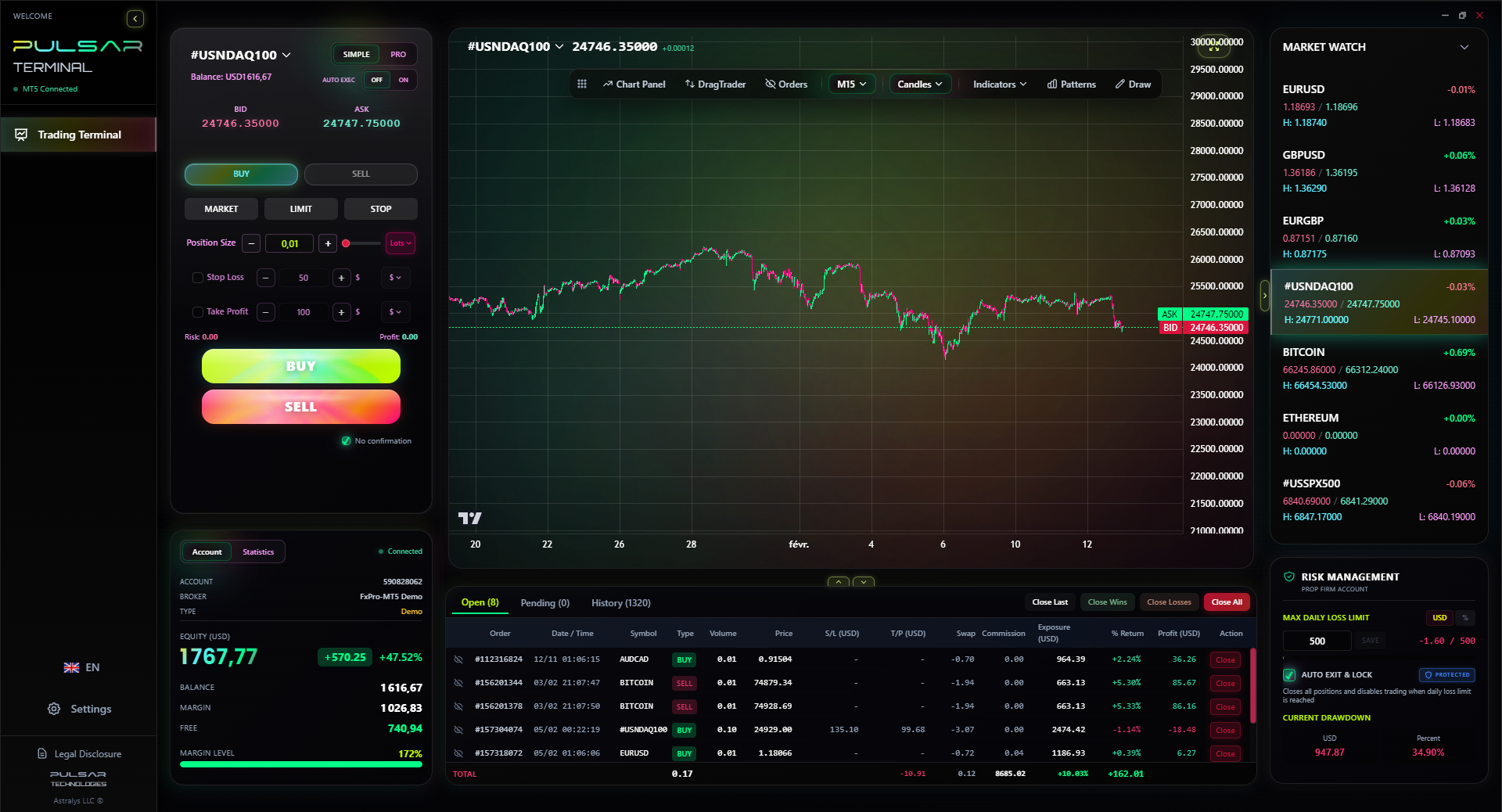
When your analysis gives you a clear plan with multiple profit targets, manually managing partial closures and moving stops to breakeven is a hassle that Pulsar Terminal automates directly on your MT5 chart.
Pulsar Terminal
La herramienta MT5 todo-en-uno: órdenes drag-and-drop, multi-TP/SL, trailing stop, grid trading, Volume Profile y protección prop firm. Usado por más de 1.000 traders diariamente.
You can be the best analyst in the world, and SARS or a scam broker will still take everything. Get this right.
Regulation is Your Shield: Only use brokers regulated by the FSCA. Yes, offshore brokers might offer 1000:1 use. They might also 'misplace' your deposit when you try to withdraw. The FSCA's 30:1 cap protects you from yourself. They also enforce client fund segregation. If an FSCA broker like AvaTrade goes under, your money is separate and should be safe. This is non-negotiable.
Tax is Your Reality: In South Africa, forex trading profits are considered income from a business (if you trade regularly) or capital gains. You must declare it to SARS. Keep careful records of every trade - your broker statements are your bible. You can deduct certain expenses like data fees, trading platform subscriptions, and even a portion of your home office if you trade professionally. Get a tax consultant who understands trading. The R2 million annual offshore allowance is useful, but remember, trading through an international broker counts towards this. Don't get caught out.
“A loss is just the cost of doing business. A margin call is the cost of failing at business.”
Forex analytics is a skill, not a product. You get better by doing, reviewing, and adapting.
Start simple. Pick one major pair like EUR/USD and one ZAR pair. Follow them for a month without trading. Write down your predictions based on your analysis each Monday, and review them on Friday. What did you get right? What did you miss? Was your error in the technical read, or did you ignore a fundamental driver?
Join a community, but be wary of 'signal services'. Look for groups that discuss analysis and rationale, not just brag about profits. The best traders I know are obsessed with their mistakes.
Finally, understand that no amount of analysis eliminates risk. It only helps you manage it. The goal is to be consistently profitable over hundreds of trades, not to win every single one. If your analytics give you a 55% win rate with a solid risk-reward ratio, you're ahead of 90% of the market. That's the game. Play the long game, protect your capital, and let the analytics guide you through the daily noise.
FAQ
Q1Is forex trading legal in South Africa?
Yes, absolutely. It's legal and regulated by the Financial Sector Conduct Authority (FSCA). The key is to only use brokers who are licensed by the FSCA to ensure your funds are protected under South African law.
Q2What's a realistic starting capital for a South African trader?
With the FSCA's 30:1 use cap, you need more than you think. I'd say a minimum of R20,000-R30,000 to trade comfortably without being wiped out by a few bad trades. This allows for proper position sizing and risk management. You can start with less at some brokers, but the risk of a margin call is extremely high.
Q3Why are the spreads on USD/ZAR so high?
The ZAR is an emerging market currency with lower liquidity compared to majors like the USD or EUR. There's simply less trading volume, so the gap between the buy and sell price (the spread definition) is wider to compensate market makers for the higher risk. It's a major cost you must factor into every trade.
Q4Do I need to pay tax on my forex profits?
Yes. The South African Revenue Service (SARS) views consistent trading profits as taxable income. You must declare it. Keep detailed records of all your trades, deposits, and withdrawals. It's wise to consult a tax professional familiar with trading.
Q5What's the single most important piece of analysis for a beginner?
Price action and support/resistance levels. Before you touch an indicator, learn to read the raw chart. Where has the price bounced or broken before? That's where the market's memory is. Everything else is a derivative of price.
Q6Can I use international brokers like Exness or IC Markets from South Africa?
You can, but you must check their regulatory status. Many, like Exness and IC Markets, have global entities not regulated by the FSCA. While they are reputable, your recourse if something goes wrong is through a foreign regulator, not the FSCA. For full local protection, choose their FSCA-regulated entity if they have one.
Lección del Prof. Winston
Puntos clave:
- ✓Analytics is a 3-part system: Technical, Fundamental, Sentiment. Use all three.
- ✓ZAR pairs have huge spreads. This forces a swing trading mindset.
- ✓Only use FSCA-regulated brokers. Your capital's safety is non-negotiable.
- ✓Journal every trade. Your biggest edge is understanding your own behavior.
¿Te resultó útil este artículo?
Haz clic en una estrella
Análisis Trading Semanal
Análisis y estrategias semanales gratis. Sin spam.
Sobre el autor
David van der Merwe
Trader de Mercados Emergentes
Trader con sede en Johannesburgo con 11 años en divisas de mercados emergentes. Especialista en pares ZAR, trading regulado por la FSCA y análisis del mercado sudafricano.
Comentarios
Aviso de riesgo
El trading de instrumentos financieros conlleva un riesgo significativo y puede no ser adecuado para todos los inversores. El rendimiento pasado no garantiza resultados futuros. Este contenido tiene fines educativos únicamente y no debe considerarse asesoramiento de inversión. Siempre realice su propia investigación antes de operar.
También te puede interesar

Cara Trading Forex Sukses: 7 Prinsip dari Trader Profesional
Cara trading forex sukses dengan 7 prinsip trader pro: manajemen modal, disiplin, journal trading, backtest. Data nyata, bukan janji profit palsu.
Jam Trading Forex Terbaik untuk Trader Indonesia: Panduan Lengkap dengan Tabel Waktu
Panduan jam trading forex untuk trader Indonesia. Tabel 4 sesi dunia, jam emas 20:00-00:00, sesi mana yang harus dihindari. Data akurat + tips dari trader berpengalaman.
Top 5 Sàn Forex Uy Tín Nhất 2026: Review Jujur dari Trader Indonesia
Top 5 sàn forex uy tín 2026 untuk trader Indonesia. Review jujur: spread, deposit, withdraw, dukungan lokal. Exness, XM, IC Markets & lebih.
Obtener Pulsar Terminal
Todas estas calculadoras están integradas en Pulsar Terminal con datos en tiempo real de su cuenta MT5.
Obtener Pulsar Terminal