


Let me guess.

David van der Merwe
Trader de Mercados Emergentes ·  South Africa
☕ 10 min de lectura
Lo que aprenderás:
- 1What Exactly Is a Forex Autotrader? (It's Not What You Think)
- 2The South African Rules: FSCA, Taxes, and Why use is Capped
- 3The Ugly Side: Scams, Fake Results, and Real Costs
- 4How to Make an Autotrader Work (The Only Way That Matters)
- 5Picking the Right Broker and Tech in South Africa
- 6The Final Verdict: Should You Use a Forex Autotrader?
Let me guess. You're tired of staring at charts, you've heard about traders making money while they sleep, and you're wondering if a forex autotrader is your golden ticket. I get it. I bought my first 'guaranteed profit' robot back in 2014 for $97. It blew up a $500 demo account in three days. The promise is seductive, but the reality for most South African traders is a fast track to a margin call. This isn't a sales pitch. It's a risk manager's breakdown of what automated trading really is, how the FSCA rules change the game, and whether you should even bother.
When you hear 'forex autotrader,' you're probably picturing a magical black box that prints money. That's the marketing. The reality is more mundane, and understanding this is your first line of defense.
A forex autotrader is simply a piece of software that executes trades on your behalf based on a predefined set of rules. In the MetaTrader world (which 90% of us use), they're called Expert Advisors or EAs. Think of it as a very obedient, very stupid intern that never sleeps. It doesn't 'think' or 'adapt' to news unless you explicitly program it to. It just follows instructions.
There are two main types:
- Commercial Robots: The ones you buy online for ZAR 500 to ZAR 10,000+. These are pre-packaged strategies. The seller shows you a beautiful backtested equity curve (which is often manipulated) and makes big promises.
- Custom-Coded EAs: This is where the real potential lies. You (or a programmer) code a strategy you've already proven works manually. This automates the execution, removing emotion and fatigue. This is what professional traders use, not the flashy commercial bots.
The critical mistake? Believing the software itself is the edge. It's not. The edge is the trading logic inside it. If your manual strategy loses money, automating it just means you'll lose money faster. I learned this the hard way. I once paid $1,200 for a 'grid trading' EA that worked beautifully in a ranging market. Then the USD/ZAR trended strongly for two weeks. The EA kept placing orders against the trend, averaging down until my entire R20,000 account was wiped out. The robot did its job perfectly. The strategy was fatally flawed.

Warning: A robot cannot create a profitable strategy from a losing one. It can only execute the strategy you give it, for better or (usually) worse.

💡 Consejo de Winston
The first rule of autotrading: never automate a strategy you can't trade profitably by hand. The computer just makes your mistakes faster.
Trading in South Africa isn't the wild west. The Financial Sector Conduct Authority (FSCA) has rules that directly impact how you can use an autotrader, and ignoring them is a recipe for disaster.
The 30:1 use Cap: This is the big one. Since 2021, the FSCA has capped use for retail traders at 30:1 on major forex pairs. If you're using a foreign broker that isn't FSCA-regulated, they might still offer you 500:1. But ask yourself: if the regulator whose job is to protect you says 30:1 is the safe limit, why would you gamble with 500:1? That extra use is how small account blow-ups turn into catastrophic ones, especially with an EA that can place multiple trades quickly. I've seen a martingale EA on a 500:1 account wipe out R50,000 in under an hour during the GBP flash crash. The 30:1 cap forces better position size discipline, which is ironically a blessing for automated trading.
Broker Choice is Critical:
- FSCA-Regulated Brokers (Like Exness SA or XM SA): Your funds are segregated, and you have recourse through the FAIS Ombud if something goes wrong. This is the safest route.
- International Brokers (Like IC Markets or Pepperstone): Often have better raw spreads and technology favored by algo traders. They are legal to use, but you're under their home country's jurisdiction (CySEC, ASIC). Do your homework.
Taxes: The South African Revenue Service (SARS) sees forex trading profits as income. You pay tax on your net profit for the year. If your shiny new autotrader makes R100,000, be prepared to hand over a chunk. Keep careful records of every trade your EA takes - this is non-negotiable.

Pro Tip: Always run a new EA on a DEMO account with your chosen South African broker first. Spreads, execution speed, and slippage can be drastically different from the vendor's tests, turning a 'profitable' bot into a loser.
“A robot cannot create a profitable strategy from a losing one. It can only execute the strategy you give it, for better or (usually) worse.”
The forex autotrader market is saturated with scams. It's a multi-million rand industry built on hope. Here’s how to spot the garbage.
The Backtest Lie: Every sales page shows a smooth, upward-sloping equity curve from 2009 to today. This is almost always curve-fitted. They've optimized the strategy to fit past data perfectly - a process called over-optimization. It looks amazing in the past but fails immediately in live markets. A real, strong strategy will have periods of drawdown in its backtest. If it doesn't, it's fake.
The 'Limited Time' Offer: The pressure tactic. "Only 10 copies left at ZAR 1999, then price goes to ZAR 9999!" This is pure marketing. A genuine trading tool doesn't need scarcity; its performance speaks for itself.
Real Costs Beyond the Purchase Price:
| Cost Factor | What It Means For You |
|---|---|
| Robot Price | ZAR 0 (free, likely useless) to ZAR 10,000+. |
| VPS (Virtual Private Server) | ~R150-400/month. Essential for 24/5 uptime without keeping your PC on. |
| Broker Spreads & Commissions | The silent killer. A scalping EA that makes 5 pips per trade will die on a broker with a 3-pip spread. |
| Drawdown Periods | The psychological cost. Can you watch your bot lose 20% of your account and not intervene? |
I once reverse-engineered a popular 'Gold Miner' EA being sold for $299. The entire logic was a basic MACD indicator crossover with a fixed stop-loss. You could code it yourself in 10 minutes. They were selling hope, not code.
The only autotraders with any credibility are those sold on platforms like MQL5, where you can see real-time, verified live performance results on actual broker accounts. Even then, past performance is no guarantee.
💡 Consejo de Winston
If a robot vendor's sales page has more testimonials than verifiable live statements, walk away. Real track records are boring; hype is exciting.
So, is it all hopeless? No. But the path to success is the opposite of what the gurus sell. It's boring, technical, and requires more work than manual trading, not less.
Start With a Manual Strategy
You must have a trading strategy that you have proven works with your own hands over at least 100 trades. Not a hunch, not 5 lucky trades - a statistically significant sample. This is your edge. Are you a swing trading specialist on XAU/USD? Do you understand the London open on EUR/USD? Automate THAT.
Code the Rules, Not the 'Genius'
Your job is to translate your clear, rule-based strategy into code. Entry conditions, exit conditions, position sizing rules. The EA should be a mirror of your disciplined self. If your strategy says 'buy when the RSI indicator is under 30 on the H1 chart,' the EA does exactly that. It shouldn't 'get a feeling' the market is turning.
Relentless Testing & Optimization
- Backtest: But be skeptical. Use tick data if possible.
- Forward Test (Demo): Run it on a live demo account for at least 2-3 months. This accounts for real spreads and slippage.
- Micro-Live Test: Run it on a live account with the smallest possible position size. I start all new systems with risk of 0.1% per trade or less. The goal is to test the execution, not make money.
The moment of truth comes when the EA enters a losing streak. This is where 99% of people fail. They see the losses, panic, and shut it off - often right before it would have recovered. You must have the psychological fortitude to let the system run its course, provided it stays within its historical drawdown parameters.

Example: Let's say your EA's worst historical drawdown was 15%. You start live with R10,000. If it drops to R8,500, you should expect it. If it blows past that to R7,500, you have a problem - the market regime has changed, and the strategy may be broken. You need a plan for this before you start.
“The 'best' autotrader for a beginner is the one you build yourself from a strategy you understand.”
Your autotrader is only as good as the infrastructure supporting it. This is a technical decision, not an emotional one.
Broker Criteria for EAs:
- Low & Stable Spreads: Especially important for scalping EAs. Check the average spread on the pairs you'll trade during your session (e.g., London session for EUR/USD).
- Fast Execution & Low Slippage: This is where brokers like IC Markets or Pepperstone built their reputations. You want an ECN/RAW account model.
- Reliable MT4/MT5 Platform: The server must be stable. Frequent disconnections will kill your EA.
- Allows Algo Trading: Explicitly confirm this with support. Most do, but some have restrictions.
The Non-Negotiable: A VPS Hosting your MT5 platform on a Virtual Private Server located near your broker's data center is mandatory. It eliminates your internet/power issues and provides sub-millisecond execution. For about R300/month, it's the best insurance you can buy. Running an EA from your home PC in Cape Town while your broker's server is in Johannesburg is asking for missed trades and frustration.
Beyond Basic MT5: The native MT5 platform is limited for serious automation. This is where professional tools come in. You need software that can manage complex trade structures - like setting multiple take-profit levels, moving stops to breakeven automatically, or implementing a full grid of orders - without you babysitting it. Manual management of an EA defeats its entire purpose.
Think about the mechanics: an EA might open a trade, but who manages the trailing stop? Who scales out partial positions at different profit targets? If you have to do that yourself, you're back to screen-staring. True automation handles the entire trade lifecycle.
💡 Consejo de Winston
Your most important job as an automated trader is not picking entries. It's managing the system's risk and knowing when to pull the plug in a drawdown.
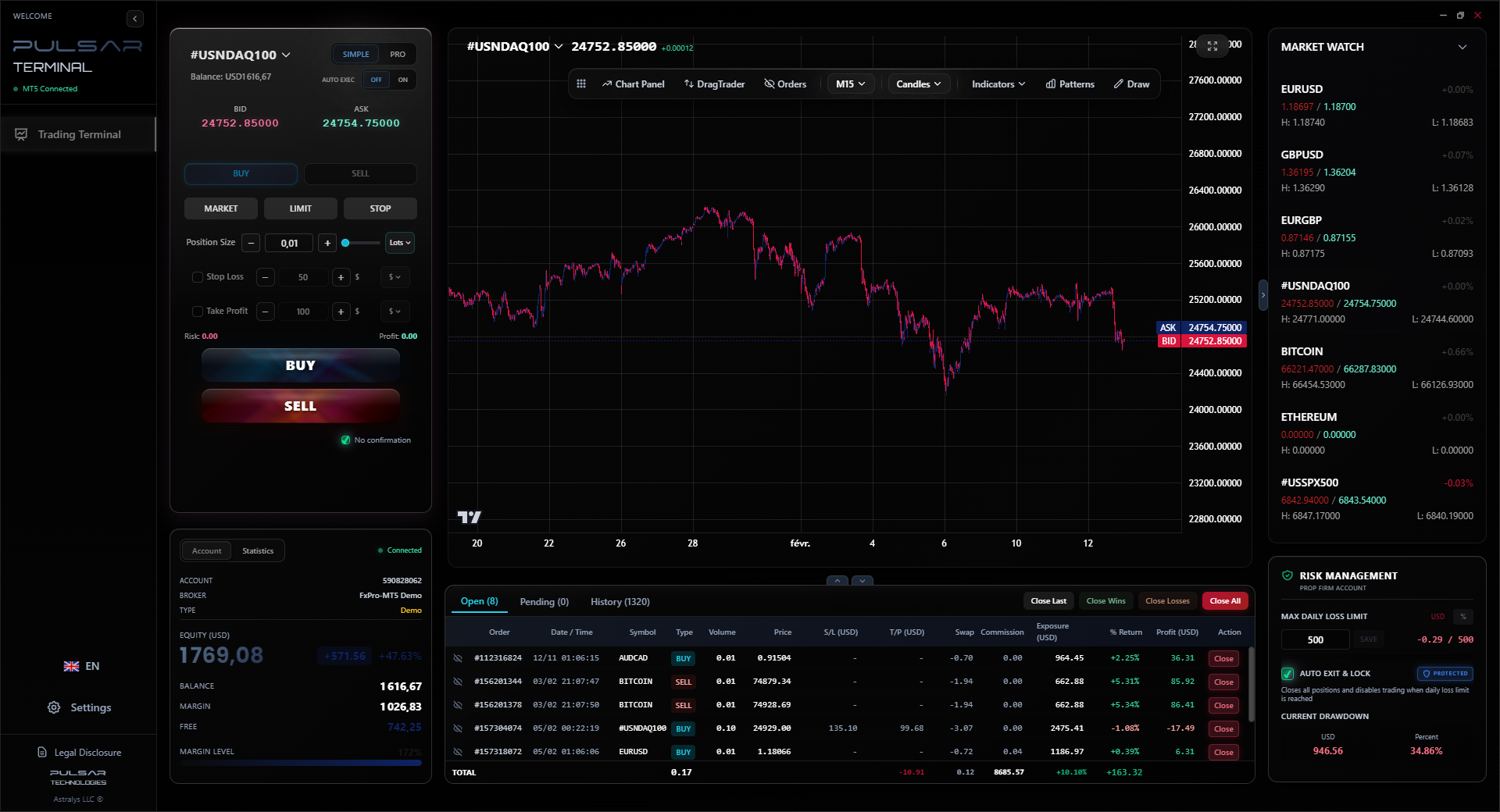
Managing complex trade exits and automated order grids is where basic MT5 fails, which is why professional algo traders use tools like Pulsar Terminal to handle it all directly on their platform.
Pulsar Terminal
La herramienta MT5 todo-en-uno: órdenes drag-and-drop, multi-TP/SL, trailing stop, grid trading, Volume Profile y protección prop firm. Usado por más de 1.000 traders diariamente.
Here's my blunt assessment after 12 years and losing money on my first few attempts.
You should NOT use a forex autotrader if:
- You are looking for a 'set and forget' solution to make money without effort.
- You believe buying a robot is a substitute for learning how to trade.
- You cannot afford to lose the money you're putting into the account.
- You are emotionally unable to watch a system go through a 2-3 month drawdown without interfering.
You SHOULD consider automation if:
- You are already a consistently profitable manual trader with a written, rule-based plan.
- You want to scale your strategy by trading multiple pairs or systems simultaneously.
- You want to remove the psychological errors of manual execution (hesitation, revenge trading).
- You are willing to become a systems manager - monitoring performance, not micromanaging trades.
For the vast majority of South African traders starting out, the ZAR 5,000 you'd spend on a robot is better invested in:
- Education (learning price action, risk management).
- Trading a small live account manually to get the real feel of the market.
- Paying for a proper position size calculator and journaling software.
Automation is the final step in a trader's journey, not the first. It amplifies whatever you are. If you're a disciplined, profitable trader, it can make you more efficient. If you're a losing trader, it will simply systematize your losses and burn through your capital while you're asleep. Choose wisely.
FAQ
Q1Are forex autotraders legal in South Africa?
Yes, using automated trading software (Expert Advisors) is completely legal. The key is using them through a reputable broker, preferably one regulated by the Financial Sector Conduct Authority (FSCA) for local protection. The software itself isn't regulated, but the broker handling your money is.
Q2What is the best forex autotrader for beginners?
Frankly, there isn't one. The 'best' autotrader for a beginner is the one you build yourself from a strategy you understand and have tested manually. Buying a black-box robot as a beginner is the fastest way to lose money. Start by learning to trade manually first. Once profitable, then learn to code or hire a coder to automate your specific edge.
Q3How much money do I need to start with a forex robot?
Far more than you think. Beyond the robot cost (ZAR 0-10,000+), you need a live trading account large enough to withstand drawdowns. With the FSCA's 30:1 use cap, you need meaningful capital. Starting with less than R20,000 is extremely risky, as a typical 10-15% drawdown could hit your margin call level quickly. You also need a budget for a VPS (~R300/month).
Q4Can I really make passive income with a forex autotrader?
It's not passive income; it's active systems management. While the trade execution is automatic, you must actively monitor the system's health, ensure the VPS is running, check for news events that might break the strategy's logic, and review weekly performance metrics. It's like owning a rental property - the rent comes in automatically, but you still have to manage the tenant and maintenance.
Q5What's the difference between a forex robot and a copy trading platform?
A forex robot (EA) is software running on your MT4/MT5 that follows its own coded rules. A copy trading platform (like eToro's or ZuluTrade) automatically copies the live trades of another human trader you choose. Both are forms of automation, but with a robot, you own/control the strategy. With copy trading, you're relying entirely on another person's skill and discipline, which introduces a whole new set of risks.
Q6How do I avoid getting scammed when buying an EA?
- Ignore YouTube ads and flashy sales pages. 2. Only buy from reputable marketplaces like MQL5 where you can see verified live account results (real money, not demo). 3. Be deeply suspicious of any strategy that claims low drawdowns and high monthly returns. 4. Demand a trial period on your own broker demo account. 5. Remember: if it was truly a money-printing machine, why would they sell it for ZAR 2000 instead of using it themselves with bank loans?
Lección del Prof. Winston
Puntos clave:
- ✓Automation amplifies your existing edge or losses.
- ✓FSCA's 30:1 use cap is a risk-management blessing.
- ✓Real costs include VPS, spreads, and psychological toll.
- ✓95% of commercial robots are over-optimized scams.
- ✓Success requires being a systems manager, not a spectator.
¿Te resultó útil este artículo?
Haz clic en una estrella
Análisis Trading Semanal
Análisis y estrategias semanales gratis. Sin spam.
Sobre el autor
David van der Merwe
Trader de Mercados Emergentes
Trader con sede en Johannesburgo con 11 años en divisas de mercados emergentes. Especialista en pares ZAR, trading regulado por la FSCA y análisis del mercado sudafricano.
Comentarios
Aviso de riesgo
El trading de instrumentos financieros conlleva un riesgo significativo y puede no ser adecuado para todos los inversores. El rendimiento pasado no garantiza resultados futuros. Este contenido tiene fines educativos únicamente y no debe considerarse asesoramiento de inversión. Siempre realice su propia investigación antes de operar.
También te puede interesar

Cara Trading Forex Sukses: 7 Prinsip dari Trader Profesional
Cara trading forex sukses dengan 7 prinsip trader pro: manajemen modal, disiplin, journal trading, backtest. Data nyata, bukan janji profit palsu.
Jam Trading Forex Terbaik untuk Trader Indonesia: Panduan Lengkap dengan Tabel Waktu
Panduan jam trading forex untuk trader Indonesia. Tabel 4 sesi dunia, jam emas 20:00-00:00, sesi mana yang harus dihindari. Data akurat + tips dari trader berpengalaman.
Top 5 Sàn Forex Uy Tín Nhất 2026: Review Jujur dari Trader Indonesia
Top 5 sàn forex uy tín 2026 untuk trader Indonesia. Review jujur: spread, deposit, withdraw, dukungan lokal. Exness, XM, IC Markets & lebih.
Obtener Pulsar Terminal
Todas estas calculadoras están integradas en Pulsar Terminal con datos en tiempo real de su cuenta MT5.
Obtener Pulsar Terminal