


Here's a hard truth most 'gurus' won't tell you: over 80% of retail traders lose money.

David van der Merwe
Trader de Mercados Emergentes ·  South Africa
☕ 10 min de lectura
Lo que aprenderás:
- 1What This 'Forex Bible' Actually Is (And Isn't)
- 2First Pillar: Understanding Your Market (The SA Angle)
- 3Second Pillar: Your Broker & Your Brain
- 4Third Pillar: A Simple, Executable Strategy
- 5Fourth Pillar: Risk & Money Management (This is The Holy Grail)
- 6Putting It All Together: A Week in the Life
- 7Leveling Up: Advanced Tools & Automation
- 8Your Personal Forex Bible Checklist
Here's a hard truth most 'gurus' won't tell you: over 80% of retail traders lose money. In South Africa, with the rand's wild swings, that number might be even higher. This isn't another fluffy motivational piece. This is your practical, actionable forex bible, built from 12 years of getting it right, and more importantly, getting it wrong. We're cutting through the noise to talk real strategy, real brokers, and how to keep your hard-earned Rands in your pocket.
Let's be clear from the start. When I say 'forex bible,' I'm not talking about a holy text promising guaranteed riches. That's a one-way ticket to a blown account. I lost R15,000 in my first year chasing that exact fantasy.
For us, the forex bible is the core set of non-negotiable rules, foundational knowledge, and battle-tested strategies that work specifically for a South African context. It's about understanding how the USD/ZAR pair moves differently to the EUR/USD. It's knowing which local brokers are legit versus which ones will vanish with your deposit. It's building a system so strong that when Eskom load shedding hits and your internet drops, your risk management plan has already protected you.
This guide is that compilation. Forget theory. We're focusing on the practical mechanics of placing a trade, the psychology of holding it through a drawdown, and the discipline of taking a profit. Think of it as your field manual for the Johannesburg, Cape Town, or Durban trading desk.
Trading GBP/JPY from a textbook is one thing. Trading it from Sandton while watching the ZAR get hammered by a Moody's report is another. Your forex bible starts with local awareness.
The ZAR is Your Reality
Every trade you place is funded in Rand. Your profits and losses are in Rand. This changes everything. A 50-pip win on EUR/USD can be completely wiped out by a 2% weakening of the ZAR against the dollar if you're not careful. You must always be aware of the USD/ZAR rate, not just the pair you're trading. I once made a $300 profit on a gold trade, only to see the ZAR weaken so much that my net gain in Rands was a pathetic R1,800. The currency risk is real.
Key Pairs for SA Traders
You don't need to watch 50 pairs. Focus is power.
- USD/ZAR: The big one. Volatile, news-driven, and a great indicator of local and global risk sentiment.
- EUR/USD: The most liquid pair globally. Tighter spreads, cleaner trends. Your go-to for practicing technical strategies. I have a full guide on mastering the EUR/USD guide that breaks down its unique rhythms.
- XAU/USD (Gold): South Africans have a cultural affinity for gold. It's a fantastic hedge against ZAR weakness and global uncertainty. Learn its patterns in my XAU/USD guide.

Warning: Never, ever trade a major pair just because the ZAR is moving. USD/ZAR and EUR/USD are different beasts. Trading one as a reaction to the other is a classic amateur mistake.
“A 50-pip win can be wiped out by a 2% ZAR move. You're always trading two currencies, not one.”
Your broker is your gateway. Your psychology is the driver. Screw up either, and the engine falls out.
Picking a Broker That Won't Rob You
Regulation is non-negotiable. The FSCA in South Africa is a good start, but many of the best platforms for international access are regulated elsewhere (ASIC, CySEC, FCA). I've tested dozens. For sheer execution speed and raw spreads, IC Markets review shows why it's a favorite for serious scalpers. If you're starting with a smaller account, Exness review offers cent accounts where you can risk literal pennies per trade to learn. For a massive platform with tons of educational resources (good for the bible study phase), check the XM review.
Your biggest enemy isn't the market. It's the face in the mirror. Greed makes you move your stop-loss. Fear makes you close a winning trade early. I've done both more times than I care to admit.
The fix? Mechanical rules. Write your trading plan down. "I will only enter if the daily trend aligns with the 4-hour MACD indicator crossover. I will risk 1% of my capital. My stop-loss is 20 pips away, no exceptions." This turns you from an emotional gambler into a cold, executing robot. That's the goal.

Pro Tip: Before you fund a live account, open a demo with two different brokers like Pepperstone review and IC Markets. Execute the same trades on both. You'll see differences in execution speed and slippage that you'd never notice otherwise.

💡 Consejo de Winston
Your first R10,000 profit isn't for a new car. It's to double your trading capital. Reinvest in your business until it can pay you a real salary.
Complexity is the enemy of consistency. Here’s a foundational strategy from the forex bible that works across timeframes.
The Trend-Pullback Confirmation Setup:
- Identify the Trend: Use the 200-period Simple Moving Average (SMA) on the H4 chart. Price above it = potential uptrend. Below = potential downtrend. Don't fight it.
- Wait for the Pullback: In an uptrend, wait for price to dip back towards the 200 SMA or a key support level. In a downtrend, wait for a rally to resistance.
- Get Confirmation: Use the 1-hour chart. Look for a reversal candle (like a bullish engulfing in an uptrend pullback) AND the RSI indicator coming out of oversold territory (below 30) and crossing back above it.
- Enter & Manage: Enter on a break of the high of that reversal candle. Place your stop-loss below the recent swing low. Your take-profit should be at least 1.5 times your risk (a 1.5:1 Reward-to-Risk ratio).
Timeframe Choice:
- If you have a day job: This is a swing trading approach. Use the H4/Daily charts. You might check charts twice a day.
- If you can screen-watch: You can adapt this to the scalping strategy realm on the M5 or M15 charts. The rules are the same, just faster.
The Critical Numbers: Never wing your position size. If your account is R20,000 and your risk per trade is 1%, you can lose R200. If your stop-loss is 25 pips away on USD/ZAR, you need to calculate the Rand value per pip to see how many lots you can trade. Use a position size calculator every single time. This one habit will save you.
“Complexity is the enemy of consistency. The best strategy is one you can execute without thinking.”
Strategy gets you to the door. Risk management is what lets you stay in the building. This is the most important chapter in your forex bible.
The 1% Rule: Never, ever risk more than 1% of your total trading capital on a single trade. On a R10,000 account, that's R100 max. This seems small, but it means you can survive 20 losing trades in a row (unlikely if you have an edge) and still have 80% of your capital. Survival is the first goal.
The Correlation Trap: Don't open three trades all betting on a strong US dollar (e.g., Long USD/ZAR, Long USD/JPY, Short EUR/USD). If you're wrong, you get hit three times. That's not diversification, it's a concentrated bet.
Dealing with a Margin Call: A margin call is your broker's way of saying you're about to lose everything. It happens when your losses eat up your usable margin. The only way to prevent it is to use sensible use and the 1% rule. If you're using 500:1 use on a R5,000 account, a 0.2% move against you can wipe you out. It's not a tool, it's a loaded gun.

Example: Account: R50,000. Risk per trade: 1% = R500. Trade: Buy EUR/USD at 1.0850, Stop-Loss at 1.0820 (30 pips risk). Pip value for a mini lot (0.1 lot) is roughly $1 (R18.50). To risk R500, you calculate: R500 / (30 pips * R18.50 per pip) = ~0.9 mini lots. So, you'd trade 0.09 standard lots. This precise math keeps you alive.
Theory is useless without practice. Here’s how the forex bible principles look in a real trading week.
Sunday Evening (SA Time): Review the weekly economic calendar. Note the big events: SA CPI, US Fed speeches, ECB decisions. Plan which days you might avoid trading due to high volatility.
Monday: No major news? Check your H4 charts. Is USD/ZAR above its 200 SMA? Maybe look for a pullback to go long. Set an alert. Don't force a trade.
Wednesday (US CPI Day): This is chaos. I often sit on my hands. If you must trade, reduce your position size by half. The spread will widen massively at the news release. I got stopped out in 2022 on a perfectly good gold trade because the spread blew out from 30 cents to $15 instantly. The news didn't even move price that far, but the broker's spread killed me.
Friday: Close out any swing positions before the weekend to avoid gap risk. Review your trades. Journal them. What worked? Did you follow your rules? This review is more valuable than any new indicator.
The rhythm is about discipline, not excitement. The most profitable weeks are often the most boring.
💡 Consejo de Winston
If you feel a rush of excitement when entering a trade, that's your signal to double-check your plan. Good trading should feel boring, calculated.
“Your most profitable weeks will be your most boring. Excitement is expensive in this game.”
Once your basics are rock solid, you can use tools to enhance precision and remove emotion. This isn't about replacing skill, it's about augmenting it.
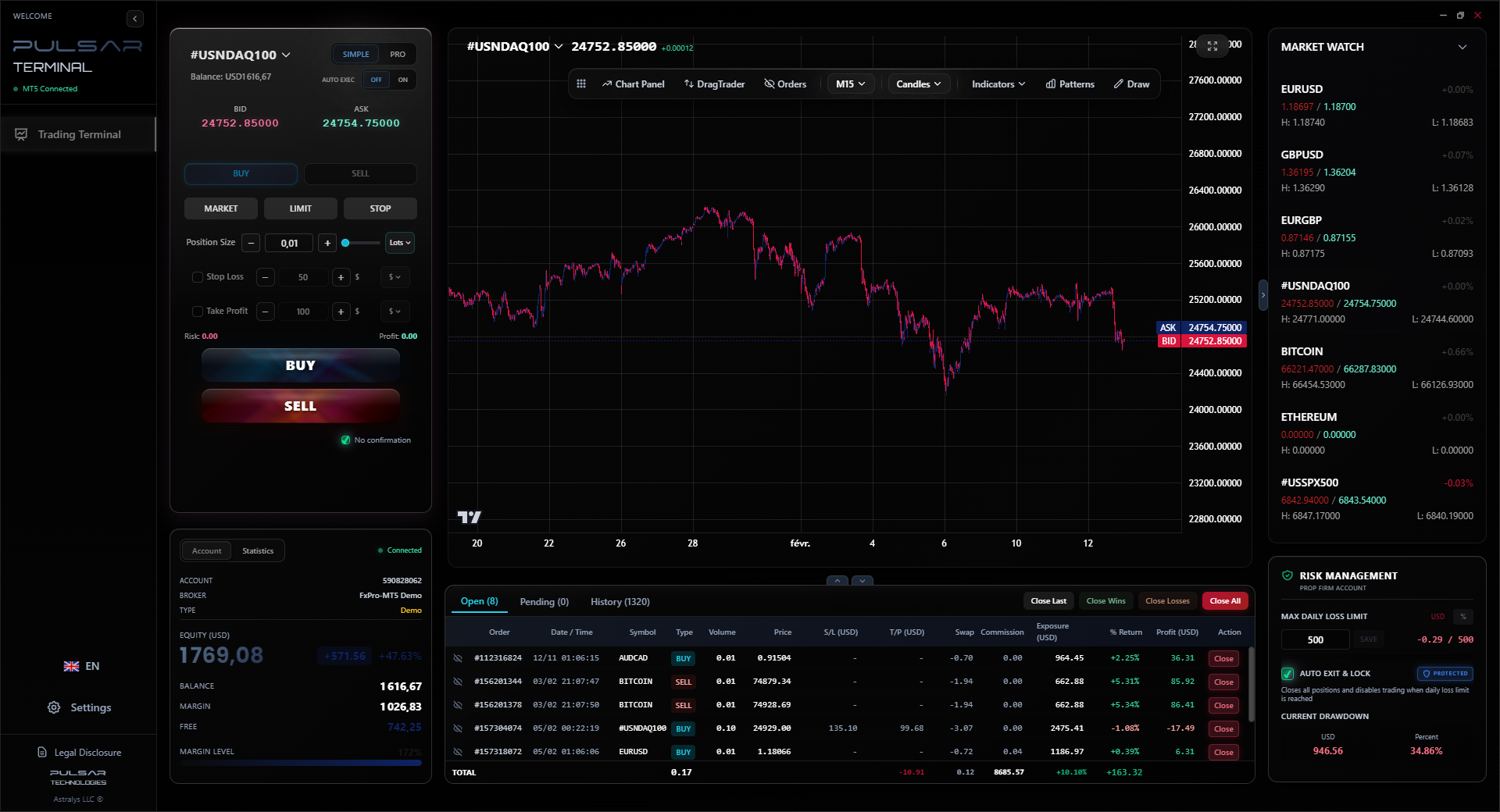
For example, managing multiple take-profit levels and moving a stop-loss to breakeven is a manual, emotional process. You start watching the screen, second-guessing. A tool that automates this based on your pre-set rules locks in your plan. Imagine setting a trade with three partial take-profits and a trailing stop that kicks in after the second target is hit. The software handles it, so you don't have to.
This is especially critical for prop firm challenges, which are huge in SA right now. These firms have strict daily loss limits. A single emotional mistake can blow the entire challenge. Having a tool that can automatically enforce your max daily loss by preventing new trades is a game-saver. It acts as the disciplined cop your brain sometimes refuses to be.
The same goes for advanced charting. Built-in MT5 tools are okay, but adding a Volume Profile overlay can show you exactly where the big banks are buying and selling, giving you far better areas for your stop-losses and take-profits. It turns vague 'support and resistance' into precise, volume-based zones.
Executing a multi-target strategy and protecting profits with a trailing stop is a core part of the forex bible, and tools like Pulsar Terminal automate this perfectly within MT5.
Pulsar Terminal
La herramienta MT5 todo-en-uno: órdenes drag-and-drop, multi-TP/SL, trailing stop, grid trading, Volume Profile y protección prop firm. Usado por más de 1.000 traders diariamente.
Print this. Stick it next to your screen.
Before You Deposit:
- Broker is properly regulated (FSCA, ASIC, FCA).
- You understand the deposit/withdrawal process in ZAR.
- You've tested the platform on a demo for at least a month.
Before Every Trade:
- The overall market trend (H4/Daily) aligns with my trade direction.
- I have a clear, logical reason for entry (price at support/resistance, indicator confirmation).
- I have calculated my position size using my position size calculator.
- My stop-loss is set at a level that invalidates my trade idea.
- My take-profit offers at least a 1.5:1 reward-to-risk ratio.
- This trade does not over-expose me to one currency or theme.
After Every Trade (Win or Lose):
- I have recorded the trade in my journal with a screenshot.
- I have noted my emotional state during the trade.
- I have reviewed whether I followed my plan 100%.
If you can't tick every box, don't take the trade. It's that simple. This checklist has saved me from more bad trades than any indicator ever could.
FAQ
Q1How much money do I need to start trading forex in South Africa?
Technically, you can start with a few hundred Rand on a cent account. But realistically, to properly implement risk management without being wiped out by a single bad trade, I'd suggest a minimum of R10,000. This allows you to risk R100 per trade (1%) and still have room to breathe. Start with a demo account first, no matter what.
Q2Is forex trading taxable in South Africa?
Yes. SARS views forex trading profits as income if you're seen as a regular trader, or as capital gains if it's more incidental. You must keep careful records of all your trades, deposits, and withdrawals. It's complex, so consult a tax professional who understands trading. Don't get caught out.
Q3What's the best time of day to trade forex in SA?
The sweet spot is between 10:00 AM and 3:00 PM SAST. This overlaps with the London session (open 10:00 SAST) and the first few hours of the New York session (open 3:00 PM SAST). Liquidity is highest, spreads are tightest, and you get the most reliable price action. The Asian session (overnight for us) is much slower and more prone to erratic moves.
Q4Can I make a living trading forex from South Africa?
It's possible, but it's a marathon, not a sprint. Don't even think about it until you've consistently profited for at least 18-24 months on a live account. You need a substantial capital base (think R500,000+) to generate a liveable income while still adhering to the 1% risk rule. Most successful 'full-time' traders I know have other income streams or started with significant capital.
Q5Why do I keep hitting my stop-loss and then price reverses in my direction?
Welcome to the club. This happens to everyone. It usually means your stop-loss is placed in an obvious spot where all the other retail traders have theirs (like just below a round number). The big players know this and can 'run the stops.' The fix? Place your stops at levels that make technical sense but aren't so obvious. Use recent swing lows/highs or a volatility-based measure like the Average True Range (ATR), not just a random 20-pip distance.
Q6Should I trade the USD/ZAR pair?
It's tempting because you understand the news, but it's a notoriously difficult pair. It's highly volatile, prone to sudden gaps, and the spreads are wider than on majors like EUR/USD. I recommend learning your strategy on EUR/USD first, where the conditions are cleaner. Once you're profitable there, you can cautiously apply the same rules to USD/ZAR with a smaller position size to account for the higher risk.
Lección del Prof. Winston
Puntos clave:
- ✓Never risk more than 1% of your capital per trade.
- ✓Master EUR/USD before touching volatile pairs like USD/ZAR.
- ✓Your trading plan must be written down, in ink.
- ✓The broker's spread can kill a good trade faster than the news.
- ✓Journal every trade, especially the losers.
¿Te resultó útil este artículo?
Haz clic en una estrella
Análisis Trading Semanal
Análisis y estrategias semanales gratis. Sin spam.
Sobre el autor
David van der Merwe
Trader de Mercados Emergentes
Trader con sede en Johannesburgo con 11 años en divisas de mercados emergentes. Especialista en pares ZAR, trading regulado por la FSCA y análisis del mercado sudafricano.
Comentarios
Aviso de riesgo
El trading de instrumentos financieros conlleva un riesgo significativo y puede no ser adecuado para todos los inversores. El rendimiento pasado no garantiza resultados futuros. Este contenido tiene fines educativos únicamente y no debe considerarse asesoramiento de inversión. Siempre realice su propia investigación antes de operar.
También te puede interesar

Cara Trading Forex Sukses: 7 Prinsip dari Trader Profesional
Cara trading forex sukses dengan 7 prinsip trader pro: manajemen modal, disiplin, journal trading, backtest. Data nyata, bukan janji profit palsu.
Jam Trading Forex Terbaik untuk Trader Indonesia: Panduan Lengkap dengan Tabel Waktu
Panduan jam trading forex untuk trader Indonesia. Tabel 4 sesi dunia, jam emas 20:00-00:00, sesi mana yang harus dihindari. Data akurat + tips dari trader berpengalaman.
Top 5 Sàn Forex Uy Tín Nhất 2026: Review Jujur dari Trader Indonesia
Top 5 sàn forex uy tín 2026 untuk trader Indonesia. Review jujur: spread, deposit, withdraw, dukungan lokal. Exness, XM, IC Markets & lebih.
Obtener Pulsar Terminal
Todas estas calculadoras están integradas en Pulsar Terminal con datos en tiempo real de su cuenta MT5.
Obtener Pulsar Terminal