


You see them everywhere: 'Earn passive income from trading!' 'Become a forex broker partner today!' In South Africa, it feels like every second person on LinkedIn is an 'IB' or 'affiliate'.

David van der Merwe
Trader de Mercados Emergentes ·  South Africa
☕ 10 min de lectura
Lo que aprenderás:
- 1What Exactly Is a Forex Broker Partnership?
- 2How It Works in the South African Context
- 3Why a Trader Would (and Wouldn't) Become a Partner
- 4Picking Your Partner: Broker Due Diligence
- 5Building It Properly: Beyond a Telegram Link
- 6Pitfalls I Fell Into (So You Don't Have To)
- 7The Final Question: Is This For You?
You see them everywhere: 'Earn passive income from trading!' 'Become a forex broker partner today!' In South Africa, it feels like every second person on LinkedIn is an 'IB' or 'affiliate'. Here's the truth they don't tell you. For every partner making R50,000 a month in commissions, there are a hundred making nothing but wasting their time. I've been on both sides. I once spent six months building a 'partner business' that netted me less than I made on one good gold trade. Let's cut through the hype.
At its core, a forex broker partnership is a referral agreement. You send traders to a broker, and they pay you a commission based on those traders' activity. In South Africa, we usually call it being an Introducing Broker (IB) or an affiliate. The broker gets a new client without the full marketing cost, and you get a slice of the revenue.
There are two main commission models here. The first is revenue share. You get a percentage (usually 20-40%) of the spread or commission the broker earns from your referred clients. The second is cost-per-action (CPA), where you get a flat fee, say R800 or R1500, once a referred client deposits and trades a certain volume. The revenue share is for the long game; CPA is a quick hit.

Warning: Many 'partner managers' will sell you the dream of lifelong passive income. Remember, most retail traders blow their accounts within 3-6 months. That 'lifetime' revenue share often has a very short lifespan.
I made my first partnership mistake early. I went for the highest revenue share percentage (a juicy 45%) from a smaller, less regulated broker. The percentage was great, but the clients I referred had terrible slippage and execution. They lost money quickly and quit. My 'high percentage' of nothing is still nothing. I learned that the broker's quality, like their spread definition and execution, matters more than the commission rate.
“For every partner making R50,000 a month, there are a hundred making nothing but wasting their time.”
South Africa's market is unique. We have the Financial Sector Conduct Authority (FSCA) overseeing things, which adds a layer of legitimacy (and complexity) you don't get everywhere. A legit broker partnership here isn't a shady side-hustle; it's a registered financial service. If you're serious, you might need a FSP number, which changes the game entirely.
The Regulatory Side
Acting as an IB without proper registration is a big no-no. The FSCA doesn't mess around. A proper partnership means the broker handles the client funds and trading platform (like MT4/5), while you handle the introduction and sometimes basic support. You're their marketing arm, not their back office.
The Realistic Earnings
Let's talk numbers. Say you refer a client to a broker like IC Markets or Pepperstone under a revenue share plan. They trade EUR/USD, generating an average of $15 in spread/commission for the broker per lot traded. Your cut is 30%, so $4.50 per lot. If that client trades 10 lots a month, you earn $45 (about R850). To make R20,000 a month, you'd need about 24 clients trading at that volume. Consistently. It's not impossible, but it's a grind of client acquisition and retention.

Example: My most successful partnership stretch was with a swing trading educational group I ran. I referred 5 serious traders over 18 months. They traded conservatively, about 5 lots per month each on average. At a 25% rev share, that was a steady ~R2,000 per month. Not life-changing, but it paid for my data subscriptions. The key was matching the right broker (good for swing trades) with the right traders.

💡 Consejo de Winston
A partnership based on a 30% share of a 0.6 pip spread is financially superior to a 50% share of a 2.0 pip spread. Always calculate the actual cents-per-lot you will earn.
“Your 'lifetime' revenue share often has a very short lifespan.”
This isn't for everyone. Honestly, if you're a consistently profitable trader, your time is almost always better spent refining your own strategy. But there are scenarios where it makes sense.
The Good:
- Diversified Income: It's a different revenue stream from your P&L. When your trading hits a drawdown, partnership income can offset some of the pain.
- use Your Knowledge: If you're already coaching or running a signal group, monetizing that community directly through a partnership is logical.
- Broker Perks: Serious IBs often get premium accounts: tighter spreads, dedicated support, even higher use. I once got a raw spread account from a broker specifically because of the volume my referrals traded.
The Bad and The Ugly:
- Massive Time Sink: Finding and onboarding traders is a sales and marketing job. It takes you away from the charts.
- Conflict of Interest: This is the big one. If your income depends on your referrals trading (not necessarily profiting), your advice can become biased. Encouraging overtrading to boost your commission is a fast track to losing everyone's trust.
- Unreliable Payouts: Your income is tied to the trading habits of others. One month can be great, the next can be zero. It's the opposite of controlled, disciplined trading.
I learned this conflict lesson the hard way. Early on, I pushed a high-frequency scalping strategy to referrals because it generated more volume (and thus commission). It was terrible for them in the long run, and I lost their trust. My short-term commission bump wasn't worth the long-term reputation damage.
“Your 'lifetime' revenue share often has a very short lifespan.”
Choosing a broker to partner with is more critical than choosing one to trade with. Your reputation is on the line.
1. Regulation is Non-Negotiable: FSCA regulation is the baseline for South African clients. For international reach, look for ASIC, FCA, CySEC. This protects your referrals and ensures the broker isn't a bucket shop. Check our deep dives on brokers like Exness or XM for how we assess them.
2. Commercial Terms: Don't just look at the percentage. Look at the basis. Is it a share of the raw spread, or a marked-up spread? A share of 1.0 pip on EUR/USD is very different from a share of 1.8 pips. Get the calculations in writing.
3. Technology and Support: Does the broker provide you with proper tracking links, reporting dashboards, and marketing materials? Is there a dedicated partner manager who actually responds? A clunky backend will make your life miserable.
4. Payout Consistency and Thresholds: How often do they pay? Monthly? Quarterly? What's the minimum payout threshold (e.g., $100)? I was once with a program that had a $500 threshold and paid quarterly. My cash flow was a nightmare.
5. Client Fit: This is the secret. Match the broker's strengths to your audience. If your network is full of algorithmic traders, partner with a broker known for low-latency VPS hosting and API access. If it's beginners, a broker with great educational resources and customer support is key.
💡 Consejo de Winston
Your most valuable asset is not your referral link, but your reputation. Never compromise it for a short-term commission. A tarnished reputation in this small community is impossible to rebuild.
“If your income depends on your referrals trading, not necessarily profiting, your advice can become biased.”
Putting your referral link in your Instagram bio is not a business. Here’s a more sustainable approach.
Find Your Niche: You can't be for everyone. Are you the guy who teaches XAU/USD trading? The expert on MACD indicator divergences? Focus there. Create genuine content that helps traders in that niche. The referrals will come from trust, not spam.
Transparency is Your Currency: Be upfront. Tell your audience you have a partnership with Broker X and may earn a commission if they sign up. Explain why you chose that broker for your specific strategy. This builds more trust than any hidden link.
Track Everything: Use the broker's dashboard, but also track clicks, sign-ups, and conversions yourself. Know your numbers. What's your conversion rate from viewer to client? 1%? 0.1%? This tells you how much traffic you need to generate to hit your income goals.
Provide Real Value First: Before you ever pitch a broker, give value. A free webinar on risk management using a position size calculator. A PDF on common RSI indicator mistakes. Earn the right to make a recommendation.

Pro Tip: The best partnership asset you can build is an email list of engaged traders. You own that list. It's not subject to the whims of a social media algorithm. Offer a free, genuinely useful trading checklist in exchange for an email address. Nurture that list with valuable insights, and your broker referrals will have a much higher conversion rate.
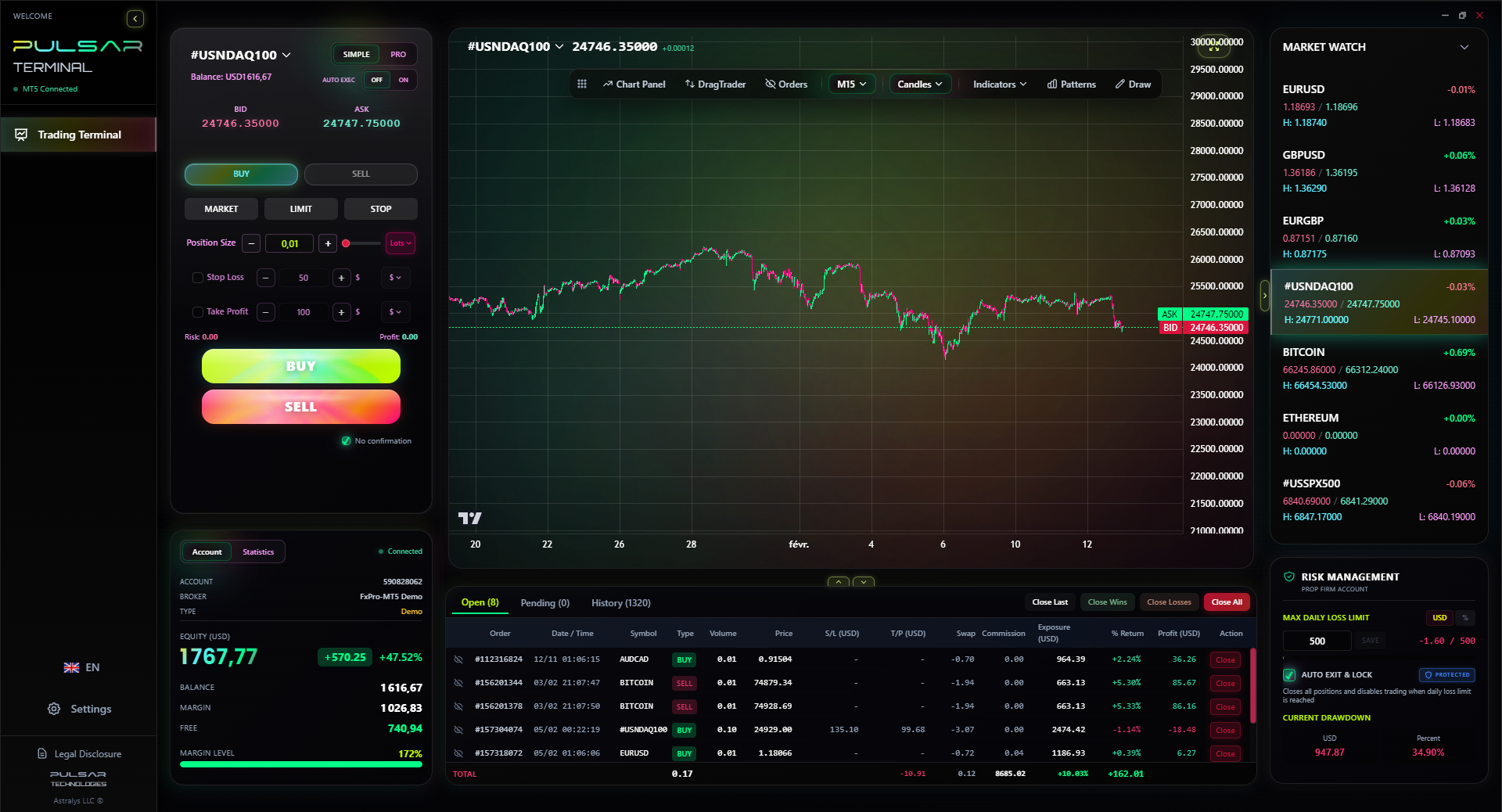
Managing your own trades while running a partnership is demanding; tools like Pulsar Terminal that streamline order management on MT5 give you back crucial time for client relationships.
Pulsar Terminal
La herramienta MT5 todo-en-uno: órdenes drag-and-drop, multi-TP/SL, trailing stop, grid trading, Volume Profile y protección prop firm. Usado por más de 1.000 traders diariamente.
“If your income depends on your referrals trading, not necessarily profiting, your advice can become biased.”
Let me save you some pain and lost time.
Chasing the Highest Payout Rate: I already mentioned this, but it's worth repeating. A 50% rev share from a dodgy broker is worse than a 25% share from a top-tier broker like Pepperstone. Your referrals will leave, and you'll earn nothing. The broker's reputation becomes yours.
Neglecting Your Own Trading: This happened to me in 2019. I got so obsessed with building my 'partner empire' - making videos, writing posts, chasing leads - that my own trading journal gathered dust. My performance slipped. The R3,000 I made in commissions that quarter was wiped out by a single bad trade I made because I was distracted.
Assuming 'Passive' Means 'No Work': The initial setup and client acquisition is brutally active. The 'passive' part only kicks in if you've built a system that consistently brings in and retains qualified traders. That takes years, not months.
Not Understanding the Legalities: Just because you're an 'affiliate' doesn't mean you can make wild promises. You cannot guarantee profits. You must disclose your relationship. In South Africa, giving specific financial advice without a license can land you in hot water with the FSCA. Stick to education and general information.
Ignoring the Client's Success: If all your referrals blow their accounts, your income stream dries up. Your long-term success is ironically tied to helping them avoid a margin call and trade sustainably. Teach them proper risk management. It's good for them, and it's good for your recurring revenue.
💡 Consejo de Winston
Track your time. If you spend 20 hours a month to earn R2000 in commissions, you're 'paying' yourself R100/hour. Is that better or worse than what your trading skills could generate in that same time? Know your numbers.
“The most successful partners I know are the quiet educators who provide immense value first.”
So, should you pursue a forex broker partnership? Ask yourself these questions honestly.
- Are you a people person? This is sales, marketing, and relationship management. If you hate that, stick to trading.
- Do you have an audience or a clear path to build one? Starting from zero is the hardest road.
- Can you handle income variability? Can your finances survive months of low or no commissions while you build?
- What's your opportunity cost? Could the hours spent on this generate more money if poured into improving your trading edge or another business?
For me, it was a worthwhile side project that taught me a ton about marketing and the business side of forex. It provided some cushion during lean trading periods. But it never replaced, nor will it ever replace, the income from my own trading. It's a supplement, not a substitute.
The most successful partners I know aren't the flashy Instagram gurus. They're the quiet educators who run specialized Discord communities, the algorithmic traders who share their VPS setups, or the analysts with a loyal following for their daily EUR/USD breakdown. They provide immense value first. The partnership is just a monetization layer for that value.
Start there. Provide value. Be transparent. Choose your broker partner as carefully as you choose your trades. Maybe then, that 'passive income' dream won't be such a mirage.
FAQ
Q1How much can I realistically earn as a forex broker partner in South Africa?
It varies wildly. A small partner with a few active clients might earn R2,000-R5,000 per month. A large operation with hundreds of active traders can earn R50,000+. The median is likely much lower. It depends entirely on the volume your referred clients trade and the broker's commission structure. Don't believe the 'get rich quick' screenshots.
Q2Do I need to be a profitable trader to be a good partner?
Not necessarily, but it helps immensely. Being profitable gives you credibility. More importantly, understanding trading helps you attract serious traders (who trade more volume) and give them advice that keeps them trading longer, which boosts your long-term revenue share. A losing trader trying to recruit others often fails.
Q3What's the difference between an IB (Introducing Broker) and an Affiliate?
In practice, the terms are used interchangeably. Technically, an IB often has a closer, more formalized relationship with the broker, may provide some client support, and is usually paid via revenue share. An affiliate is typically a simpler arrangement - you send traffic via a link, get a CPA or rev share, and have no further involvement. IBs are often expected to be FSCA registered.
Q4Can I partner with multiple brokers at once?
Yes, but I don't recommend promoting them all to the same audience. It looks spammy and destroys trust. It's better to have one primary broker partner for your main audience and perhaps another for a different niche or strategy. Always disclose your partnerships.
Q5How do I get paid, and are there taxes?
Payments are usually made via bank transfer, PayPal, or Skrill, monthly or quarterly. Yes, you absolutely must pay tax on this income in South Africa. This is taxable business income. Keep clear records of all payments and expenses. Speak to an accountant familiar with freelance/commission income.
Q6What's the biggest mistake new partners make?
Prioritizing their commission over their referred client's success. Pushing high-use, high-frequency trading to generate quick volume is a short-sighted strategy that burns clients and kills your reputation (and income stream) fast. Sustainable partnerships are built on helping clients trade better.
Lección del Prof. Winston
Puntos clave:
- ✓Commission percentage is meaningless without knowing the raw spread/commission.
- ✓Broker quality for your clients is more important than your cut.
- ✓Transparency about the partnership builds more trust than hiding it.
- ✓Track your time: partnership work has a high opportunity cost.
- ✓Sustainable income requires helping your referrals avoid blowing up.
¿Te resultó útil este artículo?
Haz clic en una estrella
Análisis Trading Semanal
Análisis y estrategias semanales gratis. Sin spam.
Sobre el autor
David van der Merwe
Trader de Mercados Emergentes
Trader con sede en Johannesburgo con 11 años en divisas de mercados emergentes. Especialista en pares ZAR, trading regulado por la FSCA y análisis del mercado sudafricano.
Comentarios
Aviso de riesgo
El trading de instrumentos financieros conlleva un riesgo significativo y puede no ser adecuado para todos los inversores. El rendimiento pasado no garantiza resultados futuros. Este contenido tiene fines educativos únicamente y no debe considerarse asesoramiento de inversión. Siempre realice su propia investigación antes de operar.
También te puede interesar

Cara Trading Forex Sukses: 7 Prinsip dari Trader Profesional
Cara trading forex sukses dengan 7 prinsip trader pro: manajemen modal, disiplin, journal trading, backtest. Data nyata, bukan janji profit palsu.
Jam Trading Forex Terbaik untuk Trader Indonesia: Panduan Lengkap dengan Tabel Waktu
Panduan jam trading forex untuk trader Indonesia. Tabel 4 sesi dunia, jam emas 20:00-00:00, sesi mana yang harus dihindari. Data akurat + tips dari trader berpengalaman.
Top 5 Sàn Forex Uy Tín Nhất 2026: Review Jujur dari Trader Indonesia
Top 5 sàn forex uy tín 2026 untuk trader Indonesia. Review jujur: spread, deposit, withdraw, dukungan lokal. Exness, XM, IC Markets & lebih.
Obtener Pulsar Terminal
Todas estas calculadoras están integradas en Pulsar Terminal con datos en tiempo real de su cuenta MT5.
Obtener Pulsar Terminal