


If you're looking at forex brokers in Kenya, you've probably heard the hype about 'easy money' and 'zero deposit' accounts.

David van der Merwe
Trader de Mercados Emergentes ·  South Africa
☕ 10 min de lectura
Lo que aprenderás:
If you're looking at forex brokers in Kenya, you've probably heard the hype about 'easy money' and 'zero deposit' accounts. I've been there, and I've lost money chasing that dream. The truth is, the Kenyan market is one of the most exciting and accessible in Africa, but it's also filled with traps for the unprepared. This guide will cut through the noise. We'll look at the real brokers, the actual costs, and the specific rules from the Capital Markets Authority (CMA) that protect you. I'll share some hard lessons from my own trades and show you how to approach this market with your eyes wide open.
Before you even think about a trade, you need to know who's watching the shop. In Kenya, that's the Capital Markets Authority (CMA). They're the main regulator for online forex brokers, and their license is your first line of defense. It's not just a sticker on a website.
A CMA license means the broker has to follow strict rules. They have to keep your money in a separate bank account from their own company funds (that's called client fund segregation). They have to be transparent about their fees and the risks of trading. They also have to meet certain capital requirements to operate. If a broker isn't CMA-licensed, you're basically trusting a stranger with your cash. I learned this the hard way early on, depositing $200 with an 'international' broker that offered crazy 1000:1 use. When I tried to withdraw my $350 profit, they vanished. Poof. Gone. That $200 lesson was cheaper than some I've heard about.

Warning: Just because a broker has a '.co.ke' website or advertises on local radio doesn't mean it's CMA-regulated. Always, always check the official CMA register. It's publicly available online.
The CMA's approach is generally seen as supportive of market growth while trying to protect retail traders. They don't impose hard use caps like South Africa's FSCA (30:1) or Europe's ESMA, but responsible brokers under their watch often limit use to sensible levels for retail accounts. Your safety net is the broker's compliance with CMA rules, not a specific use law.

💡 Consejo de Winston
A CMA license is your safety net, but your stop-loss is your life jacket. Never trade without one, especially with our sometimes-unreliable internet.
Based on current licensing and what's active in the market, here are the key players. I'm giving you real numbers I've seen or tested myself. Remember, conditions change, so verify on their sites.
| Broker | CMA License # | Min. Deposit | Typical EUR/USD Spread | Key Notes |
|---|---|---|---|---|
| Exness | 162 | $10 (≈ KES 1,300) | From 0.0 pips* | Huge global presence, popular for raw spreads. *Commission applies on raw accounts. |
| Scope Markets | 133 | $10 (≈ KES 1,300) | From 0.0 pips* | Strong regional focus, good local support. *Commission applies. |
| FXPesa (EGM Securities) | 107 | $5 (≈ KES 650) | From 1.4 pips | Very low barrier to entry, straightforward offering. |
| HotForex (HFM) | 155 | $0 | From 1.2 pips | True zero-deposit start on a cent account, great for absolute beginners. |
| Admirals | 135 | $25 (≈ KES 3,250) | From 0.0 pips* | Well-established, strong on education. *Commission applies. |
My Experience with Two of Them
I've traded actively with Exness and HotForex in Kenya. With Exness, I used their Raw Spread account. I bought EUR/USD at 1.0850 with a 0.1 pip spread, paying a $3.50 commission per lot. It was efficient for a scalping strategy I was testing. The profit was clean, but you must factor that commission into every trade. With HotForex, I started a $50 cent account (5,000 cents) to test a new strategy risk-free. The 1.5 pip spread on EUR/USD was fine for the swing trading style I used there. The zero minimum deposit is genuine, but to trade properly, you need to fund it.

Pro Tip: The 'minimum deposit' is often just to open the account. Your real 'trading capital' should be much higher. Starting with less than $100 (KES 13,000) makes it extremely hard to manage risk and use a proper position size calculator. I'd say KES 20,000 ($150) is a more realistic starting point for serious learning.
“The low minimum deposits can make forex seem like a game. Treat every shilling with the same respect you'd treat a larger investment.”
Brokers make money from you in three main ways: the spread, commissions, and swap fees. Ignoring any one of these can turn a winning strategy into a loser.
The Spread: This is the difference between the buy and sell price. It's your immediate cost to enter a trade. A '1.2 pip spread' means the price has to move 1.2 pips in your favor just to break even. On a $10,000 (1 mini lot) trade, a 1.2 pip move is $1.20. The brokers listed above offer everything from zero (with a commission) to 1.5+ pips. For a major pair like EUR/USD, under 1 pip is competitive.
Commissions: Charged per lot traded, usually on 'Raw' or 'ECN' accounts. Exness charges $3.50 per lot (round turn). So, on a standard lot ($100,000), you pay $7 to open and close. This is often cheaper than a wide spread if you're trading large sizes.
Swap Fees (Overnight Financing): This is the killer for held positions. If you keep a trade open past 5 PM New York time, you pay or receive interest. For Kenyan traders, holding a USD/ZAR trade overnight can have a hefty negative swap. I once held a small USD/ZAR position for a week, aiming for a 50-pip move. I made 40 pips, but the swap fees ate 15 of them. My net gain was much smaller than my chart showed. Always check the swap rate on your platform before holding.

Example: You buy 1 mini lot (0.1) of EUR/USD on an account with a 1.2 pip spread. Your break-even is +1.2 pips. If you hold for 3 nights with a -$0.50 daily swap, you need an extra 1.5 pips just to cover the swap. Your real break-even is now +2.7 pips.
💡 Consejo de Winston
That 'zero deposit' offer is a marketing hook. Your real starting capital should be money you can afford to lose without changing your life. Start with at least KES 20,000 to learn properly.
This is where local brokers shine. They've integrated the payment methods Kenyans actually use.
Mobile Money (M-Pesa) is King. Every reputable broker on our list offers direct M-Pesa deposits and withdrawals. It's instant for deposits, and withdrawals are usually processed within a few hours to a day. This is a massive advantage. I remember wiring money to an international broker a decade ago; it took 5 business days and cost $30 in bank fees. With M-Pesa, I can fund and be trading in 60 seconds.
Other Common Methods:
- Bank Wire Transfer: Slower but good for larger amounts.
- Credit/Debit Cards (Visa/Mastercard): Widely accepted, but check if your bank charges international transaction fees.
- E-wallets: Some brokers offer Skrill, Neteller, or Sticpay.
A Word on Currency: Your trading account will likely be in USD or EUR. When you deposit via M-Pesa in Kenyan Shillings (KES), the broker converts it at their offered rate. There's often a small markup in this conversion. It's usually fair, but it's another hidden cost to be aware of. Always check the final amount in USD that lands in your trading account.
“My biggest mistake was chasing the highest use. use is a tool, not a goal.”
Don't just pick the one with the flashiest ads. Ask yourself these questions:
What's Your Trading Style?
- Scalper? You need ultra-low spreads and fast execution. Look at Exness or Scope Markets' raw accounts. A tool that helps manage fast orders is key. (Managing rapid entries and exits is smoother with tools that automate order placement, like those in Pulsar Terminal for MT5).
- Swing Trader? Spreads are less critical, but swap fees are more so. A standard account with a slightly higher spread but lower swaps might be better. HotForex or Admirals could fit.
- Beginner? Focus on education and customer support. A cent account (like HotForex's) where 1 pip = $0.01 is useful for learning without panic.
What Platform Do You Want? MetaTrader 4 (MT4) is still the most popular, but MT5 is the future and offers more features. All the brokers here offer both. If you use advanced tools like the MACD indicator or RSI, both platforms have them.
Test Customer Support. Before you deposit, call their local Kenyan line or start a live chat. Ask a technical question. How fast and helpful are they? If they're bad before they have your money, imagine how they'll be after.
My biggest mistake was chasing the highest use. A broker offered me 500:1. I took it, used too much of it, and a normal 20-pip move against me triggered a margin call. I lost a third of my account in minutes. use is a tool, not a goal. A broker that offers sensible default use (like 100:1 or 200:1) is often more responsible than one shouting about 1000:1.
💡 Consejo de Winston
M-Pesa is a blessing for instant funding. Use it, but always check the final USD amount credited. The exchange rate spread is a hidden cost of doing business.
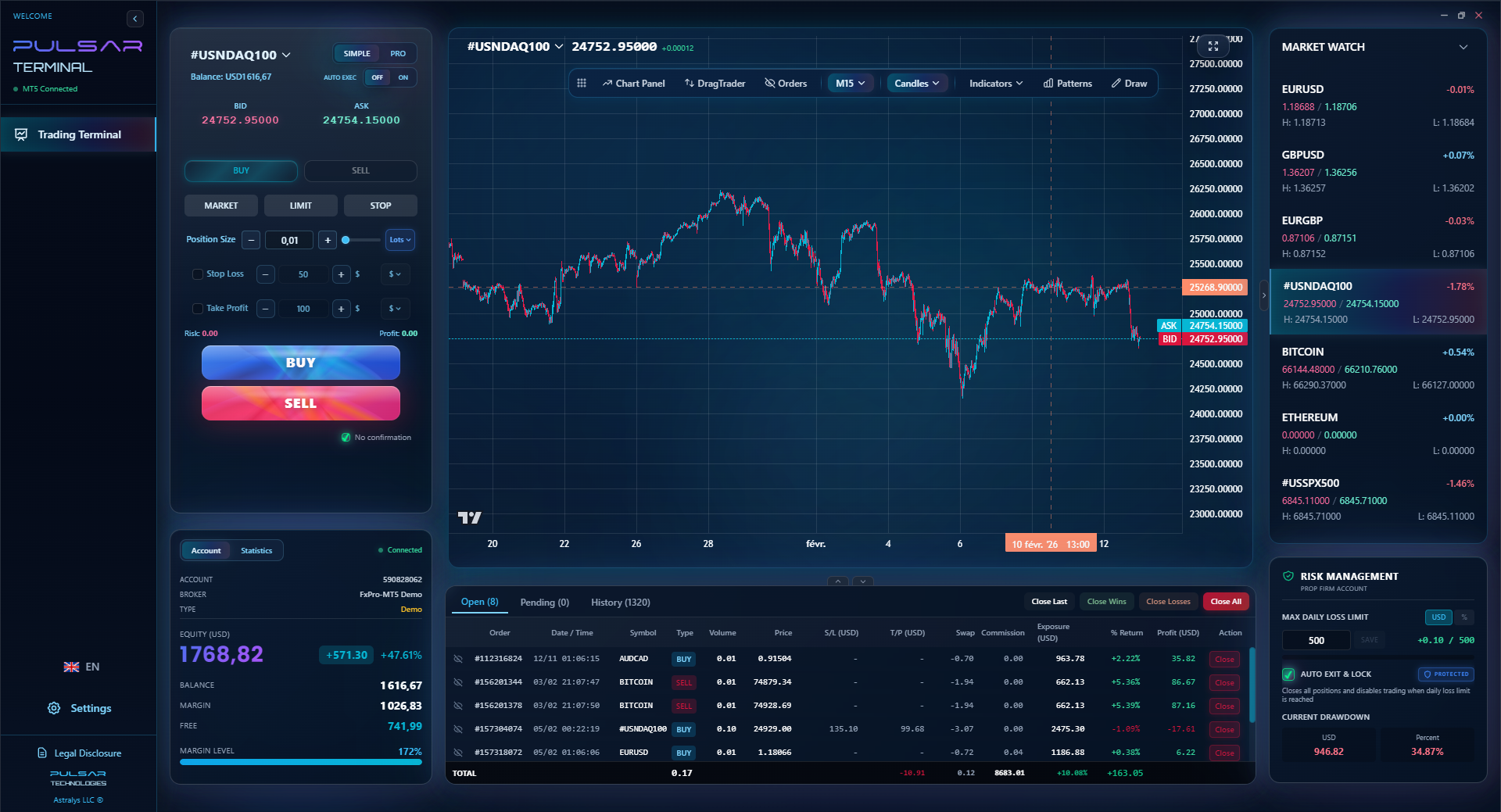
When you're managing multiple trades and need to move stops to breakeven or trail them efficiently, a tool like Pulsar Terminal automates this directly on your MT5 platform, saving you from frantic manual adjustments.
Pulsar Terminal
La herramienta MT5 todo-en-uno: órdenes drag-and-drop, multi-TP/SL, trailing stop, grid trading, Volume Profile y protección prop firm. Usado por más de 1.000 traders diariamente.
Trading from Kenya comes with unique advantages, but you must be aware of the pitfalls.
Regulatory Limits: The CMA is a good regulator, but its reach is limited to Kenya. If you have a dispute with a broker's international entity (like Exness's global arm), the CMA may not be able to help. Always trade with the broker's CMA-licensed entity. This should be clear during sign-up.
Taxation: This is crucial. In Kenya, profits from forex trading are generally considered taxable income. The Kenya Revenue Authority (KRA) expects you to declare this income and pay tax on it. Keep detailed records of all your trades, deposits, and withdrawals. I use a simple spreadsheet logging every trade. When tax season comes, it's not a nightmare.
Internet & Power Stability: We have come a long way, but disconnections happen. You must use stop-loss orders on every single trade. A disconnection during a volatile news event without a stop-loss can wipe you out. It's not the broker's fault if your internet drops.
The 'Get-Rich-Quick' Culture: Forex trading is portrayed as an easy side hustle. It's not. It's a skill that takes years to develop. The low minimum deposits can make it seem like a game. Treat every shilling with the same respect you'd treat a larger investment. The market doesn't care if you traded KES 1,000 or KES 1,000,000; the percentages work the same way.
“Your goal for the first 6 months is to preserve capital, not to make a fortune.”
Here's a concrete plan to begin on the right foot.
- Educate Yourself First. Don't deposit yet. Learn what a pip is, what a spread is, and how use works. Use free resources.
- Pick One Demo Account. Choose a broker from the list above (maybe HotForex for its cent account or Exness for its popularity). Download MT4 or MT5 and open a demo account. Practice for at least one month. Try to be consistent, not just lucky.
- Develop a Simple Plan. Decide: What pairs will you trade? (Stick to majors like EUR/USD or XAU/USD first). What's your daily loss limit? How will you find trades? (e.g., using RSI for overbought/oversold levels).
- Start Small for Real. Fund your live account with an amount you can afford to lose completely - maybe KES 5,000. Trade the smallest possible size (0.01 lots or use a cent account). Your goal for the first 6 months is to preserve capital, not to make a fortune.
- Keep a Trading Journal. Write down every trade: why you took it, your emotion, the outcome. This is how you learn from mistakes. My journal from my first year is cringe-worthy, but it shows me how far I've come.
The path for forex brokers in Kenya is clearer and safer than ever, thanks to CMA oversight. But the ultimate regulator of your success is you. Be disciplined, be patient, and always respect the risk.
FAQ
Q1Is forex trading legal in Kenya?
Yes, forex trading is completely legal in Kenya. It is regulated by the Capital Markets Authority (CMA). The key is to ensure you trade with a broker that holds a valid CMA license, as this provides you with legal protections and a recourse path for disputes.
Q2What is the best forex broker in Kenya for beginners?
For absolute beginners, HotForex (HFM) is a strong contender due to its true $0 minimum deposit and cent account feature, allowing you to trade with cents. This drastically reduces risk while learning. Their CMA license (#155) adds security. Focus on learning, not profits, in the beginning.
Q3Can I use M-Pesa to fund my forex trading account?
Absolutely. All major CMA-regulated brokers, including Exness, Scope Markets, FXPesa, and HotForex, offer direct M-Pesa integration for both deposits and withdrawals. Deposits are instant, making it the most convenient payment method for Kenyan traders.
Q4Do I pay tax on my forex trading profits in Kenya?
Yes. The Kenya Revenue Authority (KRA) considers forex trading profits as taxable income. You are required to declare this income and pay the appropriate income tax. It is essential to keep detailed and accurate records of all your trading activity for tax purposes.
Q5What use do Kenyan forex brokers offer?
The CMA does not set a fixed national use cap like some other regulators. Therefore, use offerings vary by broker. It's common to see use up to 500:1 or even 1000:1 advertised. However, responsible trading means using much, much less. I never recommend using more than 20:1 or 30:1, even if it's available. High use is the fastest way to blow up your account.
Q6How do I verify a broker's CMA license?
Visit the official Capital Markets Authority website. They have a public register of licensed entities. Search for the broker's name or their license number (e.g., '162' for Exness). Do not rely on a logo on the broker's site; verify it independently.
Q7Can I trade with international brokers instead of Kenyan ones?
Technically, yes. Many international brokers like IC Markets or Pepperstone accept Kenyan clients. However, you will not be protected under CMA rules. Your funds may not be segregated under Kenyan law, and resolving any issues will be more complex. For safety and convenience, starting with a CMA-regulated broker is strongly advised.
Lección del Prof. Winston
Puntos clave:
- ✓Always verify the broker's CMA license number independently.
- ✓Use M-Pesa for convenience but watch the FX conversion rate.
- ✓Start with a demo account for at least one full month.
- ✓Never trade without a stop-loss order in place.
- ✓Keep a detailed journal for every single trade.
¿Te resultó útil este artículo?
Haz clic en una estrella
Análisis Trading Semanal
Análisis y estrategias semanales gratis. Sin spam.
Sobre el autor
David van der Merwe
Trader de Mercados Emergentes
Trader con sede en Johannesburgo con 11 años en divisas de mercados emergentes. Especialista en pares ZAR, trading regulado por la FSCA y análisis del mercado sudafricano.
Comentarios
Aviso de riesgo
El trading de instrumentos financieros conlleva un riesgo significativo y puede no ser adecuado para todos los inversores. El rendimiento pasado no garantiza resultados futuros. Este contenido tiene fines educativos únicamente y no debe considerarse asesoramiento de inversión. Siempre realice su propia investigación antes de operar.
También te puede interesar

Cara Trading Forex Sukses: 7 Prinsip dari Trader Profesional
Cara trading forex sukses dengan 7 prinsip trader pro: manajemen modal, disiplin, journal trading, backtest. Data nyata, bukan janji profit palsu.
Jam Trading Forex Terbaik untuk Trader Indonesia: Panduan Lengkap dengan Tabel Waktu
Panduan jam trading forex untuk trader Indonesia. Tabel 4 sesi dunia, jam emas 20:00-00:00, sesi mana yang harus dihindari. Data akurat + tips dari trader berpengalaman.
Top 5 Sàn Forex Uy Tín Nhất 2026: Review Jujur dari Trader Indonesia
Top 5 sàn forex uy tín 2026 untuk trader Indonesia. Review jujur: spread, deposit, withdraw, dukungan lokal. Exness, XM, IC Markets & lebih.
Obtener Pulsar Terminal
Todas estas calculadoras están integradas en Pulsar Terminal con datos en tiempo real de su cuenta MT5.
Obtener Pulsar Terminal