


Most Nigerian traders are drowning in indicators while ignoring the single most important tool on their screen: the humble candlestick.

Olumide Adeyemi
Pionero del Trading en África Occidental ·  Nigeria
☕ 11 min de lectura
Lo que aprenderás:
- 1What Are Forex Candles? It's Not Just a Pretty Picture
- 2The 5 Candlestick Patterns That Actually Work (Forget the Rest)
- 3The Psychology Behind the Wick: Reading the Market's Mind
- 4How Nigerian Traders Screw Up Candlestick Analysis
- 5A Simple, Profitable Candle-Based Trading Strategy
- 6Candles vs. Bar Charts vs. Line Charts: What's Best for You?
- 7Setting Up for Success: Timeframes, Brokers & Tools

Most Nigerian traders are drowning in indicators while ignoring the single most important tool on their screen: the humble candlestick. I’ve seen guys with charts so cluttered you can’t even see the price, all while the candles are screaming the next move. Forget the fancy robots and secret signals for a second. If you can’t read a basic candlestick chart, you’re just gambling with a fancy interface. This guide will strip it back to what actually works. I’ll show you the handful of patterns that matter, the brutal psychology behind them, and how to use forex candles to build a real edge, not just another losing streak.
A forex candlestick is a snapshot of a market's emotional state during a specific period - whether that's one minute, one hour, or one day. Each candle tells you four critical pieces of data: the open, high, low, and close (OHLC). The 'body' (the thick part) shows the range between the open and close. The 'wicks' or 'shadows' (the thin lines) show the extreme highs and lows the price reached before being rejected.
If the close is higher than the open, the body is typically hollow or green (a bullish candle). If the close is lower, it's filled or red (a bearish candle). That's it. No magic, just pure, unfiltered price action. The real skill isn't in identifying the candle; it's in interpreting the story it tells about the battle between buyers and sellers. I made the mistake early on of only looking at the body. I ignored long wicks, thinking they were just noise. That cost me a lot of money. A long wick is a shout of rejection - it's the market saying 'not at this price,' and that's often where your best trades are.

Example: Let's say EUR/USD opens a 1-hour candle at 1.0850. It rallies up to 1.0875, sells off hard to 1.0830, then closes at 1.0845. The candle body would be red (from 1.0850 open to 1.0845 close). The upper wick would be 25 pips long (1.0875 high - 1.0850 open). The lower wick would be 15 pips long (1.0845 close - 1.0830 low). That long upper wick tells you sellers aggressively stepped in at 1.0875.

“A long wick isn't noise; it's a shout of rejection from the market.”
There are dozens of named patterns. Most are useless in the noisy, fast-moving forex market. You need patterns that show a clear shift in momentum or a strengthening of a trend. These are the five I've built my career on.
The Pin Bar (The Rejection King)
This is my personal favorite. It has a small body and a very long wick on one side. A bullish pin bar has a long lower wick; it tells you sellers pushed price down hard, but buyers fought back and closed the period near the top. It's a strong reversal signal, especially at key support levels. I caught a beauty on GBP/USD in 2022 at a major weekly support. The pin bar's wick was about 80 pips long, the body was only 15. I went long and rode it for over 200 pips.
The Engulfing Pattern (Power Shift)
This is a two-candle pattern. A bullish engulfing happens when a small red candle is followed by a large green candle that completely 'engulfs' the body of the previous candle. It shows buyers have completely overwhelmed the prior selling pressure. The key? The bigger the engulfing candle, the stronger the signal. Don't trade tiny ones.
The Doji (Indecision)
A doji has a virtually non-existent body because the open and close are almost identical. It looks like a cross or a plus sign. This shows a stalemate between buyers and sellers. By itself, it doesn't mean much. But when you see a doji after a strong trend, it's a warning sign that the trend is running out of steam. It's a signal to tighten stops, not necessarily to reverse.
The Inside Bar (Consolidation)
This is a bar whose entire range (high to low) is inside the range of the previous bar (the 'mother bar'). It shows compression and lowering volatility. The market is coiling. The breakout from the mother bar's range often leads to a powerful move. This is a cornerstone of many a good swing trading strategy.
The Marubozu (Conviction)
A candle with no or very tiny wicks. The price opened at the low and closed at the high (bullish) or vice versa (bearish). This shows one-sided, conviction-driven trading. Seeing a marubozu in the direction of your trend is a great sign to stay in or add to a position.

Warning: Never, ever trade a candlestick pattern in isolation. A pin bar in the middle of nowhere is just a pretty shape. A pin bar at a clear support/resistance level, or a key Fibonacci retracement, is a trading signal. Context is everything.

💡 Consejo de Winston
The market spends 80% of its time consolidating. Most candles in those periods are noise. Your job is to wait for the 20% of candles that form at clear decision points - the breakouts and rejections. Patience isn't a virtue here; it's a profit center.
“Most Nigerian traders are drowning in indicators while ignoring the single most important tool on their screen.”
This is where most Nigerian traders miss the point. They memorize patterns but don't understand the war each candle represents. Let me break down the psychology.
A long upper wick on a red candle? That's optimism crushed. Buyers tried to rally the market, pushed it up, but sellers slammed it back down and closed it lower. That's bearish sentiment winning the round. Conversely, a long lower wick on a green candle shows fear overcome. Sellers panicked, drove the price down, but calm, confident buyers absorbed all that selling and pushed price back up to close high. That's strength.
I remember a specific trade on XAU/USD (gold). The price was in an uptrend and pulled back. A candle formed with a huge red body - looked terrifyingly bearish. But it had an even longer lower wick. The narrative? Sellers had a moment of panic (the big red body), but the long wick showed that dip was instantly bought by stronger hands. I ignored the scary red body, focused on the wick showing support, went long, and it was one of my best gold trades that month. The candle told a story of weakness that was immediately rejected. You have to learn to read that story. Tools like the RSI indicator or MACD indicator can help confirm the momentum behind this psychology, but the candle is the primary source.
“Most Nigerian traders are drowning in indicators while ignoring the single most important tool on their screen.”
I see the same errors repeated in trading groups and forums every single day. Let's call them out.
Mistake 1: Trading Every Single Pattern. You see a hammer pattern on a 5-minute chart and you jump in. The market hasn't respected that level before, there's no news context, but the pattern is 'textbook.' This is a great way to blow up an account. Candles are a confirming tool, not a crystal ball.
Mistake 2: Ignoring the Higher Time Frame. You see a beautiful bullish engulfing on the 1-hour chart. But on the 4-hour chart, price is slamming into a massive resistance level and forming a doji. Which story is stronger? The 4-hour, always. The higher time frame dictates the overall narrative. A 1-hour signal against the 4-hour trend is a trap.
Mistake 3: Not Understanding Spreads & Slippage. On lower time frames like those used in scalping strategy, the candle's wick might only be a few pips. If your broker's spread on that pair is 2 pips, that 'signal' is already eaten up by costs before you even enter. You're fighting an immediate loss. Always know your broker's typical spread; it's why I prefer brokers like IC Markets or Pepperstone for their tight, raw spreads on majors.
Mistake 4: No Risk Management Around the Candle. You see a pin bar, you enter at market. Where's your stop loss? It should logically be beyond the tip of the pin bar's wick. That's the level the market rejected. If price goes back there, your thesis is wrong. Period. Use a position size calculator to ensure that stop distance doesn't risk more than 1-2% of your account. I've broken this rule out of overconfidence, placing my stop too tight to 'get a better risk-reward.' The market tapped the wick, took me out, and then rocketed in my original direction. It's a brutal lesson.
💡 Consejo de Winston
If you can't immediately see the story a candle is telling, walk away. Don't force a narrative. The best trades are obvious in hindsight because the candles made the story clear *before* the move.

“A candle pattern in the middle of nowhere is just a pretty shape.”
Let's get practical. Here's a straightforward swing trading strategy I've used successfully. It combines candles with one simple level.
Step 1: Find the Level. On the Daily chart, identify the most obvious recent swing high or swing low. Draw a horizontal line there. This is your key support or resistance.
Step 2: Wait for the Price & the Candle. Wait for price to approach this level. Don't anticipate. Let it touch or come very close.
Step 3: Look for the Rejection Candle. At the level, you want to see a clear rejection candle. At support, that's a pin bar with a long lower wick, a bullish engulfing, or a hammer. At resistance, you want the opposite: a pin bar with a long upper wick, a bearish engulfing, or a shooting star.
Step 4: Enter on Confirmation. Don't enter the moment the candle closes. Wait for the NEXT candle to begin moving in your direction. Enter on a small pullback during that next candle, or place a buy stop order a few pips above the high of the rejection candle (for a long trade).
Step 5: Manage the Trade. Place your stop loss just beyond the extreme of the rejection candle's wick. Your take profit should be at least 1.5 times your risk (Risk/Reward of 1:1.5). Look for the next obvious swing level as a target.

Pro Tip: This strategy works best on the 4-hour and Daily charts. The noise is filtered out. You might only get 2-3 high-quality setups a month per pair, but their win rate and payoff can be excellent. It requires patience, which is the one thing most new traders refuse to cultivate.
“A candle pattern in the middle of nowhere is just a pretty shape.”
You might wonder if this is all just preference. It's not. Each chart type gives you different information.
| Chart Type | What It Shows | Best For |
|---|---|---|
| Candlestick | Open, High, Low, Close + Visual psychology of body/wicks. | All price action analysis, spotting patterns & reversals. |
| Bar Chart (OHLC) | Same data as a candle (Open, High, Low, Close) but as a vertical line with ticks. | Traders who find candles visually cluttered; the data is identical. |
| Line Chart | Connects only the closing prices of each period. | Seeing the pure, smoothed trend. Hides volatility and intra-period battles. |
I use candlesticks 99% of the time. The visual weight of the body instantly shows who won the period (bulls or bears). A line chart hides the chaos. In early 2020 during the March volatility, a line chart of EUR/USD would have shown a smooth drop. A candlestick chart showed the massive, spiking ranges and long wicks that signaled absolute panic and, eventually, potential reversal zones. That detail is priceless. However, when I'm just trying to quickly assess the overall trend on a weekly chart, I'll sometimes flip to a line chart to cut through the noise.
💡 Consejo de Winston
Keep a trading journal. Screenshot your key candle setups - both winners and losers. Note the context. After 100 trades, you'll see patterns in your patterns. You'll learn which candle contexts you read well, and which ones consistently fool you.
“Patience isn't a virtue in trading; it's a profit center.”
Your setup can make or break your candle reading.
Timeframes: Start high and go low. Your analysis should flow from Weekly (trend) -> Daily (main context) -> 4-Hour (key levels) -> 1-Hour (entry signals). Trying to read forex candles on a 1-minute chart as a beginner is financial suicide. The market microstructure and spreads will eat you alive.
Brokers & Charting: You need a reliable broker with fast execution and clear charts. Slippage on candle breaks can ruin a good setup. I've had good experiences with Exness for local deposits and XM for their educational resources, but always test their demo first. Ensure their platform (like MT4/MT5) allows you to clearly see candle wicks and bodies. Adjust the colors to something that doesn't strain your eyes.
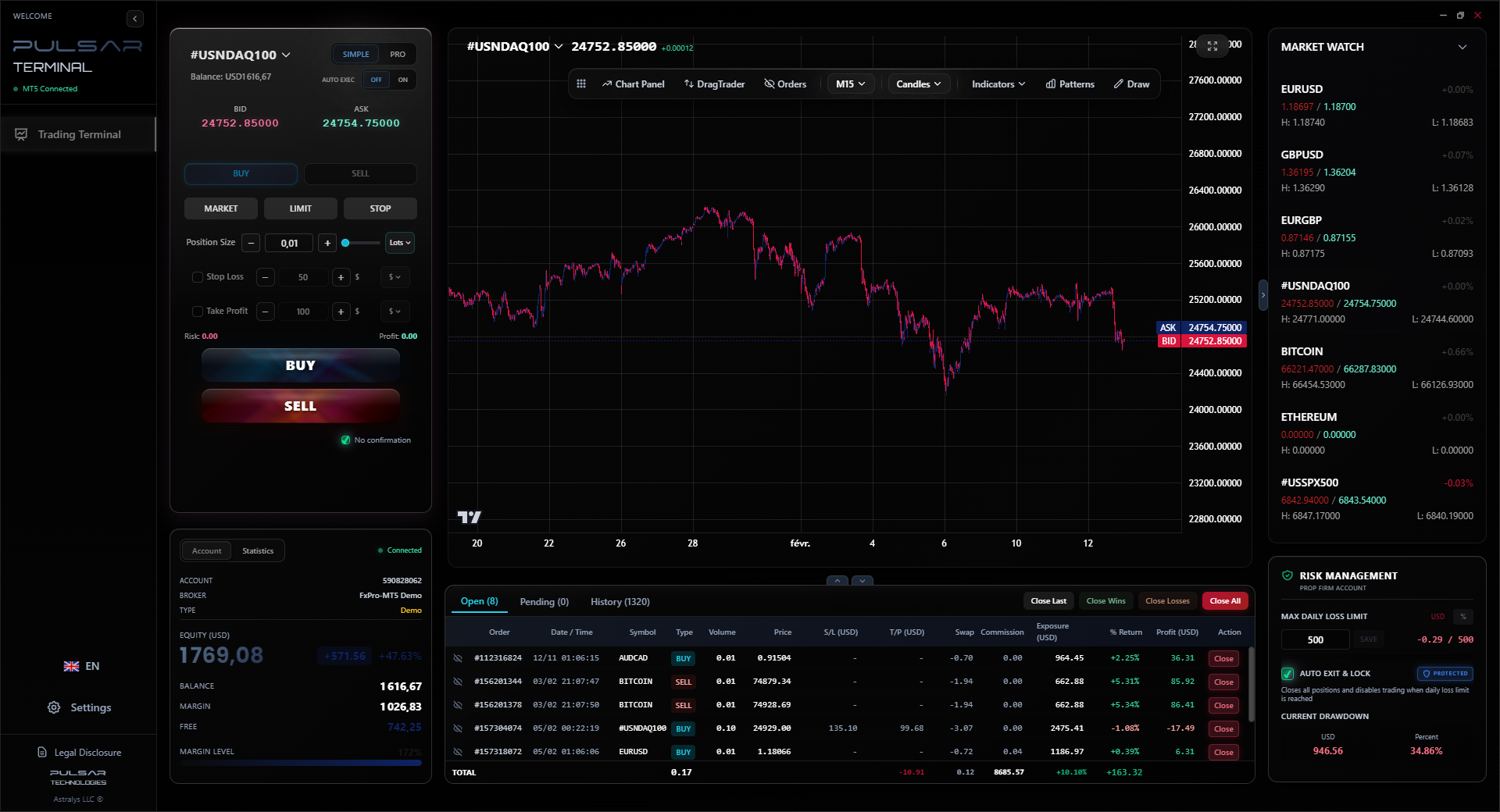
The Game-Changer Tool: This is where modern tools leave basic MT4 in the dust. Manually drawing levels, calculating position size, and setting complex stop-loss orders for multiple trades is slow and error-prone. Advanced trading terminals now integrate this directly.
Beyond Manual Drawing: The next evolution is using software that automates the tedious parts. Imagine having a tool that recognizes chart patterns from your candlestick setups for you, or lets you drag and drop to set take-profit and stop-loss levels with a visual trailing stop. Even better, one that can automatically calculate and place a grid of orders based on a key level you've identified from your candle analysis, managing the entire basket's risk. This isn't fantasy; it's what professional trading suites offer. It turns your candle-based insight into executed strategy without the manual hassle and emotional mis-clicks.
Once you can spot high-probability candle patterns at key levels, a tool like Pulsar Terminal lets you execute and manage the resulting trades with drag-and-drop orders, multi-TP/SL, and automated trailing stops directly on your MT5 chart.
Pulsar Terminal
La herramienta MT5 todo-en-uno: órdenes drag-and-drop, multi-TP/SL, trailing stop, grid trading, Volume Profile y protección prop firm. Usado por más de 1.000 traders diariamente.
FAQ
Q1What is the best timeframe to use candlestick patterns?
For reliability, start with the 4-hour and Daily charts. Patterns on these timeframes have more significance because they represent more trading volume and filter out market noise. 1-minute and 5-minute candle patterns are easily manipulated by spreads and are far less reliable for beginners.
Q2How many candlestick patterns do I really need to know?
Honestly, about 5-7. Master the Pin Bar, Engulfing Pattern, Doji, Inside Bar, and Marubozu. Understand the psychology behind them. Knowing 30 obscure patterns is useless if you can't trade the 5 major ones consistently in the right context.
Q3Why did my perfect pin bar trade fail?
Probably because you ignored context. Was the pin bar at a clear support/resistance level or a major Fibonacci level? Was there high-impact news due? Was it going against the higher timeframe trend? A candle pattern alone is not a trade signal. It's a piece of evidence that needs corroboration.
Q4Can I use candlesticks for scalping in Nigeria?
You can, but it's an advanced, high-stress game. You must account for wider spreads (especially on exotics), potential slippage, and you need a broker with ultra-fast execution. The candle patterns on a 1 or 5-minute chart are much smaller. A single wide spread can invalidate what looks like a good setup. I don't recommend it for most.
Q5What's more important, the candle body or the wick?
It depends on the story. For measuring who won the period (bulls or bears), the body is key. For identifying potential reversals or strength/weakness, the wick is often more important. A long wick shows a strong rejection, which is a powerful signal.
Q6How do I practice reading candles without losing money?
Open a demo account with a broker that offers good historical data. Go back in time on the chart. Hide the price action to the right of a certain point, and practice reading the candles as they form. Predict whether the next candle will be bullish or bearish, and why. Then, scroll forward to see if you were right. Do this for hundreds of hours.
Q7Do candlestick patterns work on all forex pairs?
They work best on major pairs with high liquidity (like EUR/USD or GBP/USD). On exotic pairs or during low-liquidity sessions (like Asian session for EUR pairs), patterns can be less reliable and more prone to false signals due to wider, erratic spreads.
Lección del Prof. Winston
Puntos clave:
- ✓Master just 5 key candlestick patterns: Pin Bar, Engulfing, Doji, Inside Bar, Marubozu.
- ✓Always trade candles with context - at key support/resistance levels.
- ✓The higher timeframe (4H/Daily) trend overrules any lower timeframe candle signal.
- ✓Place your stop loss beyond the extreme wick of your rejection candle.
- ✓A 1:1.5 risk-reward ratio is the minimum for a sustainable edge.
¿Te resultó útil este artículo?
Haz clic en una estrella
Análisis Trading Semanal
Análisis y estrategias semanales gratis. Sin spam.
Sobre el autor
Olumide Adeyemi
Pionero del Trading en África Occidental
Uno de los educadores de trading forex más activos de Nigeria. 8 años de experiencia operando desde Lagos. Especialista en estrategias de bajo capital y desafíos de prop firms para traders africanos.
Comentarios
Aviso de riesgo
El trading de instrumentos financieros conlleva un riesgo significativo y puede no ser adecuado para todos los inversores. El rendimiento pasado no garantiza resultados futuros. Este contenido tiene fines educativos únicamente y no debe considerarse asesoramiento de inversión. Siempre realice su propia investigación antes de operar.
También te puede interesar

Cara Trading Forex Sukses: 7 Prinsip dari Trader Profesional
Cara trading forex sukses dengan 7 prinsip trader pro: manajemen modal, disiplin, journal trading, backtest. Data nyata, bukan janji profit palsu.
Jam Trading Forex Terbaik untuk Trader Indonesia: Panduan Lengkap dengan Tabel Waktu
Panduan jam trading forex untuk trader Indonesia. Tabel 4 sesi dunia, jam emas 20:00-00:00, sesi mana yang harus dihindari. Data akurat + tips dari trader berpengalaman.
Top 5 Sàn Forex Uy Tín Nhất 2026: Review Jujur dari Trader Indonesia
Top 5 sàn forex uy tín 2026 untuk trader Indonesia. Review jujur: spread, deposit, withdraw, dukungan lokal. Exness, XM, IC Markets & lebih.
Obtener Pulsar Terminal
Todas estas calculadoras están integradas en Pulsar Terminal con datos en tiempo real de su cuenta MT5.
Obtener Pulsar Terminal