


You're thinking about trading forex, aren't you? Maybe you've seen the ads promising fast money, or you're just curious about how the whole thing works.
Sarah Collins
Estratega de Trading ·  United Kingdom
☕ 14 min de lectura
Lo que aprenderás:
- 1What is Forex, and How Does it Actually Work?
- 2UK Rules: The FCA and Keeping Your Money Safe
- 3The Real Costs: Spreads, Commissions, and the Hidden Tax
- 4Your First Toolkit: Choosing a Broker and Platform
- 5Your First Trade: A Step-by-Step Walkthrough
- 6Potholes in the Road: Common Beginner Mistakes I Made
- 7Building a Simple, Sustainable Strategy
You're thinking about trading forex, aren't you? Maybe you've seen the ads promising fast money, or you're just curious about how the whole thing works. I get it. I was there too, over a decade ago, clicking buy and sell with more hope than sense. The truth is, forex currency trading for dummies isn't about finding a magic button. It's about understanding a market where, frankly, most beginners get it wrong. In the UK, we've got one of the world's best-regulated environments, but that doesn't make it easy. This guide is the honest, no-fluff starting point I wish I'd had. We'll talk real numbers, my own costly mistakes, and how you can actually build a foundation instead of just blowing up an account.
Forex is just shorthand for the foreign exchange market. It's where one currency is traded for another. Think of it as the world's biggest, never-closing shop where the price of everything is relative. You're not buying a physical thing; you're speculating on whether one currency will get stronger or weaker against another.
The core mechanic is the currency pair. EUR/USD, GBP/USD, USD/JPY. The first currency is the 'base', the second is the 'quote'. The price tells you how much of the quote currency you need to buy one unit of the base. If GBP/USD is 1.2600, you need $1.26 to buy £1.
You make money by being right about the direction. If you think the Pound will strengthen against the Dollar, you buy (go long) GBP/USD. If you think it will weaken, you sell (go short) it. That ability to profit from a falling market is a key difference from just buying stocks.

Warning: This isn't investing. You're not buying a share of the UK economy. You're making a short-term bet on price movements, often magnified with borrowed money (use). It's a zero-sum game. For every winner, there's a loser on the other side of that trade.
The market is driven by a constant flow of news: interest rate decisions from the Bank of England, inflation data, political events, and simple global supply and demand. It's open 24 hours a day, five days a week, moving from Sydney to London to New York. London's session is crucial, handling about 38% of all global daily volume. That's when things really get moving for us here.
My first trade ever was on EUR/USD. I bought at 1.3050 because it 'felt low'. I had no idea about support levels or what the ECB was saying. It dropped to 1.2980 in an hour, and I panicked and sold. A £70 lesson in why 'gut feeling' is a terrible strategy. The price then rallied back above my entry. I was wrong on the direction, wrong on the timing, and wrong to panic. A perfect trifecta of beginner errors.
This is the most important section for any UK trader. We are lucky. Our regulator, the Financial Conduct Authority (FCA), is one of the toughest in the world. They don't mess about. Trading with an FCA-regulated broker isn't just a suggestion, it's your primary layer of defence.
Here’s what that regulation actually means for you:
- Your Money is Segregated: By law, your deposit must be held in a separate client money account. It can't be used to fund the broker's office party. If the broker goes bust, your money should be ring-fenced and returned.
- Negative Balance Protection: This is a game-saver. It means you can never lose more than you put in. In the old days, a flash crash could leave you owing the broker thousands. Not anymore. Your maximum loss is your account balance.
- use Caps: The FCA slashed use to protect people from themselves. For major pairs like EUR/USD, the max is 1:30. For minors like GBP/AUD, it's 1:20. It might feel restrictive, but it stopped a lot of new traders from vaporising their accounts in minutes. I used 1:100 back in the day, and it magnified my losses just as fast as my wins.
- The 85k Safety Net: The Financial Services Compensation Scheme (FSCS) can cover up to £85,000 per person if a regulated firm fails and can't return your money. Check if your broker is covered.
- The Consumer Duty: A new rule from 2023. It forces brokers to act in your best interest - to offer fair value, clear communications, and the support you need. It shifts the burden onto them to prove they're treating you right.
Always, always check the FCA register before you deposit a penny. If a 'broker' isn't on there, walk away. It's that simple. I learned this the hard way early on with an offshore firm that had 'slick' ads but terrible withdrawal practices. Never again.

Pro Tip: A broker's FCA registration number should be plastered on their UK website footer. Copy it, paste it into the FCA register search, and verify their permissions include 'dealing in investments as principal' for CFDs. This takes two minutes and is the most important trade you'll ever make.

💡 Consejo de Winston
Your first £500 is tuition, not capital. Expect to learn, not to earn. If you break even, you're in the top tier of beginners.
“Forex currency trading for dummies ends the moment you stop reacting and start following a disciplined process.”
Forex isn't free. The costs are baked in, and if you don't understand them, they'll eat your account alive even if your predictions are right. Let's break down the real numbers you'll face in the UK.
The spread is the main cost for most beginners. It's the difference between the buy (ask) and sell (bid) price. If GBP/USD is quoted as 1.2600 / 1.2602, the spread is 2 pips. You start that trade 2 pips in the red. It's the broker's fee for facilitating the trade.
| Pair Type | Example | Typical Spread (Pips) | What It Means |
|---|---|---|---|
| Major | EUR/USD, GBP/USD | 0.1 - 1.5 | Lowest cost, most liquid. |
| Minor | EUR/GBP, GBP/JPY | 1 - 5 | Higher cost, decent liquidity. |
| Exotic | GBP/TRY, USD/ZAR | 10 - 50+ | Very high cost, thin liquidity. Avoid as a beginner. |
Some brokers offer 'raw' accounts with tighter spreads but charge a commission. This is often a better deal for active traders. For example, you might pay a $4.50 round-turn commission per lot but get a 0.1 pip spread on EUR/USD. You need to do the math based on your trade size.

Example: On a standard account with a 1.5 pip spread on EUR/USD, a 1 lot (100,000 unit) trade costs you $15 to open (1.5 pips x $10 per pip). On a raw account with a 0.1 pip spread + $4.50 commission, the same trade costs $5.50 ($1 spread cost + $4.50). The raw account is cheaper.
Then there's the overnight financing charge or 'swap'. If you hold a position past 10pm UK time (the rollover), you'll either pay or earn a small interest fee based on the difference between the two currencies' central bank rates. It's usually tiny, but it adds up over time and can be a nasty surprise on long-term trades.
My mistake? I ignored swaps for months. I was holding a long GBP/JPY trade for weeks as a swing trading idea. The interest rate differential was heavily against me. I made 80 pips on the trade, but the swap fees ate over 30 of them. I was trading blind to a core cost.
Your broker and platform are your cockpit. You don't want a confusing mess when the market's moving. For a beginner in the UK, your checklist is simple: FCA regulation, low and transparent costs, a platform you can understand, and good customer support.
Based on my experience and the current 2026 landscape, here are solid starting points:
- For the All-Rounder: Pepperstone is consistently excellent. FCA-regulated, tight spreads, and they give you access to MT4, MT5, TradingView, and cTrader all from one account. Their minimum deposit is low, which is perfect for learning.
- For the Absolute Beginner: IG Group has been around forever. Their own platform is incredibly intuitive for new traders, and their educational resources are top-tier. They're a FTSE 250 company, which adds a layer of stability. Minimum deposit is £250.
- For the Cost-Conscious: XM offers a very gentle onboarding with tiny minimum deposits and a lot of educational focus. Their spreads are competitive, and they are heavily regulated globally, including by the FCA.
The Platform Dilemma: MT4 vs. MT5 vs. The Rest
You'll hear a lot about MetaTrader 4 and 5. MT4 is the old reliable, loved for its simplicity and vast library of custom indicators. MT5 is its more powerful successor, handling more asset types and offering better backtesting tools. Most UK brokers offer both.
My advice? Start with MT5. It's the future, and getting comfortable with it now will save you a switch later. Don't get bogged down in custom indicators at the start. Learn the basics: how to place a trade, set a stop-loss, and read a plain candlestick chart.
Other platforms like TradingView (integrated with many brokers) are fantastic for charting and idea generation. cTrader, offered by brokers like Pepperstone, is slick and professional. But for a beginner, stick with MT5 to learn the universal basics first. I wasted months hopping between platforms looking for a 'secret' instead of learning one tool properly.
💡 Consejo de Winston
The spread isn't a fee, it's a headwind. You start every race 5 meters behind. Don't make it harder by trading exotic pairs with 20-pip spreads.
“A 'mental stop' is worthless. You will hesitate. The market will gap, and you'll be staring at a loss far bigger than you ever imagined.”
Let's make this concrete. Let's say you've opened an account with an FCA broker, deposited £500, and downloaded MT5. Here’s exactly what you do next. (We'll use a demo account for this, but the steps are identical).
- Pick Your Pair: Stick to a major. Let's use EUR/USD. It's the most liquid, has the tightest spreads, and moves on clear fundamental drivers.
- Analyse (Simply): Don't overcomplicate. Look at the chart. Is the price generally moving up or down over the last few days? Where is it now relative to that move? Use a simple tool like the RSI indicator to see if it's potentially overbought or oversold. If RSI is above 70, maybe don't buy. Below 30, maybe don't sell.
- Plan the Trade: This is non-negotiable. Decide before you click.
- Direction: Based on your simple analysis, do you buy or sell?
- Entry: At what exact price will you enter?
- Stop-Loss: Where will you admit you're wrong? This is your safety net. For a £500 account risking 1%, that's a £5 risk. On a 0.1 lot trade in EUR/USD, where 1 pip = $1, you can afford a 50-pip stop loss (£5 ≈ $6.30). Place it at a level that, if hit, proves your idea wrong.
- Take-Profit: Where will you take profits? A good starting rule is to aim for a risk-to-reward ratio of at least 1:1.5. If your stop is 50 pips away, your target should be at least 75 pips away.
- Execute: In MT5, right-click on the chart, select 'Trading', then 'New Order'. A ticket pops up. Set your volume (0.01 lots is a micro lot, perfect for small accounts). Set your stop-loss and take-profit prices in the ticket. Click 'Buy' or 'Sell'.
- Manage: Once the trade is live, leave it alone. Don't move your stop-loss further away. That's called 'widening your stop' and it's the fastest way to turn a small loss into a big one. The trade is either right or wrong. Let it play out.
I remember my first planned trade. I sold EUR/USD at 1.1350 with a 40-pip stop at 1.1390 and an 80-pip target at 1.1270. My hands were sweating. It went against me by 20 pips first, then slowly turned. It hit my target two days later. The £8 profit felt better than any lucky £100 win I'd had before because I was in control. I followed a plan.
Warning: Never, ever trade without a stop-loss. A 'mental stop' is worthless. You will hesitate. The market will gap, and you'll be staring at a loss far bigger than you ever imagined. Use the automated tool. Every single time.
Let's fast-forward through the painful learning curve by learning from my errors. Here’s what not to do.
Mistake 1: Over-trading. This is the killer. You're bored, the market is slow, so you take a low-conviction trade just to 'be in the action'. This is gambling, not trading. I once took 14 trades in a single London session. I won 8 of them, but the commissions and spreads from all that churn left me net negative for the day. Quality over quantity. Always.
Mistake 2: Ignoring Position Size. This is the math of survival. Using a position size calculator is essential. If your account is £500, a 1-lot trade on GBP/USD is suicide. A 10-pip move against you would be a £100 loss - 20% of your capital gone in seconds. As a rule, never risk more than 1-2% of your account on a single trade.
Mistake 3: Chasing Losses. You lose £20. The instinct is to immediately trade again, bigger, to win it back. This is how you have a £200 loss in ten minutes. After a loss, walk away. Close the platform. The market will still be there tomorrow.
Mistake 4: Falling for 'Sure Thing' Signals. If someone had a system that printed money, they wouldn't sell it to you for £50 a month. I paid for two different signal services early on. One was randomly wrong as often as right. The other was a scalping strategy that required lightning-fast execution I simply didn't have. I lost the subscription fees and the trading capital following them.
Mistake 5: Not Understanding a Margin Call. I learned this one painfully. I had three trades open, using too much margin. One went slightly against me, and my available margin dropped to zero. The broker's system automatically closed my largest position at a terrible price to free up funds. I didn't get stopped out where I planned; I got liquidated. It was a brutal lesson in managing your total exposure.
💡 Consejo de Winston
If you can't write down your trade reason in one sentence ('Price bounced from the 200-day MA after a bullish RSI divergence'), you shouldn't take the trade.
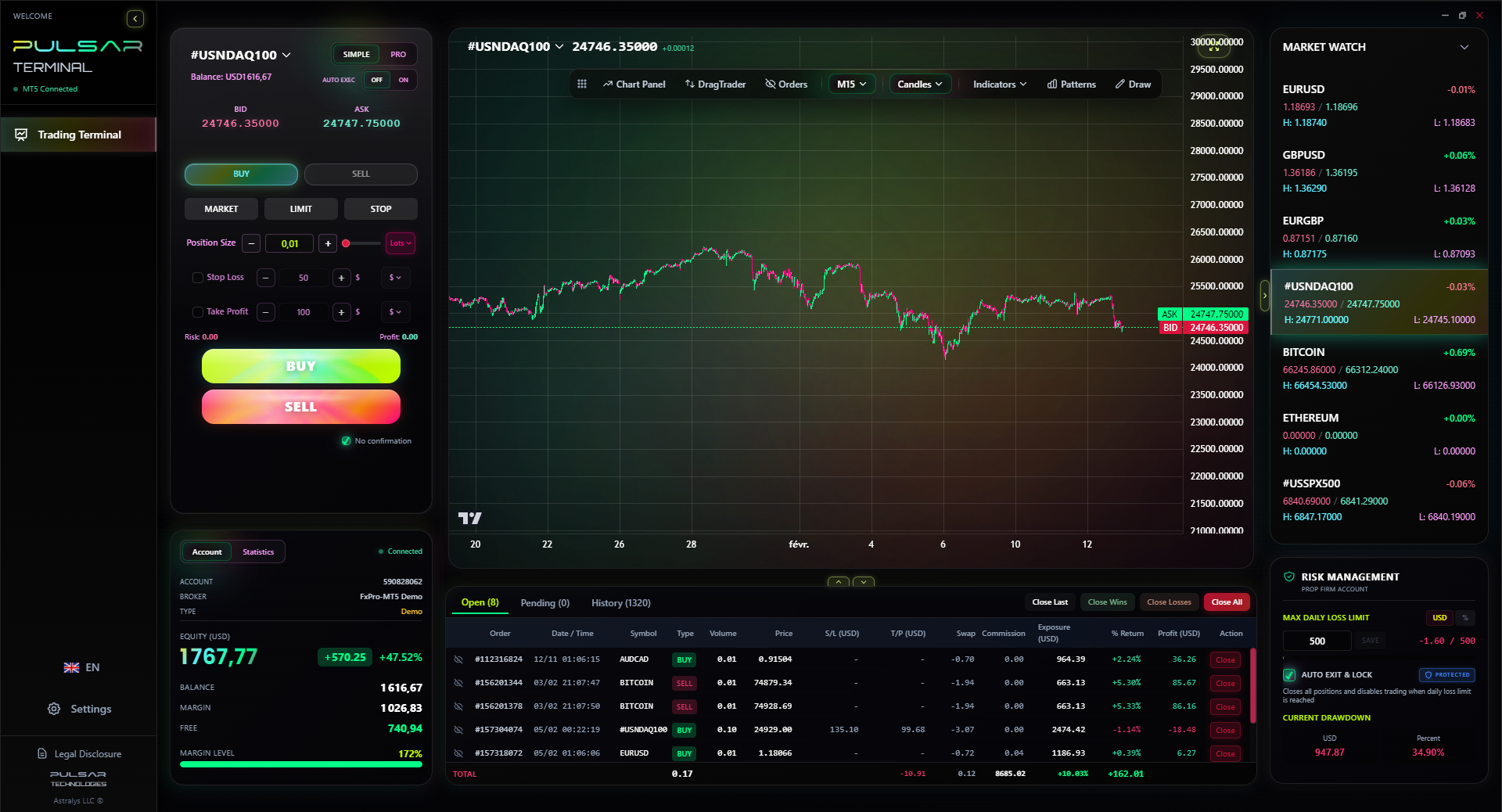
Managing multiple trades and their stop-losses manually is stressful and error-prone, which is where a tool like Pulsar Terminal that automates advanced order management directly on MT5 becomes invaluable.
Pulsar Terminal
La herramienta MT5 todo-en-uno: órdenes drag-and-drop, multi-TP/SL, trailing stop, grid trading, Volume Profile y protección prop firm. Usado por más de 1.000 traders diariamente.
“Your first £500 is tuition, not capital. Expect to learn, not to earn.”
You don't need a complicated system. You need a repeatable process that manages risk. Here's a foundational strategy you can build on.
The 'News & Level' Approach:
- Find the Level: On your EUR/USD or GBP/USD chart, draw a horizontal line at the most recent obvious high and low. These are your rough areas of support and resistance. Price often reacts at these spots.
- Watch the Calendar: Use an economic calendar (your broker provides one). Look for high-impact news for your currency pair - like UK CPI inflation or US Non-Farm Payrolls.
- The Rule: Do not trade the news release itself as a beginner. The volatility is insane and spreads widen massively. Instead, wait. See how the price reacts 15-30 minutes after the news. If it breaks cleanly above a resistance level with strong momentum after a positive UK jobs report, that's a potential long signal. Your stop-loss goes just below the old resistance (now support).
- Add a Filter: Use the MACD indicator on a 1-hour chart. Only take trades in the direction of the MACD histogram (the bars). If it's above the zero line and rising, look for longs. If below and falling, look for shorts. This keeps you trading with the medium-term momentum.
This strategy forces patience, uses clear levels, and avoids the chaos of the news spike. It won't win every time, but it provides a clear framework for decision-making, which is 80% of the battle.
Finally, keep a journal. Write down every trade: the reason, the setup, your emotional state, the outcome. Review it weekly. You'll see your patterns - your real edge and your fatal flaws. My journal showed me I was terrible at trading on Fridays (always tired, impatient). So I made a rule: no new trades after Thursday. It instantly improved my performance.
Forex currency trading for dummies ends the moment you stop reacting and start following a disciplined process. It's a skill, learned one trade, one mistake, one lesson at a time. Good luck.
FAQ
Q1Can I start forex trading in the UK with £100?
Technically, yes. Some FCA brokers like XM or Pepperstone allow very small deposits. But practically, it's extremely difficult. With a 1:30 use cap, your buying power is limited. More importantly, proper risk management (risking 1% per trade) means you'd only risk £1 per trade. After spreads, it's hard to be profitable. I'd recommend at least £500 as a more realistic starting point to learn position sizing properly without being wiped out by a single small loss.
Q2What's the difference between a demo and live account?
The platform is identical. The difference is psychology. On a demo, that £50,000 virtual balance feels like play money. You take reckless trades you never would with real cash. It's useful for learning the buttons, but it doesn't prepare you for the gut-churn of seeing your real money fluctuate. Use a demo to master the platform, then switch to a live account with a small amount of real money to learn the emotional discipline. That's the real battle.
Q3How much time do I need to spend trading each day?
As a beginner, less is more. Don't try to stare at screens for 8 hours. The London session (8am to 5pm) is the most active for GBP pairs. Even just focusing on the first 2-3 hours after the open can provide plenty of opportunity. I found that 1-2 hours of focused analysis and trading was far more productive than a whole day of distracted screen-watching. Quality of attention beats quantity of hours.
Q4Is forex trading taxable in the UK?
Yes, it is. Profits from forex trading are generally subject to Capital Gains Tax (CGT). However, you have an annual tax-free allowance (currently £3,000 for the 2026/27 tax year). Only profits above this allowance are taxable. It's crucial to keep clear records of all your trades for your Self Assessment tax return. If trading becomes your main source of income, it may be considered a business, with different tax implications. Always consult a qualified accountant.
Q5What is a pip, and how much is it worth?
A pip is a 'percentage in point', usually the smallest price move a currency pair can make. For most pairs, it's 0.0001. So a move from 1.2600 to 1.2601 is one pip. Its monetary value depends on your trade size. For a standard lot (100,000 units), 1 pip = $10 for USD-quoted pairs. For a mini lot (10,000 units), 1 pip = $1. For a micro lot (1,000 units), 1 pip = $0.10. You can use a pip calculator to work this out precisely before you trade.
Q6Why do most beginners lose money?
The FCA data showing 70-80% loss rates is real. It's not because the market is rigged, but because beginners approach it wrong. They treat it like gambling, not a skilled profession. They use too much use, trade without a plan, ignore risk management, let emotions drive decisions, and chase losses. The brokers who follow the FCA's rules have to display this statistic for a reason. It's the stark truth to encourage education and caution.
Lección del Prof. Winston
Puntos clave:
- ✓FCA regulation is your #1 priority. Verify the register.
- ✓Never risk more than 1-2% of your account on a single trade.
- ✓The spread is a guaranteed cost; factor it into every plan.
- ✓Use a stop-loss on every trade, no exceptions.
- ✓Keep a trading journal. Your patterns hold the key.
¿Te resultó útil este artículo?
Haz clic en una estrella
Análisis Trading Semanal
Análisis y estrategias semanales gratis. Sin spam.
Sobre el autor
Sarah Collins
Estratega de Trading
Estratega de trading con sede en Londres y 12 años en mercados financieros. Exanalista en una correduría de la City de Londres. Cubre pares GBP, mercados europeos y trading regulado por la FCA.
Comentarios
Aviso de riesgo
El trading de instrumentos financieros conlleva un riesgo significativo y puede no ser adecuado para todos los inversores. El rendimiento pasado no garantiza resultados futuros. Este contenido tiene fines educativos únicamente y no debe considerarse asesoramiento de inversión. Siempre realice su propia investigación antes de operar.
También te puede interesar

Cara Trading Forex Sukses: 7 Prinsip dari Trader Profesional
Cara trading forex sukses dengan 7 prinsip trader pro: manajemen modal, disiplin, journal trading, backtest. Data nyata, bukan janji profit palsu.
Jam Trading Forex Terbaik untuk Trader Indonesia: Panduan Lengkap dengan Tabel Waktu
Panduan jam trading forex untuk trader Indonesia. Tabel 4 sesi dunia, jam emas 20:00-00:00, sesi mana yang harus dihindari. Data akurat + tips dari trader berpengalaman.
Top 5 Sàn Forex Uy Tín Nhất 2026: Review Jujur dari Trader Indonesia
Top 5 sàn forex uy tín 2026 untuk trader Indonesia. Review jujur: spread, deposit, withdraw, dukungan lokal. Exness, XM, IC Markets & lebih.
Obtener Pulsar Terminal
Todas estas calculadoras están integradas en Pulsar Terminal con datos en tiempo real de su cuenta MT5.
Obtener Pulsar Terminal