


Most people think a winning forex day trading strategy is about finding a secret indicator or a fancy robot.
Sarah Collins
Estratega de Trading ·  United Kingdom
☕ 10 min de lectura
Lo que aprenderás:
Most people think a winning forex day trading strategy is about finding a secret indicator or a fancy robot. They're wrong. The real secret is understanding the UK's specific rules, your actual costs, and having the discipline to follow a simple plan. I've watched too many traders in London blow up accounts chasing complexity. Let's strip it back to what actually works here, with the FCA watching over your shoulder.
Trading in the UK isn't the wild west. The Financial Conduct Authority (FCA) sets the rules, and if you don't know them, you're already at a disadvantage. This isn't about bureaucracy, it's about your risk parameters being defined for you before you even place a trade.
The big one is use. You can't just crank it up to 1:500 like you might see advertised offshore. For major pairs like GBP/USD, you're capped at 1:30. For gold (XAU/USD), it's 1:20. This feels restrictive if you're used to gambling with high use, but honestly, it's the best thing that ever happened to most retail traders. It forces you to think about position size properly. You can't just throw a tiny £100 in and pretend you're a hedge fund manager.

Warning: Trading with an unregulated broker to get higher use is asking for trouble. You lose FCA protections like negative balance protection (so you could owe more than you deposited) and segregated client funds. It's not worth it.
The good news? The US Pattern Day Trader (PDT) rule doesn't apply here. You don't need £20,000 in your account to day trade frequently. You can start small, which is how you should learn. Also, remember that while forex trading profits are generally subject to Capital Gains Tax, spread betting on forex is currently tax-free. That's a uniquely UK consideration that changes your profit calculation.
The Cost of Doing Business
Your strategy's profitability lives and dies by your costs. Here’s the real breakdown with FCA brokers:
- Spreads: This is your main fee. On a standard account, expect EUR/USD around 0.9-1.4 pips, and GBP/USD 0.9-2.0 pips. It varies by broker and time of day.
- Commissions: On a 'raw spread' or professional account, you might pay a commission per lot. For example, Pepperstone charges £2.25 per lot on MT4/5. You need to factor this into every single trade plan.
- The Brutal Statistic: Brokers must disclose that between 61% and 89% of retail clients lose money. That's not a disclaimer, it's a reality check. Your strategy must overcome this built-in edge for the house (the spread).

💡 Consejo de Winston
The London open isn't a starting gun for you to trade. It's a data-gathering period. Watch for the first 90 minutes to see where the real liquidity and direction are, then act.
Forget the Lamborghini ads. Day trading is a grind. It's a skill job, like being a plumber or a carpenter, but your tools are charts and your own psychology. The market doesn't care about your mortgage payment or your ego.
I made every mistake early on. I'd turn a £200 profit into a £500 loss because I couldn't accept I was wrong. I'd revenge trade after a loss, trying to win it back immediately. It's embarrassing to admit, but I once lost 40% of my account in a single afternoon trading GBP/JPY news. I broke every rule I now teach. The mindset isn't about being right; it's about being disciplined when you're wrong.
Your goal isn't to win on every trade. It's to have a positive expectancy over 100 trades. That means rock-solid risk management is your strategy's foundation. If you don't have an ironclad rule for where your stop loss goes before you enter, you're not trading, you're hoping. Use a position size calculator for every single trade. No exceptions.

Pro Tip: Your daily goal should be to execute your plan perfectly, not to make a certain amount of money. The money comes as a byproduct of good process. On days I focused on the money, I usually lost. On days I focused on the process, I often ended up in profit.
“Your stop loss isn't a suggestion. It's the price where you admit your idea was wrong, and paying for that admission is the cost of doing business.”
You don't need 10 indicators. This is the core forex day trading strategy I've used for years and teach my students. It works because it's based on structure, not noise.
Timeframes: Use the 1-Hour (1H) chart for direction and key levels. Use the 15-Minute (15M) chart for your actual entry signals. This keeps you trading with the higher-timeframe trend, which statistically gives you a better chance.
Step 1: Find the 1H Trend & Key Levels. Is the price making higher highs and higher lows (uptrend) or lower highs and lower lows (downtrend)? Draw horizontal lines at the most recent obvious swing highs and swing lows. These are your support and resistance areas. Don't overcomplicate it.
Step 2: Wait for Price to Reach a Key Level on the 1H. In an uptrend, you want to look for buys near support. In a downtrend, look for sells near resistance. This is where the market often pauses or reverses.
Step 3: Switch to the 15M Chart for an Entry Signal. You're looking for price action confirmation that the level is holding. My favourite is a false break or a rejection candle.
- False Break: Price spikes through the support/resistance level briefly, then closes back on the original side. This traps weak-handed traders.
- Rejection Candle: A pin bar (wick is much longer than the body) or an engulfing candle that forms right at the level.
Step 4: Entry, Stop Loss, Take Profit.
- Entry: Place your order a few pips beyond the tip of the confirmation candle's wick (for a false break) or on a break of the high/low of the rejection candle.
- Stop Loss: Place it on the other side of the key level. If buying at support, put your stop below the recent swing low. Your risk should be predefined (e.g., 1% of account).
- Take Profit: Aim for a risk-to-reward ratio of at least 1:1.5. If your stop is 30 pips away, your target should be 45 pips minimum. You can use a multi-TP approach, taking half off at 1:1 and letting the rest run.
Real Trade Example (GBP/USD): On 12th March, GBP/USD was in a clear 1H uptrend. It pulled back to a prior support level at 1.2740. On the 15M chart, it made a sharp spike down to 1.2735 and immediately rocketed back up, closing the 15M candle above 1.2745. That was the false break. I entered long at 1.2750. Stop loss at 1.2720 (30 pips). First take profit at 1.2795 (45 pips, 1:1.5). Price hit my first TP in a few hours. I moved my stop to breakeven and the trade eventually ran another 60 pips. That's the process.
💡 Consejo de Winston
Your most expensive indicator is the one you don't understand. If you can't explain in plain English why an RSI of 67.4 means 'buy', you shouldn't be using it.
Your strategy is only as good as your ability to execute it. In the UK, you have access to some of the world's best brokers, but they're not all the same.
Stick with FCA-regulated brokers. Full stop. I've reviewed most of them. For raw spreads and fast execution, Pepperstone and IC Markets are top-tier for active day traders. Their Razor/RAW accounts offer spreads from 0.0 pips with a commission. For beginners, XM or Exness offer more user-friendly standard accounts with no commissions, but the spreads are wider. You need to decide which cost structure suits your forex day trading strategy – lots of small trades favour raw spreads, fewer trades might be okay with a wider spread.
| Broker Type | Best For | Typical EUR/USD Spread | Key Consideration |
|---|---|---|---|
| Raw Spread/ECN | Scalpers, high volume | 0.0 - 0.3 pips + commission | Lower per-trade cost, but commission adds up. |
| Standard/STP | New traders, swing traders | 0.9 - 1.5 pips, no commission | Simpler cost, but wider spread eats into small moves. |
Platforms: MetaTrader 4 (MT4) is still the king for a reason. It's stable, ubiquitous, and has every indicator you'll ever need. MT5 is more powerful for multi-asset trading. TradingView is fantastic for analysis and idea generation. Many UK brokers like IG and CMC have excellent proprietary platforms too. Choose one and learn it inside out.
Execution speed matters. During the London open (8 AM GMT), spreads can widen and slippage can happen. If your strategy involves trading the open, use limit orders instead of market orders to control your entry price. A 2-pip slippage on entry can ruin your risk/reward on a tight trade.
“Overtrading is the desperate act of a trader who confuses activity with achievement.”
This is the chapter that saves your account. You can have a mediocre strategy and good risk management and survive. You can have a brilliant strategy and poor risk management and you will blow up. I've seen it a hundred times.
- 1% Rule: Never, ever risk more than 1% of your trading account capital on a single trade. If you have a £5,000 account, that's £50 max risk per trade. This is non-negotiable. It means you can survive a losing streak of 20 trades and only be down 20%. It happens.
- Daily Loss Limit: Set a hard stop for your day. I use 3%. If I lose 3% of my account in a day, I shut down the platform. Go for a walk. This prevents a bad day from turning into a catastrophic week. This is crucial for passing prop firm challenges too.
- Use a Stop Loss. Always. Your stop loss is your lifeline. It's not a suggestion. Place it at a logical technical level where your trade idea is proven wrong. If you can't find that level, you shouldn't be in the trade.
- Position Size Religiously: Don't guess. Calculate. If your stop loss is 25 pips away on GBP/USD, and you can only risk £50, your position size is NOT 1 standard lot. You need to work it out. (Risk in £ / (Stop in pips * Pip value)). This is where most new traders fail immediately.

Example: Account: £10,000. Risk per trade: 1% = £100. Trade: Sell EUR/USD. Stop Loss: 30 pips above entry. Pip value for 1 lot (€100,000) on EUR/USD is roughly $10 (approx £8 depending on GBP/USD rate). To find max position size: £100 / (30 pips * £8 per pip) = 0.41 lots. So, you'd sell 0.41 lots (or 41,000 units).
Let me be blunt: if you skip these steps because you're "sure" the trade will work, you are gambling. The market will punish that arrogance. I know because it punished mine.
💡 Consejo de Winston
A losing trade that hit your stop loss is a successful trade. You executed your plan. A winning trade where you ignored your rules is a failure, regardless of the profit. Judge your process, not your P&L.
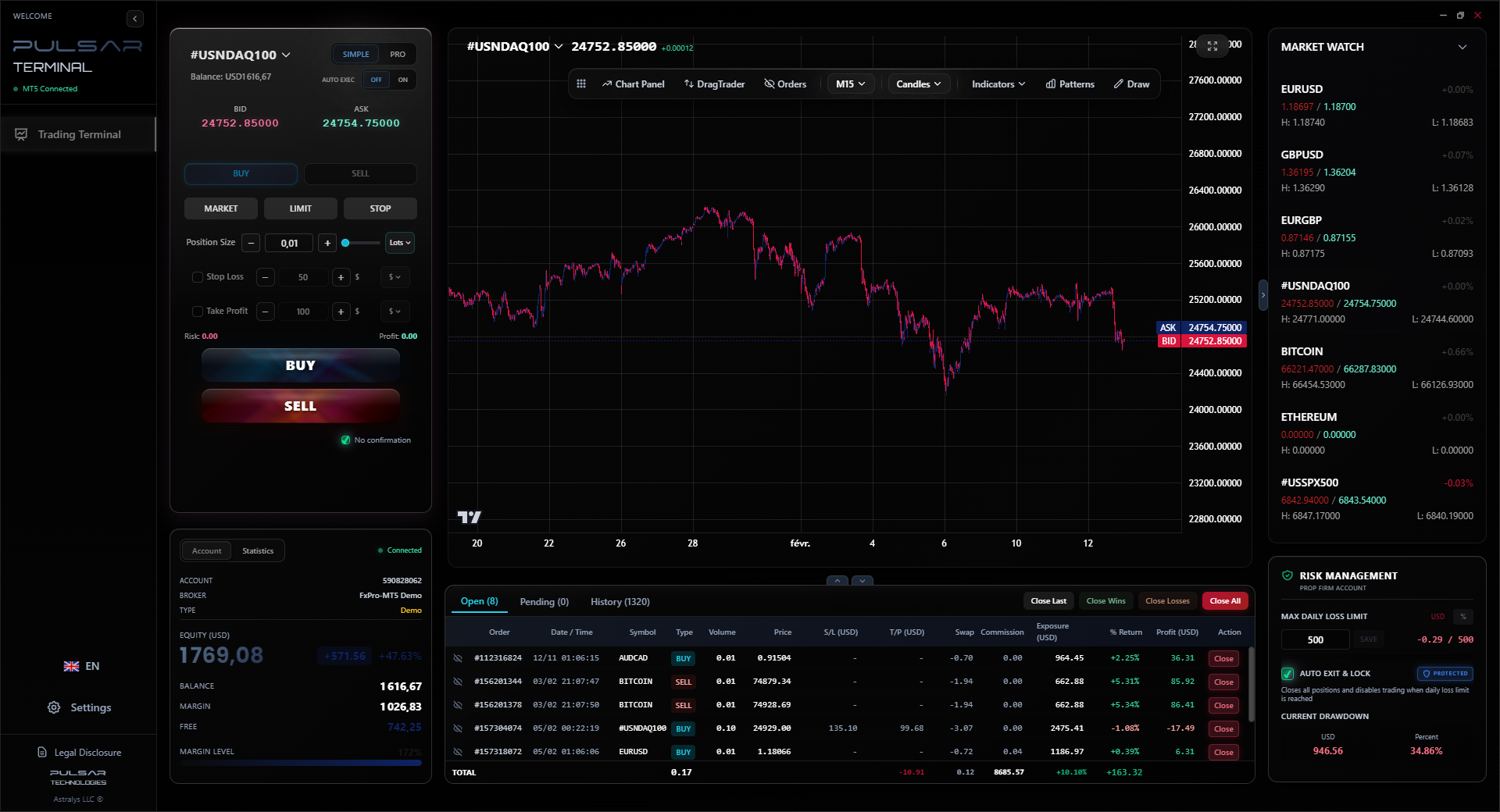
Managing multiple take-profit levels and moving stops to breakeven manually is a hassle; Pulsar Terminal automates these advanced order types directly on your MT5 chart.
Pulsar Terminal
La herramienta MT5 todo-en-uno: órdenes drag-and-drop, multi-TP/SL, trailing stop, grid trading, Volume Profile y protección prop firm. Usado por más de 1.000 traders diariamente.
Let's diagnose the classic losing moves so you don't have to make them yourself.
Overtrading: This is the #1 killer. You take trades that aren't in your plan because you're bored or want to 'get back' at the market. Your forex day trading strategy should have clear conditions. If they aren't met, you do nothing. Some of my most profitable days are when I take only 1 or 2 trades.
Chasing the Market: You see EUR/USD rocket up 50 pips and FOMO in near the top, just in time for the pullback. Your entry is terrible, your stop is huge, and you're nervous immediately. Wait for the pullback and a proper setup. The market will always give you another opportunity.
Ignoring the Economic Calendar: Trading major news like US Non-Farm Payrolls or a BOE rate decision without a plan is Russian roulette. Spreads widen to 10+ pips, execution is terrible, and price can spike violently. Either have a specific high-volatility strategy for news, or stay out. I stay out.
Over-Reliance on Indicators: Stacking the RSI indicator, MACD indicator, Bollinger Bands, and Stochastic on your chart creates confusion, not clarity. They all lag price. Pick one or two to complement your price action, not dictate it. I often use just a single moving average to define dynamic support/resistance and nothing else.
Not Keeping a Journal: If you're not writing down every trade - entry, exit, reason, emotion, screenshot - you're not improving. You're repeating errors. My journal showed me I had a 60% win rate on trades taken before 11 AM GMT, and a 35% win rate on trades taken after 3 PM. That data changed my entire schedule.
FAQ
Q1What's the minimum amount needed to start day trading forex in the UK?
Technically, many FCA brokers like Pepperstone or XM have no minimum deposit. But realistically, you need enough to manage risk properly. With 1:30 use, a £500 account means your position sizes will be tiny, and the spread becomes a huge percentage of your target. I'd say £2,000 is a more practical starting point to feel the effects of proper position sizing without being wiped out by a few losses.
Q2Is forex day trading tax-free in the UK?
Trading forex CFDs is not tax-free. Profits are generally subject to Capital Gains Tax (CGT), though you have an annual tax-free allowance (£3,000 in 2024/25). However, spread betting on forex with a UK broker is currently free from Capital Gains Tax and Income Tax. This is a significant UK advantage, but spread betting comes with its own product nuances and risk.
Q3What are the best times to day trade forex in the UK?
The London session (8 AM to 5 PM GMT) is the most liquid for GBP pairs. The overlap with the US session (1 PM to 5 PM GMT) is often the most volatile and best for trends. The Asian session (midnight to 8 AM GMT) is typically slow and range-bound. I find the first 2-3 hours after the London open offer the cleanest setups.
Q4Can I use US-style scalping strategies with UK use limits?
Yes, but you have to adapt. High-frequency scalping that relies on 1:500 use to make 5-pip profits on micro lots won't translate well. Your scalping strategy needs to account for the higher relative cost of the spread and commission. You'll need slightly larger targets or incredibly precise entries. The 1:30 use forces better trade selection.
Q5How many pairs should I focus on as a beginner?
Q6Do I need a VPS to day trade from the UK?
If you're using fully automated strategies (Expert Advisors), then yes, a Virtual Private Server near your broker's data centre is essential for stability and speed. If you're a discretionary manual trader placing a few trades a day, a reliable home internet connection is perfectly fine. Don't waste money on a VPS thinking it's a magic bullet for execution.
Lección del Prof. Winston
Puntos clave:
- ✓Risk max 1% per trade, always.
- ✓FCA rules (like 1:30 use) define your battlefield.
- ✓Use higher timeframe (1H) trend to filter 15M entries.
- ✓A trade journal is your only path to improvement.
- ✓The spread is your enemy; factor it into every target.
¿Te resultó útil este artículo?
Haz clic en una estrella
Análisis Trading Semanal
Análisis y estrategias semanales gratis. Sin spam.
Sobre el autor
Sarah Collins
Estratega de Trading
Estratega de trading con sede en Londres y 12 años en mercados financieros. Exanalista en una correduría de la City de Londres. Cubre pares GBP, mercados europeos y trading regulado por la FCA.
Comentarios
Aviso de riesgo
El trading de instrumentos financieros conlleva un riesgo significativo y puede no ser adecuado para todos los inversores. El rendimiento pasado no garantiza resultados futuros. Este contenido tiene fines educativos únicamente y no debe considerarse asesoramiento de inversión. Siempre realice su propia investigación antes de operar.
También te puede interesar

Cara Trading Forex Sukses: 7 Prinsip dari Trader Profesional
Cara trading forex sukses dengan 7 prinsip trader pro: manajemen modal, disiplin, journal trading, backtest. Data nyata, bukan janji profit palsu.
Jam Trading Forex Terbaik untuk Trader Indonesia: Panduan Lengkap dengan Tabel Waktu
Panduan jam trading forex untuk trader Indonesia. Tabel 4 sesi dunia, jam emas 20:00-00:00, sesi mana yang harus dihindari. Data akurat + tips dari trader berpengalaman.
Top 5 Sàn Forex Uy Tín Nhất 2026: Review Jujur dari Trader Indonesia
Top 5 sàn forex uy tín 2026 untuk trader Indonesia. Review jujur: spread, deposit, withdraw, dukungan lokal. Exness, XM, IC Markets & lebih.
Obtener Pulsar Terminal
Todas estas calculadoras están integradas en Pulsar Terminal con datos en tiempo real de su cuenta MT5.
Obtener Pulsar Terminal