


You're looking for a forex education site, right? You want to learn how to trade, make some extra Naira, maybe even replace your 9-to-5.

Olumide Adeyemi
Pionero del Trading en África Occidental ·  Nigeria
☕ 8 min de lectura
Lo que aprenderás:
You're looking for a forex education site, right? You want to learn how to trade, make some extra Naira, maybe even replace your 9-to-5. I get it. The internet is flooded with 'gurus' promising Lamborghinis from a $100 account. But here's the brutal truth most of those sites won't tell you: 90% of retail traders lose money. The real purpose of a good forex education site isn't to sell you a dream. It's to teach you how to not blow up your account. Let's cut through the noise.
In Nigeria, the search for a forex education site is a minefield. You've got the Instagram traders with rented supercars, the WhatsApp groups promising 100% monthly returns, and the 'masterclasses' that cost more than your monthly salary. The first lesson any real education should teach is skepticism.
I learned this the hard way early on. I paid 150,000 Naira for a 'signals service' from a popular 'mentor'. The first week, they hit three trades. I felt like a genius. The next month, a single bad EUR/USD call wiped out my entire profit and 30% of my capital. The mentor vanished from the group. That was my tuition fee for learning that paid signals are a crutch, and a broken one at that. A real forex education site should make you independent, not keep you on a leash.

Warning: If a 'educator' focuses more on their lifestyle (cars, watches, stacks of cash) than on charts, risk graphs, and losing trades, run. They are selling an aspiration, not a skill.
The local context matters. You need education that understands Naira volatility, how to fund international brokers from Nigeria, and the psychological pressure of trading when 'urgent 2k' messages are popping up. A generic, one-size-fits-all course from the US or UK often misses these critical, stress-inducing details.
“The real purpose of a good forex education site isn't to sell you a dream. It's to teach you how to not blow up your account.”
Forget fancy indicators with flashy names. The core of any legitimate forex education site is brutally simple, and frankly, a bit boring. If the curriculum doesn't hammer these points, it's worthless.
Risk Management is Not a Suggestion
This is the hill I will die on. You can have a mediocre trading strategy with impeccable risk management and survive. You can have a genius strategy with poor risk management and you will blow up. Period. Education must drill into you: never risk more than 1-2% of your account on a single trade. Use a position size calculator for every single entry. Understand what a margin call is and how to avoid it like a plague.
I once broke my own rule during the Brexit vote. Convinced the GBP/USD would snap back, I threw 5% of my account at it. It didn't snap back. I watched in horror as it kept falling, my loss ballooning. That one emotional decision set me back three months of careful profits. The lesson was more valuable than any winning trade.
Understanding Price, Not Predictions
Good education teaches you to read price action and market structure - where are the support and resistance zones? What does a trend actually look like? It moves you away from 'the EUR/USD will go up tomorrow' to 'if price holds above this level, I may look for a long opportunity.' This is the difference between gambling and trading. Tools like the RSI indicator or MACD indicator should be taught as context providers, not crystal balls.
The Psychology of Losing Your Money
This is the most overlooked part. A proper site will spend as much time on fear, greed, and revenge trading as it does on chart patterns. Can you take 3 losing trades in a row and stick to your plan? Most can't. That's why they fail. Education should give you frameworks for handling loss, not just chasing profit.

💡 Consejo de Winston
The market's primary function is to transfer wealth from the impatient to the patient. Your education should teach you how to be the latter.
“You can have a mediocre trading strategy with impeccable risk management and survive. You can have a genius strategy with poor risk management and you will blow up.”
Let's talk money. Should you pay for a forex education site? Sometimes, yes. But you must know what you're paying for.
The Free Route: You can build a solid foundation for free. Broker education centers (like those from Exness or IC Markets) have decent basics on currency pairs, what a pip is, and how spreads work. YouTube has countless hours of chart analysis. The problem? It's fragmented, unstructured, and you don't know who to trust. You'll waste hundreds of hours sifting through garbage.
The Paid Route: You're paying for structure, mentorship, and community. A good paid course should offer:
- A clear, logical progression from A to Z.
- Direct access to the educator for Q&A (not just a pre-recorded video).
- A focus on developing your own trading plan, not copying theirs.
- A community of serious traders, not a hype-filled signal group.

Pro Tip: Before paying for any course, ask for a detailed curriculum. If it's vague ('Module 3: Making Millions'), avoid it. If it's specific ('Module 3: Building a Swing Trading Plan, Position Sizing, Journaling'), that's a better sign. Also, search the educator's name + 'scam' or 'complaint' online. Do your homework.
My rule? Never pay for promises of income. Pay for clarity of education. The value is in the time it saves you from costly mistakes.
“Never pay for promises of income. Pay for clarity of education.”
Our market has its own unique flavor of scams. Know these signs to avoid losing your hard-earned money.
- The 'Prop Firm Challenge' Bypass: Someone offers to 'manage' your prop firm challenge for a fee, guaranteeing passage. This is almost always a scam. If they were that good, they'd use their own capital. Prop firms like FTMO have strict rules against this, and you'll get banned.
- The WhatsApp/Telegram Pump: You're added to a group where a 'guru' posts screenshot after screenshot of winning trades, often in demo accounts made to look real. They create fear of missing out (FOMO) to sell you an overpriced course or signals. Real traders don't have time to screenshot every win.
- The 'Secret Indicator' or 'Robot': For a one-time payment of 50k Naira, you get the holy grail that prints money. It doesn't exist. If it did, why would they sell it? I bought one early on. It worked beautifully in back-tests and failed miserably in real market conditions. The market adapts; static robots don't.
- Pressure to Deposit with a Specific 'Broker': Often, these 'brokers' are unregulated bucket shops. The educator gets a kickback from your losses. Always choose reputable, globally regulated brokers yourself. Do your own reviews on sites like ours for XM or Pepperstone.
A real forex education site will encourage you to practice on a demo account for months. A scam will rush you to deposit real money to 'start making profits now.'
💡 Consejo de Winston
If you can't explain your trade's risk (in Naira) before you enter it, you're not trading. You're donating.
“Never pay for promises of income. Pay for clarity of education.”
You don't need one perfect site. You need a curated toolkit. Here’s a step-by-step path I wish I had from day one.
Phase 1: Foundation (Months 1-2)
- Goal: Understand the mechanics, not make money.
- Actions: Read the free basics from major brokers. Learn the terminology (pip, spread, lot size, margin). Open a demo account and just watch price move. Don't trade yet. Pick one major pair like EUR/USD and one commodity like XAU/USD to focus on.
Phase 2: Strategy & Risk (Months 3-4)
- Goal: Develop and test a single, simple strategy.
- Actions: Choose one approach - maybe price action swing trading or a very disciplined scalping strategy. Learn it deeply from one or two credible sources. On your demo, practice the position size calculator for every trade. Your only metric here is consistency to your rules, not profit.
Phase 3: Psychology & Live Execution (Months 5-6+)
- Goal: Transition to a tiny live account without self-destructing.
- Actions: Fund a live account with money you can afford to lose completely - maybe 20,000 Naira. Trade your strategy with 0.01 micro lots. The goal is to feel the emotion of real profit and loss. Keep a detailed trading journal. This phase is about managing yourself, not the market.
This slow, boring approach is what the get-rich-quick sites hate. Because it works, and it doesn't make them any money upfront.
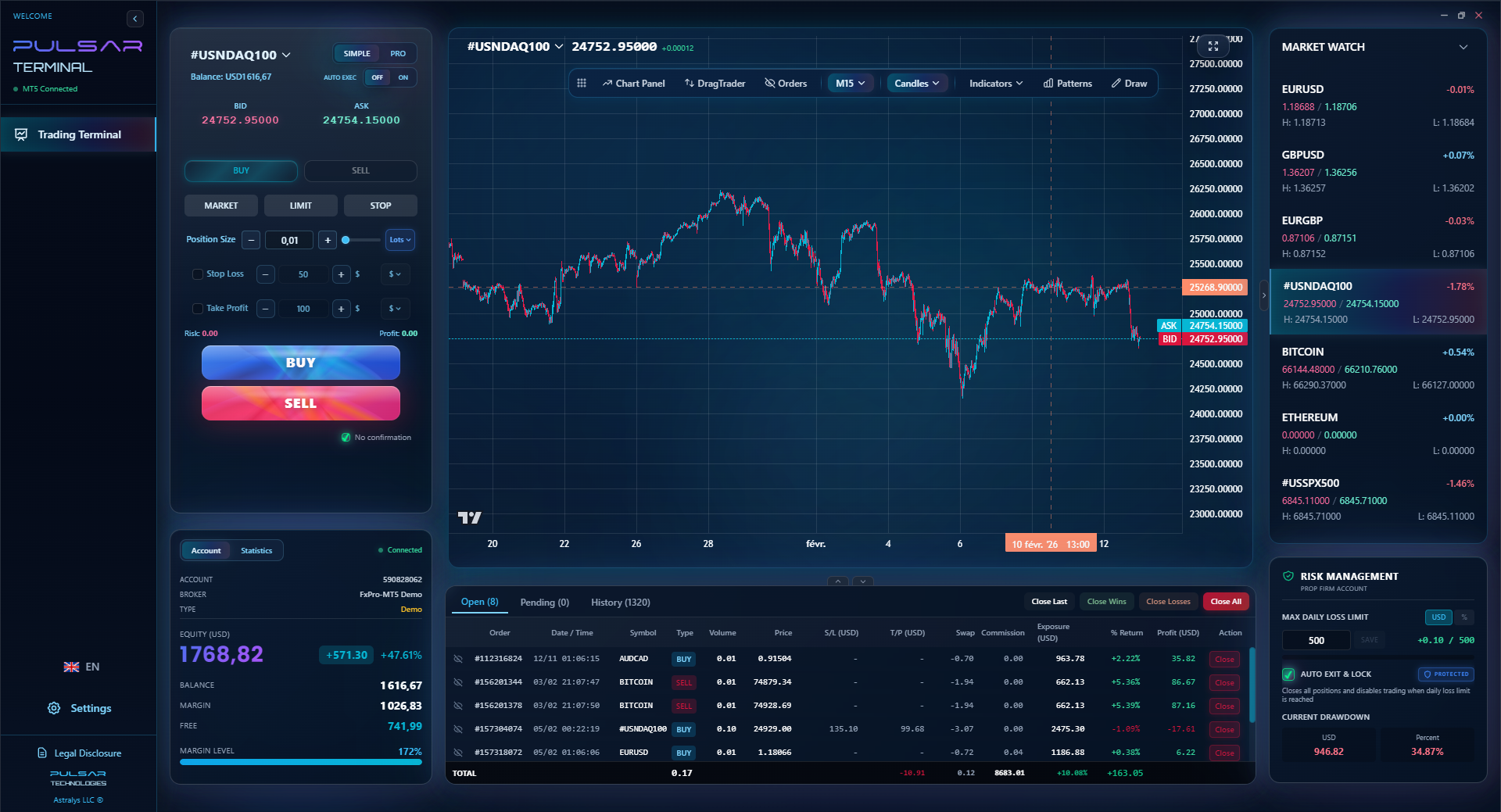
Manually managing complex trades and precise risk on every entry is where most errors happen; a tool like Pulsar Terminal automates this with drag-and-drop orders and multi-TP/SL management directly on your MT5 charts.
Pulsar Terminal
La herramienta MT5 todo-en-uno: órdenes drag-and-drop, multi-TP/SL, trailing stop, grid trading, Volume Profile y protección prop firm. Usado por más de 1.000 traders diariamente.
“The slow, boring approach is what the get-rich-quick sites hate. Because it works.”
Finally, the right tools separate the serious trader from the hopeful gambler. Your forex education site should teach you how to use these, not just flashy indicators.
A trading platform is your cockpit. You need to know how to place orders, set stops, and manage trades efficiently. Manual trailing stops are a pain. Manually calculating a 1% risk on every trade is tedious and prone to error. This is where technology becomes a force multiplier, not a crutch.

Example: Let's say you have a 100,000 Naira account (about $65). Your risk per trade is 1% (1,000 Naira). Your stop-loss on a USD/NGN trade is 50 pips. Your position size must be calculated precisely to ensure a 50-pip loss equals 1,000 Naira, not more. Doing this manually for every trade is how mistakes happen.
The community aspect is also crucial. But find a community that discusses losses, analyzes bad trades, and shares journal entries. Avoid groups that just post profit screenshots. The former improves you; the latter just fuels your insecurity and greed.
Remember, education is continuous. The market changes. Your education should be a lifelong process of refinement, not a one-time purchase of a 'secret system.'
💡 Consejo de Winston
A losing trade you followed your plan on is better education than a winning trade you took on a whim. Journal them both.
FAQ
Q1What is the best forex education site for beginners in Nigeria?
There's no single 'best' site. Look for one that starts with risk management and psychology, uses relatable examples (maybe even involving Naira pairs), and doesn't promise easy money. Combine free broker resources with a structured, paid course from a credible educator who emphasizes demo trading first.
Q2Are free forex signals a good form of education?
No, they are the opposite of education. They create dependency. You learn nothing about why a trade was taken, how to manage it, or how to find the next one. They are a shortcut that leads to a dead end. Real education teaches you to fish.
Q3How much should I pay for a forex trading course in Nigeria?
Prices vary wildly. A solid, complete course from a reputable international educator might cost $500-$2000. Be wary of courses priced in millions of Naira promising guaranteed returns - that's a scam flag. Value is in content and support, not price tag. Sometimes a $200 course focused on one skill (like price action) is better than a $1000 'everything' course that's shallow.
Q4Can I learn forex trading successfully only from free online materials?
It's possible, but extremely difficult and time-consuming. You'll face information overload and conflicting advice. Free materials are great for basics, but paying for a structured course with mentorship can save you years of trial and error - and thousands of dollars in lost tuition paid to the market.
Q5How long does it take to become a profitable trader after starting my education?
Assume a minimum of 6-12 months of dedicated, full-time equivalent learning and practice on demo/live accounts. Anyone telling you it takes '30 days' is lying. It's a skill like any other. You wouldn't expect to become a surgeon or a pilot in a month. Trading is no different.
Q6What's the biggest mistake Nigerians make when choosing a forex education site?
Letting emotion and the desire for quick money override logic. They choose the site with the flashiest car in the promo video, not the one with the most detailed curriculum. They prioritize 'signals' over 'risk management modules.' They want a magic bullet, not a textbook.
Lección del Prof. Winston
Puntos clave:
- ✓Risk over 2% per trade is a recipe for ruin.
- ✓Demo trade for 3 months minimum. No exceptions.
- ✓A detailed trading journal is your best teacher.
- ✓Choose education that focuses on losses, not just profits.
¿Te resultó útil este artículo?
Haz clic en una estrella
Análisis Trading Semanal
Análisis y estrategias semanales gratis. Sin spam.
Sobre el autor
Olumide Adeyemi
Pionero del Trading en África Occidental
Uno de los educadores de trading forex más activos de Nigeria. 8 años de experiencia operando desde Lagos. Especialista en estrategias de bajo capital y desafíos de prop firms para traders africanos.
Comentarios
Aviso de riesgo
El trading de instrumentos financieros conlleva un riesgo significativo y puede no ser adecuado para todos los inversores. El rendimiento pasado no garantiza resultados futuros. Este contenido tiene fines educativos únicamente y no debe considerarse asesoramiento de inversión. Siempre realice su propia investigación antes de operar.
También te puede interesar

Cara Trading Forex Sukses: 7 Prinsip dari Trader Profesional
Cara trading forex sukses dengan 7 prinsip trader pro: manajemen modal, disiplin, journal trading, backtest. Data nyata, bukan janji profit palsu.
Jam Trading Forex Terbaik untuk Trader Indonesia: Panduan Lengkap dengan Tabel Waktu
Panduan jam trading forex untuk trader Indonesia. Tabel 4 sesi dunia, jam emas 20:00-00:00, sesi mana yang harus dihindari. Data akurat + tips dari trader berpengalaman.
Top 5 Sàn Forex Uy Tín Nhất 2026: Review Jujur dari Trader Indonesia
Top 5 sàn forex uy tín 2026 untuk trader Indonesia. Review jujur: spread, deposit, withdraw, dukungan lokal. Exness, XM, IC Markets & lebih.
Obtener Pulsar Terminal
Todas estas calculadoras están integradas en Pulsar Terminal con datos en tiempo real de su cuenta MT5.
Obtener Pulsar Terminal