


I lost $1,200 in a single afternoon back in 2017.

Olumide Adeyemi
Pionero del Trading en África Occidental ·  Nigeria
☕ 10 min de lectura
Lo que aprenderás:
I lost $1,200 in a single afternoon back in 2017. Not from a bad trade, but from a simple misunderstanding of how the Nigerian forex exchange really works. I’d taken a nice profit on GBP/USD, tried to withdraw my Naira, and got absolutely hammered by hidden fees and a terrible conversion rate from my broker’s ‘convenient’ payment processor. The profit I thought I had? Gone. That’s when I learned that in Nigeria, your trading strategy is only half the battle. The other half is navigating the local realities of getting your money in and out. This guide is what I wish I’d had.
Let's get this straight first. Trading forex as an individual in Nigeria is legal. You won't get a knock on your door from EFCC for placing a buy order on EUR/USD. However, the regulatory framework for the brokers serving you is a bit of a wild west. The Central Bank of Nigeria (CBN) and the Securities and Exchange Commission (SEC) are the big players, but they don't directly license the international retail brokers you're probably using.
What this means for you is crucial. You are almost certainly opening an account with a broker regulated outside Nigeria - think the UK's FCA, Australia's ASIC, or Cyprus's CySEC. This isn't necessarily bad; it often means better technology and tighter spreads. But it does place the onus on you to verify that broker's offshore license. Never, ever deposit money with a "broker" that only has a fancy Lagos office address and no verifiable international regulation. That's a one-way ticket to losing your capital.
The CBN has been busy. They introduced the Nigeria Foreign Exchange Code in late 2024, which is aimed more at banks and big financial institutions to clean up the wholesale market. For you, the retail trader, the key takeaway is the continued push for a unified exchange rate. The old days of a huge gap between the official CBN rate and the parallel market rate are (slowly) closing. As of early 2026, that gap is surprisingly narrow, which is good news for the real value of your withdrawals.
Forget the advertised spreads for a second. Your total cost of trading in Nigeria has multiple layers, and if you ignore any of them, they'll eat your account.
Broker Fees: The Obvious Stuff
This is your spread and commissions. On a decent ECN account, you can get EUR/USD spreads from 0.0 pips, but you'll pay a commission, usually around $3-$7 per round lot (100,000 units). For a broker like IC Markets, that's a fair deal for the raw market access. Some brokers, like Exness, offer crazy high use and tight spreads, which is tempting but dangerous if you don't manage your risk with a solid position size calculator.

Example: You buy 1 lot of EUR/USD on an ECN account with a 0.1 pip spread and a $3.50 commission per side.
- Spread Cost: 0.1 pip * $10 per pip = $1
- Commission to Open: $3.50
- Commission to Close: $3.50 Total Transaction Cost: $8.00 Your trade needs to move 0.8 pips in your favor just to break even on costs.
The Hidden Killer: Funding Your Account
This is where my $1,200 lesson happened. You deposit Naira, your broker converts it to USD (or EUR) to trade. You profit in USD, then convert back to Naira to withdraw. Each conversion has a cost, often buried in a poor exchange rate.
Let me give you a real example from last year. I needed to fund a $500 account. The official CBN rate was roughly ₦1,380/$. My broker's payment processor offered me a rate of ₦1,425/$. That's a 3.3% fee right off the top. To deposit $500, I paid an extra ₦22,500. When I withdrew $600 in profit later, they used a rate of ₦1,360/$, another haircut. I lost money on the round trip despite a winning trade. Always, always check the actual conversion rate your payment method is using before you click 'deposit'.
Taxes and Swaps
Yes, you owe tax. The FIRS expects a 10% Capital Gains Tax on your gross trading profits. Keep detailed records. Also, pay attention to swap fees (overnight financing). Holding a USD/JPY position overnight can cost or earn you money depending on the interest rate differential. With Nigeria's interest rate at 26.5% as of early 2026, this can get complex if you're trading exotic pairs involving NGN (which you generally shouldn't be doing as a retail trader).

💡 Consejo de Winston
Your broker's conversion rate is a hidden fee. Always calculate the effective rate (NGN you paid / USD you received) and compare it to the official NFEM rate. A difference over 2% is a red flag.
“In Nigeria, your trading strategy is only half the battle. The other half is navigating the local realities of getting your money in and out.”
You'll see ads promising "1:2000 use!" and "₦4000 Minimum Deposit!". Ignore the hype. Here’s what to actually look for.
Regulation is Non-Negotiable. Your broker must be regulated by a reputable foreign authority. I prefer those with ASIC (Australia) or FCA (UK) licenses, even if they serve Nigerians through a global entity. Brokers like Pepperstone (regulated by CMA Kenya) and XM (global regulation) have established reputations. This is your first line of defense if something goes wrong.
Deposit and Withdrawal Methods. This is the make-or-break for Nigerian traders. The best broker in the world is useless if you can't get your money in or out efficiently. Look for brokers that support:
- Local Bank Transfer: In Naira. This is usually the cheapest.
- Debit/Credit Cards: Visa/Mastercard. Transactions are fast but watch for conversion fees from your bank.
- E-Wallets: Skrill, Neteller, and even local fintech options. These can be faster than bank transfers.
- Cryptocurrency: USDT (Tether) is becoming a popular option. It's borderless and often has low network fees, but understand crypto volatility.
Ask the broker's support directly: "What is your current Naira to USD conversion rate for deposits via bank transfer?" If they can't give you a straight answer, be wary.
Platform and Tools. MetaTrader 4 and 5 are the kings here. They're familiar, stable, and support countless indicators like the RSI indicator and MACD indicator. Some brokers offer their own platforms, which can be good, but ensure they have the tools you need for your strategy, whether it's scalping or swing trading.
You're trading global pairs like EUR/USD or XAU/USD (Gold), but your life is in Naira. This disconnect creates unique risks and opportunities.
The value of the Naira against the USD is your silent partner in every trade. If the Naira weakens (more Naira per Dollar), the Naira value of your USD-denominated trading profits increases. Sounds great, right? But the reverse is a killer. If the Naira strengthens significantly, your profits shrink when converted back. You can't control this, but you must be aware of it. It adds an extra layer of volatility to your overall financial picture.
Focus on the major forex pairs. The EUR/USD guide is a great starting point. These pairs have the tightest spreads, highest liquidity, and are least likely to be manipulated. Avoid exotic pairs that include the Naira unless you have a very specific, informed reason. The liquidity is poor, spreads are massive, and you're taking on unnecessary country-specific risk.

Warning: Never use a parallel market (black market) rate as the basis for your trading calculations or to judge your broker's conversion rate. It's unofficial and volatile. The relevant rate for electronic transfers is the one quoted by your bank or licensed payment processor, which should be close to the Nigerian Foreign Exchange Market (NFEM) window rate.
💡 Consejo de Winston
The most important trade you'll ever make is the one you don't take. If you're unsure about funding costs, market conditions, or your own focus, stay out. Preserving capital is a victory.
“That 1:1000 use is a debt trap, not a superpower. It magnifies losses faster than profits.”
Given the extra friction of costs and conversions, your strategy needs to be extra strong. Fancy, high-frequency strategies that work in theory often die a death of a thousand cuts from transaction costs here.
I lean towards swing trading or position trading. Why? Fewer trades mean fewer spreads and commissions paid, and less exposure to the deposit/withdrawal fee cycle. It also gives you time to analyze properly. I once spent three weeks watching GBP/JPY coil up in a tight range, waiting for a breakout. When it finally went, I caught a 400-pip move. The three trades I took (scaling in and out) cost me about $25 in total fees. A scalper might have paid that in a single hour.
Risk management is not a suggestion; it's the law. With the potential for high use (I've seen offers of 1:2000, which is insane), you must be disciplined. I never risk more than 1% of my account on a single trade. Use stop-losses religiously. A margin call is a professional failure, not bad luck. Your first goal is survival, not Lamborghinis.
Start with a realistic amount. While some brokers allow you to start with $1 or $5, that's a gimmick. You can't properly manage risk or absorb costs with that. I recommend a minimum of $500 to $1000 as a starting capital. This allows you to trade sensible position sizes and not get wiped out by a single bad trade or a round of withdrawal fees.
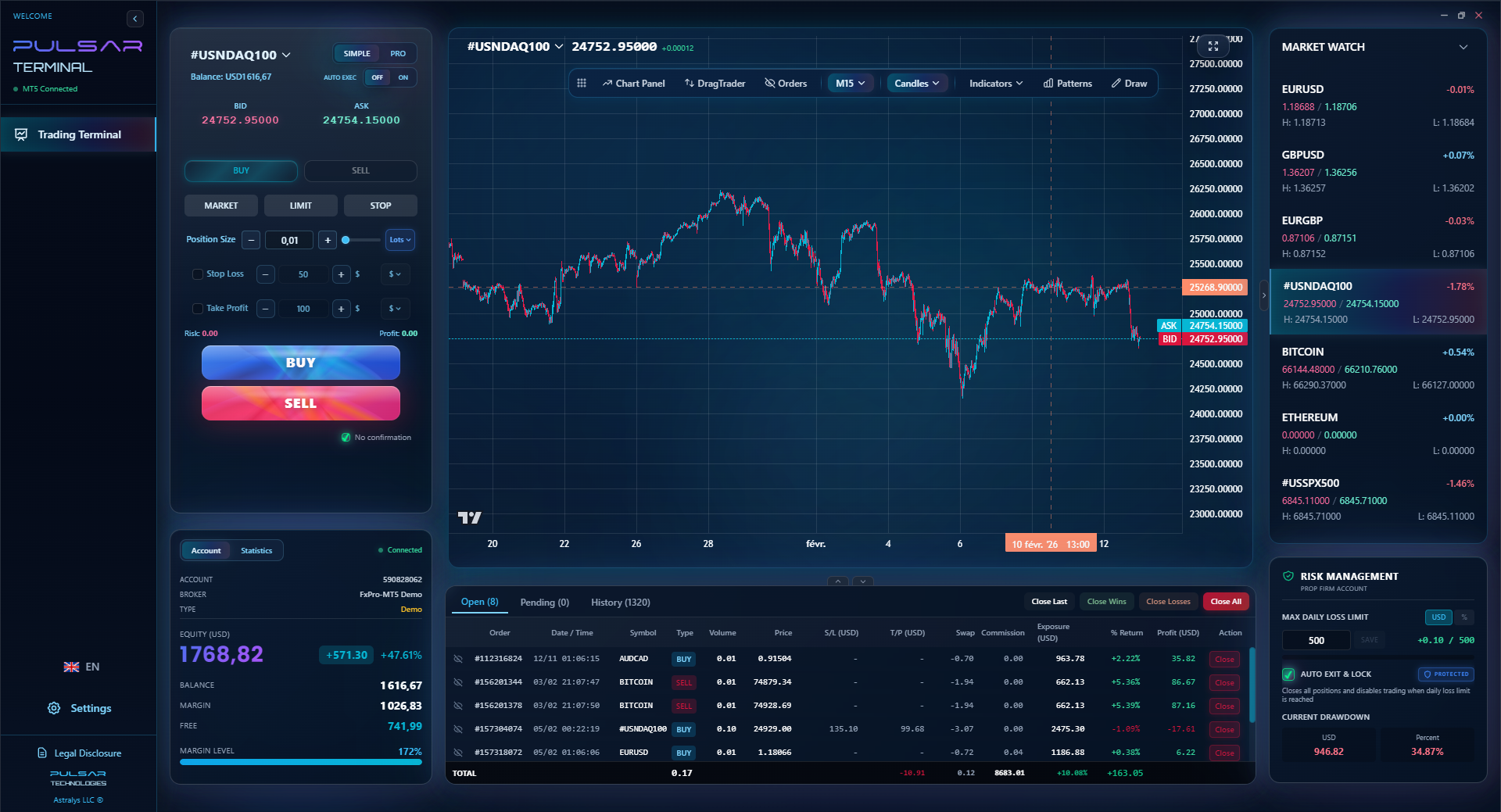
Sticking to a disciplined trading plan with precise stop-losses is non-negotiable in volatile markets, and Pulsar Terminal automates this directly on your MT5 platform.
Pulsar Terminal
La herramienta MT5 todo-en-uno: órdenes drag-and-drop, multi-TP/SL, trailing stop, grid trading, Volume Profile y protección prop firm. Usado por más de 1.000 traders diariamente.
I've made these mistakes so you don't have to.
Pitfall 1: Chasing High use. That 1:1000 use is a debt trap, not a superpower. On a $1,000 account, it lets you control $1,000,000. A 0.1% move against you wipes you out. It magnifies losses faster than profits. Stick to 1:50 or 1:100 max while you're learning.
Pitfall 2: Ignoring Total Cost. As we covered, look beyond the spread. Add up spread, commission, and estimated conversion losses. If your strategy needs a 5-pip profit to be viable but your total cost per trade is 3 pips, you're fighting a steep uphill battle.
Pitfall 3: No Trading Plan. You wouldn't drive from Lagos to Abuja without a map. Don't trade without a plan. Your plan must define your entry rules, exit rules (profit and loss), and position size for every single trade. Write it down. Follow it even when you're emotional.
Pitfall 4: Withdrawing Too Often. Every withdrawal incurs potential conversion fees. Let your profits compound in your trading account for a while. Withdraw larger amounts less frequently to minimize the percentage lost to fees. I aim to only withdraw quarterly, treating my trading account like a business.
💡 Consejo de Winston
Test a broker's withdrawal process with a small profit before you commit large capital. If they make it difficult or costly to get a small amount out, imagine what they'll do with a large one.
“Every withdrawal incurs potential conversion fees. Let your profits compound in your trading account.”
- Education First: Spend at least 3 months on a demo account. Learn what a pip and spread really mean. Test your strategy.
- Broker Selection: Choose a broker with solid international regulation and Naira-friendly deposit/withdrawal options. Compare a few from our reviews like Exness, IC Markets, and XM.
- Start Small: Fund your live account with an amount you can afford to lose completely. Use the minimum deposit to test the funding and withdrawal process with a small sum first.
- Document Everything: Keep a trading journal. Note the entry/exit prices, the reason for the trade, the conversion rates used for funding, and your emotional state.
- Tax Awareness: Consult with a local accountant to understand your precise tax obligations on trading profits. Set aside a portion of profits for this purpose.
The Nigerian forex exchange is a tough arena, but it's not unbeatable. The traders who succeed here are the most disciplined, the most patient, and the most aware of the ground under their feet. They respect the market, they respect the rules, and they never stop learning. Now you know the real game. Go play it smart.
FAQ
Q1Is forex trading illegal in Nigeria?
No, it is completely legal for individuals to trade forex in Nigeria. The confusion often comes from the fact that the local SEC does not license international retail brokers. You are legally allowed to use brokers regulated in other countries like the UK, Australia, or Cyprus.
Q2What is the best way to fund my forex trading account in Nigeria?
There's no single 'best' way, as it depends on speed and cost. Local bank transfers in Naira are often the cheapest but can be slow. Debit/credit cards are faster but may have higher bank conversion fees. Cryptocurrency (like USDT) is becoming popular for its speed and lower fees, but you must be comfortable using crypto wallets.
Q3How much money do I need to start forex trading in Nigeria?
While some brokers allow you to start with as little as $1, that's not practical. To properly manage risk and absorb transaction costs, a realistic starting amount is between $500 and $1,000. This allows for meaningful position sizing without over-leveraging.
Q4Do I pay tax on my forex trading profits?
Yes. The Federal Inland Revenue Service (FIRS) considers forex trading profits as capital gains, which are taxable at a rate of 10% on gross profits. It is your responsibility to declare this income and pay the tax. Keep detailed records of all your trades.
Q5Why is there a difference between my profit in USD and what I receive in Naira?
This is due to the currency conversion. Your broker or their payment processor converts your USD profit to Naira at their offered exchange rate. This rate often includes a margin or fee, which is how they make money on the transaction. Always check the conversion rate before withdrawing.
Q6Should I trade Naira pairs (like USD/NGN)?
Almost certainly not as a retail trader. These are exotic pairs with very wide spreads, low liquidity, and high volatility driven by local policy, not pure market dynamics. Stick to major pairs like EUR/USD, GBP/USD, or USD/JPY for better conditions.
Q7What use should I use?
Use the lowest use that allows you to execute your strategy. High use (like 1:500 or 1:1000) is a major risk, not a benefit. For beginners, I recommend not exceeding 1:50. It forces you to trade with proper capital and protects you from being wiped out by a small move.
Lección del Prof. Winston
Puntos clave:
- ✓Verify your broker's international regulation, not just its local office.
- ✓Calculate total cost: spread + commission + conversion fees.
- ✓Start with at least $500 to manage risk properly.
- ✓Use use of 1:50 or less as a beginner.
- ✓You owe 10% capital gains tax on profits.
¿Te resultó útil este artículo?
Haz clic en una estrella
Análisis Trading Semanal
Análisis y estrategias semanales gratis. Sin spam.
Sobre el autor
Olumide Adeyemi
Pionero del Trading en África Occidental
Uno de los educadores de trading forex más activos de Nigeria. 8 años de experiencia operando desde Lagos. Especialista en estrategias de bajo capital y desafíos de prop firms para traders africanos.
Comentarios
Aviso de riesgo
El trading de instrumentos financieros conlleva un riesgo significativo y puede no ser adecuado para todos los inversores. El rendimiento pasado no garantiza resultados futuros. Este contenido tiene fines educativos únicamente y no debe considerarse asesoramiento de inversión. Siempre realice su propia investigación antes de operar.
También te puede interesar

Cara Trading Forex Sukses: 7 Prinsip dari Trader Profesional
Cara trading forex sukses dengan 7 prinsip trader pro: manajemen modal, disiplin, journal trading, backtest. Data nyata, bukan janji profit palsu.
Jam Trading Forex Terbaik untuk Trader Indonesia: Panduan Lengkap dengan Tabel Waktu
Panduan jam trading forex untuk trader Indonesia. Tabel 4 sesi dunia, jam emas 20:00-00:00, sesi mana yang harus dihindari. Data akurat + tips dari trader berpengalaman.
Top 5 Sàn Forex Uy Tín Nhất 2026: Review Jujur dari Trader Indonesia
Top 5 sàn forex uy tín 2026 untuk trader Indonesia. Review jujur: spread, deposit, withdraw, dukungan lokal. Exness, XM, IC Markets & lebih.
Obtener Pulsar Terminal
Todas estas calculadoras están integradas en Pulsar Terminal con datos en tiempo real de su cuenta MT5.
Obtener Pulsar Terminal