


I lost R15,000 in a single afternoon back in 2018.

David van der Merwe
Trader de Mercados Emergentes ·  South Africa
☕ 12 min de lectura
Lo que aprenderás:
- 1The Legal Landscape: FSCA, SARB, and What 'Legal' Actually Means
- 2The Real Costs for South African Traders
- 3Picking a Broker: The Local vs Offshore Trade-Off
- 4Funding and Withdrawing: The SARB Shuffle
- 5Trading Strategies: What Works with Our Rules and Hours?
- 6Common Pitfalls (And How to Avoid Them)
- 7Getting Started: A Step-by-Step Plan for 2026
I lost R15,000 in a single afternoon back in 2018. It wasn't on a bad trade, technically. I'd made a decent profit on EUR/USD with an offshore broker, tried to withdraw it, and hit a brick wall. The money got stuck in a compliance nightmare between the broker's terms and South Africa's exchange controls. That R15k? It eventually came back, six months later, after paying fees that chewed up most of the profit. That's the real lesson about forex in South Africa. The trade is only half the battle. If you don't understand the local rules, your own bank can be a bigger enemy than the markets. Let's get you set up properly, so your profits actually land in your FNB or Standard Bank account.
Forex trading is legal here, but that word gets thrown around too loosely. Legal doesn't mean 'unregulated free-for-all.' It means you're operating inside a specific, and recently tightened, framework. You've got two main players watching over your shoulder, even if you don't realize it.
The Financial Sector Conduct Authority (FSCA) is your first line of defense. They license and oversee brokers operating in South Africa. If a broker has an FSP number from the FSCA, it means they have to follow rules on client fund segregation, fair pricing, and how they handle your complaints. The big one for traders: since 2021, the FSCA capped use for retail clients at 30:1. No more 500:1 madness that wipes out accounts in seconds. This is a good thing, trust me.
Then there's the South African Reserve Bank (SARB). This is where my R15,000 headache came from. SARB doesn't care about your stop-loss. They care about the Rand leaving the country. They enforce Exchange Control Regulations. Every time you deposit to or withdraw from an offshore broker, you're tripping over these rules. Your local bank is legally obligated to enforce them. Ignorance isn't an excuse; they'll just block your transaction and maybe flag your account.
Here's the critical distinction everyone misses. You are allowed to trade with international brokers (like Exness or IC Markets). But the moment you do, you step outside the FSCA's protective bubble. If that broker based in Cyprus or the Seychelles decides to freeze your funds, the FSCA can't help you. You're on your own. That's why their official stance is to only use FSCA-regulated brokers. It's safer, but your choice of platforms and conditions might be narrower.

Warning: Thinking of using a 'forex Malaysia' broker or any other offshore entity? Understand this: the FSCA's jurisdiction ends at our borders. A Malaysian regulator won't help you either. You are relying entirely on that broker's terms and conditions. If something goes wrong, your only recourse is likely expensive international arbitration.
“The trade is only half the battle. If you don't understand the local rules, your own bank can be a bigger enemy than the markets.”
Forget the advertised 'zero spread' hype. Your cost of trading here has layers, and some aren't on the chart.
Broker Fees: The Usual Suspects
You'll pay through the spread (the difference between buy and sell price) and sometimes a commission. An FSCA-regulated broker might show a 1.2 pip spread on EUR/USD. An offshore broker might show 0.8. But the offshore broker might be adding a hidden markup, so the effective cost is higher. You need to check live prices, not just the marketing site. Also, watch for inactivity fees. I've seen brokers charge $50 after just three months of no trading. That's over R900 gone for nothing.
The SARB Allowance: Your Annual Forex Budget
This is your most important number. The Single Discretionary Allowance (SDA) is how much you can move offshore for investments (like funding a forex account) per calendar year without extra tax clearance. As of February 2026, it's R2 million. This is up from R1 million, a significant increase.

Example: Let's say you want to fund an account with Pepperstone, an Australian broker. You transfer R100,000 from your Absa account. That uses R100,000 of your R2 million SDA for the year. If you make a R300,000 profit and withdraw it back, that return flow doesn't 'top up' your allowance. It's just a return of capital and profit.
If you need to send more than R2 million offshore in a year, you'll need a Tax Compliance Status Approval for International Transfer (TCS-AIT PIN) from SARS. It's a process, and your bank will demand it. Trying to bypass this by making multiple small payments is a great way to get your banking profile flagged.
Banking and Payment Fees
Depositing in ZAR is usually free with local brokers. For international brokers, your bank will charge an international transfer fee (around R200-300) and take a cut on the currency conversion. Using a credit card might have cash advance fees. E-wallets like Skrill or Neteller are often the cheapest and fastest for offshore funding, but they have their own fee structures. Factor all this in. A 2% deposit fee means you're down 2% before you even place a trade.

💡 Consejo de Winston
Your first R10,000 profit is a test. Withdraw it immediately. The ease (or difficulty) of that process tells you more about your broker than any review site.
“Legal doesn't mean 'unregulated free-for-all.' It means you're operating inside a specific, and recently tightened, framework.”
This is your fundamental choice: safety and simplicity vs. potential cost and variety.
FSCA-Regulated Brokers (The Safer Bet) Your money is in South Africa, governed by local laws. Deposits/withdrawals in ZAR are a breeze. You have the FSCA to complain to if things go south. The downside? You might face slightly higher spreads, fewer exotic instruments, and sometimes less advanced platform access. They must adhere to the 30:1 use cap. Examples include the local operations of global brands.
International Brokers (The Wider World) You get access to raw spreads, more instruments, higher use (if you go to an offshore entity, though I don't recommend high use), and often better technology. But you carry the risk. You're subject to a foreign regulator's rules (if any). Getting your money back to SA involves SARB rules. Your recourse in a dispute is weak.
Here’s a quick comparison based on typical setups:
| Feature | FSCA-Regulated Broker | Top-Tier Int'l Broker (e.g., IC Markets) |
|---|---|---|
| Client Fund Protection | Segregated accounts, local oversight | Segregated accounts, offshore oversight (varies by jurisdiction) |
| use on Majors | Max 30:1 | Can be up to 500:1 (but stick to 30:1 or less) |
| Deposit in ZAR | Yes, directly | No, must convert to USD/EUR first (bank/wallet does this) |
| Withdrawal Time | Often same-day/next-day | 1-5 business days, plus bank processing |
| Regulatory Recourse | FSCA Ombudsman | Foreign financial authority (lengthy, complex process) |
| SARB Compliance | Handled by broker/bank | YOUR PERSONAL RESPONSIBILITY |
My take? If you're starting out or trading with significant capital, use an FSCA broker. The peace of mind is worth a small cost difference. If you're an experienced trader running specific strategies that need ultra-low latency or certain instruments, then a reputable international broker can work - but you must become an expert on SARB rules.

Pro Tip: Never choose a broker based solely on a bonus offer. These are often tied to impossible withdrawal conditions. Your criteria should be: regulation, reputation at least 5 years old, transparent fees, and a platform (like MT5) you like using.
“Legal doesn't mean 'unregulated free-for-all.' It means you're operating inside a specific, and recently tightened, framework.”
This is the practical hurdle. Let's walk through it.
For Local FSCA Brokers: It's like an EFT. You log into your broker portal, get their local South African bank details (often Absa, FNB, etc.), and make a payment from your online banking. The money reflects in your trading account in hours, sometimes minutes. Withdrawals are the reverse. Easy.
For International Brokers: This is where you need to be sharp. The broker will not give you ZAR account details. They'll give you USD, EUR, or GBP details.
- Choose Your Method: Bank wire, Credit Card, or E-wallet (Skrill/Neteller).
- Bank Wire: You instruct your bank to send USD to the broker's overseas bank. You'll use your SDA. Your bank will ask the purpose. "Investment in foreign margin trading account" is usually accurate. They may ask for documents. The fee is high (R200+ plus forex margin).
- Credit Card: Treated as a 'miscellaneous import payment.' The limit for this is now R100,000 per transaction. It's faster, but check for cash advance fees.
- E-wallet: This is often the most efficient. You fund your Skrill account in ZAR (via card or EFT), Skrill converts to USD, and you send USD to the broker. Withdrawals come back to Skrill, and you can send to your SA bank. FNB has a direct integration with PayPal.
The Golden Rule: Keep careful records. Keep every SWIFT confirmation, proof of payment, and broker statement. When you withdraw a large profit, SARS or your bank might ask to see the trail proving it's the return of capital and profit from an initial legitimately exported amount.
I learned this the hard way. A R250,000 withdrawal was held up for two weeks because I couldn't instantly find the POP for the original R80,000 deposit from 18 months prior. Now I have a dedicated folder for it.
💡 Consejo de Winston
The most important indicator for a South African trader isn't on the chart. It's the counter in your head tracking your remaining Single Discretionary Allowance. Let that limit your position size, not greed.
“That '100% deposit bonus' is a trap. The fine print will require you to trade a volume equal to 30 or 40 times the bonus amount before you can withdraw *any* of your own money.”
South Africa is in GMT+2. This shapes everything. The London session opens at 10:00 our time, and the New York session at 16:00. The most liquid overlap is from 16:00 to 18:00. If you have a day job, this is tough.
Scalping is challenging unless you're trading full-time during those key hours. The 30:1 use cap also limits the position size you can take for very short-term moves. If you try scalping with an offshore broker at 500:1, you're just taking insane, unnecessary risk. I don't recommend it.
Swing Trading is a much better fit for most South African traders. You can analyse and place orders in the evening, manage them with stops, and not need to watch the screen all day. The use cap is more than sufficient. This approach aligns with using tools like the MACD indicator or RSI indicator on higher timeframes (4Hr, Daily).
The ZAR Pairs (USD/ZAR, EUR/ZAR): Trading the Rand can be tempting. You understand the local news. But be warned: these pairs can have massive spreads (think 50-100 pips) and are prone to sudden gaps on political or SARB announcements. The volatility is brutal. I once got stopped out on a USD/ZAR trade by a 200-pip gap on a Sunday night following a cabinet reshuffle rumor. It's a specialist's game. Stick to the major pairs like EUR/USD or XAU/USD when you're learning.
The key is to build a strategy that doesn't rely on you sitting at the screen during JSE hours. Use pending orders, set stop-losses religiously, and focus on quality setups, not quantity. A good swing trading plan that generates 2-3 trades a week is far more sustainable than trying to scalp 10 trades a day.
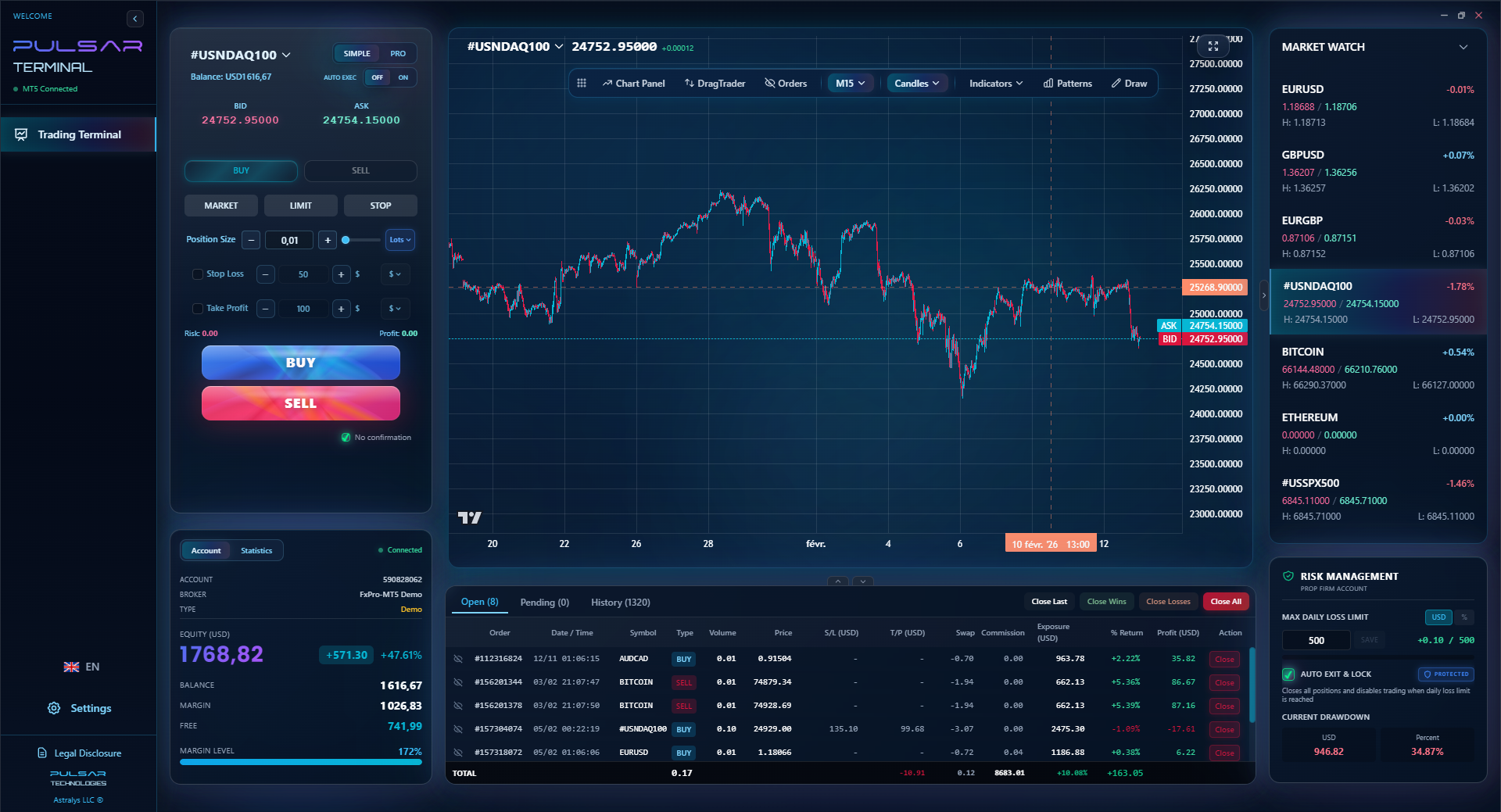
Managing swing trades across time zones is easier with tools that automate order management, letting you set your plan and walk away.
Pulsar Terminal
La herramienta MT5 todo-en-uno: órdenes drag-and-drop, multi-TP/SL, trailing stop, grid trading, Volume Profile y protección prop firm. Usado por más de 1.000 traders diariamente.
“That '100% deposit bonus' is a trap. The fine print will require you to trade a volume equal to 30 or 40 times the bonus amount before you can withdraw *any* of your own money.”
I've made these mistakes. My students make them. Let's skip the pain.
- Ignoring SARB Limits: This is the biggest one. You get excited, transfer R1.5 million in March, and then in November you have a chance to send more for a great opportunity... but you've hit your SDA. You're stuck. Plan your annual trading capital around the R2 million limit.
- Chasing Offshore Bonuses: That '100% deposit bonus' is a trap. The fine print will require you to trade a volume equal to 30 or 40 times the bonus amount before you can withdraw any of your own money. It's a mechanism to make you overtrade and blow up.
- Underestimating Total Costs: You see a 0.9 pip spread but forget the $7 round-turn commission, the R250 bank fee, and the 1.5% forex conversion loss from your bank. Suddenly, that 'low cost' trade needs to move 3 pips just to break even. Use a position size calculator that lets you input all costs.
- No Tax Plan: SARS views forex trading as speculative, meaning profits are taxable as income. Keep a detailed log of all trades (platform statements work). Speak to an accountant who understands trading. A common mistake is not setting aside a portion of profits for tax liability.
- Overleveraging with Offshore Access: Just because an international broker offers 200:1 doesn't mean you should use it. A 2% move against you wipes you out. Stick to risk principles that would work even at 30:1. I treat anything above 10:1 as dangerous for my swing trading style.
- Using Unregulated 'Signal Providers': The WhatsApp groups promising '95% win rate' are scams. They're often run from outside the country and vanish once they have your 'subscription fee.' The FSCA can't touch them. Your education is your only reliable signal provider.
💡 Consejo de Winston
If you wouldn't explain the trade and its risk to the SARS auditor who might one day ask about your profitable year, don't take the trade. Clarity of purpose keeps you disciplined.
“The most liquid overlap is from 16:00 to 18:00. If you have a day job, this is tough. Build a strategy that doesn't rely on you sitting at the screen.”
Here's a blunt, no-BS roadmap. Don't skip steps.
Step 1: Education (4-6 Weeks Minimum) Don't deposit a cent yet. Learn. Understand what a pip is, what a spread is, what a margin call is. Paper trade on a demo account. Most blow-ups happen in the first three months. Be the exception.
Step 2: Choose Your Broker Path Decide: FSCA-regulated for safety, or reputable international for conditions. Research at least three. Read the full terms, especially on withdrawals and inactivity. Check the FSCA's website for the broker's license status.
Step 3: Plan Your Capital & SARB Compliance Decide how much of your R2 million SDA you'll allocate to trading this year. Start small. Your first live account should be with money you can afford to lose completely. Open a separate folder for all financial records related to this.
Step 4: Open and Fund an Account Go through the verification process (FICA documents). Start with a small live amount - R5,000 to R20,000. Follow your funding method's steps carefully. Save the proof of payment.
Step 5: Develop and Test a Simple Strategy Don't try to trade everything. Pick one or two major pairs. Develop a rule-based strategy for entries and exits. Most importantly, define your risk per trade (e.g., never risk more than 1% of your account). Backtest it, then try it on a demo account, then on your small live account. Keep a trading journal.
Step 6: The First Withdrawal Make your first withdrawal request early, even if it's just for R500. This tests the entire system - broker processing, SARB compliance, and your bank's reception. It's better to find a snag with R500 than with R50,000.
This business is a marathon of disciplined execution, not a lottery. The South African context adds layers of complexity, but it also forces a discipline that can make you a better, more cautious trader. Now go learn, and for goodness' sake, mind your limits.
FAQ
Q1Is forex trading tax-free in South Africa?
No, it is not. SARS treats profits from speculative forex trading as income, which is taxable in your hands. You must declare it. Losses can be deducted against other income of a similar nature. Keep impeccable records of all trades, deposits, and withdrawals. Consult a tax professional.
Q2Can I trade forex with a Malaysian-regulated broker?
Technically, yes, a South African resident can open an account with a broker regulated in Malaysia or any other country. However, you will have no protection from the FSCA. The Malaysian regulator is unlikely to assist you with a dispute. You will also be solely responsible for complying with South African SARB exchange controls when moving money to and from that broker. The risks are significantly higher compared to using an FSCA-regulated entity.
Q3What is the safest way for a beginner to start?
The safest path is: 1) Educate yourself thoroughly using demo accounts. 2) Choose a well-established broker regulated by the FSCA. 3) Start with the absolute minimum deposit (e.g., R2000-R5000). 4) Trade with micro lots and never risk more than 1-2% of your account on a single trade. This limits your financial exposure while you learn the real-world mechanics of trading and withdrawals in SA.
Q4Why did my bank block my transfer to a forex broker?
South African banks are legally required to enforce SARB exchange controls. Common reasons: 1) You exceeded your Single Discretionary Allowance (SDA) without a TCS PIN from SARS. 2) The purpose of the payment was unclear or incorrectly stated. 3) The receiving entity is on a watchlist. 4) Your transaction patterns appear to be structuring (breaking a large sum into smaller payments to avoid reporting). Always be transparent with your bank and have your documentation ready.
Q5What happens if my international broker goes bankrupt?
If your broker is FSCA-regulated, there are specific conduct rules and you may have recourse through the local ombudsman. If it's an offshore broker (like a 'forex Malaysia' firm), you become an unsecured creditor in a foreign legal system. Even if they had segregated accounts, the bankruptcy process can freeze funds for years. This is the paramount risk of using offshore brokers.
Q6Is the 30:1 use limit too restrictive?
For retail traders, no, it's a lifesaver. use is a tool that amplifies both gains and losses. Most retail traders blow up their accounts by using excessive use. At 30:1, a 3.33% move against you wipes your margin. That's still a huge risk. Professional traders often use far less. The limit forces you to focus on good risk management, which is the foundation of lasting in this game.
Lección del Prof. Winston
Puntos clave:
- ✓SARB's R2 million SDA is your annual trading budget. Plan around it.
- ✓FSCA regulation means safety; offshore brokers mean you're on your own.
- ✓The 30:1 use cap is a protective gift, not a restriction.
- ✓Factor in ALL costs: spread, commission, bank fees, forex conversion.
- ✓Your first withdrawal test is more important than your first trade.
¿Te resultó útil este artículo?
Haz clic en una estrella
Análisis Trading Semanal
Análisis y estrategias semanales gratis. Sin spam.
Sobre el autor
David van der Merwe
Trader de Mercados Emergentes
Trader con sede en Johannesburgo con 11 años en divisas de mercados emergentes. Especialista en pares ZAR, trading regulado por la FSCA y análisis del mercado sudafricano.
Comentarios
Aviso de riesgo
El trading de instrumentos financieros conlleva un riesgo significativo y puede no ser adecuado para todos los inversores. El rendimiento pasado no garantiza resultados futuros. Este contenido tiene fines educativos únicamente y no debe considerarse asesoramiento de inversión. Siempre realice su propia investigación antes de operar.
También te puede interesar

Cara Trading Forex Sukses: 7 Prinsip dari Trader Profesional
Cara trading forex sukses dengan 7 prinsip trader pro: manajemen modal, disiplin, journal trading, backtest. Data nyata, bukan janji profit palsu.
Jam Trading Forex Terbaik untuk Trader Indonesia: Panduan Lengkap dengan Tabel Waktu
Panduan jam trading forex untuk trader Indonesia. Tabel 4 sesi dunia, jam emas 20:00-00:00, sesi mana yang harus dihindari. Data akurat + tips dari trader berpengalaman.
Top 5 Sàn Forex Uy Tín Nhất 2026: Review Jujur dari Trader Indonesia
Top 5 sàn forex uy tín 2026 untuk trader Indonesia. Review jujur: spread, deposit, withdraw, dukungan lokal. Exness, XM, IC Markets & lebih.
Obtener Pulsar Terminal
Todas estas calculadoras están integradas en Pulsar Terminal con datos en tiempo real de su cuenta MT5.
Obtener Pulsar Terminal