


Here's a hard truth most trading sites won't tell you: over 85% of retail traders lose money with standard forex spot trading.

David van der Merwe
Trader de Mercados Emergentes ·  South Africa
☕ 11 min de lectura
Lo que aprenderás:
- 1What Are Forex Options, Really?
- 2Why Should a South African Trader Bother with Options?
- 3How to Pick a Forex Options Broker: The Non-Negotiables
- 4Broker Landscape for South African Traders
- 5Simple Strategies to Get You Off the Sidelines
- 6The Real Costs and How to Avoid the Traps
- 7Your First Trade: A Step-by-Step Walkthrough
- 8Beyond the Basics: Tools for Better Execution

Here's a hard truth most trading sites won't tell you: over 85% of retail traders lose money with standard forex spot trading. Options can flip that script, giving you defined risk where your maximum loss is the premium you pay. But in South Africa, finding a legit forex options broker isn't about scrolling through Google ads. It's about knowing which platforms actually deliver, which are regulated by the FSCA, and how to use options without blowing up your account. I've traded options through bull markets, crashes, and everything in between. Let's talk about how you can actually use them.
Forget the complex textbook definitions. A forex option is simply a contract. It gives you the right, but not the obligation, to buy or sell a currency pair at a specific price (the strike price) on or before a certain date. You pay a premium for this right. That's it.
There are two main types you'll deal with:
- Call Option: You buy the right to purchase a currency pair. You use this when you think the price is going up.
- Put Option: You buy the right to sell a currency pair. You use this when you think the price is going down.
The beautiful part? Your risk is capped at the premium you paid. If the trade goes against you, you can just let the option expire worthless. You won't get a margin call demanding more money. This is a game-changer for psychology.

Warning: The seller (or writer) of the option has unlimited risk. As a beginner, you should only ever be a buyer of options. Selling options is for experienced pros with deep pockets.
Let's make it real. Back in early 2023, I thought the USD/ZAR was looking tired around R18.20 and due for a pullback. Instead of shorting the spot market and risking a runaway move higher, I bought a put option with a strike of R18.00 for a premium of R2,500. The pair did drop to R17.80. My option paid out R8,000. My max loss from the start was always that R2,500 premium. That's the power of defined risk.
You might be doing just fine with spot forex. I get it. But options solve specific, painful problems we face here.
First, volatility. The ZAR pairs (USD/ZAR, EUR/ZAR) are notoriously jumpy. News out of Eskom or a rand-sensitive budget speech can cause gaps that wipe out stop-losses. With a bought option, a gap against you hurts, but it doesn't destroy your account. The risk was known upfront.
Second, use management. Spot forex use can be a silent killer. It's easy to over-use on a "sure thing." Options force discipline. Your premium is your total risk. You can't lose more, so you're naturally sizing your position correctly. I wish I had used a position size calculator with this mindset years ago.
Third, strategic flexibility. You're not just betting on direction. You can profit if the market stays quiet (selling volatility) or makes a big move in either direction (a straddle). When the US Fed or SARB makes an announcement, you can structure trades that profit from the volatility spike itself, not just guessing which way price will go.
The Psychological Edge
This is the biggest benefit. Knowing your exact worst-case scenario before you enter the trade lets you sleep at night. It removes the emotional panic that leads to revenge trading. You can be wrong on direction and still manage the trade calmly because your financial ruin isn't on the line.

💡 Consejo de Winston
The premium you pay for an option is the price of insurance. Never think of it as a 'fee,' but as your total possible loss. That reframing alone will improve your position sizing.
“Your risk is capped at the premium you paid. If the trade goes against you, you can just let the option expire worthless.”
This is where most guys go wrong. They sign up for the platform with the flashiest ads. Don't. Here’s your checklist.
1. Regulation is King (FSCA is Queen). Your broker must be regulated. For South Africans, the Financial Sector Conduct Authority (FSCA) license is your first layer of protection. Many international brokers also hold top-tier licenses like CySEC (Cyprus) or ASIC (Australia). This ensures client fund segregation and a dispute resolution process. If they aren't regulated, walk away.
2. Platform & Tools. You need a platform that can handle options. MetaTrader 5 (MT5) is far better for this than MT4. You'll want clear chains showing options prices across different strikes and expiries. The platform should calculate "the Greeks" (Delta, Gamma, Theta, Vega) for you. These measure how your option's price changes with the underlying asset's price, time, and volatility.
3. Asset Coverage. Can you trade options on the pairs you care about? Most brokers offer them on majors like EUR/USD and XAU/USD. But if you want to trade USD/ZAR options, your list of brokers gets very short, very fast. You need to check this first.
4. Premiums & Spreads. Options aren't free. The premium you pay is your cost. Some brokers have wider bid/ask spreads on the options themselves, making you pay more to enter and get less when you exit. Compare.
5. Education & Support. Does the broker have decent tutorials on how their options platform works? If you call their support, do they understand an options question, or do they just try to transfer you to spot trading?

Pro Tip: Open a demo account first. Practice buying and selling options, see how the platform reacts to price changes, and test the execution speed. Paper trade for at least a month before risking real money.

Let's be brutally honest. Your choice is limited. Many global brokers don't offer forex options to retail clients at all, and even fewer actively service the South African market. Here’s a breakdown of the types you'll encounter.
| Broker Type | Pros | Cons | Best For |
|---|---|---|---|
| International CFD/Options Brokers | Wide range of assets, advanced platforms, often strong regulation. | May not offer ZAR pairs. Withdrawals in ZAR can have fees. | Traders focused on major forex pairs and indices. |
| Local South African Brokers | Easy ZAR deposits/withdrawals, local support, FSCA regulated. | Often limited to JSE-listed instruments; forex options may be limited. | Traders who prioritize local convenience and support. |
| Global Prop Trading Firms | Trade with the firm's capital, defined risk challenges. | Not a broker; you're trading a simulated account for an evaluation. | Traders confident in a specific scalping strategy or swing trading approach. |
A note on prop firms: While not traditional brokers, they are a huge part of our landscape. Firms like FTMO or The Funded Trader Program give you a capital allocation if you pass their challenge. Your risk is limited to the challenge fee. This is conceptually similar to options trading: defined, upfront risk. Tools that help manage that risk, like automatic stop-loss protection, are useful here.
From my experience, brokers like IC Markets and Pepperstone offer strong MT5 platforms that can help options trading through added plugins or integrations, though you need to confirm asset availability. For a more straightforward, all-in-one options experience on majors, some traders look to Exness or XM, but again, you must check if they offer the specific forex options you want.
“Knowing your exact worst-case scenario before you enter the trade lets you sleep at night.”
Start simple. Your goal isn't to impress anyone with complexity; it's to make money with controlled risk.
1. The Long Call or Put (Directional Bet). This is your bread and butter. You believe USD/ZAR will rise? Buy a call option. You believe it will fall? Buy a put option. Your profit is unlimited (in theory), your loss is the premium. It's a cleaner, safer alternative to a spot trade.
2. The Covered Call (For Existing Holders). This is more advanced but useful. Let's say you hold a physical USD position from R17.50 and it's now at R18.20. You think it might stall. You can sell a call option at a higher strike (e.g., R18.50). You collect the premium immediately. If the price stays below R18.50, you keep the premium as extra profit. If it rockets past R18.50, your upside is capped, but you still profit from your original position and the premium.
3. Using Indicators with Options. Options add a time dimension. Combine them with classic indicators. For example, if the RSI indicator shows USD/ZAR is oversold on the daily chart, but the MACD indicator is still pointing down, maybe the bounce will take time. Instead of buying spot now, you could buy a call option that expires in 30 days. This gives the market time to stage your expected recovery.
My Early Mistake: I once bought a weekly at-the-money call option on EUR/USD right before a major ECB announcement. I was right on the direction, but volatility crushed the option's value post-announcement (this is called "volatility crush"). The underlying price moved my way, but not enough to offset the time decay and drop in implied volatility. I lost 90% of my premium. Lesson: Be very careful buying expensive options (high premium) right before major news. Sometimes it's better to wait for the storm to pass.
💡 Consejo de Winston
Time decay is not your friend as a buyer. Always give your trade thesis enough runway to be right. Buying weekly options is gambling, not trading.
Trading options isn't a cheap magic bullet. You pay for the privilege of limited risk.
The Major Cost: Time Decay (Theta). This is the silent killer of option buyers. An option is a wasting asset. Every day that passes, its time value erodes, all else being equal. This decay accelerates as you get closer to the expiry date. Buying options with very short expiry (like 2-3 days) is usually a loser's game unless you expect an immediate, massive move.
Other Costs & Pitfalls:
- The Bid/Ask Spread: The difference between what you can buy an option for and what you can sell it for. On illiquid options, this can be huge, making it hard to break even.
- Implied Volatility (IV): This is the market's forecast of volatility. High IV means expensive premiums. Buying when IV is high and then seeing it drop can lose you money even if the price moves your way.
- Liquidity Risk: Some options strikes just don't trade much. You might struggle to exit your position at a fair price.

Example: You buy a USD/ZAR call option for a R1,000 premium. The pair goes sideways for a week. Even though the price hasn't moved, your option might now only be worth R600 due to time decay. You need a favorable price move and for it to happen before time eats your premium.
The fix? Give yourself time. Consider buying options with at least 30-45 days to expiry. This gives your trade time to work out. And always, always know your break-even point before you enter.
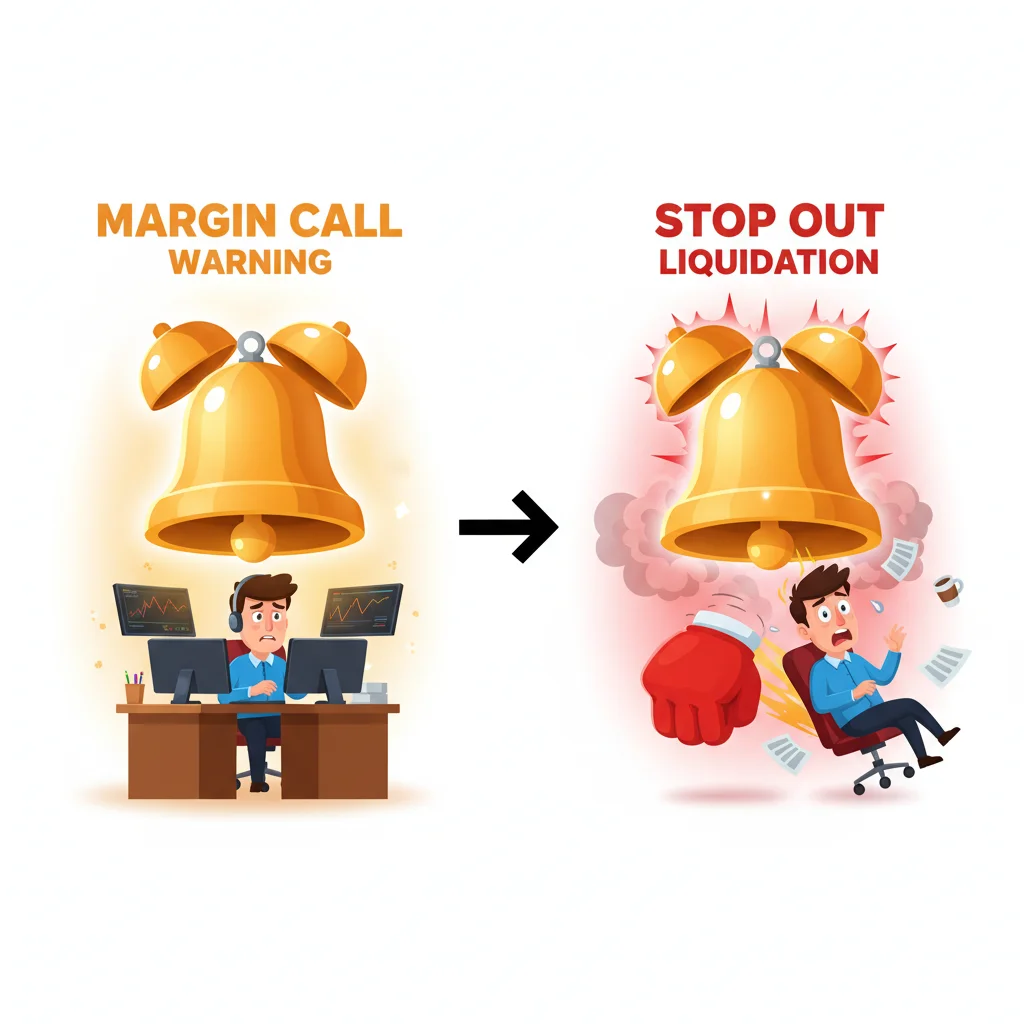
“Buying options with very short expiry is usually a loser's game unless you expect an immediate, massive move.”
Let's walk through a hypothetical, conservative first trade.
Scenario: It's October. USD/ZAR is at R18.40. You've done your analysis and believe political uncertainty and load-shedding will pressure the rand towards R19.00 by year-end, but you're wary of sudden interventions.
- Choose Your Instrument: You decide to buy a USD/ZAR Call Option.
- Choose Your Expiry: You pick an expiry date in mid-December (about 60 days away). This gives your view time to play out.
- Choose Your Strike Price: You look at the "chain." An at-the-money call at R18.40 is expensive. You opt for an out-of-the-money call with a strike price of R18.70. It's cheaper, so you can control more position size for the same capital.
- Check the Premium: The broker's platform shows the premium for this R18.70 Dec Call is R350 per contract (each contract might control a standard lot).
- Size Your Position: You decide to risk R1,750 of your capital. R1,750 / R350 = 5. You buy 5 contracts. Your maximum loss is R1,750. No more.
- Define Your Exit:
- If USD/ZAR soars: You might sell the option back to the market before expiry to capture profits.
- If USD/ZAR stagnates or falls: You let the option expire worthless. You lose R1,750, close your platform, and go for a braai. No margin calls, no sleepless nights.
This structured approach turns a speculative view into a managed business transaction. The key is sticking to the plan you set before the emotions of the market hit.
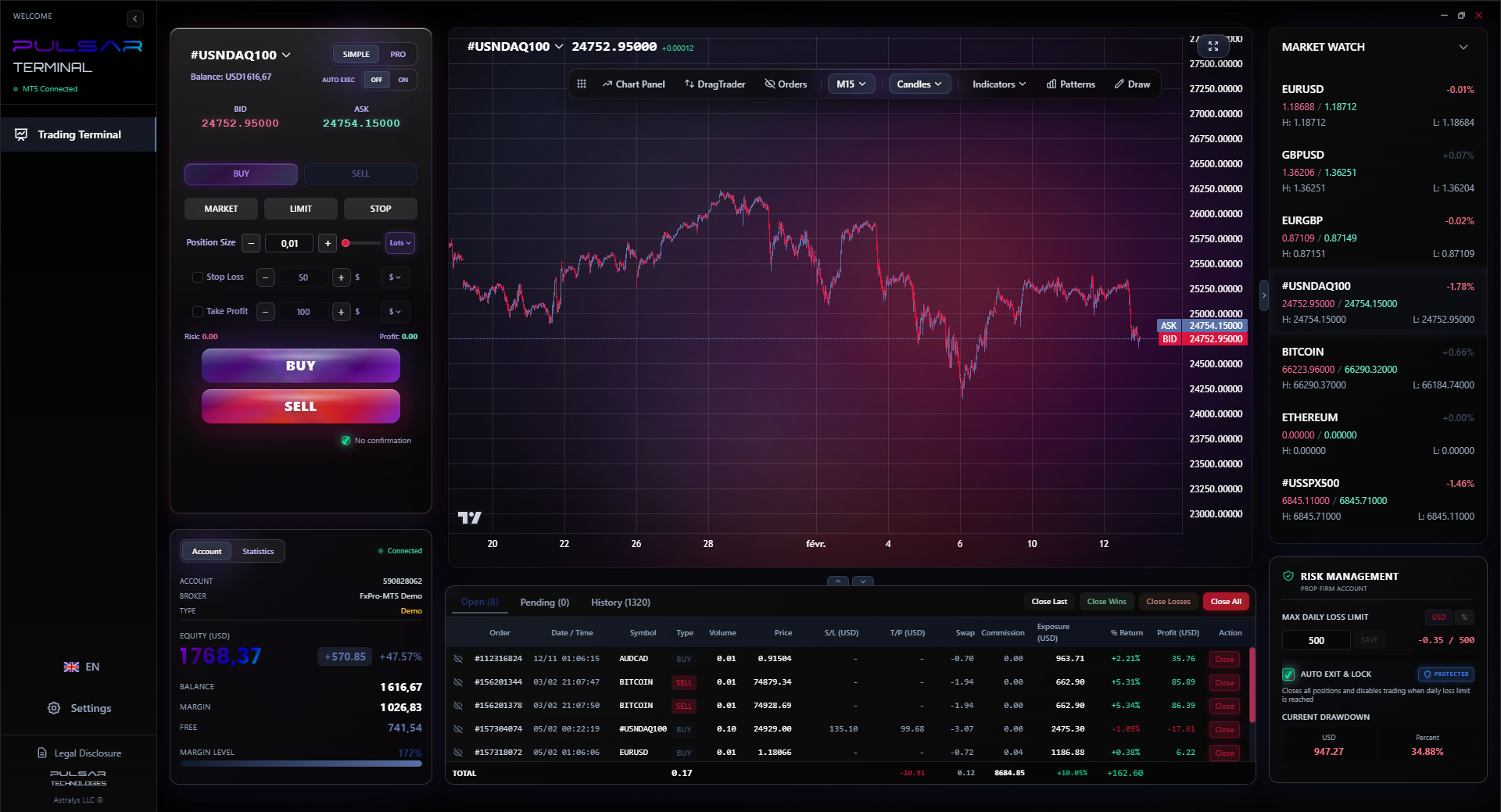
Managing complex option strategies and protecting capital during volatile news events is far easier with a tool that automates order execution and risk rules directly on your MT5 platform.
Pulsar Terminal
La herramienta MT5 todo-en-uno: órdenes drag-and-drop, multi-TP/SL, trailing stop, grid trading, Volume Profile y protección prop firm. Usado por más de 1.000 traders diariamente.
Once you're comfortable with basic buys, you can start using tools to manage trades more precisely. This is where good software separates the amateurs from the serious traders.
Think about managing multiple option legs or a complex spot-and-options portfolio. Manually moving stop-losses or taking partial profits on several positions during a volatile SARB announcement is stressful and error-prone.
Specialized trading terminals that plug into MT5 can automate these mechanics. Imagine setting a trailing stop on your option position, or automatically closing half your contracts at a 50% profit target and moving the stop-loss to breakeven on the rest. This isn't fantasy; it's what professional risk management looks like.
For prop firm traders, some tools can automatically enforce the firm's daily loss limit, shutting you out before you breach your challenge rules - saving you from yourself. When you're in a trade, your biggest enemy is often emotion. Letting a tool handle the mechanics based on your pre-set rules is a massive advantage.
The right tools let you focus on your analysis and strategy, not on frantically clicking buttons. They turn your trading plan into an executable, disciplined system.
FAQ
Q1Is trading forex options legal in South Africa?
Yes, it is completely legal. You must trade through a broker that is authorised to offer these products. The safest route is to use a broker regulated by the South African FSCA or a reputable international regulator like ASIC or CySEC.
Q2What is the minimum capital needed to start trading forex options?
It varies wildly by broker. You can find some international brokers where you can start with a few hundred dollars (R5,000-R10,000). However, to trade responsibly and withstand a few losing trades while you learn, I'd strongly recommend having at least R20,000 in risk capital that you can afford to lose entirely.
Q3Can I trade USD/ZAR options specifically?
This is the tricky part. While many brokers offer options on majors like EUR/USD, offerings on emerging market pairs like USD/ZAR are less common. You will need to specifically check with each broker on your shortlist. Some local South African derivatives providers may offer them, but the liquidity might be lower.
Q4What's the difference between forex options and CFDs?
A crucial difference. A CFD is a contract for difference on the spot price; your loss can theoretically be unlimited if the market moves against you without a stop-loss. A bought forex option has a defined maximum loss (the premium you pay). Options are generally a safer way to speculate for retail traders because of this built-in risk cap.
Q5How are profits from forex options taxed in South Africa?
In South Africa, profits from trading (whether spot forex, CFDs, or options) are generally considered capital gains if you are deemed an investor, or income if you are deemed a trader (running a business of trading). It's complex. You must declare these profits to SARS. I am not a tax advisor - you should consult with a qualified South African tax professional to understand your specific liabilities.
Q6Is MT4 or MT5 better for options trading?
MT5, without a doubt. MetaTrader 4 was built for spot forex and CFDs. MetaTrader 5 has a much more strong architecture that properly supports derivatives like options and futures, including depth of market and a more complete economic calendar. If you're serious about options, use MT5.
Lección del Prof. Winston
Puntos clave:
- ✓Only ever buy options as a beginner; selling carries unlimited risk.
- ✓Your maximum loss is always the premium paid - size accordingly.
- ✓Give trades time; avoid options expiring in less than 30 days.
- ✓Always verify broker regulation (FSCA, ASIC, CySEC) first.
- ✓Use MT5, not MT4, for serious options trading.
¿Te resultó útil este artículo?
Haz clic en una estrella
Análisis Trading Semanal
Análisis y estrategias semanales gratis. Sin spam.
Sobre el autor
David van der Merwe
Trader de Mercados Emergentes
Trader con sede en Johannesburgo con 11 años en divisas de mercados emergentes. Especialista en pares ZAR, trading regulado por la FSCA y análisis del mercado sudafricano.
Comentarios
Aviso de riesgo
El trading de instrumentos financieros conlleva un riesgo significativo y puede no ser adecuado para todos los inversores. El rendimiento pasado no garantiza resultados futuros. Este contenido tiene fines educativos únicamente y no debe considerarse asesoramiento de inversión. Siempre realice su propia investigación antes de operar.
También te puede interesar

Cara Trading Forex Sukses: 7 Prinsip dari Trader Profesional
Cara trading forex sukses dengan 7 prinsip trader pro: manajemen modal, disiplin, journal trading, backtest. Data nyata, bukan janji profit palsu.
Jam Trading Forex Terbaik untuk Trader Indonesia: Panduan Lengkap dengan Tabel Waktu
Panduan jam trading forex untuk trader Indonesia. Tabel 4 sesi dunia, jam emas 20:00-00:00, sesi mana yang harus dihindari. Data akurat + tips dari trader berpengalaman.
Top 5 Sàn Forex Uy Tín Nhất 2026: Review Jujur dari Trader Indonesia
Top 5 sàn forex uy tín 2026 untuk trader Indonesia. Review jujur: spread, deposit, withdraw, dukungan lokal. Exness, XM, IC Markets & lebih.
Obtener Pulsar Terminal
Todas estas calculadoras están integradas en Pulsar Terminal con datos en tiempo real de su cuenta MT5.
Obtener Pulsar Terminal