


Let's be blunt: most people who talk about forex partnership programs are selling you a dream.

David van der Merwe
Trader de Mercados Emergentes ·  South Africa
☕ 15 min de lectura
Lo que aprenderás:
- 1What Exactly Is a Forex Partnership Program? Cutting Through the Jargon
- 2The FSCA Rules & The Legal Reality You Can't Ignore
- 3How You Actually Get Paid: Real Numbers from the Front Lines
- 4Picking the Right Broker Partner: It's More Than Just the Payout
- 5Building Your Business, Not Just Dropping Links
- 6Common Pitfalls (And How I Stepped in Them So You Don't Have To)
Let's be blunt: most people who talk about forex partnership programs are selling you a dream. They'll flash screenshots of massive payouts and talk about 'passive income' while glossing over the grind, the regulations, and the very real chance you'll earn nothing. I've been on both sides of this game for over a decade, first as a trader, then building a network. I've made good money, but I've also wasted months on programs that went nowhere. This isn't a hype piece. It's a practical, no-BS look at how these programs actually work in South Africa, what the FSCA expects from you, and how to build something real, not just a fantasy.
At its core, a forex partnership program is a referral system. You send clients to a broker, and they pay you for it. But the devil, as always, is in the details. The two main models you'll encounter are the Introducing Broker (IB) and the Affiliate, and understanding the difference is your first critical step.
An Introducing Broker (IB) is a more hands-on role. You're not just dropping a link; you're often expected to provide some level of support, education, or guidance to the clients you refer. In South Africa, if you're managing client funds or giving specific trading advice, you're treading into territory that requires an FSCA license. Most IBs, however, act as a conduit. The broker handles the platform, execution, and compliance, while you handle the relationship. Your payout is typically a revenue share - a percentage of the spreads or commissions generated by your clients' trading activity.
An Affiliate is more of a marketer. You promote the broker through websites, social media, or paid ads. Your job is to generate leads and clicks. Your payout is often a Cost Per Acquisition (CPA), a flat fee paid when someone you refer makes a qualifying deposit and starts trading. It's less about ongoing relationships and more about conversion volume.

Warning: That 'passive income' tag is a myth, especially when starting. Building a consistent stream of referrals that actually trade requires serious work - content creation, community building, or advertising spend. Anyone who tells you otherwise hasn't done it.
Here’s a quick breakdown of the two main models:
| Model | Your Role | Typical Payout | Best For... |
|---|---|---|---|
| Introducing Broker (IB) | Relationship manager, educator, local point of contact. | Revenue Share (20-50% of spreads/fees). | Someone with a network (traders, clubs, forums) who can provide value. |
| Affiliate | Digital marketer, content creator, lead generator. | Cost Per Acquisition (CPA) or Hybrid. | Someone skilled in SEO, social media, or paid advertising. |
The most successful partners I know often blend these models. They might use affiliate-style marketing to attract an audience, then transition into an IB-style relationship to build loyalty and higher trading volumes. It's not one or the other; it's about using the right tool for the job.
My first foray was as a pure affiliate. I built a basic blog about scalping strategy, stuck some broker links on it, and waited. Six months later, I'd made a grand total of $87. The lesson was brutal: traffic without trust converts terribly. When I shifted focus to creating genuine educational content for a local trading group and became their go-to guy for broker questions (effectively an IB), my revenue share from just 15 active clients surpassed that affiliate 'income' in a single month.

💡 Consejo de Winston
Your first ten referrals will likely come from people you already know. Start by having honest conversations with your trading circle, not by buying ads.
“The 'passive income' tag is a myth, especially when starting. Building a consistent stream of referrals that actually trade requires serious work.”
This is the part most 'gurus' skip because it's boring and complicated. But in South Africa, it's the difference between a sustainable business and a potential legal headache. The Financial Sector Conduct Authority (FSCA) isn't a suggestion; it's the law.
The Licensing Question
The big one: Do you need an FSCA license? The answer is, frustratingly, 'it depends.'
If you are simply referring people to a broker and the broker does all the client onboarding, account management, and trading execution, you are likely operating as a marketing agent. You probably don't need your own FSP license, but you must be properly contracted with a broker who is itself FSCA-licensed.
However, the moment you start giving specific financial advice, making trade recommendations, or handling client money, you are stepping into regulated territory. The FAIS Act is clear on this. I learned this the hard way early on. A few traders in my circle asked me to manage a small pool of capital for them. The fees were tempting, but a lawyer friend sat me down and outlined the compliance nightmare and personal liability I was inviting. I shut it down immediately. It wasn't worth the risk.
Your Non-Negotiable Checklist
- Partner only with FSCA-regulated brokers. This is non-negotiable. If your broker isn't on the FSCA's list, walk away. Their lack of compliance becomes your problem. Your clients won't have access to the Ombudsman for Financial Services if something goes wrong. Brokers like XM, FP Markets, and AvaTrade have local FSCA authorization. This should be the first thing you verify.
- Transparency is mandatory. You must disclose that you earn a commission. Don't hide it. Frame it honestly: 'I recommend this broker because I've had a good experience, and yes, I earn a small fee if you sign up through my link. This doesn't cost you anything extra.' Trust is your only real asset.
- Understand client fund segregation. A proper FSCA-regulated broker keeps client money in separate, ring-fenced accounts at major banks. This means if the broker goes under (unlikely with the big ones, but still), client funds are protected. You should be able to explain this simply to a potential referral.

Pro Tip: When evaluating a broker's partnership program, ask for their FSCA FSP number. Then, go to the FSCA's website and verify it yourself. Don't take their word for it. This five-minute check can save you years of regret.
Operating within the rules isn't just about avoiding fines (which can be up to R1 million for serious breaches). It's about building a reputation that lasts. In a market where trust is scarce, being the guy who does things by the book is a massive competitive advantage.
“Operating within the FSCA rules isn't just about avoiding fines. It's about building a reputation that lasts.”
Let's talk numbers, because the advertised 'up to 70% revenue share' is often the best-case scenario for a whale, not the new guy. Here’s what the commission structures really look like on the ground.
Revenue Share: This is a percentage of the broker's revenue from your clients. If your client trades a lot of EUR/USD and the broker earns R1000 in spreads that month, and you're on a 30% deal, you get R300. Sounds simple, right? The catch is the spread. If your broker's spread on EUR/USD is 1.5 pips and a competitor's is 0.8, your client is paying more, which might mean they trade less or leave. Your revenue share is a percentage of a smaller pie. I once partnered with a broker offering a juicy 45% share, but their spreads were awful. My clients complained, volume dried up, and my 'high' percentage was a percentage of almost nothing. I made more money with a broker offering 25% but with razor-thin spreads that kept clients active. Look at brokers known for tight pricing, like IC Markets or Pepperstone, for sustainable volume.
Cost Per Acquisition (CPA): This is a one-time bounty. You refer a client, they deposit the minimum (say, $200), place a few trades, and you get a flat fee. This can range from $200 to $800, sometimes even higher for targeted regions. The upside is immediate cash. The downside? You get nothing if that client becomes a profitable, lifelong trader for the broker. I have a friend who took a $500 CPA for a client who later traded over 500 lots in a year. The broker made a fortune in commissions; my friend got his $500 and that was it. CPA is great for quick cash flow, but it caps your upside.
Hybrid Models: These are becoming more common and are often the sweet spot. You might get a smaller CPA upfront (e.g., $100) plus a reduced revenue share (e.g., 20%). This balances immediate reward with long-term potential.

Example: Let's say you refer 10 clients in a month on a hybrid model: $100 CPA + 20% rev share. All 10 qualify, so you get $1000 upfront. If those 10 clients generate a total of $2000 in spread/commission revenue for the broker the next month, you also earn $400 (20% of $2000). Your total for that client cohort in Month 2 is $1400.
The Realistic Earnings Ladder:
- Starting Out (Months 1-6): You might refer 5-10 clients. If half are active, you could be looking at a few hundred to a couple thousand Rand per month. Don't quit your day job.
- Building (6-18 months): With a solid content or community strategy, you might build a base of 30-50 active traders. At this stage, a consistent R10,000 - R30,000 per month is a realistic target for a well-managed IB.
- Established (2+ years): With hundreds of active referrals and possibly a team, top South African IBs can clear R100,000+ monthly. But this is the 1%. It requires treating it like a real business, not a side hustle.
Remember, your clients' success is your success. If they blow up their accounts quickly, your revenue stream dies with them. This is why the best partners focus on education and risk management. It's not altruism; it's smart business.
💡 Consejo de Winston
Treat your first commission payment as a milestone, not income. Re-invest it into creating one piece of high-quality educational content. It will pay back tenfold.
“I made more money with a broker offering 25% revenue share but with razor-thin spreads than with one offering 45% with awful execution.”
Choosing a broker for your forex partnership program is like choosing a business partner. The highest commission rate is a terrible reason to pick one. Here’s what matters, in order of importance.
- Regulation (FSCA): Already covered, but it's worth repeating. It's your foundation.
- Local Support & ZAR Accounts: Does the broker have a local support team that speaks your language? Can they onboard clients with South African IDs and proof of residence smoothly? Do they offer a ZAR-denominated account? This is huge. If your client deposits in Rands into a USD account, they get hit with conversion fees twice. A local account like those offered by Khwezi Trade or many international brokers with ZAR options removes a major friction point.
- Platform & Tools: Your traders will likely want MT4 or MT5. Does the broker offer it? Is it stable? Also,, are there tools that can help you? A detailed partner dashboard with real-time stats, marketing materials, and reliable tracking links is essential. I once had a broker's tracking system 'glitch' for a month, and I lost credit for dozens of referrals. Their apology didn't pay my bills.
- Commercial Terms (The Fine Print): Now look at the payout.
- Payment Frequency: Monthly? Weekly? I prefer weekly for cash flow.
- Payment Method: Direct EFT to my South African bank account? PayPal? Skrill? Make sure it's convenient and low-cost.
- Minimum Payout: Is there a threshold you have to hit before they pay you? R500 is reasonable. R5000 might be a problem when you're starting.
- Negative Balance Protection: Does the broker offer it? This protects your clients (and thus your reputation) from owing more than they deposited.
- Spreads & Execution: Finally, we look at the trading conditions. Tight spreads on majors (EUR/USD, GBP/USD) and local pairs like USD/ZAR matter. Slippage and requotes will drive your clients mad. Check independent reviews. A broker like HF Markets (HFM) often ranks well for both its partnership program and its trading conditions in our region.
My biggest mistake was chasing a 50% revenue share from a broker with mediocre platforms and slow support. My clients had issues, I couldn't get them resolved quickly, and they left. I now work with a broker that offers 35%, but their support is 24/5 and solves issues in minutes. My client retention rate tripled, and my overall earnings are much higher. The lower percentage of a better-performing whole beats a high percentage of nothing every time.
“I made more money with a broker offering 25% revenue share but with razor-thin spreads than with one offering 45% with awful execution.”
This is the heart of it. Anyone can get a referral link. Building a business that generates consistent, qualified referrals is the real work. Here are the models I've seen work in South Africa.
The Educator Path: This is what worked for me. You create genuine value first. Start a YouTube channel, a Telegram group, or a blog focused on teaching. Don't just teach how to trade; teach how to choose a broker, understand margin calls, use a position size calculator. Become a trusted resource. Then, when someone asks, 'So, which broker do you use?', you have earned the right to make a recommendation. Your affiliate link becomes a natural next step, not a sales pitch.
The Community Builder: Create or moderate a Facebook group or forum for South African traders. build discussion, weed out scammers, and build a respectful space. Your influence as the community manager gives your broker recommendation significant weight. This requires daily engagement, but the loyalty it builds is powerful.
The Performance Marketer: If you have skills in Facebook Ads, Google Ads, or SEO, you can buy traffic. This is a faster, but costlier and riskier path. You need to track your metrics religiously: Cost Per Click (CPC), Conversion Rate, and Customer Lifetime Value (LTV). You must know that a click costing you R5 converts to a lead that converts to a trader that generates R500 in revenue share for you over six months. If you don't know these numbers, you'll burn cash. This is a pure numbers game.
Warning: Never, ever guarantee profits or downplay the risk of trading to get a sign-up. It's unethical, it will blow up in your face when your clients lose money, and the FSCA takes a very dim view of it. Your credibility is your entire business.
use Local Knowledge: Talk about things that matter to South Africans. Create content about tax implications for traders (it's income, talk to an accountant), the best local payment methods for funding accounts, or reviews of brokers that accept FNB payments easily. This hyper-local focus is something big international affiliates can't match.
A final, vulnerable admission: I spent a year trying to be everything to everyone - YouTube videos, daily signals, a paid course. I burned out and the quality suffered. I finally found my niche: deep-dive guides on specific instruments, like the EUR/USD or XAU/USD. By focusing, I attracted a more serious, dedicated audience that was far more valuable as referrals. Sometimes, doing less allows you to earn more.
💡 Consejo de Winston
Once a month, have a coffee with your most active referred trader. Don't sell them anything. Just listen. You'll learn more about what really matters to clients than any broker webinar will teach you.
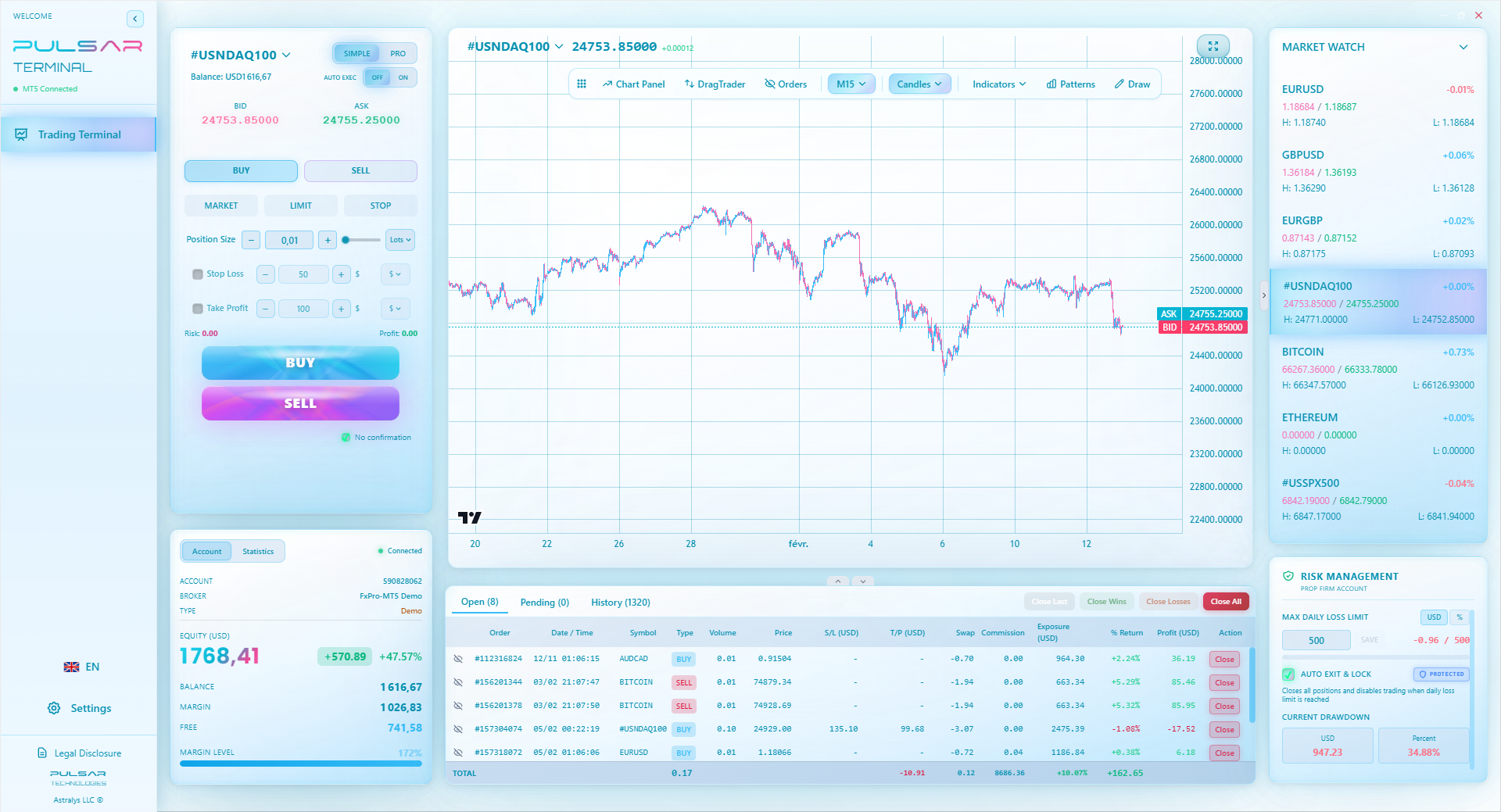
Managing a community of traders means answering endless questions about tools; having a powerful MT5 add-on like Pulsar Terminal with advanced drawing tools and Volume Profile helps you provide better, more visual guidance.
Pulsar Terminal
La herramienta MT5 todo-en-uno: órdenes drag-and-drop, multi-TP/SL, trailing stop, grid trading, Volume Profile y protección prop firm. Usado por más de 1.000 traders diariamente.
“Your credibility is your entire business. Never guarantee profits to get a sign-up.”
Let's wrap this up by talking about failure. Because you will make mistakes. Here are the big ones I've made or seen others make, so you can sidestep them.
Pitfall 1: Partnering with an Unregulated or Shady Broker. This is the cardinal sin. The promise of higher payouts is a siren song. I almost fell for it with a 'broker' offering 60% revenue share and 'guaranteed' no slippage. A bit of digging showed they were registered in a dubious offshore jurisdiction with multiple complaints about withdrawal delays. The short-term gain would have destroyed my long-term reputation. Always, always verify FSCA regulation first.
Pitfall 2: Neglecting Your Own Trading Education. How can you genuinely relate to or educate traders if you don't understand the MACD indicator or the psychology of a swing trading drawdown? You don't need to be a pro, but you need to speak the language fluently. I once tried to explain a broker's ECN model to a prospective client and fumbled it badly. I lost the sign-up and his respect. I spent the next month drilling down on order book dynamics so it would never happen again.
Pitfall 3: Chasing Volume Over Quality. In my affiliate days, I'd run ads to a 'FREE $100,000 DEMO ACCOUNT!' landing page. I got sign-ups, but they were mostly kids playing with fake money. Zero conversions to real accounts. When I changed the ad to 'A Realistic Guide to Risk Management for South African Traders,' I got one-tenth the clicks, but the people who came were serious. My conversion rate went from 0.1% to over 5%. Quality leads beat empty volume every single time.
Pitfall 4: Not Tracking Your Data. If you don't know which article, which video, or which ad brought in your best client, you're flying blind. Use UTM parameters on your links. Use the analytics in your partner dashboard. Know your numbers. This is business, not luck.
Pitfall 5: Expecting Overnight Success. This is a marathon. My first profitable month as an IB took 8 months of consistent, unpaid work. If you need money next week, get a part-time job. This is a long-term build.
The forex partnership program landscape in South Africa is full of real opportunity, but it's covered in a thick layer of hype and get-rich-quick nonsense. Scrape that away, focus on providing genuine value within a solid regulatory framework, and you can build a legitimate, rewarding business. It won't be easy, but the things worth doing rarely are. Start with the right broker, focus on helping one person understand what a pip really is, and build from there. Good luck.
FAQ
Q1Do I need an FSCA license to start a forex partnership program in South Africa?
Not necessarily, but you must be very careful. If you are only referring clients to a fully licensed FSCA broker and not managing their funds or giving specific financial advice, you can often operate under the broker's license as a marketing partner. However, the moment you give tailored trading advice or handle client money, you likely need your own FSP license. Always consult with a financial services lawyer and only partner with FSCA-regulated brokers to stay safe.
Q2What's better: Revenue Share or CPA (Cost Per Acquisition)?
There's no universal 'better.' It depends on your goals. CPA gives you immediate cash ($200-$800 per qualified client), which is great for short-term cash flow. Revenue Share (20-50% of spreads) offers long-term, residual income but takes time to build. Many successful partners prefer a hybrid model: a smaller CPA plus a lower revenue share. This balances instant reward with ongoing potential.
Q3How much can I realistically earn as a beginner in South Africa?
Manage your expectations. In your first 6 months, if you refer 5-10 active traders, you might earn a few hundred to a couple thousand Rand per month. This is a build-up phase. Consistent earnings of R10,000+ per month typically require 12-18 months of dedicated work building an audience or community. The 'R100,000 per month' stories are from established businesses with large networks, not beginners.
Q4Which FSCA-regulated brokers have the best partnership programs for South Africans?
Look for brokers that combine strong local support with competitive terms. XM, FP Markets, AvaTrade, and HF Markets (HFM) all have FSCA authorization and structured IB/affiliate programs. Key things to check: do they offer ZAR accounts for easy deposits? Do they have a local support line? Is their partner dashboard detailed and reliable? Don't just pick the one with the highest advertised commission rate.
Q5Is it legal to promote forex trading to South Africans?
Yes, it is legal to promote forex trading and broker services in South Africa, provided you and the broker you're promoting comply with FSCA regulations. The critical rules are transparency (disclosing your commission), not guaranteeing profits, and ensuring all marketing is fair and not misleading. Promoting an unregulated, offshore broker to South African residents carries significant risk and is not advisable.
Q6What's the biggest mistake new forex affiliates make?
Focusing on quantity over quality. Spamming referral links everywhere attracts poor-quality leads that don't convert or trade for long. The biggest mistake is not providing value first. Build trust by educating and helping potential traders. The referrals that come from a place of trust are far more valuable and sustainable than any click from a random ad.
Lección del Prof. Winston
Puntos clave:
- ✓FSCA regulation is non-negotiable. Verify it yourself.
- ✓Revenue share from tight spreads beats a high percentage from wide ones.
- ✓Focus on quality, trusted referrals, not spammy volume.
- ✓It's a 12-18 month build, not a 30-day miracle.
¿Te resultó útil este artículo?
Haz clic en una estrella
Análisis Trading Semanal
Análisis y estrategias semanales gratis. Sin spam.
Sobre el autor
David van der Merwe
Trader de Mercados Emergentes
Trader con sede en Johannesburgo con 11 años en divisas de mercados emergentes. Especialista en pares ZAR, trading regulado por la FSCA y análisis del mercado sudafricano.
Comentarios
Aviso de riesgo
El trading de instrumentos financieros conlleva un riesgo significativo y puede no ser adecuado para todos los inversores. El rendimiento pasado no garantiza resultados futuros. Este contenido tiene fines educativos únicamente y no debe considerarse asesoramiento de inversión. Siempre realice su propia investigación antes de operar.
También te puede interesar

Cara Trading Forex Sukses: 7 Prinsip dari Trader Profesional
Cara trading forex sukses dengan 7 prinsip trader pro: manajemen modal, disiplin, journal trading, backtest. Data nyata, bukan janji profit palsu.
Jam Trading Forex Terbaik untuk Trader Indonesia: Panduan Lengkap dengan Tabel Waktu
Panduan jam trading forex untuk trader Indonesia. Tabel 4 sesi dunia, jam emas 20:00-00:00, sesi mana yang harus dihindari. Data akurat + tips dari trader berpengalaman.
Top 5 Sàn Forex Uy Tín Nhất 2026: Review Jujur dari Trader Indonesia
Top 5 sàn forex uy tín 2026 untuk trader Indonesia. Review jujur: spread, deposit, withdraw, dukungan lokal. Exness, XM, IC Markets & lebih.
Obtener Pulsar Terminal
Todas estas calculadoras están integradas en Pulsar Terminal con datos en tiempo real de su cuenta MT5.
Obtener Pulsar Terminal