


Let's be blunt: most people think a forex pool account is a shortcut to riches.

David van der Merwe
Trader de Mercados Emergentes ·  South Africa
☕ 12 min de lectura
Lo que aprenderás:
- 1What Exactly Is a Forex Pool Account? (It's Not What You Think)
- 2The South African Rules: FSCA, SARB, and What's Actually Legal
- 3Real Numbers: Costs, Minimums, and the Rand's Impact
- 4FSCA-Regulated Brokers Offering PAMM & MAM in SA
- 5How to Vet a Manager (And Spot a Scam a Mile Away)
- 6Honest Alternatives: Is a Pool Account Even Right For You?
- 7A Step-by-Step Plan to Start Safely (If You Proceed)
Let's be blunt: most people think a forex pool account is a shortcut to riches. They're wrong. I've seen more accounts blown in managed pools than by solo traders making their own mistakes. The allure is obvious - hand your money to a 'pro' and watch it grow. But in South Africa, with our unique regulations and the rand's wild swings, it's a minefield. I've been on both sides, as an investor and later managing capital. I'll show you exactly how these accounts work, the legal fine print the FSCA cares about, and how to tell a genuine opportunity from a disaster waiting to happen.
When you hear 'forex pool account' in South Africa, forget the image of a communal fund. You're almost always talking about one of two specific broker tools: a PAMM or a MAM account. These aren't magical profit generators. They're administrative systems that let one person place trades that automatically replicate across multiple investors' accounts.
A PAMM (Percentage Allocation Management Module) account is the most common. Here's how it works: Investors (like you) allocate funds to a designated 'manager' account. The manager trades. All profits and losses are then distributed proportionally based on each investor's share of the total pool. If you put in 10% of the capital, you get 10% of the profit (or loss). The broker's software handles all the math.
A MAM (Multi-Account Manager) account is more flexible, often used by professional money managers. The manager has one master terminal. They can allocate different trade sizes or risk percentages to each sub-account under their control. This means not every investor gets the identical position size, which allows for customisation based on an investor's risk tolerance.
The critical thing to understand? You are NOT buying into a collective investment scheme in the traditional, regulated sense (though the FSCA watches these closely, as we'll discuss). You are opening a trading account with a broker, and you are granting trading authority to a third party. Your money stays in your name, in a segregated account at the broker. But the manager has the power to trade it.

Warning: This structure is the core of the risk. You are legally liable for every loss the manager incurs on your allocated funds. There is no 'limited liability' pool. If the manager blows up the account, you lose your deposit. I learned this the hard way early on, trusting a manager with a great track record during a calm market. When USD/ZAR spiked on a political rumor, his aggressive strategy wiped out my $2,000 allocation in under an hour. The broker's system just executed the losses across all sub-accounts, mine included.

💡 Consejo de Winston
A manager who talks more about risk management than returns is worth ten who only show you profit charts. The first is a professional; the second is a marketer.
This is where most online guides get vague. In South Africa, the rules around forex pool accounts sit in a grey area between several regulators. Ignoring this is how you get into trouble.
The FSCA's Role
The Financial Sector Conduct Authority (FSCA) is your first line of defence. They regulate the conduct of financial services providers. The broker offering the PAMM/MAM platform MUST be licensed by the FSCA. This is non-negotiable for your protection. It ensures client funds are segregated, and the broker meets certain financial standards. You can check any broker's status on the FSCA's website.
However, and this is crucial: The FSCA does NOT license or approve individual PAMM managers. Their oversight is of the broker, not the guy in his home office running the strategy. So when a manager shows you his 'track record,' that's not FSCA-verified performance. It's just a report from the broker's system.
The SARB and Exchange Controls
The South African Reserve Bank (SARB), through its Financial Surveillance Department (FinSurv), controls the movement of capital in and out of South Africa. You are allowed to invest offshore, but you must use an authorised dealer (like your bank or a licensed broker). When you fund a forex pool account with an international broker, you're engaging in a cross-border transaction. You must declare this if asked. The broker handles the conversion from ZAR.

Pro Tip: Always use an FSCA-regulated broker that offers ZAR-denominated accounts or easy ZAR deposits. It simplifies the exchange control process and reduces conversion fees. Brokers like XM review and others on our list offer this.
The CISCA Act Grey Zone
The Collective Investment Schemes Control Act (CISCA) regulates things like unit trusts. If someone is publicly promoting a 'forex investment pool' and soliciting funds from the public with a promise of returns, they might be illegally operating a collective investment scheme without a license. A PAMM account offered by a legitimate broker to its clients is generally structured to avoid this classification. But if you see someone on social media gathering money into their personal account to 'trade for the pool,' run. That's likely illegal.
The regulatory landscape is tightening. The FSCA's 2025-2028 plan aims for clearer rules, and they've been cracking down on unlicensed entities since late 2024. Trading with an FSCA broker is your safest harbour in this regulatory sea.
“The FSCA regulates the broker, not the guy in his home office running the strategy. That oversight gap is where your due diligence must live.”
Let's talk specifics, because vague promises hide real costs. A forex pool account has multiple layers of fees that eat into returns.
1. The Broker's Costs: You still pay the broker's spreads or commissions on every trade the manager makes. On major pairs like EUR/USD, raw spreads can be as low as 0.0 pips with brokers like IC Markets review or Pepperstone review, plus a commission. But if the manager is a high-frequency scalper, those commissions add up fast across hundreds of trades.
2. The Manager's Performance Fee: This is the big one. A typical structure is "30% of profits." But you need to read the fine print. Is it 30% of net profits each month? Is there a high-water mark? A high-water mark means the manager only takes a fee once they've made back any previous losses for you. Without it, they can lose your money in January, make half back in February, and still take a fee on the February gain - even though you're still down overall. I got burned by this early on.
3. Minimum Deposits: These vary wildly. Some pools allow you to start with as little as $5 or $10. Others, especially serious MAM setups, require $100, $200, or even more. A low minimum isn't always good - it can attract managers who just want a large number of small accounts to look impressive.
The ZAR Factor: Your investment journey starts and ends in Rands. If you deposit ZAR 10,000 when USD/ZAR is at 18.00, and later withdraw when it's at 16.50, you've made a 9% gain on the currency move alone before any trading even happens. The reverse is also true. A good trading profit can be wiped out by a rand rally. You must factor this currency risk into your total return calculation.
Example from my journal: In Q1 2025, I allocated $1,000 (approx. ZAR 18,000 at the time) to a conservative PAMM. The manager made a 7% trading profit ($70). His 30% fee took $21. My net was $49. When I withdrew, USD/ZAR had strengthened to 17.00, so my $49 profit was only about ZAR 833. The net return in ZAR terms was less than 5%. The forex move halved my effective gain.
💡 Consejo de Winston
When evaluating a track record, zoom in on the periods of loss, not the wins. How a manager behaves in a drawdown tells you everything about their discipline.
Based on current offerings and my own experience, here are brokers that provide these services to South African clients under FSCA regulation. This isn't a recommendation, but a starting point for your research.
| Broker | Account Type Offered | Key Feature for SA Traders | Min. Deposit (Approx.) |
|---|---|---|---|
| FP Markets | MAM/PAMM | Raw spreads from 0.0 pips, ECN pricing. | $100+ |
| AvaTrade | PAMM | Well-established, strong regulation. | $100 |
| IC Markets | MAM | Very popular for raw spread accounts. | $200 |
| XM | MT5 Multi-Account Tools | Offers ZAR accounts, very low minimums. | $5 |
| Vantage | PAMM/MAM Support | Includes copy trading via Myfxbook. | Varies |
| Tickmill | Tailored MAM | Premium conditions on request. | On request |
A critical step is to go beyond this list. Visit the FSCA website (www.fsca.co.za) and verify the broker's license number yourself. Then, dig into the specific terms of their PAMM/MAM offering. How are fees deducted? How transparent is the manager's historical drawdown? Can you withdraw your allocation at any time, or is it locked?
Some brokers, like Exness review, also have sophisticated multi-account management tools, though their specific FSCA status should always be double-checked as offerings change. The platform of choice is almost always MetaTrader 4 or 5, as the PAMM/MAM plugins are built for them. If you're considering swing trading strategies in a pool, ensure the manager's style aligns with the platform's execution capabilities.
“A low minimum deposit isn't always good - it can attract managers who just want a large number of small accounts to look impressive.”
This is the most important skill you'll learn. The manager is everything. Here’s my checklist, forged from expensive mistakes.
The Scam Red Flags:
- Guaranteed Returns: Anyone promising monthly returns (e.g., "10% per month guaranteed") is lying. Forex is risk. Period.
- No Visible Track Record: A real PAMM/MAM account on a broker's platform will have a publicly viewable history. If they only show screenshots of a trading terminal, it's fake.
- Pressure to Deposit: Urgency is a tool of fraudsters.
- Complex Withdrawal Rules: If it sounds complicated to get your money back, it's because they don't intend to give it back.
The Due Diligence Process:
- Analyze the Verified Track Record: Look for at least 18-24 months of history. Anyone can be lucky for 6 months. Check the broker's PAMM leaderboard or the manager's Myfxbook link. Look at the drawdown - the largest peak-to-trough loss. A 70% return means nothing if it came after a 60% drawdown. That's gambling, not management.
- Understand the Strategy: Ask the manager. Are they a scalping strategy user? A news trader? Do they use indicators like the RSI indicator or MACD indicator? If they can't explain it simply, they might not have one.
- Check Consistency: Are returns steady and modest, or are they giant spikes followed by periods of loss? Smooth equity curves are better than Himalayan mountains.
- Communication: A professional manager should be able to articulate their risk management. What's their maximum risk per trade? How do they handle losing streaks? My rule: if they don't mention risk first, I'm out.

Example: I once evaluated a manager showing a 120% yearly return. Sounds great. But using a position size calculator to reverse-engineer his average trade size showed he was risking over 5% of the account per trade. One string of losses would be catastrophic. I passed. Six months later, his account was closed after a 90% drawdown.
💡 Consejo de Winston
If you can't explain the manager's core strategy in one simple sentence to a friend, you haven't understood it well enough to invest.
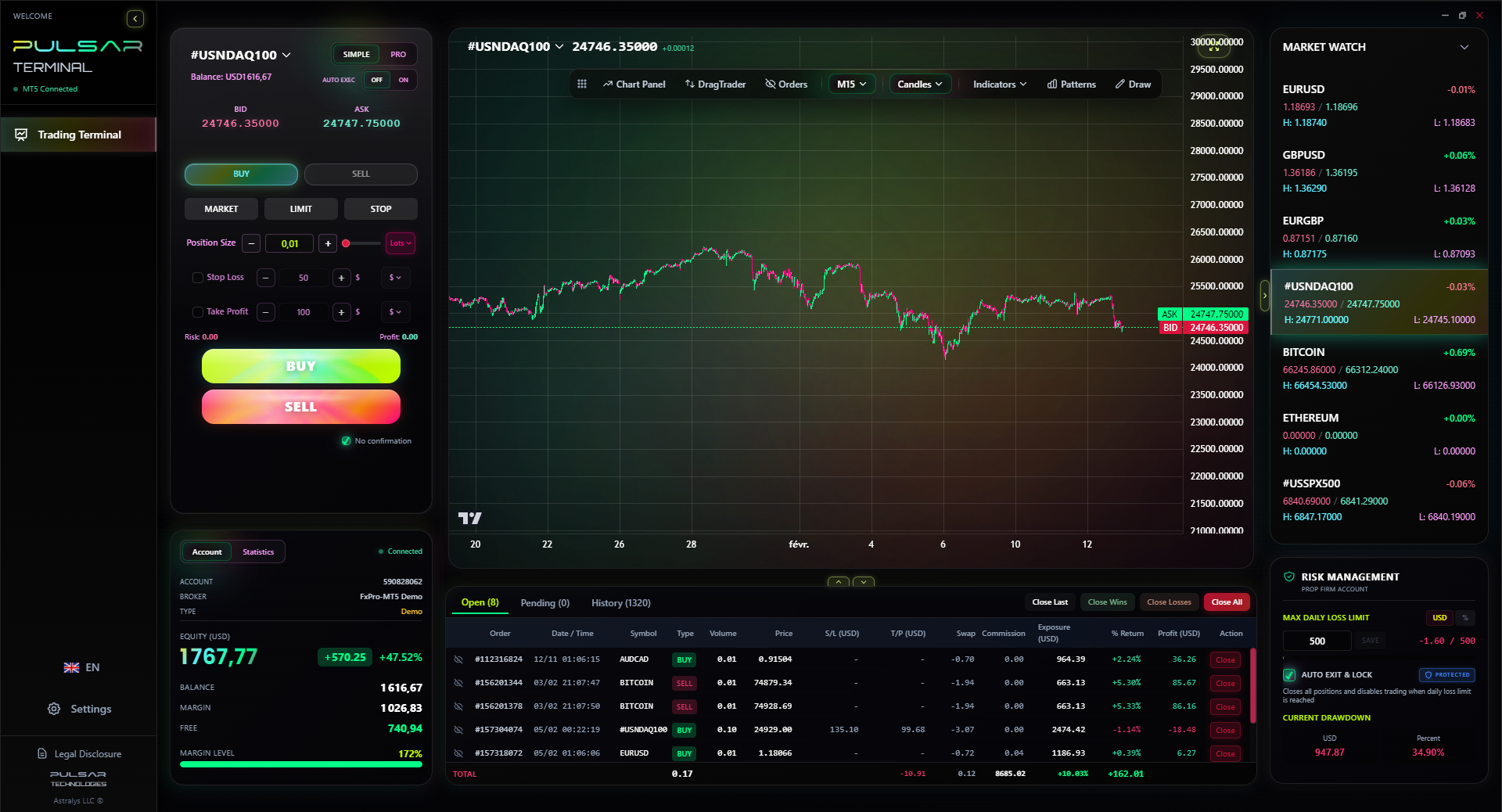
Vetting a manager's strategy is key, and tools like Pulsar Terminal's advanced charting and Volume Profile on MT5 let you analyze market structure just like a pro would.
Pulsar Terminal
La herramienta MT5 todo-en-uno: órdenes drag-and-drop, multi-TP/SL, trailing stop, grid trading, Volume Profile y protección prop firm. Usado por más de 1.000 traders diariamente.
After 12 years, I believe forex pool accounts are suitable for a very narrow set of people: those with capital who understand the markets but have no time or desire to trade themselves, and who have done immense due diligence. For everyone else, consider these alternatives first.
1. Learn to Trade Yourself: It's harder, but you keep 100% of the profits and learn an useful skill. Start with a demo account, then a very small live account. The education is a better investment than any manager's fee. Our guide on EUR/USD guide is a solid starting point for understanding a major pair.
2. Use a Copy Trading Platform: Some brokers offer integrated copy trading (like Vantage with Myfxbook). You choose a trader to copy, and their trades are mirrored in your account in real-time. The key difference? You can usually stop copying with one click. You have more direct control and can set your own risk parameters (like trade size multiplier). It's more transparent than many opaque PAMM structures.
3. Invest in Regulated Instruments: If you want exposure to currency moves without the use risk, consider SARB-approved ETFs or funds that track currency baskets. It's boring, but it's safe.
The brutal truth is that the high unemployment driving many South Africans to seek quick returns in forex is the same reason scam pools thrive. Desperation clouds judgment. If you wouldn't hand a stranger ZAR 20,000 in cash to bet at a casino, don't hand it to an unvetted PAMM manager. The principle is identical.
Managing the psychology of watching someone else trade your money is also tough. When they hit a drawdown, the urge to pull out is intense, even if it's part of their plan. You need the discipline to stick to your initial due diligence, not emotional reactions.
“If you wouldn't hand a stranger ZAR 20,000 in cash to bet at a casino, don't hand it to an unvetted PAMM manager. The principle is identical.”
If you've read everything above and still want to proceed, here's a conservative action plan. I wish I had followed this myself a decade ago.
Step 1: Education Before Capital. Spend a month understanding forex basics. Know what a pip definition and spread definition are. Learn what a margin call is. This knowledge lets you ask intelligent questions.
Step 2: Broker First, Manager Second. Choose an FSCA-regulated broker from the list above that offers transparent PAMM/MAM services. Open a standard live account with a tiny deposit (e.g., $50). Get familiar with their platform and withdrawal process first.
Step 3: The Paper Test. Most broker PAMM platforms let you view manager statistics. Pick 2-3 managers whose philosophy you like. For 3 months, paper track them. Record their weekly results, drawdown, and see if their actual performance matches their stated strategy. Do this without any money invested.
Step 4: The Pilot Allocation. Allocate a small amount you can afford to lose completely - maybe 5% of your total trading capital. Use this to test the actual process: funding the allocation, watching the trades appear, seeing how fees are deducted, and practicing a withdrawal. This is a systems test, not a profit test.
Step 5: Evaluate and Scale (Maybe). After 6 months of successful pilot allocation, if you're comfortable with the manager's performance through various market conditions (like rand volatility), then you might consider a larger allocation. Never put all your capital in one pool. Never add more money after a big winning streak out of excitement.
This process is slow. It's boring. It won't make you rich next month. But it's the only method I've seen that separates the careful investors from the statistical casualties. The forex market will be here tomorrow. The key is making sure you are too.
FAQ
Q1Is it legal for South Africans to use international forex pool accounts?
Yes, but with conditions. You must use an authorised dealer (an FSCA-licensed broker is your safest bet) to transfer funds abroad for investment. The broker handles the exchange control reporting. Investing through an unregulated offshore entity is risky and may violate SARB regulations.
Q2What's the difference between a PAMM account and copy trading?
In a PAMM, you allocate funds to a manager's pool and surrender trading control. Your profit share is calculated periodically. In copy trading, you link your own account to a trader's account, trades are copied in real-time into your account (which you still control), and you can usually set your own risk parameters and stop copying instantly.
Q3What is a 'high-water mark' and why is it important?
A high-water mark is a clause in a manager's fee structure that prevents them from taking performance fees until they have made back any previous losses they incurred for you. It aligns their interests with yours. Without it, a manager can collect fees on gains even if your account is still in a net loss position from their earlier trading.
Q4Can I lose more money than I deposit in a forex pool account?
With a standard PAMM/MAM account at a reputable broker, no. Your loss is limited to the capital you allocated, plus any accrued fees. However, some exotic account types or fraudulent schemes might expose you to unlimited liability. Always confirm with the broker that your account has 'negative balance protection,' which is standard with FSCA-regulated entities.
Q5How are taxes handled on profits from a PAMM account in South Africa?
Profits from forex trading are generally considered capital gains or income by SARS, depending on your trading frequency and intent. It is your responsibility as the investor to declare any profits from a PAMM account for tax purposes. Keep detailed records of all statements, deposits, withdrawals, and fee reports from the broker.
Q6What happens if the PAMM manager decides to stop managing?
Typically, the manager will close all open positions and the PAMM account will be dissolved. Your allocated capital, plus or minus the final profit/loss, will be returned to your main trading account with the broker. The specific process should be outlined in the broker's PAMM terms and conditions.
Lección del Prof. Winston
Puntos clave:
- ✓Verify FSCA license first, before looking at returns.
- ✓Demand a minimum 18-month verified track record.
- ✓A high-water mark fee clause is non-negotiable.
- ✓Start with a pilot allocation you can afford to lose 100%.
¿Te resultó útil este artículo?
Haz clic en una estrella
Análisis Trading Semanal
Análisis y estrategias semanales gratis. Sin spam.
Sobre el autor
David van der Merwe
Trader de Mercados Emergentes
Trader con sede en Johannesburgo con 11 años en divisas de mercados emergentes. Especialista en pares ZAR, trading regulado por la FSCA y análisis del mercado sudafricano.
Comentarios
Aviso de riesgo
El trading de instrumentos financieros conlleva un riesgo significativo y puede no ser adecuado para todos los inversores. El rendimiento pasado no garantiza resultados futuros. Este contenido tiene fines educativos únicamente y no debe considerarse asesoramiento de inversión. Siempre realice su propia investigación antes de operar.
También te puede interesar

Cara Trading Forex Sukses: 7 Prinsip dari Trader Profesional
Cara trading forex sukses dengan 7 prinsip trader pro: manajemen modal, disiplin, journal trading, backtest. Data nyata, bukan janji profit palsu.
Jam Trading Forex Terbaik untuk Trader Indonesia: Panduan Lengkap dengan Tabel Waktu
Panduan jam trading forex untuk trader Indonesia. Tabel 4 sesi dunia, jam emas 20:00-00:00, sesi mana yang harus dihindari. Data akurat + tips dari trader berpengalaman.
Top 5 Sàn Forex Uy Tín Nhất 2026: Review Jujur dari Trader Indonesia
Top 5 sàn forex uy tín 2026 untuk trader Indonesia. Review jujur: spread, deposit, withdraw, dukungan lokal. Exness, XM, IC Markets & lebih.
Obtener Pulsar Terminal
Todas estas calculadoras están integradas en Pulsar Terminal con datos en tiempo real de su cuenta MT5.
Obtener Pulsar Terminal