


Let's get this out of the way: 90% of you trying to scalp forex in Nigeria will blow your account.

Olumide Adeyemi
Pionero del Trading en África Occidental ·  Nigeria
☕ 9 min de lectura
Lo que aprenderás:
- 1Who is Bob Volman and Why Should You Care?
- 2The Core Rules (Non-Negotiable for Nigeria)
- 3A Real Trade Example: EUR/USD with a Local Broker
- 4Why This is So Damn Hard in Nigeria
- 5Tools You Actually Need (Not What You Want)
- 6My Advice? Skip This. Learn Swing Trading First.
- 7Final Verdict: Is Volman's Method Worth It?
Let's get this out of the way: 90% of you trying to scalp forex in Nigeria will blow your account. You're not special. The dream of quick Naira from a few pips is a fast track to a margin call. But for that stubborn 10% willing to suffer through the education, there's a method that actually works. I'm talking about the framework from Bob Volman's 'Forex Price Action Scalping.' It's not a magic system, it's a merciless discipline. This guide will tear apart Volman's approach, show you exactly how to apply it with Nigerian brokers like Exness and IC Markets, and tell you why you'll probably fail anyway.
Bob Volman isn't some Instagram guru selling a get-rich-quick dream. He's a former professional trader who wrote a dense, technical manual called 'Forex Price Action Scalping.' Forget fancy indicators, automated robots, or news trading. His entire philosophy is built on one thing: reading the raw price movement on a 1-hour and 15-minute chart to find high-probability, low-risk entries for scalps that last minutes.
His book is famously difficult. It's 400+ pages of chart patterns with names like 'inside bar thrust' and 'spacious range.' It assumes you already understand support, resistance, and basic market structure. For a Nigerian trader used to chasing signals from WhatsApp groups, it's a cold shower. But that's the point. Scalping isn't about excitement; it's about surgical precision and extreme patience. Volman provides the surgical manual.

Warning: If you're looking for a 'setup' that wins 8 out of 10 times, stop reading. Volman's method is about finding 1-2 exceptional setups per day where the risk is tiny and the potential reward is 2-3 times that risk. Most of your day will be spent watching and doing nothing. That boredom is what kills most traders here.
“Scalping isn't about excitement; it's about surgical precision and extreme patience.”
Volman's strategy has pillars. Break one, and you're not trading his method, you're just gambling with a fancy excuse.
Rule 1: The 1-Hour Chart is King
Every single trade starts on the 1-hour chart. You use it to identify the overall trend and key support/resistance levels. The 15-minute chart is only for fine-tuning your entry. Starting on a lower timeframe is a surefire way to get chopped up by market noise. I learned this the hard way. In early 2023, I ignored a clear downtrend on the EUR/USD 1-hour chart because I saw a 'pretty' bullish pin bar on the 5-minute. I went long. The market ripped 40 pips against me in 90 seconds. That was a $400 lesson funded by my own arrogance.
Rule 2: Risk a Maximum of 0.5% Per Trade
This is where Nigerian traders screw up. With brokers offering high use, the temptation to risk 5% or 10% for a 'quick double' is insane. Volman is adamant: 0.5%. On a $1,000 account, that's $5. If your stop loss is 5 pips away, your position size must be micro (0.01 lots) or nano lots. Use a position size calculator for every single trade. No exceptions.
Rule 3: The Setup Must Be "Clean"
Volman has specific criteria for what constitutes a tradable pattern. It must occur at a clear technical level (like a previous swing high). The price action bars leading to it must show conviction, not indecision. If the pattern looks messy or occurs in the middle of nowhere on the chart, you skip it. This rule alone will have you skipping 95% of what you initially think are trades.

💡 Consejo de Winston
A setup that looks 'good enough' is a setup you should skip. Volman's edge comes from waiting for the exceptional, not trading the average.
“If you're looking for a 'setup' that wins 8 out of 10 times, stop reading.”
Let's make this concrete with numbers from a broker popular here, like Exness or IC Markets.
Date: March 15, 2024 Instrument: EUR/USD Broker: IC Markets (Raw Spread Account) Account Balance: $2,500
- 1-Hour Analysis: EUR/USD is in a steady uptrend, making higher highs and higher lows. It pulls back to a clear support level that was previously resistance (a 'role reversal').
- The Setup: On the 1-hour, a bullish engulfing bar forms right at that support. Switching to the 15-minute chart, I see a tight consolidation followed by a break above a minor high.
- The Trade:
- Entry: 1.0885 (buy limit order placed after the 15-min break)
- Stop Loss: 1.0875 (10 pips below entry, placed just below the 1-hour support)
- Take Profit: 1.0915 (30 pips above entry, near the next 1-hour resistance)
- Risk: 0.5% of $2,500 = $12.50
- Pip Risk: 10 pips
- Position Size: ($12.50 / 10 pips) = $1.25 per pip. On EUR/USD, that's a 0.13 lot position (rounded to 0.12 for safety).
- Costs: IC Markets Raw account had a 0.1 pip spread on EUR/USD at that time, plus a $3.50 commission per lot, round turn. Commission = 0.12 lots * $7 = $0.84. A negligible cost against a potential $36 profit.
- Result: Price moved up smoothly, hit my take profit in about 2 hours. Net profit: ~$35.
That's it. Not glamorous. Not a life-changing sum. But it was a 3:1 reward-to-risk trade taken with discipline. This is the grind Volman advocates.
“If you're looking for a 'setup' that wins 8 out of 10 times, stop reading.”
The theory is simple. The execution in our environment is a nightmare. Here’s what you’re fighting:
Internet & Power Instability: A scalping trade can be over in minutes. If your generator kicks in or your data drops for 30 seconds during entry, you're done. I once had a perfect setup on XAU/USD (gold). My internet died as I clicked 'buy.' By the time I reconnected, the trade had hit its stop loss and reversed to hit its would-be take profit. I just sat there, watching money I couldn't make.
Broker Execution & Spreads: Not all brokers are equal for scalping. You need a broker with razor-thin spreads and instant execution. During volatile news events, spreads on even the best brokers can widen from 0.1 pips to 10 pips or more. If your strategy relies on a 10-pip stop loss, a 5-pip spread on entry instantly eats half your risk buffer. This is why I stick with brokers known for good execution like Pepperstone or IC Markets for this style.
The Psychological Toll: Sitting for 6 hours to maybe take one trade goes against every 'hustle' bone in a Nigerian's body. The pressure from family expecting quick returns, the temptation to over-use just to make the day 'worth it'... it's immense. This strategy requires you to be a monk.

Pro Tip: Test your broker's execution in a demo account during London open (1 PM Nigerian time) and NY open (2 PM Nigerian time in non-DST periods). Place market orders and see the slippage. If it's consistently more than a pip on majors, find a new broker for scalping strategy.
💡 Consejo de Winston
Your first 100 scalping trades are tuition, not income. If you haven't blown a small demo account learning this, you haven't learned anything.
“Starting on a lower timeframe is a surefire way to get chopped up by market noise.”
You don't need 20 indicators cluttering your screen. You need a clean, reliable setup.
- A Proper Platform: MetaTrader 4 or 5 is the standard. Most Nigerian brokers support it. Learn how to set horizontal support/resistance lines and trendlines. That's your primary tool.
- A Stable Connection: Invest in a reliable ISP with a backup (like your phone's hotspot). Treat it as a business cost.
- A Trading Journal (The Most Important Tool): This isn't optional. For every trade, screenshot the setup, note your entry/exit reasoning, your emotional state, and the result. After 100 trades, you'll see your real edge (or lack thereof). My journal showed me I was terrible at trading during the Asian session. I now only trade London and NY overlaps.
- Optional: Volume Confirmation. While Volman uses pure price action, I sometimes use the MACD indicator on the 1-hour chart not for signals, but to check for momentum divergence at key levels. If price makes a new high but MACD doesn't, it warns me the trend might be exhausted. Don't overcomplicate it.
Let's compare what matters for a Nigerian scalper:
| Feature | Why It Matters for Volman's Scalping | Nigerian Reality Check |
|---|---|---|
| Spreads | Need to be tight & stable. A 2-pip spread kills a 10-pip stop loss. | Check brokers like FP Markets, IC Markets for Raw/ECN accounts. Avoid standard accounts with 2-pip+ spreads. |
| Execution Speed | Slippage on entry can ruin risk management. | Look for brokers with NDD/ECN models. Demo test extensively. |
| Minimum Deposit | You need enough capital to risk 0.5% sensibly. | Many brokers allow $100-$200. With $100, a 0.5% risk is $0.50. Your position size will be tiny, but it's a start. |
| Withdrawal Method | You need to get your profits out. | Prioritize brokers with reliable local bank transfer or crypto withdrawals. XM and Exness are known for this here. |
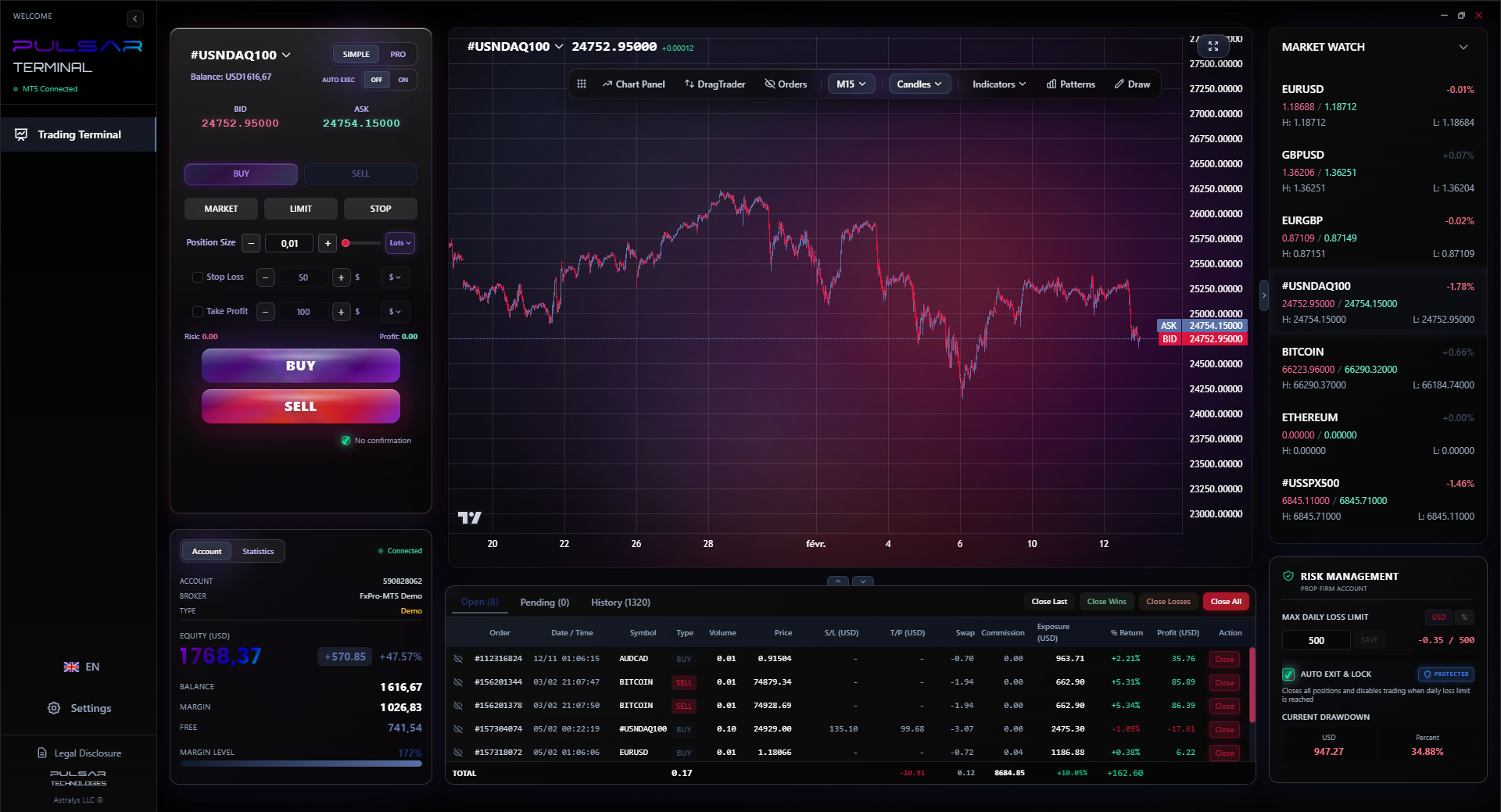
Managing multiple take-profit levels and a trailing stop on a fast-moving scalp is nearly impossible manually, which is where a tool like Pulsar Terminal automating it on MT5 becomes essential.
Pulsar Terminal
La herramienta MT5 todo-en-uno: órdenes drag-and-drop, multi-TP/SL, trailing stop, grid trading, Volume Profile y protección prop firm. Usado por más de 1.000 traders diariamente.
“Starting on a lower timeframe is a surefire way to get chopped up by market noise.”
I've been mentoring traders for over a decade. If you're new and reading this from Lagos, Abuja, or Port Harcourt, I'm telling you straight: do not start with forex price action scalping by Bob Volman.
It's a master's degree in trading. You need to learn the alphabet first. The emotional control, chart reading, and risk management required are extreme. You will lose money while learning, and with scalping, those losses happen fast and frequently.
Start with swing trading. Hold trades for days, not minutes. Learn to analyze the daily chart. Get comfortable with a 50-pip stop loss. Build your capital and your confidence. After a year or two of consistent swing trading profits, then maybe, just maybe, look at Volman's book. The principles of reading price action are the same, but the timeframe gives you time to think.
Scalping exposes every flaw in your psychology and technique instantly. Most people aren't built for that kind of feedback. It's okay to admit that. Preserving your capital is the first rule. Jumping into the deep end with concrete shoes is not a strategy.
💡 Consejo de Winston
The most important price action happens in the 30 minutes before London opens. Watch it like a hawk, but don't feel compelled to trade.
“The dream of scalping for quick Naira is a siren song that leads to broken accounts.”
Bob Volman's 'Forex Price Action Scalping' is the real deal. It's a legitimate, professional-grade methodology. But calling it a 'strategy' undersells it. It's a complete trading philosophy that demands total commitment.
Is it worth it for a Nigerian trader? Only if:
- You have at least $2,000 in risk capital you can afford to lose.
- You have a rock-solid internet connection and a quiet place to trade.
- You've already mastered basic technical analysis on higher timeframes.
- You possess inhuman levels of patience and discipline.
For the 99%, the answer is no. The local challenges amplify the difficulty tenfold. The dream of scalping for quick Naira is a siren song that leads to broken accounts. If you're determined, buy the book. Study it for six months on demo. Then trade micro lots for another six months. If you're still profitable, you might have what it takes.
For everyone else, there are smarter, slower ways to build wealth in the markets. Start there. Your bank account will thank you.
FAQ
Q1What is the minimum account balance needed to start scalping with Bob Volman's method in Nigeria?
Technically, you can start with $100 on a micro account. Practically, I wouldn't touch it with less than $2,000. Why? With a 0.5% risk rule, a $100 account only risks $0.50 per trade. After broker spreads and commissions, you have no room for error. A $2,000 account lets you risk $10 per trade, allowing for more sensible position sizing and the ability to withstand a string of losses without blowing up.
Q2Which Nigerian forex broker is best for this type of scalping?
Look for international brokers with strong local support, ECN/Raw accounts, and tight spreads. Based on execution speed and cost, brokers like IC Markets, FP Markets, and Pepperstone are often top contenders. Always verify their current withdrawal methods for Nigeria, as policies can change. Avoid any broker with a 'no scalping' policy or consistently wide spreads.
Q3Can I use Volman's scalping method on my phone?
Absolutely not. Don't even think about it. Scalping requires precise entry orders, quick adjustments, and a clear, large chart. Trying to do this on a mobile screen is a guaranteed way to make costly mistakes. This is a desktop-only activity.
Q4How many pips does Bob Volman aim for per trade?
Volman doesn't aim for a fixed pip target. He aims for a favorable risk-to-reward ratio, typically 1:2 or 1:3. If his stop loss is 5 pips, he'll aim for a 10-15 pip profit. The take profit is always based on the next logical technical level on the chart, not a random number.
Q5Is this strategy good for trading USD/NGN?
No. The USD/NGN pair is highly illiquid for retail traders and subject to direct Central Bank of Nigeria (CBN) interventions. The spreads are massive and unpredictable. Volman's method relies on liquid markets with tight spreads. Stick to major pairs like EUR/USD, GBP/USD, or USD/JPY.
Q6Do I need to buy Bob Volman's book to learn this?
Yes. There are summaries online, but they're incomplete. The real value is in Volman's detailed explanations of context and his hundreds of chart examples. Consider the book a necessary tuition fee. If you're not willing to invest in the textbook, you're not serious about the method.
Q7What's the biggest mistake Nigerian traders make with scalping?
Over-leveraging. They see a small account, tight stops, and think high use is the key to big profits. It's the key to instant ruin. A 0.5% risk rule with 1:100 use is disciplined. The same rule with 1:500 use is a ticking bomb. Your broker's available use is a limit, not a target.
Lección del Prof. Winston
Puntos clave:
- ✓The 1-hour chart dictates all. Never enter on a lower timeframe bias.
- ✓Maximum risk per trade is 0.5%. This is non-negotiable.
- ✓A 'clean' setup at a key level is worth 10 mediocre ones.
- ✓Broker execution speed is more critical than any indicator.
¿Te resultó útil este artículo?
Haz clic en una estrella
Análisis Trading Semanal
Análisis y estrategias semanales gratis. Sin spam.
Sobre el autor
Olumide Adeyemi
Pionero del Trading en África Occidental
Uno de los educadores de trading forex más activos de Nigeria. 8 años de experiencia operando desde Lagos. Especialista en estrategias de bajo capital y desafíos de prop firms para traders africanos.
Comentarios
Aviso de riesgo
El trading de instrumentos financieros conlleva un riesgo significativo y puede no ser adecuado para todos los inversores. El rendimiento pasado no garantiza resultados futuros. Este contenido tiene fines educativos únicamente y no debe considerarse asesoramiento de inversión. Siempre realice su propia investigación antes de operar.
También te puede interesar

Cara Trading Forex Sukses: 7 Prinsip dari Trader Profesional
Cara trading forex sukses dengan 7 prinsip trader pro: manajemen modal, disiplin, journal trading, backtest. Data nyata, bukan janji profit palsu.
Jam Trading Forex Terbaik untuk Trader Indonesia: Panduan Lengkap dengan Tabel Waktu
Panduan jam trading forex untuk trader Indonesia. Tabel 4 sesi dunia, jam emas 20:00-00:00, sesi mana yang harus dihindari. Data akurat + tips dari trader berpengalaman.
Top 5 Sàn Forex Uy Tín Nhất 2026: Review Jujur dari Trader Indonesia
Top 5 sàn forex uy tín 2026 untuk trader Indonesia. Review jujur: spread, deposit, withdraw, dukungan lokal. Exness, XM, IC Markets & lebih.
Obtener Pulsar Terminal
Todas estas calculadoras están integradas en Pulsar Terminal con datos en tiempo real de su cuenta MT5.
Obtener Pulsar Terminal