


Here's a statistic that should make you pause: over 90% of the 'top 10 broker' lists you find on the first page of Google are paid placements.

Olumide Adeyemi
Pionero del Trading en África Occidental ·  Nigeria
☕ 10 min de lectura
Lo que aprenderás:
- 1What Forex Review Sites Actually Are (Hint: It's Not Journalism)
- 2Red Flags: How to Spot Fake Reviews and Biased Lists
- 3What to Actually Look For: The Data That Matters
- 4Using Reviews to Vet Popular Brokers in Nigeria (2026)
- 5Beyond Websites: The Power of Forum Communities
- 6The Final Check: Doing Your Own Broker Due Diligence
- 7Putting It All Together: A Smarter Research Workflow

Here's a statistic that should make you pause: over 90% of the 'top 10 broker' lists you find on the first page of Google are paid placements. They're not reviews, they're advertisements dressed up as objective advice. In Nigeria, where the thirst for reliable forex information is real, this creates a dangerous minefield. I've seen traders lose deposits to brokers they found on 'trusted' review sites, only to discover the site was owned by the broker all along. This guide isn't about which site to trust blindly. It's about teaching you how to dissect them, find the truth hidden between the lines, and protect your capital from the very platforms claiming to help you.
Let's clear this up first. Most forex review sites are lead generation businesses. Their primary goal is to get you to click a link, sign up with a broker through their referral code, and collect a commission. That's the business model. It doesn't automatically make them evil, but it fundamentally shapes their content.
A site that makes $500 when you open an account with Broker A, and only $300 with Broker B, has a powerful financial incentive to rank Broker A higher. The 'review' becomes a sales pitch. I've been offered 'content partnerships' where a broker would pay a flat fee for a 'detailed review' that promised a positive outcome. I turned them down, but many don't.
The best forex review sites try to balance this conflict by being transparent about their partnerships and maintaining rigorous, evidence-based testing. The worst are brochure websites. Your first job is to figure out which is which.

Warning: If a site has a 'Best Broker 2026' banner with a broker's logo slapped on it, that's not an award. It's a paid advertising deal. Treat it with the same skepticism you would a billboard on the Lekki-Epe Expressway.
“Over 90% of the 'top 10 broker' lists on Google's first page are paid placements, not objective advice.”
Nigerian traders are a prime target for misleading marketing. Here’s what to look for, based on 12 years of seeing the same tricks.
The Language of Deception:
- Overly Generic Praise: "This broker is amazing for all traders!" Real trading has trade-offs. A broker great for scalping strategy might be terrible for swing trading due to spreads.
- No Specific Numbers: They talk about 'low spreads' but never state the actual pip value on EUR/USD during the London session. They say 'fast withdrawals' but don't mention it's 3-5 business days for bank transfers. Vague language hides poor conditions.
- Ignoring Nigerian Pain Points: Does the review mention deposit/withdrawal methods that actually work here? Does it discuss customer support in WAT business hours? A global review that doesn't address local access is useless to you.
The Conflict of Interest Test: Scroll to the very bottom of the website. Look for the "Disclosure" or "Disclaimer" link. It's usually in tiny font. Does it clearly state they receive compensation from brokers they review? If there's no disclosure, that's a major red flag. Also, check if the site has reviews for truly bad brokers. If every single review is glowing, the site is a marketing arm, not a reviewer.
My Personal Mistake: Early on, I trusted a site that ranked a particular broker #1 for 'ease of use.' I deposited $1,000. The platform was slick, but the spreads on XAU/USD were 50 pips during major news. My position size calculator was right, but the execution cost blew up my risk management. The review site never mentioned volatile spreads because they weren't trading with real money. I learned to cross-reference every claim on at least three independent sites, including forums where real traders complain.

💡 Consejo de Winston
A review site that doesn't list a single negative point about any broker isn't reviewing, it's selling. True analysis weighs strengths against weaknesses.
“A site that makes $500 when you sign up with Broker A has a powerful incentive to rank them higher. The 'review' becomes a sales pitch.”
Forget the star ratings. You need hard data. A useful review site should provide a consistent, comparable table of facts for each broker. Here’s what’s critical for a Nigerian trader:
Regulatory Licenses (The Safety Net)
This is non-negotiable. The broker should be regulated by a reputable authority. For Nigeria, common ones are:
- FSCA (South Africa): Common and respected in our region.
- FCA (UK), ASIC (Australia): Top-tier, but sometimes restrict use for retail clients.
- FSA (Saint Vincent): Common offshore license. Lower barrier to entry. Higher risk.
A good review will list ALL licenses a broker holds. A broker like Pepperstone holds multiple top-tier licenses, which is a strong sign.
Real Trading Costs
This is where you make or lose money before your trade even moves.
- Spreads: Look for the average spread on EUR/USD, not just the 'from' spread. A 'from 0.0 pips' claim is often for a pro account with a high commission. What's the typical spread on a standard account?
- Commissions: If charged, how much per lot? Is it round turn or per side?
- Swap/Rollover Rates: If you hold positions overnight, these matter. Some brokers have very high swap fees.
- Deposit/Withdrawal Fees: Specifically for methods you use. Does funding with your Nigerian debit card incur a 2% fee? Does the broker or the payment processor charge it? A review should break this down.
Local Relevance
- NGN Accounts: Does the broker offer Naira-denominated accounts? This can help avoid conversion fees. Brokers like XM and HF Markets often do.
- Local Support: Phone, email, WhatsApp? What are their operating hours?
- Accepted Payment Methods: Bank transfer, card, USSD, local e-wallets? Speed and cost of withdrawals back to your Nigerian bank are crucial.

Example: Let's compare two claims.
- Site A says: "Broker XYZ has incredibly low fees."
- Site B says: "Broker XYZ's Razor account offers EUR/USD spreads of 0.1 pips average during London/NY overlap, with a commission of $7 per round lot. Nigerian bank withdrawals take 24-48 hours with no broker fee, though your bank may charge." Site B is giving you actionable data. Site A is giving you fluff.
“A site that makes $500 when you sign up with Broker A has a powerful incentive to rank them higher. The 'review' becomes a sales pitch.”
Based on consistent presence across multiple independent forums and actual trader feedback (not just review sites), these brokers are frequently discussed in the Nigerian context. Use this as a starting list for your own deep dive.
| Broker | Key Point for Nigerian Traders | What to Verify on a Review Site |
|---|---|---|
| Exness | Known for very high use and accessibility. Popular for its local presence. | Check recent feedback on withdrawal speed for Naira. Verify if the advertised 'unlimited' use applies to your client category. Read our Exness review for a detailed breakdown. |
| IC Markets | Favored by many for raw spreads & good execution on MT4/MT5. | Confirm the actual commission structure. Check if their cTrader platform is available and if deposits in NGN are smooth. Our IC Markets review looks at this. |
| XM | Strong reputation for order execution and educational resources. | Look for data on spread stability during volatile periods. Verify their minimum deposit is still as low as advertised ($5). |
| Pepperstone | Respected for its Razor account (tight spreads + commission). | Check if their premium MT4/MT5 tools are available to all clients. Review their market analysis quality. |
| HF Markets (HotForex) | Offers NGN accounts and has a long-standing reputation. | Investigate the specifics of their NGN account: are spreads different? Are all instruments available? |
The trap is picking one from a list like this and stopping your research. Your next step is to go to 2-3 review sites and compare their data tables for your top 2 choices. Then, search for "[Broker Name] withdrawal problem Nigeria" on Twitter and forums. That's where you'll find the unfiltered truth.
💡 Consejo de Winston
Your first withdrawal is more important than your first trade. It tells you everything about how the broker treats client capital. Test it with a small amount immediately.

“Forex review sites give you the brochure. Trader forums give you the gossip in the car park after the meeting.”
Forex review sites give you the brochure. Trader forums give you the gossip in the car park after the meeting. This is useful.
Places like Nairaland's Business & Investment section, specific trading Facebook groups, and even Reddit (r/Forex, but be wary) contain real experiences. The signal-to-noise ratio is low, but you can find gems.
Look for patterns, not single complaints. One person shouting about a withdrawal delay could be an outlier. Ten people over six months mentioning the same issue with a broker's card processor? That's a pattern. I once avoided a broker because on a forum, three separate traders posted screenshots of their margin call levels being changed without notice during high volatility. No review site ever caught that.
Use forums to ask specific questions: "Who here uses Broker A with UBA transfers? How long did your last withdrawal take?" You'll get real answers from people in your situation.

Pro Tip: When you test a broker, always start with a small deposit - just enough to test the platform, execution, and most importantly, the withdrawal process. Withdraw your money before you commit serious capital. If you can't get a small amount out easily, you'll never get a large amount out.
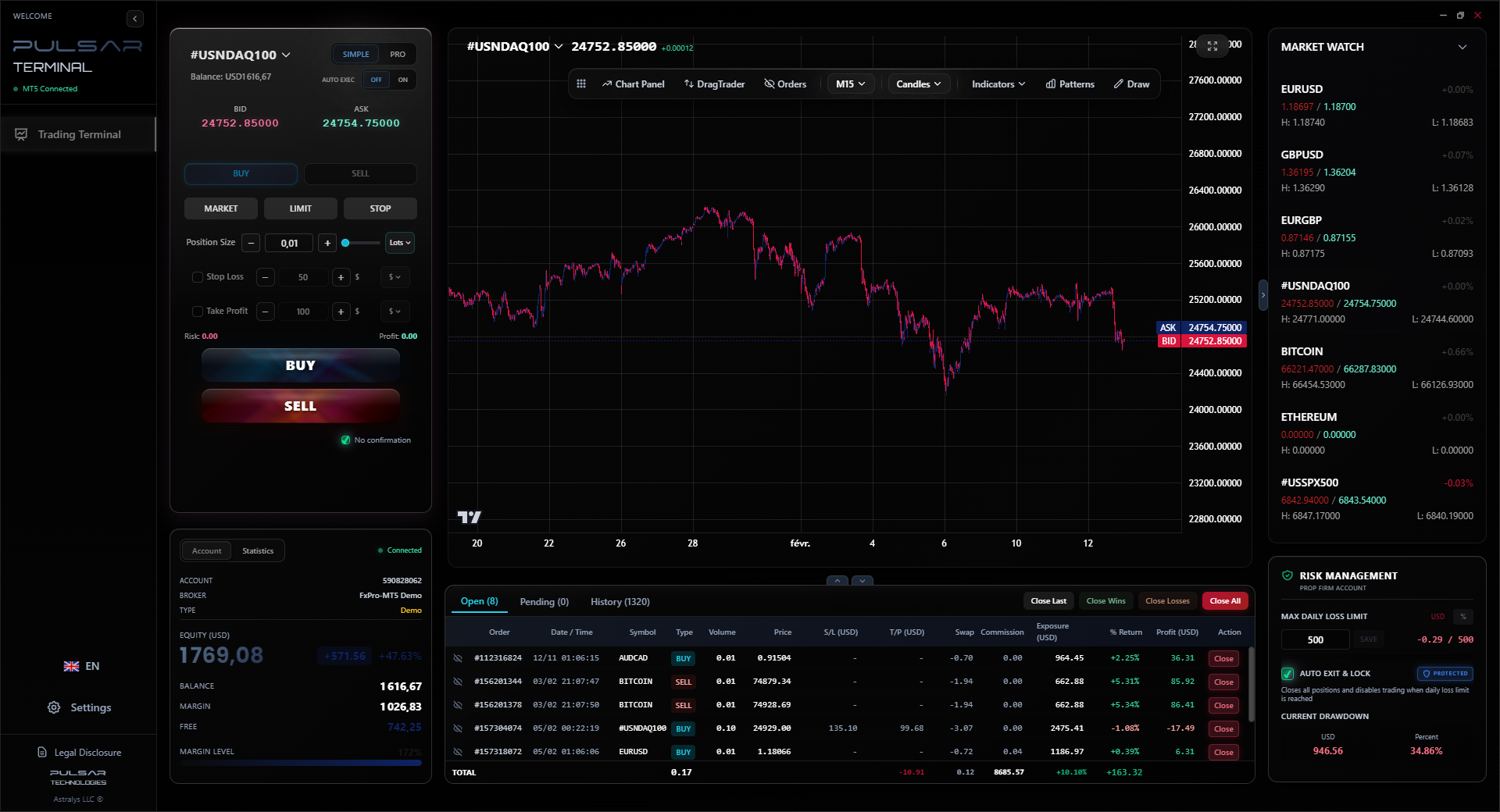
Once you've found a reliable broker, managing your trades efficiently is the next battle. Tools like Pulsar Terminal add advanced order management like trailing stops and multi-TP/SL directly to your MT5 platform, helping you execute your plan without emotional interference.
Pulsar Terminal
La herramienta MT5 todo-en-uno: órdenes drag-and-drop, multi-TP/SL, trailing stop, grid trading, Volume Profile y protección prop firm. Usado por más de 1.000 traders diariamente.
“Forex review sites give you the brochure. Trader forums give you the gossip in the car park after the meeting.”
A review site hands you a report. You need to become the auditor. Here's your checklist:
- Verify the Regulation: Go to the regulator's website (e.g., FSCA's FSP register). Type in the broker's licensed entity name (exactly as listed on their site) and check that the license is active and covers the services they offer you.
- Test the Platform: Download their MT4/MT5 or proprietary platform. Open a demo account. Don't just watch the candles. Place limit orders, stop orders, modify them. Check the spread definition in real-time on the symbols you'll trade. See how it behaves at market open.
- Contact Support: Ask a technical question before you deposit. "What's your server name for MT4 in Lagos for best latency?" Gauge their response time and knowledge. If they can't answer a simple pre-sales question, imagine trying to get help during a trade crisis.
- Read the Terms & Conditions: I know, it's painful. But skim the sections on withdrawals, inactive accounts, and bonus terms (if any). Bonuses are often a trap that locks your funds with impossible trading volume requirements.
- Cross-Reference Financials: For extra assurance on larger brokers, some review sites might mention if the broker's parent company is publicly listed. This adds a layer of financial transparency.
This process takes an afternoon. It's boring. But it's saved me from at least two disastrous broker choices over the years. That afternoon of work is cheaper than any losing trade.
💡 Consejo de Winston
Regulation is your safety net, but it's not a trampoline. It ensures there's a process for complaint, not that you'll get your money back instantly. Always trade with capital you can afford to lose, even with a regulated broker.

“You're not looking for a 'best' broker. You're looking for the broker that is best for you, right now, in Nigeria.”
So, how should you actually use forex review sites? Not as an oracle, but as one tool in a toolbox.
Your New Research Process:
- Idea Generation: Use 2-3 major review sites to generate a shortlist of 4-5 brokers that seem to fit your style (e.g., low spreads for scalping, good swap rates for swing trading).
- Data Aggregation: Open a spreadsheet. For each broker, note down the key data points from the review sites: regulator, average EUR/USD spread, commission, NGN account availability, withdrawal methods.
- Reality Check: Hit the forums and social media. Search for each broker name + "Nigeria." Look for consistent complaints or praise. Note any discrepancies with the review sites.
- Direct Verification: Visit each broker's official website. Check their regulatory page. Start a live chat. Download their platform.
- Micro-Test: Pick your top two. Deposit the minimum. Place a few small trades. Then, initiate a withdrawal of your initial deposit (or a portion of it). The broker that executes this flawlessly gets your real business.
This turns you from a passive consumer of reviews into an active investigator. You're not looking for a 'best' broker. You're looking for the broker that is best for you, right now, in Nigeria, based on evidence you've gathered yourself. The review sites provide the initial map, but you have to navigate the terrain.
FAQ
Q1Are forex review sites legally regulated in Nigeria?
No, forex review sites themselves are not specifically regulated by the SEC or CBN. They operate as media or marketing websites. The regulation applies to the forex brokers and trading platforms they write about. This is why due diligence on your part is so critical.
Q2What is the most important thing to check on a broker review for Nigeria?
Beyond regulation, check for concrete information on Naira deposits and withdrawals. The review should specify which local payment methods work, any fees involved, and the typical processing time to get your money back into your Nigerian bank account. If this info is missing, the review isn't tailored for you.
Q3How can I tell if a 'Best Broker' award is genuine?
Genuine awards are given by independent bodies after a judging process. A paid 'award' is usually just a logo the broker pays to display. Ask: Who gave the award? What were the judging criteria? Can you find a press release from the awarding body? If it's just a badge on the broker's site with no context, assume it's marketing.
Q4I see a broker has an FSA (Saint Vincent) license. Is that safe?
It's a common offshore license with lighter regulation compared to the FCA or ASIC. It's not inherently a scam, but it offers you less protection. It means you are relying more on the broker's own integrity than on a powerful regulator stepping in if something goes wrong. Prefer brokers with at least one top-tier license if safety is your priority.
Q5Why do review sites never seem to have bad reviews?
Because brokers that get bad reviews often stop paying affiliate commissions to that site, or they threaten legal action. Some sites also remove negative reviews to maintain relationships. This is why you must go to independent forums to see the unfiltered negative feedback.
Q6Is a high 'Trust Score' on a review site reliable?
It's a start, but don't rely on it alone. These scores are often algorithmic, based on factors like years in business and number of licenses. They can't measure customer service quality or recent withdrawal problems. Use the score as a filter, not a final verdict.
Q7Should I trust reviews that compare spreads using 'typical' numbers?
"Typical" is better than "from," but the gold standard is seeing a live spread table or a chart of average spreads over time (e.g., by hour of the day). The best reviews will show you a screenshot from the broker's own platform or data from a third-party spread comparison tool.
Lección del Prof. Winston
Puntos clave:
- ✓Treat review sites as lead generators, not holy texts.
- ✓Verify every claim, especially spreads and withdrawal info.
- ✓Test the withdrawal process before committing serious capital.
- ✓Forum complaints in volume are a stronger signal than a 5-star rating.
- ✓Your own due diligence is the only regulation that never sleeps.
¿Te resultó útil este artículo?
Haz clic en una estrella
Análisis Trading Semanal
Análisis y estrategias semanales gratis. Sin spam.
Sobre el autor
Olumide Adeyemi
Pionero del Trading en África Occidental
Uno de los educadores de trading forex más activos de Nigeria. 8 años de experiencia operando desde Lagos. Especialista en estrategias de bajo capital y desafíos de prop firms para traders africanos.
Comentarios
Aviso de riesgo
El trading de instrumentos financieros conlleva un riesgo significativo y puede no ser adecuado para todos los inversores. El rendimiento pasado no garantiza resultados futuros. Este contenido tiene fines educativos únicamente y no debe considerarse asesoramiento de inversión. Siempre realice su propia investigación antes de operar.
También te puede interesar

Cara Trading Forex Sukses: 7 Prinsip dari Trader Profesional
Cara trading forex sukses dengan 7 prinsip trader pro: manajemen modal, disiplin, journal trading, backtest. Data nyata, bukan janji profit palsu.
Jam Trading Forex Terbaik untuk Trader Indonesia: Panduan Lengkap dengan Tabel Waktu
Panduan jam trading forex untuk trader Indonesia. Tabel 4 sesi dunia, jam emas 20:00-00:00, sesi mana yang harus dihindari. Data akurat + tips dari trader berpengalaman.
Top 5 Sàn Forex Uy Tín Nhất 2026: Review Jujur dari Trader Indonesia
Top 5 sàn forex uy tín 2026 untuk trader Indonesia. Review jujur: spread, deposit, withdraw, dukungan lokal. Exness, XM, IC Markets & lebih.
Obtener Pulsar Terminal
Todas estas calculadoras están integradas en Pulsar Terminal con datos en tiempo real de su cuenta MT5.
Obtener Pulsar Terminal