


Here's the biggest mistake I see new traders make in South Africa: they spend 95% of their time looking for the perfect entry signal and about 5% figuring out how to protect their money.

David van der Merwe
Trader de Mercados Emergentes ·  South Africa
☕ 12 min de lectura
Lo que aprenderás:
Here's the biggest mistake I see new traders make in South Africa: they spend 95% of their time looking for the perfect entry signal and about 5% figuring out how to protect their money. They're obsessed with finding the next big move in USD/ZAR but treat risk like an afterthought. Let me be blunt - that's a surefire way to turn your trading account into a donation. The real 'secret' isn't some magical indicator; it's having a toolbox of disciplined risk management practices. I learned this the hard way, and today, I'm going to walk you through the exact forex risk management tools you need to survive and thrive in our local market.
If you're not using these two tools on every single trade, you're not trading - you're gambling. It's that simple. A stop-loss (SL) is your pre-defined exit point for a losing trade. A take-profit (TP) is your pre-defined exit point for a winning trade. Their purpose isn't to be clever; it's to remove emotion from the equation.
I want you to forget about 'setting and forgetting' for a moment. The real skill is in where you place them. Back in 2018, I got caught in a nasty USD/ZAR spike. I'd placed my stop-loss based on a round number (R14.50), which was also where everyone else had theirs clustered. The price tapped R14.51, took out all those stops, and reversed. I lost R2,800 on a trade that would have been profitable if I'd just placed my stop a few pips beyond that obvious level.

Warning: Never place your stop-loss at a obvious, round-number price. That's where the market makers know the retail orders are piled up. Look for a level just beyond recent swing highs or lows on the 1-hour or 4-hour chart.
Your take-profit should be based on a realistic reward-to-risk ratio. Aiming for a 1:1 ratio (you risk R100 to make R100) is a solid starting point. Many platforms, including those from brokers like IC Markets or Exness, let you set these orders directly when you open a trade. Don't just type in numbers; use the visual tools on your chart to drag and drop your SL and TP to logical technical levels.
The Psychology of Sticking to Your Plan
Here's the hard part: watching a trade go against you by a few pips and moving your stop-loss 'just a little further' to give it room. I've done it. You will be tempted to do it. It's how a R500 planned loss becomes a R2,500 disaster. The moment you move a stop-loss away from the market, you've broken your system. The tool only works if you have the discipline to let it.

💡 Consejo de Winston
A tool is only as good as the hand that holds it. You can have the best trailing stop software in the world, but if you lack the discipline to set it, it's worthless. Master your own psychology first.
“If you're not using a stop-loss on every single trade, you're not trading - you're gambling.”
This is, hands down, the most important forex risk management tool you have. It answers the question: 'How much should I risk on this trade?' Your position size determines your financial survival. Risking 5% of your account on a trade is reckless. Risking 0.5% is conservative and sustainable.
Here's a personal rule I haven't broken in 8 years: I never risk more than 1% of my trading capital on any single trade. For my main account, that's 1% of R50,000, which is R500. That means if my stop-loss is hit, I lose R500, not a cent more.
Let's make this practical with the USD/ZAR. Say your account is R20,000. Your 1% risk is R200. You analyze the chart and decide to go long on USD/ZAR at R18.50, with a stop-loss at R18.40. That's a 100 pip risk (R18.50 - R18.40 = R0.10, and 1 pip for USD/ZAR is R0.001, so R0.10 / R0.001 = 100 pips).
Now, you need to figure out your position size so that a 100-pip loss equals R200. You can use a position size calculator, or do the quick math: (Account Risk in Rands) / (Stop Loss in Pips * Pip Value). For a standard lot (100,000 units), the pip value for USD/ZAR fluctuates, but let's assume it's roughly R75. You'd need a much smaller position. A 0.03 lot size might get you close to that R200 risk. This math forces you to trade smaller, which is the key to longevity.

Example:
- Account: R20,000
- Risk per Trade: 1% = R200
- Trade: Buy USD/ZAR at R18.50, SL at R18.40 (100 pip risk)
- Approx. Pip Value for 1 lot: R75
- Position Size: R200 / (100 pips * R75) ≈ 0.026 lots
- You would trade 0.03 lots.
This tool stops you from blowing up your account after a string of losses. If you have five losing trades in a row at 1% risk, you're down 5%. It hurts, but you're still in the game. If you were risking 5% each time, you'd be down 25% and likely in a panic.
“High use is not a tool for making more money; it's a tool for amplifying risk.”
Once you've mastered SL, TP, and position sizing, you can layer in more sophisticated tools. These help you manage trades after they're open, which is where many profits are made or saved.
Trailing Stop-Loss: This is a dynamic stop-loss that moves as the trade moves in your favor. If you buy USD/ZAR at R18.00 with a 50-pip trailing stop, and it rises to R18.20, your stop automatically moves up to R18.15. It locks in profits while giving the trade room to run. The catch? You need enough volatility for it to work without getting stopped out by normal market noise. It's less effective on extremely choppy pairs.
Breakeven Stop: This is a manual or automated move where you shift your stop-loss to your entry price once the trade has moved a certain distance in your favor. It turns a risky trade into a risk-free one. My typical method is to move my stop to breakeven after the price has moved twice the distance of my original risk. If I risked 50 pips, once I'm 100 pips in profit, my stop goes to entry.
Partial Close (Multiple Take-Profit Levels): Instead of one TP target, you set several. You close a portion of your position (e.g., 50%) at your first target, then let the rest run with a trailing stop. This books some profit early and reduces stress. I used this on a long EUR/USD trade last year, taking half off at 1.0950 and letting the rest run with a trail, which eventually captured another 60 pips. It's a great psychological tool.
Many local brokers offer these features. Platforms like MetaTrader 5 have them built in, but managing them manually across multiple charts can be a hassle. This is where external tools that integrate with MT5 can simplify the process, letting you set complex rules like 'move to breakeven plus 5 pips after target 1 is hit' automatically.
“High use is not a tool for making more money; it's a tool for amplifying risk.”
In South Africa, the FSCA has capped use for retail traders at 30:1 on major forex pairs. Some international brokers might still offer you 500:1, but I'm telling you right now: treat that like a loaded gun. High use is not a tool for making more money; it's a tool for amplifying risk.
Here's what 30:1 actually means. With R10,000 in your account, you can control a position worth R300,000. That sounds powerful, but look at it through the lens of risk. A 1% move against you on that R300,000 position is a R3,000 loss - that's 30% of your actual capital gone in a blink.
My advice? Start with even less than the maximum. Use 10:1 or 15:1 while you're learning. This forces you to commit more of your own capital per trade, which makes you more careful with your analysis and position sizing. I made my worst mistake early on with a broker offering 100:1. I put on a trade that was far too large, a margin call was triggered, and I lost 40% of my account in one afternoon on a GBP/USD news spike. The use didn't cause the loss, but it turned a bad trade into a catastrophic one.
use is a tool that should be dialed down, not up. Your goal is consistent returns, not a lottery ticket. A broker like Pepperstone or XM, which is FSCA-regulated, will apply the 30:1 cap by default for South African clients, which honestly does you a favor.
💡 Consejo de Winston
Risk management isn't about avoiding losses. It's about structuring your losses so they're small, predictable, and never fatal. A 1% loss is a statistic. A 20% loss is a crisis.
“Your first trade of the day should be your smallest. You're testing the waters, not diving into the deep end.”
Your broker's platform is packed with built-in forex risk management tools. Not using them is like buying a car and ignoring the brakes.
Negative Balance Protection: This is non-negotiable. It ensures you can never lose more money than you have in your account. If a wild market gap (like during a SARB interest rate surprise) sends your position deep into the red, this feature prevents your account balance from going below zero. All reputable FSCA-regulated brokers offer this. Never, ever trade with a broker that doesn't.
Margin Call & Stop Out Levels: Understand these terms. A margin call is a warning from your broker that your account equity is falling close to the required margin level. It's a 'add funds or we'll close positions' alert. The stop out level is the point where they automatically start closing your positions, starting with the biggest loser, to prevent a negative balance. Know your broker's percentages (e.g., Stop Out at 50%). Keep your account well above this level through sensible position sizing.
Account Risk Calculators: Most trading platforms have these built in. Before you click 'buy' or 'sell', the platform should show you the exact monetary risk based on your chosen position size and stop-loss. If it doesn't, find the setting or find a new broker. This real-time feedback is crucial.
Volatility Alerts: Some brokers offer alerts for when market volatility (measured by the ATR indicator) exceeds a certain threshold. On volatile pairs like USD/ZAR or during local data releases, this can be a signal to reduce your position size or avoid trading altogether. It's a great preventative tool.
When choosing a broker, look at their toolset. A broker like IC Markets offers deep liquidity and tight spreads, which is itself a risk management tool (lower transaction costs), while others might focus on superior educational resources on risk.
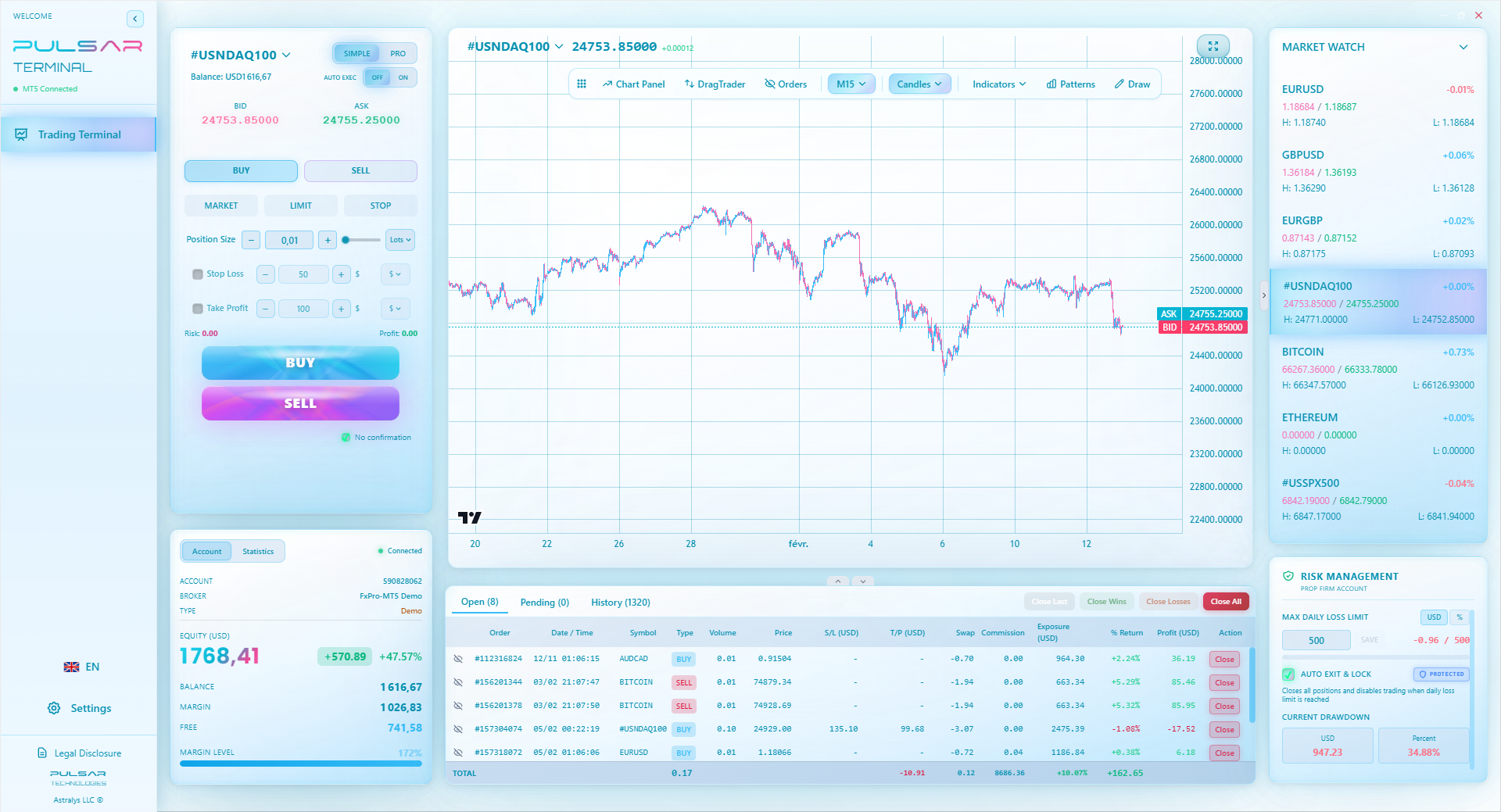
Managing complex risk rules like multiple take-profit levels and breakeven stops across several charts is where a tool like Pulsar Terminal excels, automating your plan directly on MT5 so you can focus on analysis.
Pulsar Terminal
La herramienta MT5 todo-en-uno: órdenes drag-and-drop, multi-TP/SL, trailing stop, grid trading, Volume Profile y protección prop firm. Usado por más de 1.000 traders diariamente.
“Your first trade of the day should be your smallest. You're testing the waters, not diving into the deep end.”
Tools are useless without a system to use them. Your risk management system is your personal rulebook. Here's how to build one.
1. The Daily Loss Limit: This saved my career. Decide the maximum amount you're willing to lose in a single day. Mine is 3% of my account. If I hit that loss, I shut down the platform and walk away. No exceptions, no 'one more trade to make it back.' It prevents a bad day from becoming a ruinous week.
2. The Weekly Drawdown Limit: Extend the logic. Set a maximum loss for the week, say 6%. This protects you from a string of bad days and forces you to re-evaluate your strategy if you hit it.
3. Correlated Pairs Rule: Don't risk your 1% on both EUR/USD and GBP/USD at the same time. They often move together. You think you have two separate 1% risks, but you might have one 2% risk. Be aware of market correlations.
4. Strategy-Specific Rules: Your risk rules might change slightly based on your approach. A scalping strategy might use a tighter stop-loss (10-15 pips) and risk 0.5% per trade due to higher frequency. A swing trading approach might use wider stops (50-100 pips) and risk the full 1%. Adjust your position size accordingly.
Write these rules down. Keep them next to your screen. The market's job is to test your discipline every single day. Your system is your anchor.

Pro Tip: Your first trade of the day should be your smallest. You're testing the waters, getting a feel for the market's mood. If it wins, you have a small profit cushion. If it loses, you've minimized the damage and can reassess without pressure.
“The market's job is to test your discipline every single day. Your risk system is your anchor.”
Our local context creates unique risks. Being aware of them is a management tool in itself.
ZAR Volatility: The Rand is an exotic currency. USD/ZAR can move 200-300 pips in a day on local political news or SARB decisions. A 50-pip stop-loss that works on EUR/USD can be laughably tight on our home pair. When trading ZAR pairs, you must widen your stops and significantly reduce your position size to keep the monetary risk the same. Use the Average True Range (ATR) indicator to gauge current volatility and set stops accordingly.
Local Market Hours & Gaps: The most liquid time for USD/ZAR is during Johannesburg trading hours (7am-5pm SAST) and when London overlaps. Trading it in the dead of night (SAST) means wider spreads and thinner liquidity, which can lead to worse fills and slippage on your stops. Also, be extremely cautious around major local data releases (CPI, interest rate decisions). The market can gap right through your stop-loss.
Tax Implications: This is a financial risk. Your profits are taxable as income. Don't get to the end of a successful year and realize you haven't set aside 30-40% for SARS. Factor tax into your profit targets and keep careful records. It's not a trading tool, but poor tax management can erase your carefully guarded profits.
Emotional Trading During Load Shedding: It sounds silly, but it's real. Nothing leads to impulsive, rule-breaking trades like the stress of your power, internet, and trading platform flickering on and off. Have a backup plan - mobile data, a power bank - and if conditions are too unstable, just don't trade. Preserving capital is a win.
FAQ
Q1What is the single most important risk management tool for a beginner?
The stop-loss order, without a doubt. It's your automatic ejector seat. Before you even think about profit, you must know exactly where you'll admit you're wrong and exit. Pair it with strict position sizing (never risk more than 1% of your account) and you have the foundation for survival.
Q2Is the FSCA's 30:1 use limit good or bad for traders?
It's excellent, especially for beginners. It forces discipline. While it limits potential returns on tiny accounts, it dramatically reduces the risk of a catastrophic wipeout from a single bad trade. Experienced traders with proven systems might chafe at the limit, but for the vast majority, it's a protective barrier they should be thankful for.
Q3How do I calculate my position size for volatile pairs like USD/ZAR?
Use the same 1% risk rule, but your stop-loss in pips will likely be much wider due to ZAR's volatility. Let's say your 1% risk is R200. If your USD/ZAR stop-loss is 150 pips wide, and a pip is roughly R75 per standard lot, your position size would be R200 / (150 * R75) = approximately 0.018 lots. Always use a position size calculator to be precise, as pip values change with the exchange rate.
Q4What should I do if my broker's platform doesn't have a trailing stop feature?
You have a few options. First, consider switching to a broker whose platform does, like most MetaTrader 4/5 brokers. Second, you can manually trail your stop by moving it up (for a long trade) every time the price makes a new significant high. It's more work but achieves the same goal. Third, look into third-party trading assistant software that can add automated trailing stop and breakeven functionality to your existing platform.
Q5How does negative balance protection work in South Africa?
It's a mandatory rule for FSCA-regulated brokers. If a market moves so violently that your losses exceed the money in your account (e.g., a huge gap overnight), the broker absorbs the loss beyond your balance. Your account will go to zero, but not into negative figures. You won't owe the broker money. This is a critical layer of security.
Q6Can I use the same risk percentage for scalping and swing trading?
You can use the same monetary risk percentage (e.g., 1% of account), but your trade parameters will differ drastically. A scalper might have 10 trades a day with tight stops. The 1% rule means your position size per scalp must be much smaller to keep the total daily risk under control. A swing trader with fewer trades can use a larger position size for that 1% risk, as the stop is wider. The key is that the total capital at risk per trade is consistent.
Lección del Prof. Winston
Puntos clave:
- ✓Use a stop-loss on every trade, placed beyond obvious round numbers.
- ✓Never risk more than 1% of your account on a single trade.
- ✓Start with use below the FSCA's 30:1 cap (try 10:1).
- ✓Set a daily loss limit (e.g., 3%) and walk away if you hit it.
- ✓Widen stops and reduce size for volatile ZAR pairs.
¿Te resultó útil este artículo?
Haz clic en una estrella
Análisis Trading Semanal
Análisis y estrategias semanales gratis. Sin spam.
Sobre el autor
David van der Merwe
Trader de Mercados Emergentes
Trader con sede en Johannesburgo con 11 años en divisas de mercados emergentes. Especialista en pares ZAR, trading regulado por la FSCA y análisis del mercado sudafricano.
Comentarios
Aviso de riesgo
El trading de instrumentos financieros conlleva un riesgo significativo y puede no ser adecuado para todos los inversores. El rendimiento pasado no garantiza resultados futuros. Este contenido tiene fines educativos únicamente y no debe considerarse asesoramiento de inversión. Siempre realice su propia investigación antes de operar.
También te puede interesar

Cara Trading Forex Sukses: 7 Prinsip dari Trader Profesional
Cara trading forex sukses dengan 7 prinsip trader pro: manajemen modal, disiplin, journal trading, backtest. Data nyata, bukan janji profit palsu.
Jam Trading Forex Terbaik untuk Trader Indonesia: Panduan Lengkap dengan Tabel Waktu
Panduan jam trading forex untuk trader Indonesia. Tabel 4 sesi dunia, jam emas 20:00-00:00, sesi mana yang harus dihindari. Data akurat + tips dari trader berpengalaman.
Top 5 Sàn Forex Uy Tín Nhất 2026: Review Jujur dari Trader Indonesia
Top 5 sàn forex uy tín 2026 untuk trader Indonesia. Review jujur: spread, deposit, withdraw, dukungan lokal. Exness, XM, IC Markets & lebih.
Obtener Pulsar Terminal
Todas estas calculadoras están integradas en Pulsar Terminal con datos en tiempo real de su cuenta MT5.
Obtener Pulsar Terminal