


The screen was a sea of red.

James Mitchell
Analista de Trading Sénior
☕ 9 min de lectura
Lo que aprenderás:

The screen was a sea of red. It was October 2014, and I was watching the EUR/USD crater after the Swiss National Bank removed its peg. In a live account, I'd have been a statistic, another blown-out retail trader. But that chaos was unfolding on my demo platform. I felt the same gut-punch fear, the same urge to panic-sell. That's when I truly understood the value of a forex simulator. It wasn't just a toy. It was a pressure cooker for your psychology, and the only place you should ever make your first, and most expensive, mistakes.
Most people get this wrong. They think a forex simulator trading account is where you go to learn what buttons to click. That's like saying a flight simulator is where you learn to find the seatbelt. It's so much more profound.
The real value is in experiencing market psychology without financial consequence. You can read about fear and greed all day. Feeling your hands get clammy as a trade moves against you, fighting the impulse to override your stop-loss, watching a winning position turn into a loser because you got greedy with your take-profit... that's the curriculum. A simulator lets you fail spectacularly. I once turned a $10,000 demo balance into over $50,000 in two weeks with an insanely risky martingale strategy. I felt like a genius. Then I lost it all in one afternoon. That lesson, about the seduction of unsustainable wins, was priceless. It would have cost me five figures in a live account.

Warning: The biggest danger in a simulator is developing bad habits because "it's not real money." If you wouldn't do it with your rent money, don't do it in the sim. The goal is to build discipline, not just a big fake number.

💡 Consejo de Winston
Treat your simulator balance like a real $10,000 grant from a skeptical investor. You have to report every loss. It changes how you view risk.

“A simulator lets you fail spectacularly. That lesson, about the seduction of unsustainable wins, was priceless.”
Not all demo accounts are created equal. You need one that mirrors reality as closely as possible.
The Non-Negotiables
First, it must be from a reputable broker that you'd actually consider funding with later. The spreads, execution speed, and slippage need to be identical to their live environment. I made this mistake early on. I practiced for months on a simulator with 0.5 pip spreads on the EUR/USD. When I went live with a different broker, their typical spread was 1.8 pips. My entire scalping strategy was instantly unprofitable because I hadn't accounted for nearly double the transaction cost.
Second, you need full functionality. This means the ability to set pending orders, stop-losses, take-profits, and trailing stops. If the simulator doesn't let you use a trailing stop, you're not learning how to manage a runner, which is a critical skill. Some advanced platforms, like MT5, have more sophisticated order types that you should practice with.
My Go-To Platforms
For beginners, I usually point people to XM or Exness for their demo accounts. They're straightforward, reliable, and give you a huge amount of virtual capital to play with. For more serious practice that bridges into professional tools, I use IC Markets with their raw spread account demo. It gets you used to the concept of commissions, which is how most ECN accounts work.

Pro Tip: When you set up your demo, fund it with the exact amount of capital you plan to start with live. If you're going to start with $2,000, don't practice with $100,000. Your position size calculator inputs and risk perception will be completely off.
“The moment you go live, you'll discover new psychological hurdles. That's normal. The simulator's job was to eliminate the technical ones.”
Winging it in a simulator is a waste of time. You need a syllabus. Here's a plan I wish someone had given me.
Weeks 1 & 2: Mechanics & Market Rhythm Don't even think about making a profit. Your only goals:
- Place 5 trades a day using at least 3 different order types (market, limit, stop).
- Get fluent with modifying and closing orders.
- Watch one major currency pair, like the EUR/USD, for the entire London and New York overlap. Just watch. Note when volatility spikes.
Weeks 3 & 4: Strategy Implementation Pick ONE simple strategy. Maybe a moving average crossover, or support/resistance bounce. Your goal is consistency in execution, not profitability. Use your position size calculator for every single trade. Record every trade in a journal: entry reason, entry price, stop-loss, take-profit, exit price, and most importantly, your emotional state.
The Final Exam: A Volatile Event Schedule your practice around a major news release. A Non-Farm Payrolls (NFP) Friday is perfect. Your mission is not to trade it, but to survive it. Have a few positions open before the release. Watch what happens to your stops, see the spread widen in real-time, feel the slippage. This is where you learn why trading news is a different beast.

“The moment you go live, you'll discover new psychological hurdles. That's normal. The simulator's job was to eliminate the technical ones.”
This is the hardest jump. The psychology shifts when real money is on the line. The simulator has done its job if it has made the mechanical part of trading automatic.
I use a two-step process:
- The "Skin in the Game" Test: Open a micro or cent account with a minimal amount - $50 or $100. The money should be an amount you can afford to lose, but that you'd still feel bad about wasting. Trade your proven strategy from the simulator here. The P&L will be in cents, but it feels real. This bridges the emotional gap.
- The Graduated Exposure: Once you're consistently executing well in the cent account for a month, scale up to your intended starting capital. But do it in phases. Maybe fund 25% of your planned account, trade with that for two weeks, then add the rest. It eases the pressure.
The moment you go live, you'll discover new psychological hurdles. That's normal. The simulator's job was to eliminate the technical hurdles, so you can focus all your mental energy on controlling your emotions. If you find yourself hesitating to pull the trigger on a setup you'd trade all day in the sim, that's a sign you need more "skin in the game" practice.

Example: In my simulator, I had a 70% win rate on a specific RSI indicator divergence setup on the 1-hour chart. When I moved to a $500 live account, my win rate dropped to 55% initially. Why? I was taking profits too early out of fear. The setup was the same. My execution was the problem. I had to go back to the sim and drill the discipline of letting my trades hit their full target.
💡 Consejo de Winston
The most valuable data from your simulator isn't your profit/loss. It's your trade journal. Review why you entered, why you exited, and what you felt. That's the gold.

“You can hide in the simulator forever, using the lack of real risk as a comfort blanket.”
I've seen these destroy traders before they even start.
Pitfall 1: The Unlimited Reset Mentality. Blow up your account? Just reset it! In the real world, you can't reset. You must practice strict risk management from day one. Treat every demo dollar as real. If you blow the account, the exercise is over. Start a new one with a smaller size and figure out what went wrong.
Pitfall 2: Ignoring Slippage & Spreads. Simulators often have ideal conditions. On high volatility, a live market might give you 3 pips of slippage on your stop-loss. If your strategy only works with perfect execution, it's doomed. Always assume worse fills than the sim shows.
Pitfall 3: Not Practicing Losses. Everyone practices winning. You need to practice losing gracefully. This means entering trades where your stop-loss is hit, and doing nothing. Let the stop work. Don't intervene. Getting comfortable with small, controlled losses is the key to avoiding one catastrophic margin call.
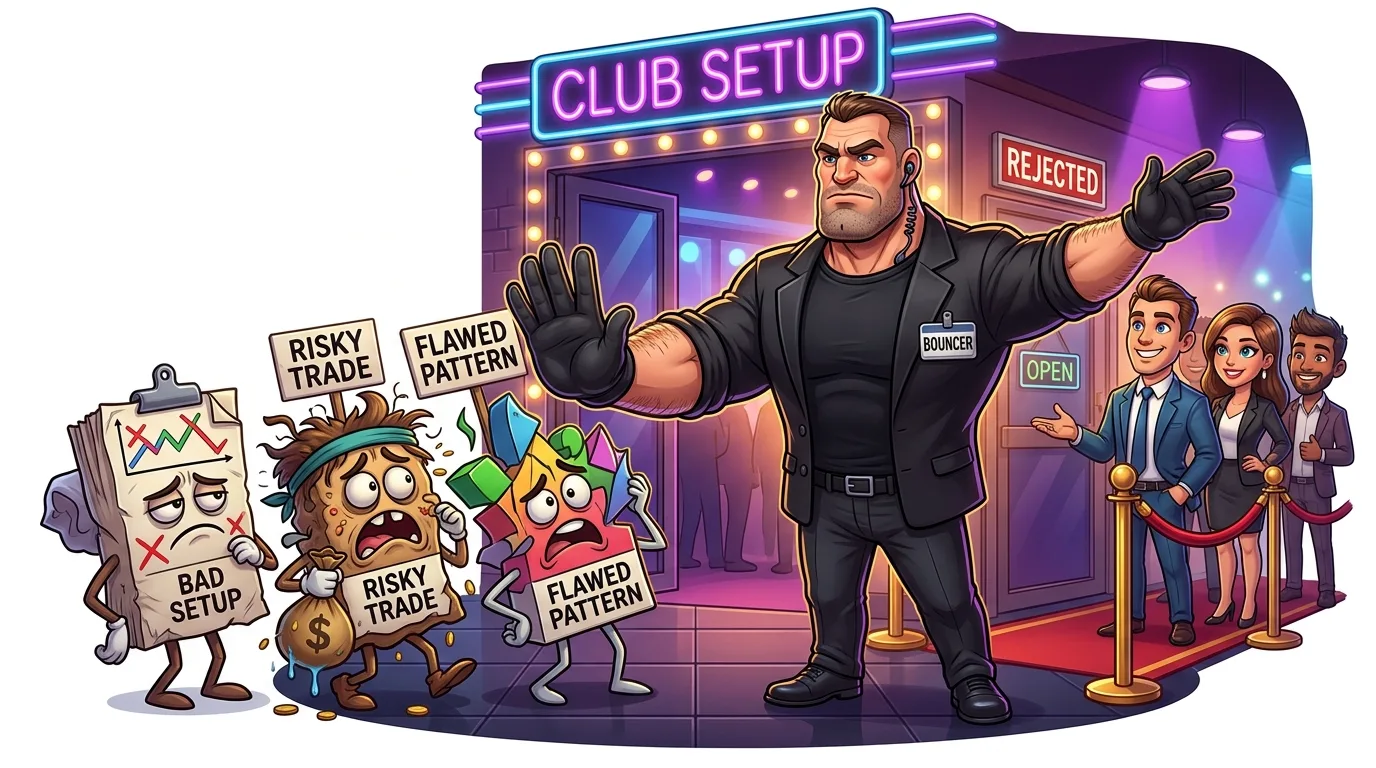
Pitfall 4: Overtrading Because It's "Free." A simulator lets you trade 100 times a day. This builds a terrible habit. Force yourself to wait for your A+ setup, just as you would with real money. Quality over quantity. This patience is the foundation of swing trading and most other successful approaches.
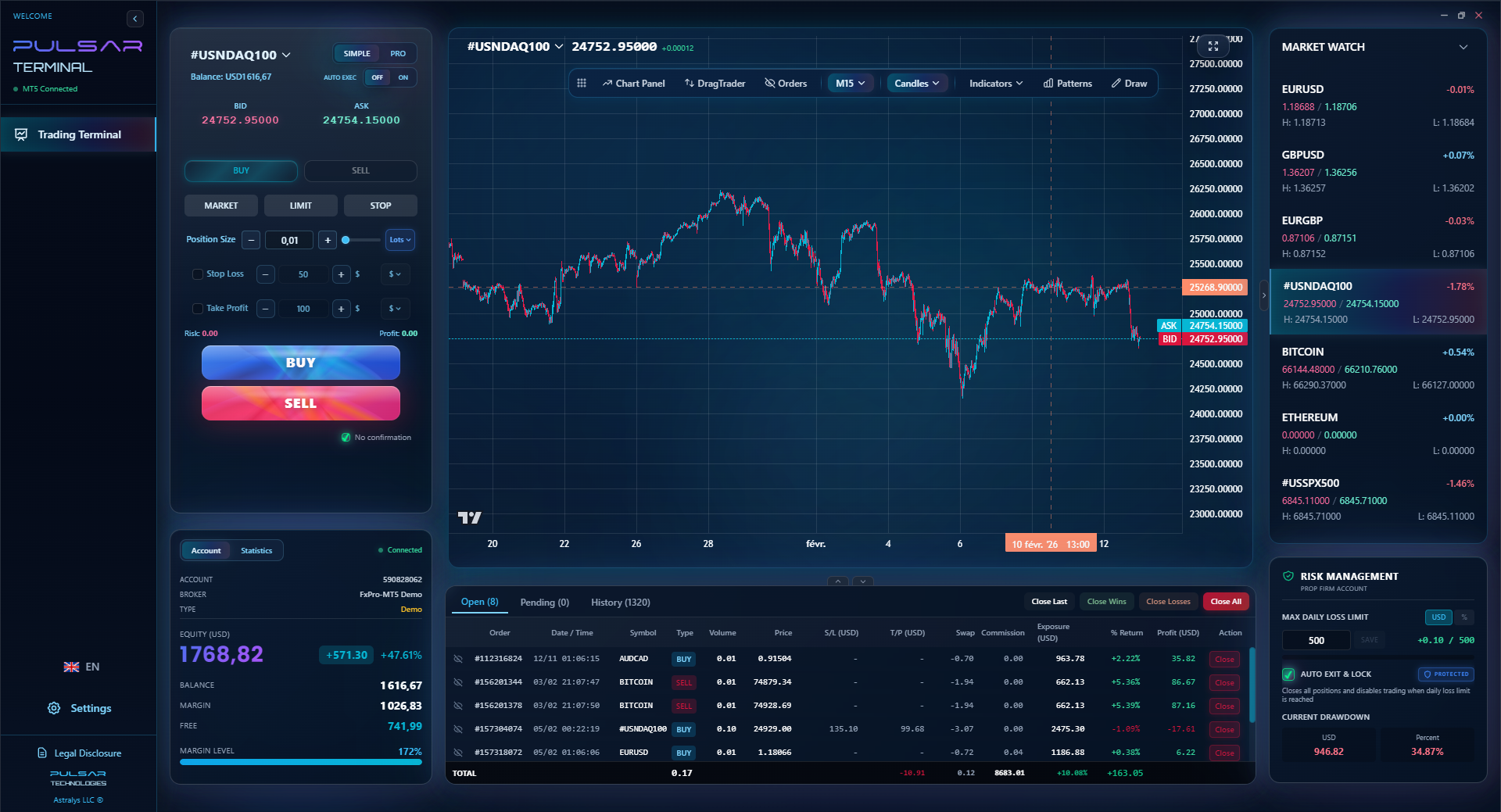
Practicing complex order management like multi-level take-profits and trailing stops is clunky on a basic platform, but tools like Pulsar Terminal let you build and test these advanced executions seamlessly on your MT5 simulator.
Pulsar Terminal
La herramienta MT5 todo-en-uno: órdenes drag-and-drop, multi-TP/SL, trailing stop, grid trading, Volume Profile y protección prop firm. Usado por más de 1.000 traders diariamente.
“You can hide in the simulator forever, using the lack of real risk as a comfort blanket.”
Once you've mastered the basics, these drills will sharpen your edge.
The Drawdown Drill: Start your simulator account. Your goal is to get it to a 10% drawdown as quickly as possible through controlled, planned losses. Then, your mission is to climb back to breakeven. This teaches you how to trade under pressure and dig yourself out of a hole - a vital skill.
The One-Chart Drill: Pick a cross pair, like GBP/AUD. Only look at that one chart for a week. No EUR/USD, no gold, no S&P 500. Learn its personality, its typical daily range, when it's active. This builds deep focus and pattern recognition on a single instrument.
The News Blackout Drill: Turn off all economic calendars and news feeds. Trade purely based on price action and your technical indicators. After each trade, then check if news was released. This helps you determine if your strategy is strong enough to handle unknown fundamental shocks, or if you're just accidentally trading the news.
These drills force adaptability. The market changes. The MACD indicator that worked beautifully in a trending market will chop you up in a range. A simulator is the only place you can safely spend weeks learning to identify those regime shifts without paying tuition to the market.
“The simulator's purpose is to make you bored. Bored with the mechanics, so your full brainpower is on psychology.”
This is a tough one. You can hide in the simulator forever, using the lack of real risk as a comfort blanket.
You're ready to go live when you can answer "yes" to these questions:
- Have you traded through at least 100 complete trades (open to close) in the simulator?
- Have you experienced both a strong winning streak and a strong losing streak in the sim, and maintained the same risk per trade (e.g., never more than 1-2%) through both?
- Can you articulate exactly why your last 10 trades were placed? ("The chart looked good" doesn't count).
- Is your primary feeling about moving to a live account one of cautious confidence, not excitement or fear?
If you're hesitating because of fear, that's actually a good sign. It means you respect the market. The reckless ones are dangerous. Move to a micro account and take the pressure off. The simulator's purpose is to make you bored. Bored with the mechanics, bored with your checklist, so that when real money is involved, your full brainpower is on psychology and nuance, not on remembering how to set a stop-loss.
I still use a simulator today, 12 years in. I use it to test new ideas, like a complex multi-order grid trading setup, or to practice a strategy for a new instrument like XAU/USD before risking capital. It's my laboratory. For you starting out, it needs to be your entire trading universe until you've proven you can survive in it.
💡 Consejo de Winston
If you can't be bored in a simulator - waiting patiently for days for your setup - you'll be terrified and impulsive with real money. Boredom is a skill.
FAQ
Q1How long should I use a forex simulator before trading live?
There's no set time, but a minimum benchmark is 100 completed trades and at least one full market cycle (e.g., a period of clear trends and a period of choppy consolidation). For most people dedicating a few hours a day, this takes 2-3 months. The key is consistent, structured practice, not just logging time.
Q2Is demo trading pointless because the psychology isn't real?
No, that's a common misconception. While the fear of financial loss is absent, other psychological elements are very real: the frustration of a losing streak, the overconfidence of a winning streak, the boredom of waiting for a setup, the impulse to deviate from your plan. A simulator is where you learn to recognize and manage these emotions in a safe space.
Q3My demo account is highly profitable, but I lose money live. Why?
This is the classic trap. It's usually one of three things: 1) You took larger risks in the demo because it was "play money," skewing your results. 2) You didn't account for real-world execution issues like slippage and wider spreads on a live account. 3) The psychological pressure of real money caused you to change your behavior - closing winners early, moving stop-losses, overtrading.
Q4Can I use a simulator to pass a prop firm challenge?
Absolutely, it's essential. A prop firm challenge has strict, non-negotiable rules (max daily loss, max overall drawdown, minimum trading days). You must use a simulator to practice your strategy within those exact constraints. It's a specific type of pressure you need to rehearse. Messing up in the sim costs nothing; messing up in the challenge costs your fee.
Q5Do professional traders ever use simulators?
Yes, constantly. Pros use them as sandboxes. Before implementing a new algorithmic strategy with real capital, they'll back-test it and then run it in a simulated environment (often called "paper trading") to see how it behaves with live data feeds and order execution. It's a standard risk management step.
Q6What's the difference between a forex simulator and back-testing?
Back-testing applies rules to historical data to see how a strategy would have performed. A simulator (or forward-testing) lets you practice executing your strategy in real-time with live, incoming data. It tests your reaction speed, decision-making under uncertainty, and order execution skills, which back-testing cannot.
Lección del Prof. Winston
Puntos clave:
- ✓Practice with the exact capital you'll start with live.
- ✓100 trades minimum in the sim before going live.
- ✓Let your simulator stop-losses work without intervention.
- ✓Your trade journal is more important than your fake P&L.
¿Te resultó útil este artículo?
Haz clic en una estrella
Análisis Trading Semanal
Análisis y estrategias semanales gratis. Sin spam.
Sobre el autor
James Mitchell
Analista de Trading Sénior
Con sede en Nueva York y más de 9 años de experiencia en trading. Se enfoca en pares USD principales, desafíos de prop firms y el panorama regulatorio estadounidense.
Comentarios
Aviso de riesgo
El trading de instrumentos financieros conlleva un riesgo significativo y puede no ser adecuado para todos los inversores. El rendimiento pasado no garantiza resultados futuros. Este contenido tiene fines educativos únicamente y no debe considerarse asesoramiento de inversión. Siempre realice su propia investigación antes de operar.
También te puede interesar

Cara Trading Forex Sukses: 7 Prinsip dari Trader Profesional
Cara trading forex sukses dengan 7 prinsip trader pro: manajemen modal, disiplin, journal trading, backtest. Data nyata, bukan janji profit palsu.
Jam Trading Forex Terbaik untuk Trader Indonesia: Panduan Lengkap dengan Tabel Waktu
Panduan jam trading forex untuk trader Indonesia. Tabel 4 sesi dunia, jam emas 20:00-00:00, sesi mana yang harus dihindari. Data akurat + tips dari trader berpengalaman.
Top 5 Sàn Forex Uy Tín Nhất 2026: Review Jujur dari Trader Indonesia
Top 5 sàn forex uy tín 2026 untuk trader Indonesia. Review jujur: spread, deposit, withdraw, dukungan lokal. Exness, XM, IC Markets & lebih.
Obtener Pulsar Terminal
Todas estas calculadoras están integradas en Pulsar Terminal con datos en tiempo real de su cuenta MT5.
Obtener Pulsar Terminal