


I once sat in a Sandton coffee shop listening to two guys at the next table.

David van der Merwe
Trader de Mercados Emergentes ·  South Africa
☕ 10 min de lectura
Lo que aprenderás:
I once sat in a Sandton coffee shop listening to two guys at the next table. 'The cable's looking heavy, bro. Think we'll see a squeeze before London closes?' one said. The other nodded, 'Ja, but mind the wicks on the M5. Got taken out yesterday for 50 pips on a false breakout.' I knew exactly what they meant. A year earlier, I wouldn't have had a clue. That confusion cost me real money. I remember mishearing 'BTFD' as some complex strategy, only to later learn it stood for 'Buy The F****** Dip' – a lesson I learned the hard way by hesitating on a USD/ZAR pullback and missing a 200-pip rally. This isn't just slang; it's the shorthand of survival.
Think of forex slang as the difference between reading a textbook and having a beer with a veteran prop trader. The textbook gives you the theory; the slang gives you the context, the emotion, and the street-smart shortcuts. In South Africa, with over 200,000 active traders and a daily volume punching above $21 billion, you're either in the know or you're the mark.
When a broker chat support says, 'Mind the spread on ZAR pairs during SA open,' they're not being cryptic. They're warning you that liquidity is thinner, and the cost to trade (the spread) can widen, sometimes dramatically. Not knowing that can turn a calculated entry into an instant loser.
This language also filters the noise. Financial news is full of fluff. Trader chat, when you understand it, is brutally efficient. 'Long the Rand' means you're betting the ZAR will strengthen. 'Short dollars' means you're betting against the USD. It's immediate. More importantly, it connects you to a global community. That guy in a scalping strategy Discord channel in London uses the same terms as the guy swing trading EUR/ZAR from Durban.
This is where every conversation starts. Get these wrong, and you'll sound like a rookie immediately.
Long/Short: The absolute fundamentals. Being 'long' a currency means you've bought it, expecting its price to rise. Being 'short' means you've sold it, expecting it to fall. In South Africa, you'll often hear 'I'm long Rand' or 'I'm short dollar.' It's that simple.
Entry/Exit: Your entry price is where you got in. Your exit is where you plan to get out (take profit or stop loss). 'My entry on USD/ZAR was 18.50, looking for an exit at 18.30.'
Stop Loss (SL) & Take Profit (TP): Your lifelines. SL is the price where your trade automatically closes to limit losses. TP is where it closes to lock in profits. 'I've got a tight stop at 18.55 and a TP at 18.35.'
Getting Stopped Out & Slippage
This is the painful one. 'Getting stopped out' means the price hit your stop loss and closed your trade for a loss. It happens to everyone. The related horror is 'slippage.' This is when your order executes at a worse price than you requested, common during high volatility or news events. On ZAR pairs, which can be less liquid, I've had slippage of 5-10 pips on what should have been a simple market order. It turns a small loss into a bigger one fast.

Warning: Never place a trade without a stop loss. Calling it a 'mental stop' is just a fancy term for having no plan. The market doesn't care what you 'mentally' decided. Use the actual order.
Pips: The unit of movement. For most pairs, it's the 4th decimal place (0.0001). For USD/ZAR, it's usually the 2nd decimal place (0.01). A 50-pip move on USD/ZAR from 18.50 to 18.00 is massive. Knowing the pip definition for your specific pair is non-negotiable.

💡 Consejo de Winston
If you can't explain your trade in plain English without any slang, you don't understand what you're doing. Jargon hides poor thinking.
“This isn't just slang; it's the shorthand of survival.”
Traders personify the market. It's not just going up or down; it has a personality.
Range-bound/Choppy: The price is bouncing between a clear high and low with no clear direction. It's frustrating for trend followers but a playground for certain strategies. The EUR/USD can spend weeks like this.
Trending: The market is making consistent higher highs and higher lows (uptrend) or lower highs and lower lows (downtrend). This is where you want to be for directional trades. 'USD/ZAR is in a clear downtrend on the daily.'
Breakout/Breakdown: When the price pushes decisively above a key resistance level (breakout) or below key support (breakdown). These can signal the start of a new move. 'Watch for a breakout above 18.80 on the 4-hour chart.'
False Breakout: The market's favourite trick. The price pushes beyond a level, tempting everyone in, only to reverse sharply and stop out all the new positions. I got caught in a classic false breakout on GBP/ZAR last year. Price took out the 23.00 resistance, I went long, and it reversed 70 pips in minutes for a nasty loss. This is why confirmation is key.
Liquidity: How easily an asset can be bought or sold without affecting its price. Major pairs like EUR/USD have high liquidity. Some exotic ZAR pairs have lower liquidity, leading to wider spreads and sharper moves. 'There's no liquidity in this pair right now' means tread carefully.
Volatility: The size and frequency of price movements. High volatility means big, fast swings. Low volatility means slow, sleepy price action. News events cause volatility spikes.
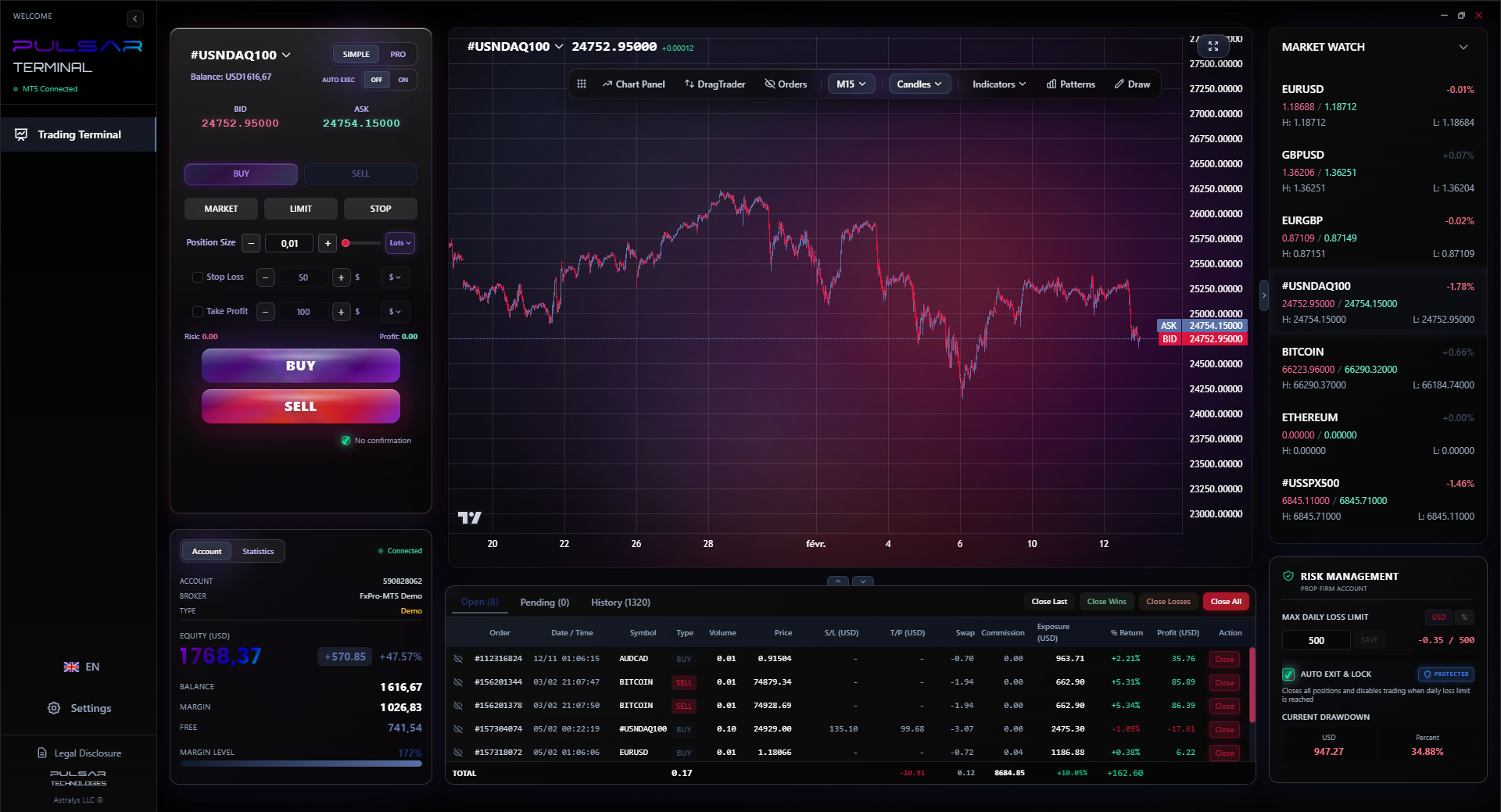
Managing multiple orders and stops, like scaling into a 'long Rand' position or protecting against a 'false breakout', is far easier with tools that let you drag, drop, and automate your exits.
Pulsar Terminal
La herramienta MT5 todo-en-uno: órdenes drag-and-drop, multi-TP/SL, trailing stop, grid trading, Volume Profile y protección prop firm. Usado por más de 1.000 traders diariamente.
This is where the colourful stuff lives.
Scalping: Taking many small profits over a very short time frame (seconds to minutes). A scalper might aim for 5-10 pips per trade. It's intense and requires serious focus.
Swing Trading: Holding trades for days or weeks, aiming to capture a 'swing' in the market. This is more common for retail traders with day jobs.
BTFD (Buy The F**** Dip):** An aggressive, often reckless, strategy of buying an asset during a sharp decline within an overall uptrend. It requires serious conviction and risk management. Not for the faint-hearted.
Fading the move: Going against the current price momentum. If the market is screaming higher, a 'fader' might look for a short entry. This is typically a counter-trend strategy and is high-risk.
The Squeeze: A rapid price move that forces many traders to exit their positions, often amplifying the move. A 'short squeeze' happens when price rises rapidly, forcing those who are short to buy back (cover) their positions, pushing price even higher.
Bid/Ask: The bid is the price buyers are willing to pay. The ask (or offer) is the price sellers are willing to accept. The difference is the spread. You sell at the bid, buy at the ask.

Pro Tip: When looking for a broker, don't just look at the advertised spread. Look at the effective cost, which includes any commissions. A broker like Tickmill might show 0.1 pips but add a commission, while another like XM might have a 0.8 pip spread with no commission. Do the math for your typical trade size using a position size calculator.
💡 Consejo de Winston
The most important slang term to master is 'stop loss'. The second most important is 'position size'. Everything else is commentary.
“Calling it a 'mental stop' is just a fancy term for having no plan.”
We have our own flavour here, mixing global terms with local reality.
'Long the Rand' / 'Short the Rand': The most common directional call. Given the ZAR's volatility, this is a daily discussion. 'With the SARB holding rates, I'm staying long Rand for now.'
'Trading the ZAR pairs': Specifically referring to crosses like USD/ZAR, EUR/ZAR, GBP/ZAR. These have unique characteristics: higher spreads (Pepperstone shows ~5 pips on USD/ZAR, 14 on EUR/ZAR), sensitivity to local politics and commodity prices, and sometimes wild swings.
'Loadshedding Play': A morbidly local term. Some traders jokingly refer to strategies around predictable market micro-movements when major South African news or data hits during loadshedding, assuming some local participants might be offline. (I don't recommend this as a strategy, but it shows how local conditions seep in).
'FSCA use': A specific reference to the 30:1 use cap imposed on retail traders by our regulator. It's a defining constraint. 'I can't size that trade like I used to, thanks to FSCA use.' It forces more conservative position sizing, which isn't a bad thing.
Offshore vs Local Broker: A constant debate. 'Offshore' brokers (like IC Markets or Exness) might offer higher use but lack direct FSCA recourse. 'Local' brokers are FSCA-regulated but must adhere to the 30:1 rule. About 80% of Rand trading happens offshore, which tells you something about where the liquidity is.
The 'Carry Trade': This is a global concept but particularly relevant with high-interest-rate currencies. It involves borrowing in a low-yielding currency (like JPY) and investing in a high-yielding one (like ZAR), profiting from the interest rate differential. It works until the ZAR depreciates sharply, wiping out the interest gains. Risky business.
This is the vocabulary of loss. You will become intimately familiar with it.
Margin Call: The broker's demand to deposit more funds when your losses have eaten too much of your account equity. It's a last warning before automatic closure. I got my first one trading GBP/JPY with too much size. A 100-pip move against me triggered it. I learned about margin call limits the hard way.
Blown Account: When your account balance hits zero (or so close it doesn't matter). The ultimate failure of risk management. The goal is to never add this term to your personal dictionary.
Revenge Trading: Trading emotionally after a loss to 'get your money back.' This is a guaranteed way to turn a bad day into a catastrophic one. I've done it. It never works.
Overtrading: Trading too frequently, often due to boredom or frustration, not based on solid setups. It racks up spreads and commissions and leads to sloppy decisions.
Analysis Paralysis: The opposite problem. Over-analysing every indicator (RSI, MACD, Fibonacci, you name it) until you miss the trade entirely.
Drawdown: The peak-to-trough decline in your account balance. A 10% drawdown means your account is down 10% from its highest point. Managing drawdown is more important than chasing profits.
💡 Consejo de Winston
In South Africa, 'FSCA use' isn't a limitation, it's a guardrail. The traders complaining loudest about it are the ones who needed it most.
“Consistent profitability earns you more respect than the slickest jargon.”
Knowing the words is one thing. Using them correctly is another.
First, listen more than you speak. Lurk in trading communities, read analysis from reputable local traders, and absorb how the terms are used in context. Don't be the guy who shouts 'BTFD!' every time the market dips 5 pips.
Second, focus on clarity. Slang is useful for speed among peers, but when you're writing down your trading plan or explaining a idea to a mentor, use clear, unambiguous language. 'I will buy USD/ZAR if the price breaks above the consolidation high of 18.75 on the 1-hour chart' is better than 'I'll go long if it breaks that level.'
Finally, let your trading do the talking. Consistent profitability earns you more respect than the slickest jargon. All the slang in the world won't save you from poor risk management. Use these terms as tools for understanding and communication, not as a substitute for a solid edge in the market.

Example: Let's say you're trading USD/ZAR. The 'ask' is 18.5020, the 'bid' is 18.5000. That's a 2 pip spread. If you buy, you enter at 18.5020. You place a stop loss 50 pips away at 18.4520. If the price drops to your stop, you 'get stopped out.' If the market gaps down on news and your stop executes at 18.4500, you've experienced 2 pips of 'slippage.'
FAQ
Q1What does 'long' and 'short' mean in forex?
In forex, 'long' means you have bought a currency pair, betting the base currency will rise against the quote currency. 'Short' means you have sold the pair, betting the base currency will fall. For example, if you go 'long USD/ZAR', you are buying US Dollars and selling South African Rand, expecting the Dollar to strengthen.
Q2What is a 'pip' and how is it calculated for ZAR pairs?
A pip is the standard unit for measuring price movement. For most pairs (like EUR/USD), it's 0.0001. For ZAR pairs like USD/ZAR, a pip is typically 0.01 (the second decimal place). So, a move from 18.50 to 18.51 is a 1 pip move. Understanding the pip definition is crucial for calculating profit and loss.
Q3What does 'getting stopped out' mean?
It means the market price reached your pre-set stop loss order, automatically closing your trade at a loss. It's a core part of risk management. The goal isn't to never get stopped out (that's impossible), but to ensure your stop losses are placed logically and your winning trades are larger than your losses.
Q4Why is use limited to 30:1 for South African retail traders?
The Financial Sector Conduct Authority (FSCA) imposed a 30:1 use cap for retail clients in 2021 as a consumer protection measure. While it limits potential gains, it more importantly limits potential catastrophic losses, preventing traders from blowing up their accounts too easily with oversized positions.
Q5What is a 'false breakout'?
A false breakout occurs when the price moves beyond a key support or resistance level, convincing traders a new trend is starting, only to reverse sharply and move back within the previous range. It's a common trap that 'stops out' traders who entered on the breakout. Waiting for a candle close beyond the level can help avoid some of these.
Q6What's the difference between 'scalping' and 'swing trading'?
Scalping involves taking many trades for small profits (5-20 pips) over very short timeframes (seconds to minutes). It requires intense focus and low spreads. Swing trading involves holding trades for days or weeks to capture larger market 'swings'. It's less time-intensive and often uses higher timeframes like the 4-hour or daily charts for analysis.
Q7What does 'BTFD' stand for and should I do it?
BTFD stands for 'Buy The F****** Dip'. It's a aggressive, often meme-inspired strategy of buying during sharp pullbacks in a strong uptrend. It requires very strong conviction in the underlying trend and excellent timing. For most new traders, it's a fast track to losses. It's better to wait for confirmed structure and momentum rather than trying to catch a falling knife.
Lección del Prof. Winston
Puntos clave:
- ✓Slang speeds up communication but never replaces a written plan.
- ✓A 2-pip wider spread on ZAR pairs can kill a scalping strategy.
- ✓Getting 'stopped out' is part of the business; blowing your account isn't.
- ✓Understand the FSCA's 30:1 rule; it's there for your protection.
¿Te resultó útil este artículo?
Haz clic en una estrella
Análisis Trading Semanal
Análisis y estrategias semanales gratis. Sin spam.
Sobre el autor
David van der Merwe
Trader de Mercados Emergentes
Trader con sede en Johannesburgo con 11 años en divisas de mercados emergentes. Especialista en pares ZAR, trading regulado por la FSCA y análisis del mercado sudafricano.
Comentarios
Aviso de riesgo
El trading de instrumentos financieros conlleva un riesgo significativo y puede no ser adecuado para todos los inversores. El rendimiento pasado no garantiza resultados futuros. Este contenido tiene fines educativos únicamente y no debe considerarse asesoramiento de inversión. Siempre realice su propia investigación antes de operar.
También te puede interesar

Cara Trading Forex Sukses: 7 Prinsip dari Trader Profesional
Cara trading forex sukses dengan 7 prinsip trader pro: manajemen modal, disiplin, journal trading, backtest. Data nyata, bukan janji profit palsu.
Jam Trading Forex Terbaik untuk Trader Indonesia: Panduan Lengkap dengan Tabel Waktu
Panduan jam trading forex untuk trader Indonesia. Tabel 4 sesi dunia, jam emas 20:00-00:00, sesi mana yang harus dihindari. Data akurat + tips dari trader berpengalaman.
Top 5 Sàn Forex Uy Tín Nhất 2026: Review Jujur dari Trader Indonesia
Top 5 sàn forex uy tín 2026 untuk trader Indonesia. Review jujur: spread, deposit, withdraw, dukungan lokal. Exness, XM, IC Markets & lebih.
Obtener Pulsar Terminal
Todas estas calculadoras están integradas en Pulsar Terminal con datos en tiempo real de su cuenta MT5.
Obtener Pulsar Terminal