


I watched my screen, stomach sinking, as EUR/USD ripped 80 pips against me.

James Mitchell
Analista de Trading Sénior
☕ 12 min de lectura
Lo que aprenderás:
- 1What Is Forex Swing Trading (And Why It Fits The US Mindset)
- 2The Non-Negotiable Principles (My $600 Lesson)
- 3Three Practical Swing Trading Strategies That Work
- 4How US Regulations Directly Impact Your Swing Trading
- 5Building Your Swing Trading Plan: A Checklist
- 6Mistakes I've Made (So You Don't Have To)
- 7Tools & Platforms: Making the Rules Work For You
- 8Your First Steps: From Reading to Trading

I watched my screen, stomach sinking, as EUR/USD ripped 80 pips against me. It was October 2022. I was short at 0.9950, convinced the downtrend would continue. I’d ignored the weekly support level, the oversold RSI, and the looming FOMC minutes. My stop-loss was a hopeful 30 pips away, a number I’d plucked from thin air. The loss was $600 on a $5,000 account - a 12% hit in one go. That trade taught me the brutal difference between hoping for a swing and trading one. Swing trading isn't about catching every move. It's about patience, structure, and surviving the US regulatory landscape that's built to protect you from yourself. Here’s what I’ve learned the hard way.
Swing trading sits in the sweet spot between the frantic pace of scalping and the glacial patience of long-term investing. You're holding trades for days to weeks, aiming to capture the 'swings' within a larger trend. For a US trader, this rhythm often works. You're not glued to the screen during the London open at 3 AM ET. You can analyze in the evening, set alerts, and manage positions around your day.
But here's the crucial part most guides miss: the US regulatory environment fundamentally shapes your swing trading approach. With use capped at 50:1 on majors (and just 20:1 on minors), you can't rely on insane gearing to turn small moves into big wins. Your broker, like OANDA or FOREX.com, is required to segregate your funds and follow the FIFO (First-In, First-Out) rule. You can't hedge willy-nilly. This isn't a limitation; it's a forced discipline. It makes your forex swing trading strategies lean heavily on good risk management and precise entries, because you can't just throw use at the problem.

Warning: That 50:1 use limit? It feels restrictive compared to offshore offers of 500:1. But I promise you, it's a blessing. Blowing up an account at 50:1 takes real effort. At 500:1, one bad trade can do it before you blink.
You can have the best strategy in the world, but without these principles, you'll lose. I learned them by violating every single one.
Risk Management Is Your Job #1
Your first calculation on any trade should be your potential loss, not your potential gain. I use a hard rule: never risk more than 1% of my account capital on a single trade. On that $5,000 account, that's $50. My disastrous $600 loss? That was a 12% risk. Stupid. Use a position size calculator every time. With US use limits, proper position sizing is how you stay in the game.
The Trend Is Your Context, Not Your Command
Swing trading with the trend has better odds. But a 'trend' on a 15-minute chart is noise on the daily. You need multiple timeframes. I start with the daily chart to identify the primary trend, then drop to the 4-hour or 1-hour for entry timing. Trying to swing trade against a strong daily trend is like swimming upstream in a river. You might make progress, but you'll exhaust yourself.
Patience & Selectivity
This was my hardest lesson. You don't need to trade every week. The best swing traders I know might only take 2-3 high-quality setups a month. In the US, with spreads and commissions (even on commission-free accounts, the cost is in the spread), overtrading will eat you alive. Wait for your specific setup. If it's not there, walk away.

Pro Tip: Set your charts to New York close (5 PM ET). This ensures your daily candles represent a full trading day in the world's most influential financial center, giving you cleaner data for your swing analysis.

💡 Consejo de Winston
The market's job is to make you feel smart right before it takes your money. Your biggest wins will feel obvious in hindsight. Your biggest losses will feel impossible at the time. Trust your plan, not your gut.
“Swing trading isn't about catching every move. It's about patience, structure, and surviving the US regulatory landscape that's built to protect you from yourself.”
These are the frameworks I've used consistently. They're simple, which is the point. Complexity fails under pressure.
1. The Pullback Strategy (The Trend Follower)
This is my bread and butter. You identify a strong trend on the daily chart, then wait for a counter-trend move (a pullback) to a key area to enter in the trend's direction. Setup:
- Trend: EUR/USD in a clear uptrend on daily, making higher highs and higher lows.
- Pullback: Price dips back towards a key support level. This could be a moving average (like the 50-period EMA), a previous resistance-turned-support, or a Fibonacci retracement level (38.2%, 50%).
- Entry Signal: Look for a bullish reversal pattern on the 4-hour chart at that support. A pin bar, a bullish engulfing candle, or the RSI indicator curling back up from oversold territory.
- Trade Example: In Jan 2023, GBP/USD was in an uptrend. It pulled back to the 50% Fib level near 1.2260. A bullish engulfing candle formed on the 4-hour chart. I entered long at 1.2275. Stop-loss placed below the recent swing low at 1.2200 (75 pips risk). Took profit in two stages at 1.2375 and 1.2450.
2. The Range Breakout Strategy
Markets trend only 30% of the time. The rest, they range. This strategy waits for the range to break. Setup:
- Identify the Range: Clear, horizontal support and resistance on the daily or 4-hour chart. XAU/USD is often great for this.
- Wait for the Break: Don't anticipate. Wait for the price to close decisively outside the range (outside the weekly high/low can be a strong signal).
- Entry: Enter on a retest of the broken level (support becomes resistance, or vice versa).
- The Catch: False breakouts are common. This is why the retest entry is critical. Your stop-loss goes on the other side of the range.
3. The Divergence Reversal Strategy (Catching Turns)
This is higher difficulty but can catch major trend reversals early. It uses momentum indicators like the MACD indicator or RSI. Setup:
- Regular Bullish Divergence: Price makes a lower low, but the indicator (e.g., RSI) makes a higher low. This shows selling momentum is weakening.
- Entry: Don't buy the divergence immediately. Wait for price action confirmation - a break above a minor trendline or a key candle close. This strategy requires tighter stops and is best used at major support/resistance zones.

Example: Let's say you're trading a $10,000 account with FOREX.com on a commission account. You see a EUR/USD pullback setup. Your stop-loss is 50 pips away. Risking 1% ($100) means your position size is: $100 / (50 pips * $1 per pip on a mini lot) = 2 mini lots (20,000 units).
You can't talk about forex swing trading strategies in the US without getting into the rules. They change everything.
| Regulation | What It Is | How It Affects Your Swing Trade |
|---|---|---|
| 50:1 use Limit | Max use on major pairs like EUR/USD. | You need a larger account or smaller position size to swing trade effectively. A 200-pip swing on a micro lot is $20, not $200. It forces realistic profit targets. |
| FIFO Rule | You must close your oldest position first. | Complicates scaling into a position. If you add to a losing trade, you can't close the new, better entry first. You're stuck closing the worst one. |
| No Hedging | Can't hold buy and sell orders on the same pair. | Eliminates a common risk-management technique used elsewhere. You can't 'lock in' a loss temporarily. You must decide: cut the loss or ride it. |
| CFTC/NFA Oversight | Strict broker requirements, fund segregation. | You trade with brokers like tastyfx or OANDA knowing they have $20+ million in capital. Your money is safer, but offerings (bonuses, instruments) are more limited. |
The biggest psychological impact? It removes shortcuts. You can't hedge a bad swing trade. You can't throw 400:1 use at a small move. You have to be right on direction, timing, and management. It's a purer, harder form of trading. But when you succeed here, you know it's skill, not just use.
“Your first calculation on any trade should be your potential loss, not your potential gain.”
Your plan is your anchor. Mine fits on one page.
1. Market Selection:
- I focus on 3-5 major pairs (EUR/USD, GBP/USD, USD/JPY, AUD/USD, USD/CAD). They have the tightest spreads and clearest trends.
- I avoid exotics. The spreads are too wide for swing holds.
2. Daily Routine:
- Evening (After NY Close): Review daily charts of my pairs. Note key levels, trends. No trading decisions.
- Morning (Before London Open): Check 4-hour charts. Are any setups from last night still valid? Set price alerts for key levels.
- During Day: I check alerts. If one hits, I assess the 1-hour chart for precise entry. Otherwise, I ignore the screen.
3. Entry Checklist (All must be YES):
- Is the daily trend in my favor (for pullback trades)?
- Has price reached my pre-defined key level (support/resistance/Fib)?
- Is there a confirming price action signal on the 4H/1H chart?
- Have I calculated my position size using my 1% risk rule?
- Is my risk/reward ratio at least 1:2?
4. Exit Strategy:
- Stop-Loss: Always a stop. Always. It's placed beyond the level that invalidates my trade idea.
- Take Profit: I use a partial closure method. Take 50-70% off at the first target (1:1.5 R:R), then trail a stop on the remainder. This books profit and lets runners go.
This structure turns emotion into process. It's boring. It works.
💡 Consejo de Winston
A good swing trade should be boring after entry. Set your orders, set your alerts, and walk away. If you're constantly checking and worrying, your position size is too big.
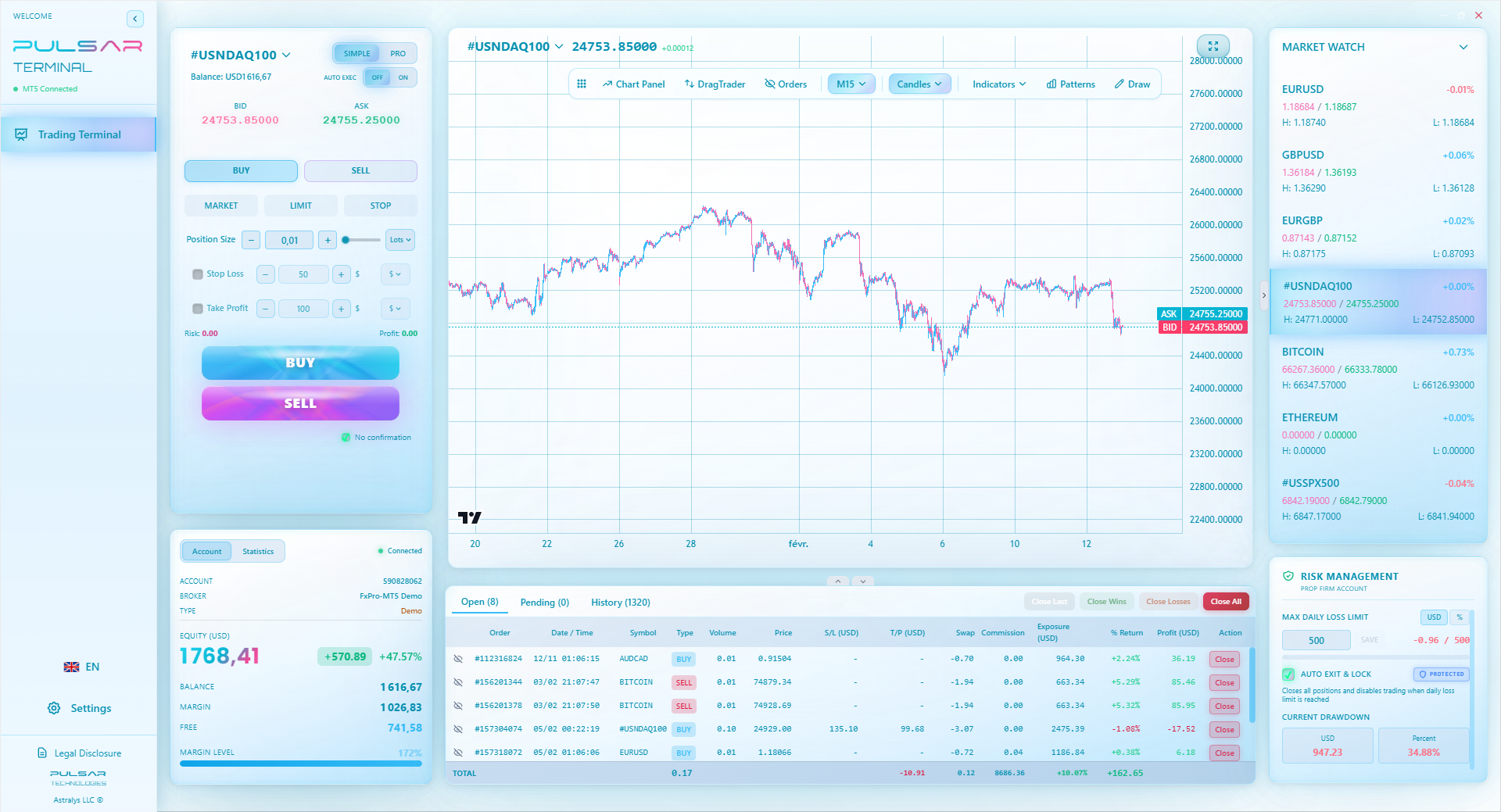
Managing multiple take-profit levels and trailing stops on swing trades is critical, and Pulsar Terminal automates this directly on your MT5 platform.
Pulsar Terminal
La herramienta MT5 todo-en-uno: órdenes drag-and-drop, multi-TP/SL, trailing stop, grid trading, Volume Profile y protección prop firm. Usado por más de 1.000 traders diariamente.
Let's get painfully honest. These are the holes in my ledger.
Pitfall 1: Moving Your Stop-Loss Further Away. The classic 'give it room to breathe' mistake. In swing trading, if price hits your logical stop level, your idea is wrong. Moving the stop is just delaying a loss and increasing its size. I turned a $200 loss into an $800 loss on a USD/JPY swing doing this. The discipline of a fixed stop is everything.
Pitfall 2: Chasing the Move. You see a pair rocket 150 pips. FOMO kicks in. You jump in late, near the top, just in time for the pullback. Your stop gets hit, the trend resumes without you. I've done this more times than I can count. Swing entries are about patience at levels, not panic in momentum.
Pitfall 3: Ignoring the Economic Calendar. Swing trading a currency pair into a major US news event (NFP, CPI, FOMC) is gambling. The volatility can blow through your stop or trigger massive gaps. I learned to either close positions before high-impact news or widen stops significantly (which changes my position size). Better yet, just avoid it.
Pitfall 4: Over-optimizing Indicators. I spent months backtesting the perfect RSI and MACD settings. Guess what? The default settings worked just as well. The edge isn't in the magic formula; it's in your consistency and psychology. Don't get lost in the settings. Focus on the price.
These mistakes are why a rock-solid plan and tools that enforce discipline are non-negotiable. A margin call is often just the end result of a series of these small errors.
“The US rules force a slower, more deliberate path. In the long run, that might be the biggest advantage you have.”
You need a platform that fits within the US regulatory box but gives you professional-grade tools.
MetaTrader 4/5: Still the gold standard for charting and analysis. Most US brokers like FOREX.com and OANDA offer MT4. MT5 is less common but growing. The built-in indicators and ability to code custom scripts are useful for testing your forex swing trading strategies.
TradingView: My personal favorite for analysis. The social features and quality of charting are top-notch. I use it for my initial daily scan and drawing key levels, then execute on my broker's platform.
Broker Platforms: Don't overlook the native platforms from Pepperstone or IC Markets (for non-US) or FOREX.com's Advanced Dashboard for US traders. They often have superior market research, news integration, and risk management widgets built specifically for their environment.
The key is integration. Your analysis tool, your execution platform, and your risk management need to work in a seamless flow. Clunky processes lead to missed entries and sloppy exits.
Okay, you're convinced. Here's how to start without lighting money on fire.
- Open a Demo Account: Not for a week. For at least three months. Use it to practice the full cycle: analysis, planning, entry, management, exit. Pick a US-regulated broker's demo (OANDA's is great). Treat the virtual $50,000 as real money.
- Journal Religiously: Every trade. The setup, the reason, the outcome, the emotion. Screenshot your charts. This is how you find your personal edge and your fatal flaws. My journal showed me I was terrible at range breakouts but decent at pullbacks. I stopped trading ranges.
- Start with a Micro Account: When you go live, fund the minimum. For OANDA, that's $0. But fund it with an amount you can afford to lose - $500, $1000. Trade micro lots (1,000 units). Your goal in the first six months is not profit. It's to execute your plan flawlessly, trade after trade. The profits will follow the process.
- Find a Community (Carefully): Avoid the 'get rich quick' discords. Look for communities focused on education and review of trading journals. A second pair of eyes on your swing trade analysis is priceless.
Swing trading is a marathon. It took me two years of consistent loss, study, and adjustment before my equity curve turned sustainably upward. The US rules force a slower, more deliberate path. In the long run, that might be the biggest advantage you have.
FAQ
Q1What's a realistic return for a forex swing trader in the US?
If anyone gives you a percentage, be skeptical. A consistently profitable swing trader might aim for a 10-30% annual return on their risk capital. But the key word is 'consistent.' Most months might see small gains or losses, with a few big winners from successful swings. Focus on the process, not a target return. The broker stats showing 60-75% of accounts lose money are real.
Q2Can I use automated trading or EAs for swing trading in the US?
Yes, you can use Expert Advisors (EAs) on platforms like MT4/MT5 with US brokers. However, remember the regulations (FIFO, no hedging) still apply. Your EA's logic must comply. Also, finding a truly strong, long-term profitable swing trading EA is incredibly difficult. Most fail outside their specific backtest conditions.
Q3How do taxes work on forex swing trading profits in the US?
The IRS treats forex trading as ordinary income by default. You'll receive a 1099 form from your broker. Many active traders elect 'Section 475(f) mark-to-market' accounting. This treats all gains/losses as 60% long-term and 40% short-term capital gains, simplifies accounting, and allows loss deductions beyond the $3,000 annual limit. This is complex; consult a tax professional experienced with traders.
Q4Is swing trading better than day trading for a beginner?
For most US beginners, yes. Swing trading's slower pace allows time for analysis, reduces emotional decision-making, and works better with lower use. Day trading requires intense screen time, faster reactions, and often leads to overtrading. Swing trading teaches market structure and patience - the core skills for any timeframe.
Q5What timeframes should I actually look at for swing trading?
I use a top-down approach: Weekly (for major trend context) -> Daily (for swing direction and key levels) -> 4-Hour (for entry zone and structure) -> 1-Hour (for precise entry signal). The daily chart is your primary decision-making timeframe. Never take a swing trade signal from a chart below the 1-hour.
Q6How do I handle weekend gaps with swing trades?
You can't avoid them, so you manage the risk. First, be aware of major news or events over the weekend. Second, consider reducing your position size before the Friday close if you're holding, or use a wider stop-loss to account for potential gap volatility. Sometimes, the safest move is to close the position and re-assess on Sunday.
Lección del Prof. Winston
Puntos clave:
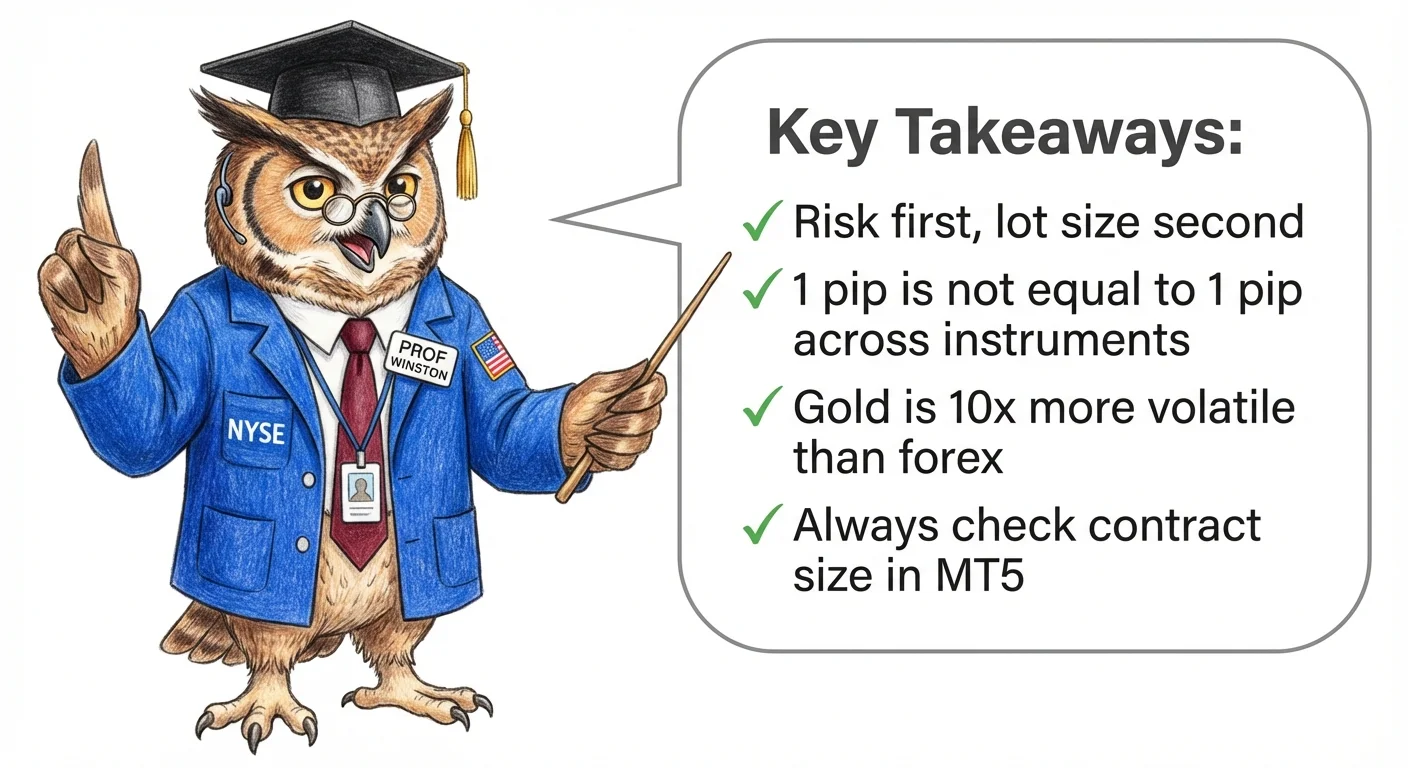
- ✓Risk a maximum of 1% per trade. Always.
- ✓Use the daily chart for direction, the 4-hour for timing.
- ✓US use limits (50:1) are a protective discipline.
- ✓Wait for the pullback, never chase the breakout.
- ✓A trading journal is your most important tool.
¿Te resultó útil este artículo?
Haz clic en una estrella
Análisis Trading Semanal
Análisis y estrategias semanales gratis. Sin spam.
Sobre el autor
James Mitchell
Analista de Trading Sénior
Con sede en Nueva York y más de 9 años de experiencia en trading. Se enfoca en pares USD principales, desafíos de prop firms y el panorama regulatorio estadounidense.
Comentarios
Aviso de riesgo
El trading de instrumentos financieros conlleva un riesgo significativo y puede no ser adecuado para todos los inversores. El rendimiento pasado no garantiza resultados futuros. Este contenido tiene fines educativos únicamente y no debe considerarse asesoramiento de inversión. Siempre realice su propia investigación antes de operar.
También te puede interesar

Cara Trading Forex Sukses: 7 Prinsip dari Trader Profesional
Cara trading forex sukses dengan 7 prinsip trader pro: manajemen modal, disiplin, journal trading, backtest. Data nyata, bukan janji profit palsu.
Jam Trading Forex Terbaik untuk Trader Indonesia: Panduan Lengkap dengan Tabel Waktu
Panduan jam trading forex untuk trader Indonesia. Tabel 4 sesi dunia, jam emas 20:00-00:00, sesi mana yang harus dihindari. Data akurat + tips dari trader berpengalaman.
Top 5 Sàn Forex Uy Tín Nhất 2026: Review Jujur dari Trader Indonesia
Top 5 sàn forex uy tín 2026 untuk trader Indonesia. Review jujur: spread, deposit, withdraw, dukungan lokal. Exness, XM, IC Markets & lebih.
Obtener Pulsar Terminal
Todas estas calculadoras están integradas en Pulsar Terminal con datos en tiempo real de su cuenta MT5.
Obtener Pulsar Terminal