


Here's a fact that might surprise you: while the average daily turnover in India's forex market has nearly doubled from $32 billion to $60 billion since 2020, the vast majority of that volume isn't from retail traders like you and me.

Rajesh Sharma
Analista Forex Sénior ·  India
India
☕ 12 min de lectura
Lo que aprenderás:

Here's a fact that might surprise you: while the average daily turnover in India's forex market has nearly doubled from $32 billion to $60 billion since 2020, the vast majority of that volume isn't from retail traders like you and me. It's from banks and institutions. Why? Because the rules for forex trading in India are some of the strictest in the world. I've seen too many new traders get excited, deposit money with some flashy international broker, and only later realize they're operating in a legal grey area. Let's cut through the noise. This isn't about getting rich quick. It's about understanding exactly what you can and cannot do, where the real opportunities lie, and how to protect your capital in a market that doesn't always play by global rules.
This is the first and most important question. The short answer is yes, but with massive, non-negotiable caveats. Forget everything you've seen on YouTube ads from brokers promising unlimited use on EUR/USD.
The legal framework is the Foreign Exchange Management Act (FEMA) of 1999. It's not a suggestion; it's the law. The Reserve Bank of India (RBI) and the Securities and Exchange Board of India (SEBI) enforce it strictly.
Here’s the core rule: Indian retail traders are only permitted to trade currency derivatives (futures and options) on SEBI-regulated domestic exchanges. This means the National Stock Exchange (NSE), the Bombay Stock Exchange (BSE), and the Metropolitan Stock Exchange (MSEI).
What you CANNOT do is just as critical. Spot forex trading - where you directly buy and sell currency pairs - is not permitted for Indian residents. Using your bank account to send money to an offshore broker like Exness or IC Markets to trade global pairs like GBP/JPY is a direct violation of FEMA. The RBI has issued countless warnings about this. They monitor transactions, and the penalties can be severe, including freezing of accounts and legal action.

Warning: The Liberalised Remittance Scheme (LRS), which lets you send up to $250,000 abroad annually, explicitly excludes speculative forex trading. Using it to fund an international trading account is illegal. Don't let any broker tell you otherwise.
So, where does that leave you? With exchange-traded currency derivatives. It's a different beast than the spot forex you read about globally, but it's the only fully legal playground for most of us.

💡 Consejo de Winston
The RBI doesn't care about your technical analysis. They have a mandate for currency stability. Always ask, 'What would the RBI want?' before taking a large USD/INR position.

Your menu is limited, but it's enough to build a strategy. You're trading futures and options contracts, not the spot price. This changes your cost structure and expiry dates, which we'll get into.
The Legal Currency Pairs
You can only trade pairs where the Indian Rupee (INR) is one side. The main ones are:
| Currency Pair | Contract Size (Typical) | Primary Exchange |
|---|---|---|
| USD/INR | $1000 | NSE, BSE |
| EUR/INR | €1000 | NSE, BSE |
| GBP/INR | £1000 | NSE, BSE |
| JPY/INR | ¥100,000 | NSE, BSE |
There's a bit of a grey area with cross-currency pairs (like EUR/USD, GBP/USD). Some brokers on Indian exchanges offer futures on these, but they are far less liquid than the INR pairs. Your primary focus should be on USD/INR - it has by far the deepest liquidity and tightest spreads.
How It Works: Futures vs. The 'Grey' Market
On the NSE, you're buying a standardised contract for a future date. Each contract has a fixed size (like $1000 for USD/INR). Your profit or loss is the difference between your entry price and the exit price, multiplied by the contract size. There's no use in the traditional CFDs sense, but you post a margin with your broker.
Now, let's talk about the elephant in the room. Many Indian traders still use international brokers. How? They often use international debit/credit cards or cryptocurrencies to fund accounts with brokers' offshore entities (like an IC Markets Seychelles account). This is the 'grey' market. While these brokers offer global pairs and higher use, you have zero legal protection from SEBI. If the broker has an issue, your recourse is in a foreign country. I did this for my first two years, trading EUR/USD with a broker regulated in Cyprus. I made money, but the anxiety of a potential RBI notice was always there. I eventually moved my capital back to trading USD/INR futures on a local broker, just for peace of mind.

Pro Tip: Start with USD/INR futures on a SEBI broker. Understand the pip definition in this context (it's 0.0025 for USD/INR). Master one market before you even think about venturing elsewhere.
“The only fully legal playground for most Indian retail forex traders is exchange-traded currency derivatives.”
Your choice of broker dictates your trading costs, execution speed, and overall experience. Let's break down the two worlds.
SEBI-Regulated Brokers (The Legal Route)
These are your stockbrokers who also offer currency derivatives. They are safe, regulated, and your funds are protected.
- Zerodha: The giant. Their Kite platform is excellent for charting and execution. Low brokerage fees.
- Upstox Pro: Very popular, competitive pricing.
- Angel One, ICICI Direct, HDFC Securities: Traditional giants, reliable but platforms can feel older.
- 5Paisa, Motilal Oswal: Good alternatives.
With these brokers, you'll use their proprietary platform or maybe MetaTrader 5 if they offer it (some do for commodities). Your funding is via normal bank transfer. Your profits land directly in your linked bank account.
International Brokers (The Grey Route)
These brokers accept Indian clients through their offshore entities. They offer MetaTrader 4/5, cTrader, and global markets.
- FP Markets: Actively courts Indian traders. Offers local funding via UPI and Netbanking to its Seychelles entity. This is a double-edged sword - convenient, but makes the transaction very visible.
- IC Markets: Known for raw spreads and fast execution. Minimum deposit $200.
- XM: Very low minimum deposit ($5), but spreads are wider on standard accounts.
- Pepperstone: Great execution speed and customer service.
The Real Cost Breakdown
On Indian exchanges, your costs are:
- Brokerage: A fixed fee per trade or a percentage of turnover. Zerodha charges ₹20 per executed order, or 0.03% of the turnover (whichever is lower).
- Exchange & SEBI Charges: Tiny statutory fees.
- STT (Securities Transaction Tax): 0.001% on the sell side of futures.
- GST: 18% on the brokerage fee.
On international brokers, costs are different:
- Spreads: On a standard account, expect 1.5-2.0 pips on EUR/USD. On a raw/ECN account, spreads can be near zero, but you pay a commission. Check our Exness review and IC Markets review for detailed comparisons.
- Commissions: Often $3-$7 per round turn (per lot).
- Payment Fees: Funding via international card can cost 3-5% in bank fees. Some brokers absorb this.
I learned this the hard way. In 2019, I was scalping EUR/USD on an ECN account. I was paying $5 commission per lot. I did 10 trades a day, 1 lot each. That's $50 a day in commissions, or $1000 a month. My net profit was only $1200 that month. The costs were eating me alive. I wasn't trading enough size to justify the activity. Always, always calculate your costs first. Use a position size calculator that includes commissions.

The taxman always gets his share. In India, it's relatively straightforward but easy to mess up if you're trading internationally.
For trading on Indian exchanges (USD/INR futures): Your profits are treated as Business Income or Speculative Business Income. You need to file ITR-3 or ITR-4. You can deduct your business expenses (brokerage, data fees, home office costs). You pay tax at your applicable income tax slab rate.
There's also a Tax Collected at Source (TCS) of 0.1% on the sale of futures contracts if the turnover exceeds ₹50 lakhs in a financial year. Your broker handles this.
For trading with international brokers (the grey area): This is murkier. Legally, you must still declare this income. It would likely be classified as Income from Other Sources or as foreign income. You need to convert your P&L from USD to INR using the RBI's financial year-end exchange rate. The tax rate is your slab rate.
The big risk here is disclosure. If you've remitted money illegally and then declare the profit, you're admitting to a FEMA violation. This is the core dilemma of the grey market. I consult with a CA who specialises in traders. His first question to any new client is, "Where is your broker based?" It changes everything.
Warning: There is NO separate 10% tax on capital gains for forex trading. That's a common myth. Your profits are added to your total income and taxed at your slab rate. Plan for at least 30% of your profits to go to taxes if you're in the highest bracket. Not accounting for this is a surefire way to blow up your financial planning.
💡 Consejo de Winston
Your biggest edge in USD/INR is patience. It's not a pair for scalping 10 times a day. Wait for the 4-hour or daily chart to give you a clear signal. One good trade a week beats ten mediocre ones.
“Using the LRS to fund an international trading account for speculative forex is illegal. Don't let any broker tell you otherwise.”
Trading USD/INR isn't like trading EUR/USD. It's heavily influenced by RBI intervention, oil prices (India imports oil in USD), and domestic capital flows. You need a different lens.
I primarily use a simple swing trading approach on the daily chart. Here’s a real example from last quarter.
- The Setup: USD/INR had been in a steady uptrend (dollar strengthening). The RSI indicator on the daily chart showed a reading of 75 (overbought). I waited.
- The Trigger: The price pulled back to a key moving average (the 20-day EMA) and formed a small bullish pin bar. The RSI had dipped back to 55, showing the overbought condition had eased. This was my signal that the uptrend might be resuming.
- The Trade: I bought 2 lots of the next-month USD/INR futures contract at 83.2500. My stop loss was placed below the low of the pin bar at 83.1800. That's a risk of 70 points per lot. Since each point for USD/INR is worth ₹0.0025 * $1000 = ₹2.5, my total risk was 70 points * ₹2.5 * 2 lots = ₹350.
- The Management & Exit: I used a simple 2:1 risk-reward target. My take-profit was set at 83.3900 (140 points away). The trade hit my target three days later. Profit: 140 points * ₹2.5 * 2 lots = ₹700.
Why this works? It respects the trend, uses a common indicator for context, and has a clear plan. The key is patience. USD/INR can be range-bound for weeks. Don't force trades. I use the MACD indicator to confirm trend momentum, but the RSI and price action are my primary guides.

Example: Let's say you have a ₹100,000 trading capital. A good rule is to risk no more than 1% per trade, so ₹1000. For a USD/INR trade with a 70-point stop loss, each point risks ₹2.5. So, ₹1000 / (70 * 2.5) = ~5.7. You could trade a maximum of 5 lots to stay within your risk limit. Never max this out. I'd take 2 or 3.

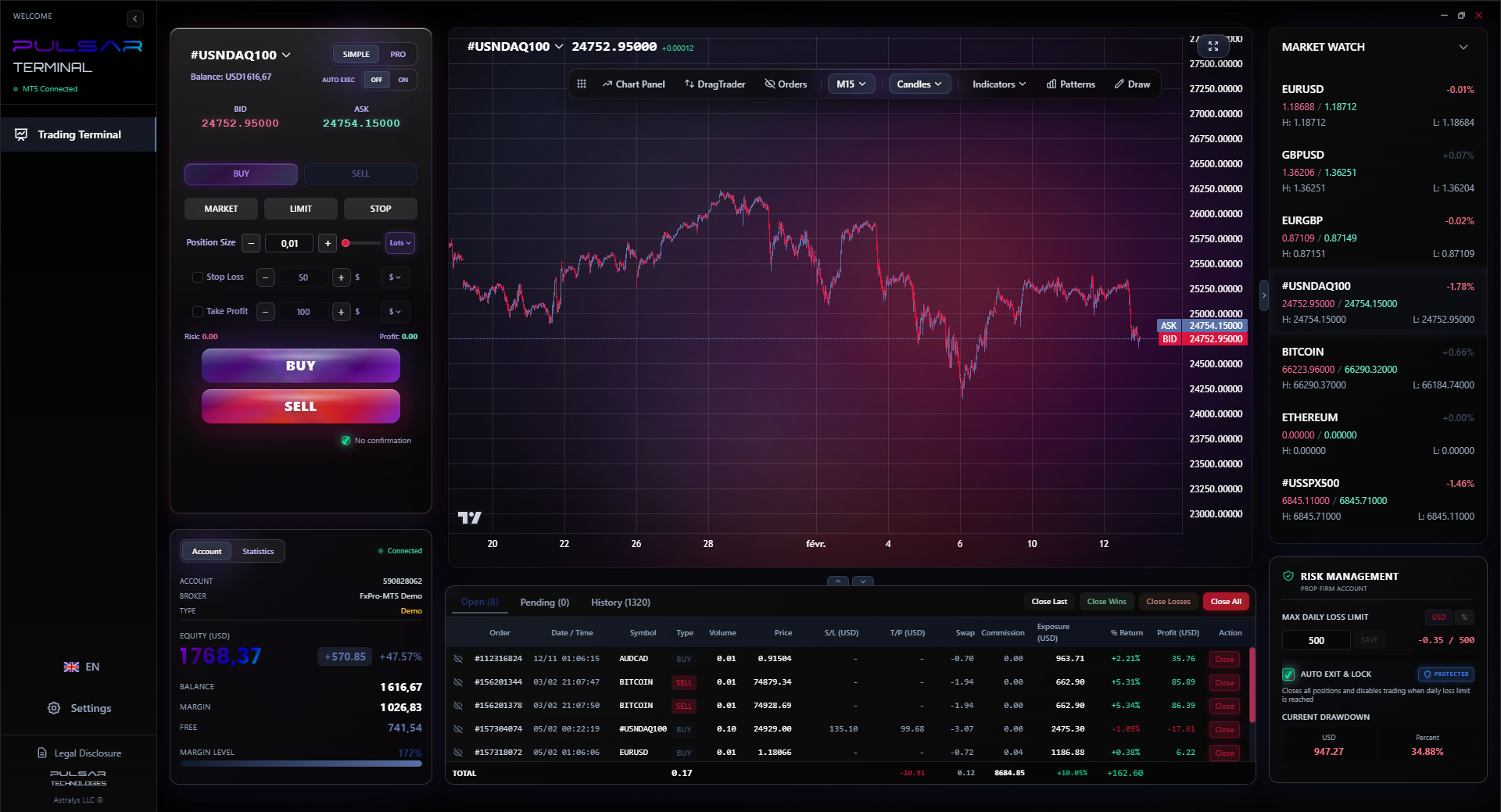
Managing multiple lot sizes and partial exits on USD/INR futures is clunky on most platforms, but Pulsar Terminal's drag-and-drop order system and multi-TP/SL tools make it intuitive directly on MT5.
Pulsar Terminal
La herramienta MT5 todo-en-uno: órdenes drag-and-drop, multi-TP/SL, trailing stop, grid trading, Volume Profile y protección prop firm. Usado por más de 1.000 traders diariamente.
I've made most of these mistakes so you don't have to.
Pitfall 1: Chasing the Illegal use Dream. An offshore broker offers you 1:500 use. You think, "With ₹50,000, I can control ₹2.5 crore!" This is a trap. That use will magnify your losses so fast you won't believe it. I once lost 60% of a small account in one afternoon trying to trade GBP/JPY with high use. The volatility ate me alive. The use on Indian exchanges is much lower and safer by design.
Pitfall 2: Ignoring the Spread. In low-liquidity times, the spread on USD/INR futures can widen. If you're a scalper, this can turn a winning strategy into a loser. Always check the bid-ask before entering.
Pitfall 3: No Risk Management. This is universal, but crucial here. You must know your exact risk before every trade. Use a stop loss. Always. I've seen too many traders "hope" a trade comes back because they can't stomach the loss. It never ends well. Understand what a margin call is, even in the lower-use Indian context.
Pitfall 4: Trading Based on Global USD News Alone. If the US Non-Farm Payrolls are strong, EUR/USD might fall. But USD/INR? The RBI might step in to curb volatility. The local dynamic often overrides the global one. Follow RBI policy announcements like a hawk.
The biggest lesson? Trade smaller than you think you should. Preserve your capital. The market isn't going anywhere. My most profitable year came after my worst drawdown, because I finally learned to keep my position sizes tiny and consistent. It's boring, but it works.
💡 Consejo de Winston
When calculating profit for taxes from an international account, use the RBI's FY-end exchange rate, not the rate you converted at. This small detail has caused many audit headaches.

“My most profitable year came after my worst drawdown, because I finally learned to keep my position sizes tiny and consistent.”
Let's build a safe, legal launch plan.
- Education First, Money Later: Spend a month paper trading USD/INR futures on a platform like TradingView or your broker's demo. Don't touch real money until you can explain your strategy in one sentence.
- Open a Demat & Trading Account: Choose a SEBI-regulated broker like Zerodha or Upstox. The process is fully online. You'll need your PAN, Aadhaar, and bank details.
- Fund Your Account: Transfer a small, risk-capital amount from your bank. I tell everyone to start with no more than ₹50,000. This is money you can afford to lose completely.
- Learn the Platform: Understand how to place a futures order, set a stop loss, and view your margin. It's different from a spot forex platform.
- Execute Your First Micro-Trade: Buy 1 single lot of USD/INR. Not to make money, but to go through the entire process: entry, setting a stop, watching it, and exiting. The psychological weight of real money, even a tiny amount, is the best teacher.
- Keep a Journal: Write down every trade. Why you took it, your emotion, the outcome. Review it weekly. This is more valuable than any indicator.
From here, you can scale up slowly, or explore the world of currency options for more complex strategies. But master the basics of the futures market first. It's the only solid foundation you have in the unique world of forex trading in India.
Remember, this is a marathon. I've been at this for over a decade, and I'm still learning. The goal isn't to be right on every trade. The goal is to be disciplined on every trade. That's how you survive and eventually thrive.

FAQ
Q1Can I legally trade EUR/USD or GBP/USD from India?
Not in the spot forex market. The only fully legal way is if these pairs are offered as futures or options contracts on SEBI-regulated Indian exchanges like the NSE. However, these cross-currency futures have much lower liquidity than USD/INR. Most traders accessing liquid EUR/USD markets are using international brokers in a legal grey area, which carries significant risk.
Q2What is the minimum amount needed to start forex trading in India?
On Indian exchanges, you need enough to cover the margin for one contract. For 1 lot of USD/INR futures, the initial margin can be as low as ₹8,000-₹12,000, depending on volatility. So technically, you could start with around ₹15,000. However, I strongly recommend starting with at least ₹50,000 as risk capital to allow for proper position sizing and to withstand a few losses without blowing your account.
Q3Do I have to pay GST on my forex trading profits?
No, you do not pay GST on your profits. You pay GST (18%) on the brokerage fees and other service charges your broker levies. Your trading profit is subject to income tax under the head 'Business Income' or 'Speculative Business Income' at your applicable slab rate.
Q4Is MetaTrader 5 (MT5) legal to use in India?
The MT5 platform itself is not illegal. Some SEBI-regulated brokers offer MT5 for trading commodities and possibly currency derivatives. However, using MT5 to connect to an offshore broker to trade spot forex or CFDs on global pairs is where you violate FEMA rules. The legality is about who you trade with and what you trade, not the software.
Q5What happens if I get caught trading with an international broker?
The RBI and enforcement agencies can take action for violating FEMA. This can include penalties, fines (which can be multiples of the unauthorised amount), and in severe cases, prosecution. They can also instruct your bank to freeze related accounts. The risk is real, though enforcement intensity can vary.
Q6Can I trade forex 24 hours a day from India?
If you are trading USD/INR futures on Indian exchanges, no. The NSE's currency derivatives segment is open from 9:00 AM to 5:00 PM IST, Monday to Friday. If you are trading through an international broker in the grey market, you can access global markets 24/5, but you again face the legal and regulatory risks associated with that path.
Q7How are my funds protected with a SEBI broker?
SEBI-regulated brokers must keep client funds (segregated from their own money) in separate bank accounts. They are also required to be part of the Investor Protection Fund, which provides a limited safety net. This offers significantly more protection than keeping funds with an unregulated offshore entity.
Lección del Prof. Winston
Puntos clave:
- ✓Trade only INR pairs on NSE/BSE for full legal safety.
- ✓Budget 30% of profits for tax if in the highest slab.
- ✓Risk a maximum of 1% of capital on any single trade.
- ✓USD/INR margin can start as low as ₹8,000 per lot.
- ✓Brokerage, STT, and GST are your real trading costs.
¿Te resultó útil este artículo?
Haz clic en una estrella
Análisis Trading Semanal
Análisis y estrategias semanales gratis. Sin spam.
Sobre el autor
Rajesh Sharma
Analista Forex Sénior
Más de 10 años operando en mercados indios y del sur de Asia. Comenzó con derivados de divisas en el NSE antes de pasar al forex internacional. Especialista en USD/INR y pares de mercados emergentes.
Comentarios
Aviso de riesgo
El trading de instrumentos financieros conlleva un riesgo significativo y puede no ser adecuado para todos los inversores. El rendimiento pasado no garantiza resultados futuros. Este contenido tiene fines educativos únicamente y no debe considerarse asesoramiento de inversión. Siempre realice su propia investigación antes de operar.
También te puede interesar

Cara Trading Forex Sukses: 7 Prinsip dari Trader Profesional
Cara trading forex sukses dengan 7 prinsip trader pro: manajemen modal, disiplin, journal trading, backtest. Data nyata, bukan janji profit palsu.
Jam Trading Forex Terbaik untuk Trader Indonesia: Panduan Lengkap dengan Tabel Waktu
Panduan jam trading forex untuk trader Indonesia. Tabel 4 sesi dunia, jam emas 20:00-00:00, sesi mana yang harus dihindari. Data akurat + tips dari trader berpengalaman.
Top 5 Sàn Forex Uy Tín Nhất 2026: Review Jujur dari Trader Indonesia
Top 5 sàn forex uy tín 2026 untuk trader Indonesia. Review jujur: spread, deposit, withdraw, dukungan lokal. Exness, XM, IC Markets & lebih.
Obtener Pulsar Terminal
Todas estas calculadoras están integradas en Pulsar Terminal con datos en tiempo real de su cuenta MT5.
Obtener Pulsar Terminal