


Here's the biggest lie I hear from new traders: 'SARS won't know about my forex profits.' Let me stop you right there.

David van der Merwe
Trader de Mercados Emergentes ·  South Africa
☕ 11 min de lectura
Lo que aprenderás:
Here's the biggest lie I hear from new traders: 'SARS won't know about my forex profits.' Let me stop you right there. In 2026, with the data-sharing agreements they've got in place, they absolutely will. Pretending your trading account doesn't exist is a fast track to penalties, back taxes, and a world of stress. I've seen it happen. This isn't about scare tactics; it's about trading as a sustainable business. I'll walk you through exactly how SARS views forex trading, what you'll pay, and the smart moves to keep more of your hard-earned profits.
This is the single most important concept for your forex trading tax SARS obligations. SARS doesn't see 'traders.' They see two distinct boxes, and which one you fall into changes your tax bill dramatically. They'll look at your behavior to decide.
The Active Trader (Revenue Account) This is you if trading is your business. You're in and out of positions daily or weekly, you've got a defined strategy, and it's a primary source of income. Think of it like running a spaza shop, but your inventory is currency pairs. Your profits here are considered ordinary revenue. That means every rand of profit gets added to your other income (salary, rental income, etc.) and is taxed at your marginal income tax rate. Ouch. The upside? All your legitimate business expenses are deductible.
The Occasional Investor (Capital Account) This is the 'dabbler.' You might place a few trades a month, hold positions for weeks or months, and it's more of a side hobby than a job. Your profits here might be classified as capital gains. This is where it gets interesting. Only 40% of your net capital gain is included in your taxable income. So, if you make R100,000 profit, only R40,000 is added to your income and taxed. The effective maximum tax rate on capital gains is 18%.

Warning: Don't try to fool SARS. They look at frequency, volume, financing, and intent. If you're executing 50 trades a week with a clear scalping strategy, calling yourself an 'investor' won't fly. Be honest with your classification.
How SARS Actually Decides
They use a 'badges of trade' test. No single factor decides it, but the more you tick, the more likely you're a trader:
- Frequency: Daily or weekly trading? Trader.
- Holding Period: Positions open for minutes/hours? Trader. Months? Possibly investor.
- Financing: Using significant use? That screams trading activity.
- Intention: Did you buy EUR/USD to make a quick profit (trader) or as a long-term store of value (investor)?
I learned this the hard way early on. In 2018, I had a killer year swing trading XAU/USD. Made about R280,000 in profit. I filed it all as capital gains, thinking my 3-4 week hold times qualified. My accountant (a good one I hired later) nearly had a heart attack. He explained that the volume and systematic nature of my trades, plus my use of a position size calculator for every entry, clearly pointed to revenue activity. We had to re-file. It was a paperwork nightmare, but it saved me from a much bigger problem later.

💡 Consejo de Winston
Your first tax consultation with a professional is a business expense. Claim it. It's the best R2,000 you'll ever spend to avoid a R20,000 problem.
Let's talk brass tacks. Forget the theoretical stuff. Here’s what hits your pocket in 2026.
What You Owe (The Damage)
| Your Status | Tax Treatment | Effective Tax Rate (Max) | Key Detail |
|---|---|---|---|
| Individual (Trader) | Income Tax | Up to 45% | Your full profit is income. Use the progressive tax tables. |
| Individual (Investor) | Capital Gains Tax (CGT) | Up to 18% | Only 40% of the gain is taxable. Big difference. |
| Registered Company | Company Tax | 27% | Flat rate on company profits. Simpler, but has setup costs. |
The Tax-Free Threshold: Good news. If your total taxable income for the year (from all sources) is below R95,750 (2025 tax year), you pay no income tax. That includes your trading profits. This is a major incentive for part-time traders starting out.
What You Can Claim Back (The Silver Lining) If you're classified as a trader (revenue), your deductible expenses are your best friend. These reduce your taxable profit. Keep every receipt.
- Platform & Data Fees: Monthly charges for TradingView, MetaTrader, or broker data feeds.
- Education: Trading courses, books, seminars. If it makes you a better trader, it's likely deductible.
- Hardware & Software: A percentage of your computer, monitors, internet, and electricity. If you use it 80% for trading, claim 80% of the cost.
- Home Office: If you have a dedicated trading space, you can claim a portion of rent, rates, and cleaning. The SARS formula is specific – don't overclaim.
- Travel: Going to a trading seminar? Keep a logbook. Mileage and related costs count.

Pro Tip: Open a separate business bank account. Route all trading deposits, withdrawals, and expenses through it. Come tax time, your bank statement is 90% of your record-keeping done. It's the simplest trick that most traders ignore.
Retirement Annuity (RA) Rescue: This is a powerful tool. As a provisional taxpayer, you can contribute up to 27.5% of your taxable income (capped at R350,000) to an RA. This contribution is deducted from your taxable income. Made R500,000 in trading profit? Contribute R137,500 to your RA, and you only pay tax on R362,500. It's a forced savings plan with a massive tax break.
“In 2026, with SARS's tech, assuming they won't find out is financial suicide.”
You're not a salaried employee with PAYE deducted at source. Welcome to the world of provisional tax. This is how SARS ensures they get their money during the year, not just at the end. Ignoring this is the #1 administrative mistake traders make.
You MUST register as a provisional taxpayer once you start trading with the intention of making a profit. It's not optional.
The tax year runs from 1 March to 28 February. You'll make at least two payments:
- First Period: Ends 31 August. You must make a payment by the end of August.
- Second Period: Ends 28/29 February. Payment is due by the end of February.
There's a potential third period if you still owe tax after your second estimate, but let's keep it simple.
How to Estimate Your Payment: This is the tricky part. You're estimating your total year's profit. SARS offers two methods:
- Estimate 1 (August): Base it on your best guess for the year. If you have no idea, you can declare 'nil' but be careful.
- Estimate 2 (February): This should be far more accurate. You have 11 months of data.

Example: Let's say in August, you project a R200,000 trading profit for the full year (March-Feb). Your total estimated tax liability (using the tax tables) might be, say, R45,000. Your first provisional payment is 50% of that: R22,500, due by 31 August.
The IRP6 and ITR12: You submit an IRP6 form for each provisional period, even if you pay nothing. At the year's end, you submit your annual ITR12 return (by October/November), which reconciles all your estimates and actual income. Any underpayment gets settled then, with possible interest.
My personal rule? I always overestimate my first provisional payment by 10-15%. It's better to get a refund than to face underpayment penalties. The interest SARS charges on late payments is not friendly.
💡 Consejo de Winston
Set up a separate, free savings account. Every time you make a profitable trade, transfer 30% of the profit there. Call it your 'SARS & Savings' account. No surprises in February.
Your trading log is your legal defense. In 2026, with SARS's tech, assuming they won't find out is financial suicide.
Non-Negotiable Records:
- Full Trade History: Every single trade, with entry/exit price, time, pip gain/loss, and reason for trade (your strategy). Most brokers like Exness or IC Markets let you download this as a CSV.
- Bank Statements: All deposits to and withdrawals from your trading account. This proves the money trail.
- Profit & Loss Statements: Monthly and annual summaries.
- Expense Receipts: Digitize them. Use a folder on your cloud drive.
Broker Choice & The FSCA: You can use FSCA-regulated brokers (like XM or Pepperstone in SA) or international ones. There's a trade-off.
- FSCA Brokers: Safer in terms of local regulation and fund segregation. But they must enforce the 30:1 use cap.
- International Brokers: May offer higher use and different conditions. However, if something goes wrong, the FSCA can't help you. And crucially, SARS still wants their cut. Your tax residency doesn't change based on your broker's location.
The R1 Million Rule: Funding an offshore account? Pay attention. If you want to transfer more than R1 million abroad in a calendar year, you need a Tax Compliance Status (TCS) pin from SARS. Your bank will ask for it. This is the SARB (Reserve Bank) and SARS working together to monitor capital flows. Smaller amounts are generally hassle-free via credit card or e-wallet.
A mistake I made years ago was not converting profits to ZAR at the correct rate. If you withdraw USD profits, you must convert them to ZAR using the official SARS average exchange rate for the month of withdrawal (find it on their website). Don't just use the spot rate on the day; SARS has their own table. Getting this wrong throws your numbers off.
“The taxman is your silent partner. Understand his cut, keep him happy with accurate paperwork, and you can focus on the next trade.”
This is the 'next-level' question. Once your trading profits are consistently solid, operating through a registered (Pty) Ltd company becomes worth considering.
The Big Advantage: The 27% Flat Rate. Instead of your profits being pushed into your personal income tax bracket (potentially 45%), the company pays tax on its profits at a flat rate of 27%. That's a potential 18% saving right off the top. The company's after-tax profits can then be retained for more trading capital.
The Downsides (And They're Big):
- Setup & Running Costs: Accounting, auditing, and CIPC fees. You're looking at thousands of rands per year, minimum.
- Complexity: You can't just dip into the company's money. You need to draw a salary (which is taxable) or declare dividends (which have Dividend Withholding Tax).
- SARS Scrutiny: Trading companies are known to SARS. Your compliance needs to be impeccable.
Is It For You? As a rough guide: If your annual trading profits are consistently over R500,000, have a chat with a tax professional about a company structure. Below that, the admin costs probably eat up the tax benefit. I didn't make the switch until my third consecutive year of six-figure profits. It was a headache to set up, but the long-term tax efficiency has been worth it.
Warning: This is not DIY territory. Do not register a company because of a blog post. You need a qualified tax practitioner or attorney who understands financial markets. A bad structure can be worse than no structure at all.
💡 Consejo de Winston
If you're serious about trading as a business, buy a cheap laser printer. A physical paper trail, filed monthly, is still the most convincing thing you can show an auditor.
I've made some of these. My friends have made others. Let's learn from our collective pain.
The Top 3 Blunders:
- The Ostrich Approach: Not declaring trading income at all. In the age of Common Reporting Standards (CRS), SARS gets data feeds from foreign brokers. They will find you.
- Mixing Money: Using your trading account like a personal slush fund. Depositing R10,000 for trading, withdrawing R2,000 for groceries. It makes reconciling your actual trading profit impossible and looks terrible in an audit.
- Forgetting Provisional Tax: Thinking you only pay tax when you submit your ITR12. The penalties for missing provisional payments are harsh and add up fast.
The Audit (It Might Happen): If you get a letter, don't panic. It's not necessarily an accusation of fraud. It's a request for verification.
- Get a Professional: Immediately hire a tax practitioner who deals with SARS regularly. Their fee is worth every cent for the stress they save.
- Be Organised: This is where your careful records pay off. You should be able to provide your trade history, bank statements, and expense receipts in a neat, logical package.
- Be Cooperative but Precise: Answer the questions asked, provide the documents requested. Don't volunteer extra information or get chatty.
My only SARS query came in 2021. They questioned a large withdrawal from my IC Markets account that hit my personal bank statement. Because I had my separate trading account statements and a clear log showing it was a profit withdrawal, my accountant resolved it with a single letter and document package. Took 48 hours. Without those records, it could have taken months.
The bottom line? Trading is a business. Run it like one from day one. The taxman is your silent partner. Understand his cut, keep him happy with accurate paperwork, and you can focus on what matters: finding the next good trade.
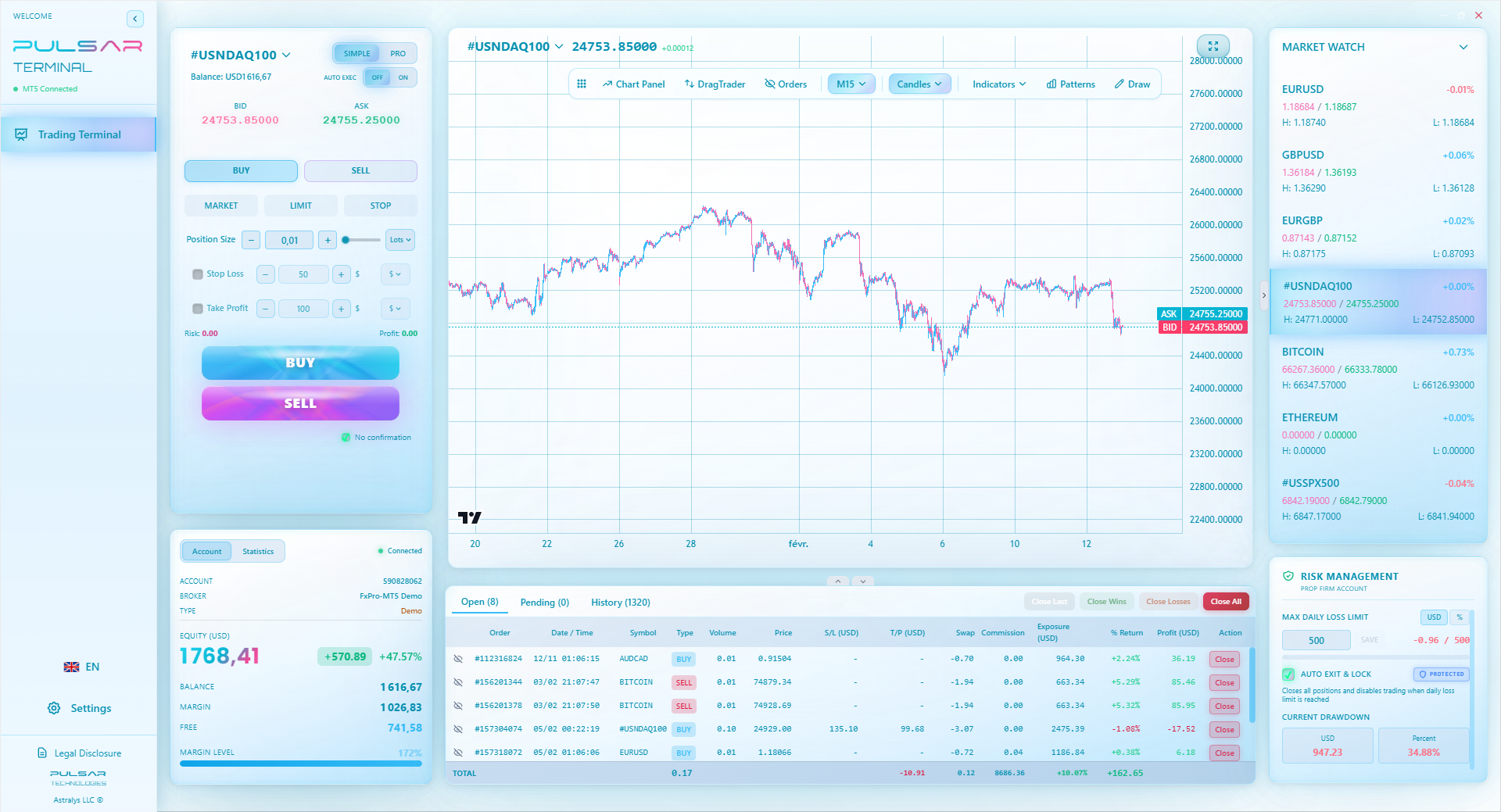
Accurate tax reporting starts with accurate trade tracking, and Pulsar Terminal logs every order, partial close, and P&L change directly on your MT5 chart for flawless record-keeping.
Pulsar Terminal
La herramienta MT5 todo-en-uno: órdenes drag-and-drop, multi-TP/SL, trailing stop, grid trading, Volume Profile y protección prop firm. Usado por más de 1.000 traders diariamente.
FAQ
Q1Do I pay tax on forex trading if I make a loss?
No, you don't pay tax on a loss. However, you must still declare your trading activity on your tax return (ITR12), showing the loss. This loss can potentially be carried forward to offset against future trading profits, reducing future tax bills. You also still need to comply with provisional tax submissions, even if you estimate a loss for the year.
Q2What is the tax-free threshold for forex trading in South Africa?
There isn't a separate 'forex trading' threshold. You use the general individual tax threshold. For the 2025 tax year (1 March 2024 - 28 February 2025), if your total taxable income from ALL sources (salary, trading, rentals, etc.) is less than R95,750, you will pay no income tax. If your trading is classified as capital gains, the annual exclusion for individuals is R40,000.
Q3Can SARS find out about my trading with an international broker?
Yes, absolutely. South Africa is part of international Common Reporting Standard (CRS) agreements. Most reputable international brokers are required to report account information (including balances and payouts) of South African tax residents to their local authority, which shares it with SARS. Assuming you are invisible is a major risk.
Q4How do I convert my USD profits to ZAR for SARS?
You must use the official SARS average exchange rate for the specific month in which you withdrew the profits (or realized the gain). Do not use the commercial bank rate or the spot rate on the day. You can find the monthly average rates for all major currencies on the SARS website. Keep a record of the rate used for each conversion.
Q5What happens if I don't register for provisional tax?
You will be charged penalties and interest. SARS can levy an administrative penalty (a fine) for failure to register and submit returns. More painfully, they will charge interest on any tax you should have paid during the year, calculated from the date the provisional payments were due. This interest is not tax-deductible and can significantly increase your bill.
Q6Are spreads and commissions tax deductible?
Yes, 100%. If you are taxed as a trader (revenue account), your trading costs are direct expenses against your income. This includes the spread (the difference between buy and sell price) and any explicit commissions charged by your broker. These costs reduce your gross profit to arrive at your net taxable profit.
Q7I use a prop firm challenge account. Is that taxable?
Yes. Any profit you make, whether from a demo, challenge, or live account, is potentially taxable once it is real, withdrawable money in your name. The payout from a prop firm after passing a challenge is considered income. The cost of the challenge fee itself may be a deductible expense if you are trading as a business.
Lección del Prof. Winston
Puntos clave:
- ✓SARS classifies you as a Trader (taxed up to 45%) or Investor (max 18% CGT).
- ✓Register for Provisional Tax immediately. Two payments a year are mandatory.
- ✓Keep every record: trade logs, statements, receipts. Your folder is your defense.
- ✓Use the SARS average exchange rate, not your bank's rate, for currency conversion.
- ✓Consider a company structure only after consistent profits over R500k.
¿Te resultó útil este artículo?
Haz clic en una estrella
Análisis Trading Semanal
Análisis y estrategias semanales gratis. Sin spam.
Sobre el autor
David van der Merwe
Trader de Mercados Emergentes
Trader con sede en Johannesburgo con 11 años en divisas de mercados emergentes. Especialista en pares ZAR, trading regulado por la FSCA y análisis del mercado sudafricano.
Comentarios
Aviso de riesgo
El trading de instrumentos financieros conlleva un riesgo significativo y puede no ser adecuado para todos los inversores. El rendimiento pasado no garantiza resultados futuros. Este contenido tiene fines educativos únicamente y no debe considerarse asesoramiento de inversión. Siempre realice su propia investigación antes de operar.
También te puede interesar

Cara Trading Forex Sukses: 7 Prinsip dari Trader Profesional
Cara trading forex sukses dengan 7 prinsip trader pro: manajemen modal, disiplin, journal trading, backtest. Data nyata, bukan janji profit palsu.
Jam Trading Forex Terbaik untuk Trader Indonesia: Panduan Lengkap dengan Tabel Waktu
Panduan jam trading forex untuk trader Indonesia. Tabel 4 sesi dunia, jam emas 20:00-00:00, sesi mana yang harus dihindari. Data akurat + tips dari trader berpengalaman.
Top 5 Sàn Forex Uy Tín Nhất 2026: Review Jujur dari Trader Indonesia
Top 5 sàn forex uy tín 2026 untuk trader Indonesia. Review jujur: spread, deposit, withdraw, dukungan lokal. Exness, XM, IC Markets & lebih.
Obtener Pulsar Terminal
Todas estas calculadoras están integradas en Pulsar Terminal con datos en tiempo real de su cuenta MT5.
Obtener Pulsar Terminal