


It was 1:15 PM WAT on a Tuesday, and I was watching EUR/USD like a hawk.

Olumide Adeyemi
Pionero del Trading en África Occidental ·  Nigeria
☕ 11 min de lectura
Lo que aprenderás:
- 1Why Time Zones Aren't Just a Clock
- 2WAT's Your Schedule? The Nigerian Trader's Clock
- 3Matching Your Style to the Session
- 4The Nigerian Context: Regulations, Taxes & Realities
- 5Building Your Time Zone Routine
- 6Tools to Track the Globe from Your Phone
- 7Pitfalls Every Nigerian Trader Faces (And How to Dodge Them)
- 8Putting It All Together: Your Action Plan
It was 1:15 PM WAT on a Tuesday, and I was watching EUR/USD like a hawk. The London session was in full swing, and New York was just waking up. The chart, which had been dozing all morning, suddenly sprang to life. In 45 minutes, it moved 40 pips. That wasn't luck. It was the London-New York overlap in action. If you're trading from Lagos, Abuja, or Port Harcourt, understanding these global forex trading time zones isn't just theory. It's the difference between catching a wave and watching it pass you by. Your location in West African Time (WAT) gives you a unique, and frankly brilliant, window into the world's most liquid market.
Here's the thing most new traders miss: the forex market doesn't have a single opening bell. It's a 24-hour relay race where the baton gets passed from one financial center to the next. Price isn't just moving because of news. It's moving because of who's at their desk. When London's banks and hedge funds log on, the volume in GBP and EUR pairs explodes. When New York joins the party, USD pairs get wild. For us in Nigeria, this means volatility isn't constant. It comes in waves. Trading during the dead zone between sessions is like fishing in an empty pond. You might get a nibble, but you're wasting your bait. I learned this the hard way. I used to try and scalp the Asian session from 3 AM WAT, bleary-eyed and desperate for action. The spreads were wider, the moves were tiny, and I'd often get stopped out by meaningless noise before the real market even opened. I was fighting the clock, not trading with it.

Warning: Trading during low-liquidity periods (like late New York close or early Asian session) is dangerous. Spreads widen significantly, and a single large order can cause a sharp, unpredictable spike that will take out your stop loss. It's not worth the risk.
Let's map the global sessions to our West African Time (GMT+1). Forget GMT for a second. This is your daily reality.
| Trading Session | Financial Center | WAT (GMT+1) | Key Characteristics |
|---|---|---|---|
| Asian | Tokyo, Singapore | 01:00 AM - 10:00 AM | Often range-bound. Focus on AUD, JPY, NZD. Good for some swing trade setups. |
| European | London, Frankfurt | 09:00 AM - 06:00 PM | The engine room. Highest volume. All EUR, GBP, CHF pairs come alive. |
| North American | New York, Toronto | 01:00 PM - 10:00 PM | USD takes center stage. Momentum from London often continues or reverses. |
| Pacific | Sydney | 11:00 PM - 08:00 AM | Very quiet. Mostly a continuation of the New York close. |
Look at that European session. It kicks off at 9 AM WAT. For many of you with a 9-to-5, that's just as you're starting work. The North American session starts at 1 PM WAT, right after lunch. This isn't a coincidence. It's an opportunity. Your natural day aligns almost perfectly with the two most powerful market sessions on the planet.
The Golden Hours: Session Overlaps
This is where the magic happens. When two major trading centers are open simultaneously, liquidity doubles, and volatility often follows.
The Tokyo-London Overlap (08:00 AM - 09:00 AM WAT): A short one-hour window. It can provide an early morning spark, especially in EUR/JPY or GBP/JPY. It's a decent warm-up, but not the main event.
The London-New York Overlap (01:00 PM - 05:00 PM WAT): This is it. The superstar. For four glorious hours, the two biggest financial capitals in the world are trading together. This is when you see the cleanest trends, the strongest breakouts, and the most reliable volume. If you can only trade one block of time, make it this one. I've placed more profitable trades between 1:30 PM and 4 PM WAT than in all other hours combined. It's where daily highs and lows are frequently tested and broken.

💡 Consejo de Winston
The market pays you for your patience, not your presence. If your chosen session is quiet, that's not a signal to trade a worse setup. It's a signal to read a book.
“The London-New York overlap is the superstar. If you can only trade one block of time, make it this one.”
Not all strategies work in all time zones. You need to pick the right tool for the job.
The London Session (9 AM - 1 PM WAT) is for...
- Swing Traders: Looking for daily chart setups. The initial directional bias for the day is often set here.
- Breakout Traders: Key European economic data (like German CPI or UK Employment figures) drops in this window, causing decisive moves.
- Trend Followers: If a clear trend establishes early in London, it has a high chance of running into the New York open.
The London-New York Overlap (1 PM - 5 PM WAT) is for...
- Scalpers: This is paradise for a scalping strategy. Tight spreads, fast moves, plenty of 5-15 pip opportunities. You need a broker with razor-thin spreads here, like IC Markets or Pepperstone.
- Momentum Traders: Ride the wave. This session has the highest Average True Range (ATR) on most major pairs.
- News Traders: US data (Retail Sales, CPI, NFP) hits at 1:30 PM or 3 PM WAT, right in the heart of the overlap. Volatility is guaranteed.
The Late New York / Asian Session (6 PM - 10 AM WAT) is for...
- Analysis & Planning: Seriously, stop trading. This is when you review your day, mark up your charts for tomorrow, and manage any open swing trading positions. The market is thin and manipulative.

Pro Tip: My personal rule? I don't open new positions after 5:30 PM WAT. I might manage existing ones, but the quality of new setups plummets as New York winds down. Protect your capital from the afternoon drift.
Trading the sessions is one thing. Getting your money in and out is another. Let's talk about the ground rules here in Nigeria.
First, yes, forex trading is legal for individuals. But the local regulatory scene for the brokers you and I use is... let's say 'developing.' The CBN isn't really checking the spreads on your Exness account. This means we rely heavily on international brokers regulated abroad (like the UK's FCA or Australia's ASIC). It's extra important to do your homework on broker safety.
Now, the taxman. The FIRS expects a 10% Capital Gains Tax on your gross trading profits. Not net. Gross. If you make ₦1,000,000 in profit over the year, you owe ₦100,000. Keep a simple spreadsheet. It's not worth the headache later.
The biggest practical headache? Funding your account. The CBN doesn't allow using official forex windows for trading. And as you know, many Nigerian bank cards are blocked for international broker deposits. The workaround? Fintech apps and crypto. Brokers like XM and HF Markets accept deposits via local transfer to a Nigerian intermediary, which is a lifesaver. Others are set up for USDT (Tether) deposits. This is the new normal.
A real example from last year: I withdrew $2,000 from my broker via USDT to a crypto wallet, sold the USDT on a local P2P platform for Naira, and had it in my bank account in under 90 minutes. The whole process cost about 1.5% in fees. It's not ideal, but it works.
“Complexity is the enemy of execution. A world clock and a shaded chart are often all you need.”
Knowledge is useless without a plan. Here’s a sample routine for a Nigerian trader with a day job:
6:30 AM - 8:00 AM WAT (Pre-Market):
- Check your phone. Scan for any major news that hit during the Asian session.
- Look at the daily charts. Did price close at a key level? Update your swing trading watchlist.
- No trading. Just preparation.
9:00 AM - 12:30 PM WAT (London Session):
- The market is now open. If you can, monitor the first 90 minutes for the initial direction.
- Place any pending orders for breakouts you identified earlier.
- If you see a strong trend forming with the MACD indicator confirming, consider an entry.
1:00 PM - 5:00 PM WAT (The Overlap - Core Trading):
- This is your focused trading time. Be at your screens if possible.
- Watch for reactions to US news at 1:30 PM.
- This is when I actively manage trades, look for retracements to join trends, or take quick scalps.
- Always use a position size calculator. The volatility here can wipe out an account fast if you're over-leveraged.
After 5:30 PM WAT:
- Close charts. Walk away.
- Journal your trades. What session was it? What worked? What didn't?
- Plan for tomorrow.
The key is discipline. The market will be there tomorrow. You don't need to catch every pip.
💡 Consejo de Winston
Your most important trading tool is an alarm clock set for 5:29 PM WAT. When it goes off, close your platform. The money saved after hours will fund your best trades tomorrow.
Sticking to a disciplined trading routine is easier when your tools help you manage risk automatically, like setting multiple take-profit levels for different session targets.
Pulsar Terminal
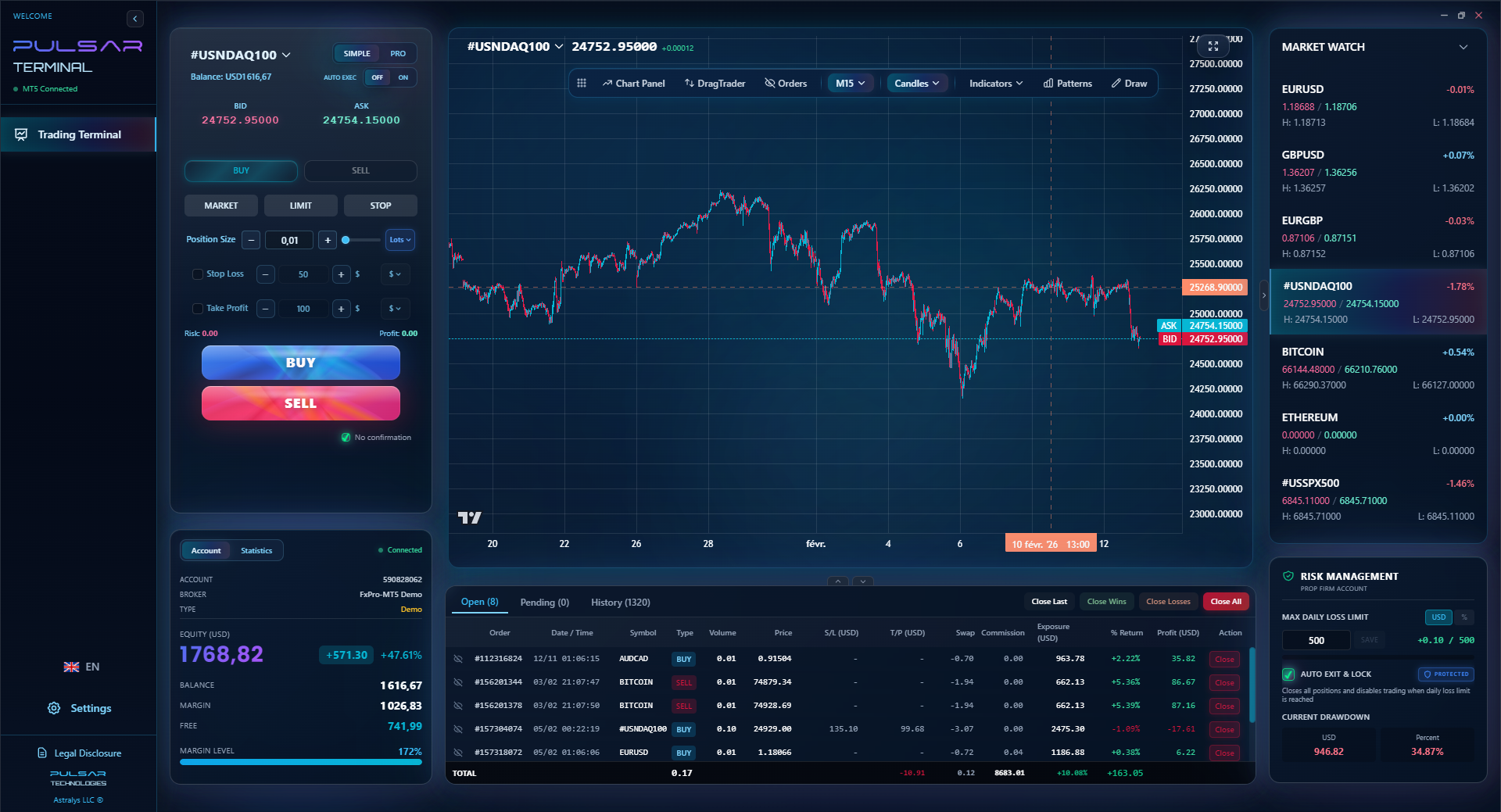
La herramienta MT5 todo-en-uno: órdenes drag-and-drop, multi-TP/SL, trailing stop, grid trading, Volume Profile y protección prop firm. Usado por más de 1.000 traders diariamente.
You don't need to memorize everything. Use technology.
- Economic Calendar: Every broker has one. Filter for ‘High Impact’ news and note the time in WAT. Set alerts for 10 minutes before major releases.
- Session Indicator Scripts: In MT4/MT5, you can download free scripts that shade the chart background for each session. Seeing the London-New York overlap shaded on your chart is a constant visual reminder.
- World Clock Widget: Add London (GMT), New York (EST), and Tokyo (JST) to your phone's world clock. A quick glance tells you who's open.
- Volatility Indicators: Add the Average True Range (ATR) indicator to your chart. You'll see the line physically rise during the overlap, confirming what you feel.
I have a simple dashboard on my trading monitor: my MT5 chart, an economic calendar tab, and a world clock. That's it. Complexity is the enemy of execution.

Example: Let's say the ATR on EUR/USD is 50 pips at 11 AM WAT. By 2 PM WAT, during the overlap, it expands to 85 pips. That's a 70% increase in average daily movement. Your stop losses need to account for this, or you'll get shaken out.
“You don't need to catch every pip. The market will be there tomorrow.”
I've made these mistakes so you don't have to.
Pitfall 1: Trading the 'Dead Zone'. After 6 PM WAT, boredom sets in. You see a little move on GBP/USD and jump in. Then, at 11 PM WAT, some unrelated news hits the wires, the spread widens to 5 pips, and you're stopped out. Solution: Have a hard stop time. Use a platform feature to disable trading after a certain hour if you have to.
Pitfall 2: Ignoring the Overlap. You place a trade at 10 AM WAT based on a perfect RSI indicator divergence. It goes your way for 15 pips. Then New York opens at 1 PM, and the momentum completely reverses, wiping out your profit. Solution: Understand that New York can override London's early direction. Consider taking partial profits before 1 PM, or wait for New York's first 30 minutes to show its hand before entering.
Pitfall 3: Mismatched Time Frames. You're trying to scalp the 1-minute chart during the quiet Asian session. The noise will drive you insane. Solution: Align your chart time frame with the session's volatility. Use higher time frames (1H, 4H) in the Asian session for analysis, and lower time frames (5M, 15M) during the overlap for entry precision.
Pitfall 4: Forgetting About Friday. The New York session closes early on Friday (around 9 PM WAT instead of 10 PM). Liquidity drains away faster. Squawk boxes start talking about 'weekend risk.' Solution: Avoid holding highly leveraged positions over the weekend unless it's a core swing trading idea. The Monday gap can be brutal.
💡 Consejo de Winston
New York doesn't care what London did before lunch. Always wait 30 minutes after the US open (1:30 PM WAT) to see who's really in charge before committing serious capital.
Alright, let's make this concrete. Here’s your first-week assignment:
- Don't trade. Just watch. For one week, open your chart of EUR/USD or XAU/USD at 9 AM, 1 PM, and 4 PM WAT. Note the price, the speed of the candles, and the visible volume.
- Mark the sessions. Draw vertical lines on your chart at 9 AM (London open), 1 PM (New York open), and 5 PM (London close). See how price behaves in these zones.
- Identify YOUR window. Based on your job, family, and energy levels, which 2-3 hour block can you consistently dedicate to focused trading? Is it early London (9 AM-11 AM)? The heart of the overlap (2 PM-4 PM)? Commit to that.
- Adjust your strategy. If you're a scalper, only practice during your chosen volatile window. If you're a swing trader, do your analysis in the morning and place orders that will be triggered by the day's volatility.
The global forex market turns over nearly $10 trillion a day. A huge chunk of that flows between 1 PM and 5 PM your time. Your location in WAT isn't a disadvantage. It's a strategic gift. You're perfectly positioned to trade the world's most active hours without pulling all-nighters. Now, go sync your watch with the market's heartbeat.
FAQ
Q1What is the best time to trade forex in Nigeria?
The absolute best time is the London-New York overlap, from 1:00 PM to 5:00 PM West African Time (WAT). This 4-hour window has the highest liquidity and volatility, providing the cleanest trends and most reliable trading opportunities for strategies like scalping and momentum trading.
Q2Is it legal to trade forex in Nigeria?
Yes, it is legal for individuals to trade forex with their personal funds. However, the local regulation of international retail forex brokers is limited. Nigerian traders primarily use brokers regulated overseas. Remember, you are liable for a 10% Capital Gains Tax on your gross trading profits.
Q3Can I trade the Asian session from Nigeria?
You can, but it's often not optimal. The Asian session (1:00 AM - 10:00 AM WAT) is typically lower in volatility. While it can be good for analyzing swing setups on higher time frames, it's challenging for strategies that require big moves. The spreads can also be wider, increasing your costs.
Q4Why is the London session so important?
London is the world's largest forex trading hub. When it opens at 9:00 AM WAT, it brings massive volume, particularly to Euro (EUR) and British Pound (GBP) pairs. This session often sets the tone and directional bias for the entire trading day, making it crucial for analysis and placing initial trades.
Q5How do I fund my forex account as a Nigerian?
Due to restrictions on Nigerian bank cards for international transactions, common methods include: depositing via a local bank transfer to a broker's Nigerian payment partner (offered by some like HF Markets), using fintech apps, or depositing cryptocurrency (like USDT). Always check your broker's specific deposit options for Nigeria.
Q6What is a good broker for Nigerian traders?
Look for internationally regulated brokers that accept Nigerian clients and offer convenient deposit methods. Brokers like XM (low minimum deposit), IC Markets (tight spreads), and HF Markets (local Naira support) are popular choices. Always prioritize regulation and reliable withdrawals.
Q7Do I need to stay up all night to trade forex successfully?
Absolutely not! In fact, that's a great way to burn out and make bad decisions. Your WAT time zone is perfect for trading the most active periods (London and New York sessions) during normal waking hours. Avoid trading the late New York and Pacific sessions (after 6 PM WAT).
Lección del Prof. Winston
Puntos clave:
- ✓Trade the London-New York overlap (1-5 PM WAT) for maximum opportunity.
- ✓Never trade the 'dead zone' after 6 PM WAT.
- ✓Pay your 10% Capital Gains Tax on gross profits.
- ✓Use crypto or local transfers to fund your account.
- ✓Match your strategy to the session's volatility.
¿Te resultó útil este artículo?
Haz clic en una estrella
Análisis Trading Semanal
Análisis y estrategias semanales gratis. Sin spam.
Sobre el autor
Olumide Adeyemi
Pionero del Trading en África Occidental
Uno de los educadores de trading forex más activos de Nigeria. 8 años de experiencia operando desde Lagos. Especialista en estrategias de bajo capital y desafíos de prop firms para traders africanos.
Comentarios
Aviso de riesgo
El trading de instrumentos financieros conlleva un riesgo significativo y puede no ser adecuado para todos los inversores. El rendimiento pasado no garantiza resultados futuros. Este contenido tiene fines educativos únicamente y no debe considerarse asesoramiento de inversión. Siempre realice su propia investigación antes de operar.
También te puede interesar

Cara Trading Forex Sukses: 7 Prinsip dari Trader Profesional
Cara trading forex sukses dengan 7 prinsip trader pro: manajemen modal, disiplin, journal trading, backtest. Data nyata, bukan janji profit palsu.
Jam Trading Forex Terbaik untuk Trader Indonesia: Panduan Lengkap dengan Tabel Waktu
Panduan jam trading forex untuk trader Indonesia. Tabel 4 sesi dunia, jam emas 20:00-00:00, sesi mana yang harus dihindari. Data akurat + tips dari trader berpengalaman.
Top 5 Sàn Forex Uy Tín Nhất 2026: Review Jujur dari Trader Indonesia
Top 5 sàn forex uy tín 2026 untuk trader Indonesia. Review jujur: spread, deposit, withdraw, dukungan lokal. Exness, XM, IC Markets & lebih.
Obtener Pulsar Terminal
Todas estas calculadoras están integradas en Pulsar Terminal con datos en tiempo real de su cuenta MT5.
Obtener Pulsar Terminal