


Here's a statistic that should keep you up at night: over 70% of retail forex traders lose money.

David van der Merwe
Trader de Mercados Emergentes ·  South Africa
☕ 10 min de lectura
Lo que aprenderás:
- 1Market Structure: The 24/7 Casino vs. The 9-to-5 Business
- 2The Real Costs: From FSCA use Limits to JSE Broker Fees
- 3What You're Actually Trading: Currency Pairs vs. Living Companies
- 4Access & Capital: Low Barriers vs. Meaningful Minimums
- 5The Psychological Warfare: Overtrading vs. Paralysis
- 6The Verdict: Which One Is For You, The South African Trader?
Here's a statistic that should keep you up at night: over 70% of retail forex traders lose money. On the JSE, the average investor underperforms the index by about 4% annually. I've blown accounts in both arenas. The real question isn't which market is 'better' - it's which one gives someone like you, with your psychology and capital, a fighting chance. Let's strip away the marketing and look at the cold, hard numbers from a South African perspective.
This is the fundamental divide. The forex market is a decentralized, over-the-counter beast that never sleeps. From Sunday evening when Sydney opens to Friday afternoon when New York closes, price is moving. That's tempting - you can trade the USD/ZAR reaction to a US jobs report at 2:30 PM our time, or the EUR/USD during the London open at 10 AM. But that accessibility is a double-edged sword. It feeds overtrading. I can't tell you how many times I've revenge-traded a loss on the USD/JPY at 11 PM, making a bad situation catastrophic.
The JSE, by contrast, has set hours (9 AM to 5 PM). It's an exchange, not a dealer network. You're buying a share in an actual company - Sasol, Naspers, MTN - with intrinsic value based on earnings, dividends, and assets. The market closes, and you're forced to step away. For most beginners, that structure is a lifesaver. It imposes discipline. You analyze after hours, place your order, and let the market work. No midnight meltdowns.

Warning: The forex market's 24/5 schedule is marketed as a benefit, but for most, it's a psychological trap. Constant access means constant temptation. The JSE's closing bell is a built-in circuit breaker for your emotions.
Forex liquidity is insane - trillions daily. That means you can get in and out of a major pair like EUR/USD in milliseconds with minimal slippage. On the JSE, trading a small-cap stock might mean wider bid-ask spreads and slower fills. But that forex liquidity comes with a catch: you're trading against banks, hedge funds, and algorithms that see your retail-sized order coming a mile away. Your edge is microscopic. On the JSE, while you're still the small fish, a solid fundamental analysis of a company can give you a real, lasting edge that high-frequency traders don't care about.
Everyone talks about potential profits. Let's talk about the guaranteed costs that eat your account before you even start.
Forex: The Spread & Swap Tax
Your primary cost in forex is the spread - the difference between the buy and sell price. On a good ECN account, EUR/USD might be 0.1 pips plus a $3.50 commission per lot. Sounds cheap. But trade 10 lots a day? That's $35 in commissions. Do that 20 days a month, and you've paid $700 just to break even. For the USD/ZAR, the spread is wider - often 50-100 pips. At a 50-pip spread, you're down R500 on a standard lot before the trade moves a cent in your favor.
Then there's the swap, the interest for holding overnight. Going long USD/ZAR (buying USD, selling ZAR) often has a negative swap because of South Africa's higher interest rates. You pay to hold that position. I once held a USD/ZAR long for two weeks during a quiet period. The trade went nowhere, but the swap charges quietly drained over $120 from my account.
The FSCA's use cap of 30:1 for retail clients is actually a gift. Before this, brokers offered 500:1 or even 2000:1 offshore. That's financial suicide on a stick. At 30:1, a 3.33% move against you wipes your margin. It's still dangerous, but it prevents the instant vaporization of accounts that was all too common. Always check your broker's regulation status. Using an unregulated entity for higher use is asking for trouble, including potential difficulty withdrawing funds.
JSE: The Brokerage Fee Reality
On the JSE, you're not fighting the spread in the same way. Your main cost is brokerage. A typical online broker might charge 0.25% of the trade value, with a minimum of R50. Buy R10,000 of shares? That's R50 to get in, and R50 to get out - R100 total, or 1% of your capital. To make a profit, the share needs to move more than 1% just to cover costs.
There's also the Securities Transfer Tax (STT) of 0.25% on purchase. And if you're using CFDs to trade stocks, you're back in the world of spreads and overnight financing, which is usually more expensive than direct share ownership.

Example: Let's say you have R20,000. In forex, you put down R666 margin (at 30:1) to control a full USD/ZAR lot. The 50-pip spread costs you R500 immediately. On the JSE, you use R20,000 to buy shares. Brokerage + STT might be ~R100. The forex trade has a 2.5% cost of entry. The JSE trade has a 0.5% cost. Which gives your trade more room to breathe?

💡 Consejo de Winston
The market doesn't care about your opinion. Your first loss is your best loss. Get out, reassess, and live to trade another day. A R1,000 loss you recover from is cheaper than a R500 loss you let turn into a R5,000 [margin call](/en/glossary/margin-call).
“Forex's 24/5 schedule is marketed as a benefit, but for most, it's a psychological trap. The JSE's closing bell is a built-in circuit breaker for your emotions.”
This is a mental shift most traders fail to make. In forex, you're trading a relative value between two economies. You're betting on interest rate differentials, geopolitical stability, and commodity flows (like gold's impact on the ZAR). The 'asset' has no earnings, no balance sheet. Its value is purely perceptual and driven by macro flows. This is why news trading and scalping strategies are so prevalent. It's a pure price-action game.
On the JSE, you're buying a piece of a business. You can read its annual report, analyze its debt, assess its management, and understand its market. The price can disconnect from value in the short term, but over time, there's a gravitational pull towards that intrinsic value. This allows for a different approach - swing trading based on fundamentals, or long-term investing. You can also get paid to wait via dividends.
I learned this the hard way. Early in my career, I treated mining stocks like forex pairs, just chasing momentum on the charts. I got shredded when company-specific news - a labor strike at a specific mine - caused a collapse that the broader commodity price didn't justify. I was trading a ticker symbol, not understanding the business underneath it.
The forex market, with its focus on majors like EUR/USD and crosses, can feel cleaner analytically. Fewer variables. But that's an illusion. You're trying to model the entire US vs. Eurozone economy. Good luck. With a company, your circle of competence can be smaller and more manageable.
Forex wins on pure accessibility, and that's not always a good thing. With brokers like XM or Exness offering minimum deposits of $5-$10, anyone with a smartphone can open an account. You can trade micro-lots (1,000 units). This allows for incredibly precise risk management. You can risk R50 on a trade if you want. It's the ultimate sandbox.
The JSE has higher barriers. Most brokers require a few thousand Rand to start meaningfully. Buying a single share of Naspers? That's a big chunk of a small account. You often need to use Exchange Traded Funds (ETFs) or fractional shares to get proper diversification with limited capital.
But here's the paradox: the low barrier to entry in forex is why so many blow up. It makes trading seem trivial, like a mobile game. Depositing R500 feels like play money, so you take risks you never would with R50,000 on the JSE. The psychological weight of the capital matters. When I started treating my forex account with the same seriousness as my stock portfolio - using a strict position size calculator for every single trade - my consistency improved dramatically.
The ability to go short easily is another forex advantage. On the JSE, short selling has more restrictions and costs. In forex, selling the USD/ZAR is as easy as buying it. This symmetry is powerful in a trending market.
💡 Consejo de Winston
If you can't write down your exact entry reason, profit target, and stop-loss level before clicking 'buy,' you're not trading. You're gambling. This rule applies to a USD/ZAR scalp and a Naspers share purchase equally.
“A R500 forex account is almost impossible to manage properly. The low barrier to entry is why so many blow up.”
Each market attacks your psyche differently. Forex is a machine designed to induce overtrading. The charts move constantly, setups appear every hour, and that tiny spread makes pulling the trigger feel cheap. You get addicted to the action. A winning day can feel like genius, but it's often just randomness. I've had 10-trade winning streaks following a simple RSI indicator strategy, only to give it all back plus more on trades 11 through 15 because I started thinking I was invincible.
The stock market induces a different flaw: analysis paralysis. You can research a company for weeks, watching the price climb, never pulling the trigger because you're waiting for the 'perfect' entry. Or you fall in love with your investment thesis and hold a losing position for years, watching it decay, because 'it's a good company.' The lack of constant action can make you complacent, ignoring stop-losses because 'it's a long-term investment.'

Pro Tip: Your personality dictates which poison you can handle. If you're impulsive and action-oriented, the JSE's structure will protect you. If you're prone to over-analysis and falling in love with ideas, forex's cold, technical nature might keep you disciplined. Be brutally honest with yourself.
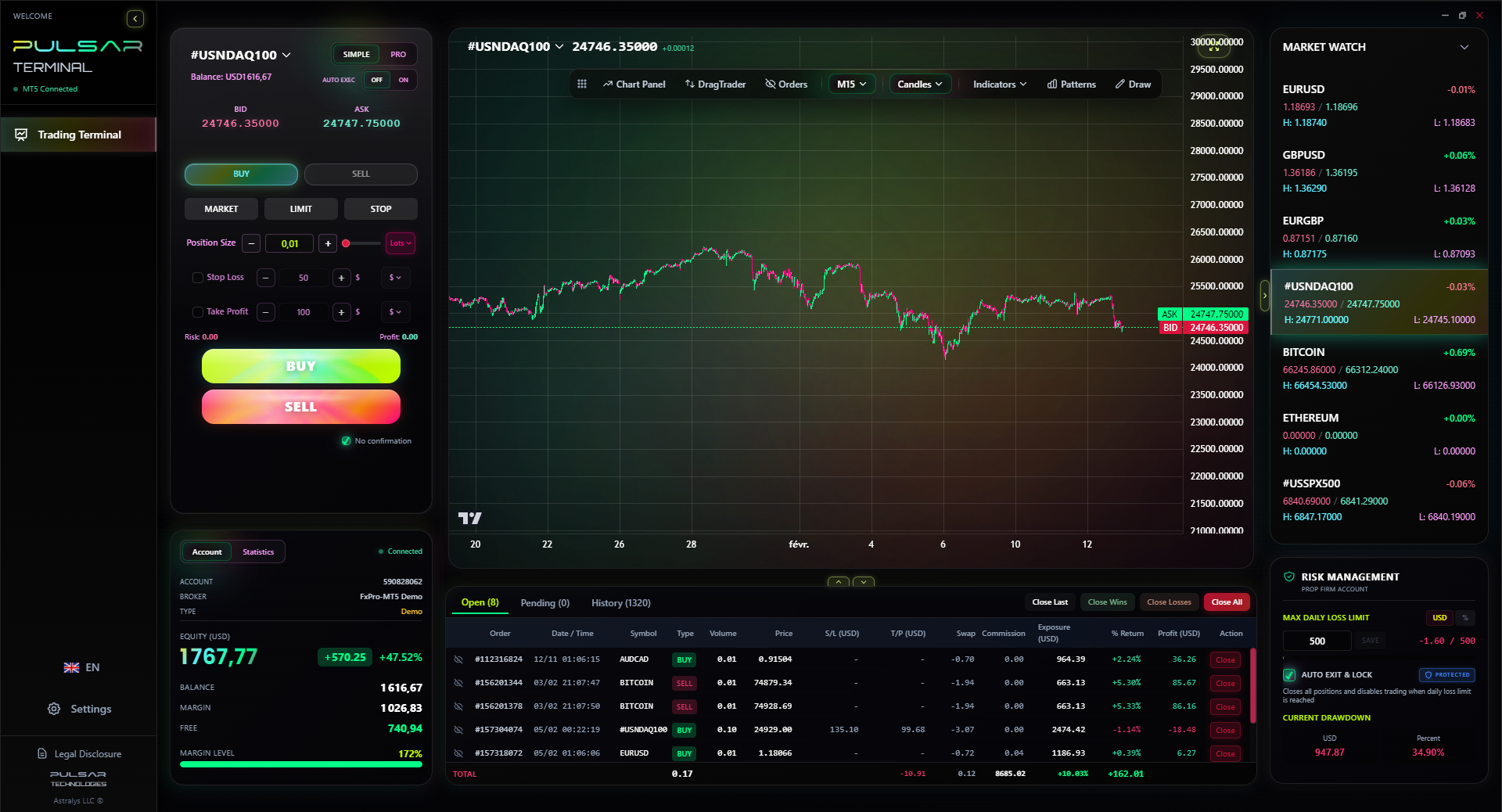
The tools you use also shape your behavior. The constant flow of data in a forex platform like MT5 can be overwhelming. This is where a tool like Pulsar Terminal, which works with MT5, can add a layer of discipline. Setting a multi-level take-profit order with a trailing stop automates your exit strategy, removing the emotional decision of when to close a winning trade - a weakness in both markets.
Managing the psychological stress of open positions is easier when you can set automated multi-level take-profit and trailing stop orders directly on your MT5 charts, removing the emotion from the exit.
Pulsar Terminal
La herramienta MT5 todo-en-uno: órdenes drag-and-drop, multi-TP/SL, trailing stop, grid trading, Volume Profile y protección prop firm. Usado por más de 1.000 traders diariamente.
So, after 12 years and countless mistakes in both, here's my blunt assessment.
Choose FOREX if:
- You have less than R20,000 in starting capital and need the micro-lot flexibility.
- You are ruthlessly disciplined, have a tested mechanical strategy, and can follow it without deviation.
- You're a night owl who wants to trade global macro events.
- You understand that you are a speculator, not an investor, and you're okay with that.
- You will use the FSCA's 30:1 use as a risk-management tool, not a lottery ticket.
Choose the JSE if:
- You have R20,000+ to start and think in terms of years, not days.
- You enjoy the deep work of researching companies and industries.
- You want the possibility of dividend income alongside capital growth.
- You need the structure of market hours to contain your trading impulses.
- You want your capital housed under the direct protection of South African regulation (FSCA, JSE rules).
For most South Africans starting out, I recommend this path: open a small, separate forex account (maybe R5,000) with a broker like Pepperstone or IC Markets to learn technical analysis and risk management in a controlled environment. Simultaneously, build your core wealth in a low-cost JSE ETF or a few blue-chip shares you understand. Use the forex account as a skills lab. If, after two years, you are consistently profitable there, you can reconsider allocation.
The biggest mistake is diving into forex with your life savings because a YouTube guru promised easy money. The second biggest mistake is ignoring the JSE entirely because it seems 'slow.' Both markets offer opportunity, but they demand completely different mindsets. Pick the one that fits your psychology, not your greed.
💡 Consejo de Winston
Your biggest edge is time horizon. Everyone else is frantic. The patient trader, in forex or stocks, picks up the money the impatient leave on the table. Slow down.
FAQ
Q1Is forex trading safer than the stock market in South Africa?
No, it's generally riskier for retail traders. The FSCA's 30:1 use limit helps, but forex's volatility, 24/5 hours, and over-the-counter nature (you're trading against your broker's liquidity provider) create a faster-paced, higher-pressure environment where psychological mistakes are amplified. The JSE, while not 'safe,' has structural brakes like market hours and direct ownership of assets.
Q2Can I trade the JSE with the same use as forex?
Not directly. When you buy shares, you pay the full value. However, through Contracts for Difference (CFDs) offered by forex brokers, you can get use on JSE stocks. But be warned: this subjects you to CFD costs like spreads and overnight financing, and it's just as dangerous as forex use. The FSCA retail use caps apply to these CFD products as well.
Q3What is the minimum amount I need to start forex trading in South Africa?
Technically, as little as $5 (roughly R90) with some international brokers. Practically, I wouldn't start with less than R2,000-R5,000. You need enough capital so that a string of small losses (which is guaranteed) doesn't wipe you out, and so that brokerage costs and spreads don't consume a huge percentage of your account. A R500 account is almost impossible to manage properly.
Q4Do I pay tax on forex trading profits in South Africa?
Yes. SARS views forex trading as speculative, so profits form part of your normal taxable income. You must keep careful records of all trades, including entries, exits, and fees. Losses can be deducted against other income. It's more straightforward than many think, but you absolutely must declare it.
Q5Which market has higher potential returns?
Forex has higher potential short-term returns due to use. You can make 50% in a day. You can also lose 100%. The JSE has higher proven long-term returns. The historical average is over 11% per year in ZAR terms. Compounded over 20 years without use, that turns R100,000 into over R800,000. Very few forex traders achieve a consistent 11% annual return over decades.
Q6As a beginner, should I use MT4/MT5 for both?
MT4/MT5 are fantastic for forex and CFDs. For direct JSE share trading, you'll likely use your broker's proprietary web platform or app (like EasyEquities, Standard Bank WebTrader, etc.). The skills of reading candlestick charts and using indicators like the MACD indicator transfer between platforms, but the trading mechanics and order types differ.
Lección del Prof. Winston
Puntos clave:
- ✓Forex costs are hidden in spreads & swaps; JSE costs are transparent fees.
- ✓FSCA use is 30:1 - use it for risk control, not magnification.
- ✓Trade companies on JSE (fundamentals), trade flows in forex (technicals).
- ✓Start with >R2,000 for forex, >R20,000 for serious JSE investing.
¿Te resultó útil este artículo?
Haz clic en una estrella
Análisis Trading Semanal
Análisis y estrategias semanales gratis. Sin spam.
Sobre el autor
David van der Merwe
Trader de Mercados Emergentes
Trader con sede en Johannesburgo con 11 años en divisas de mercados emergentes. Especialista en pares ZAR, trading regulado por la FSCA y análisis del mercado sudafricano.
Comentarios
Aviso de riesgo
El trading de instrumentos financieros conlleva un riesgo significativo y puede no ser adecuado para todos los inversores. El rendimiento pasado no garantiza resultados futuros. Este contenido tiene fines educativos únicamente y no debe considerarse asesoramiento de inversión. Siempre realice su propia investigación antes de operar.
También te puede interesar

Cara Trading Forex Sukses: 7 Prinsip dari Trader Profesional
Cara trading forex sukses dengan 7 prinsip trader pro: manajemen modal, disiplin, journal trading, backtest. Data nyata, bukan janji profit palsu.
Jam Trading Forex Terbaik untuk Trader Indonesia: Panduan Lengkap dengan Tabel Waktu
Panduan jam trading forex untuk trader Indonesia. Tabel 4 sesi dunia, jam emas 20:00-00:00, sesi mana yang harus dihindari. Data akurat + tips dari trader berpengalaman.
Top 5 Sàn Forex Uy Tín Nhất 2026: Review Jujur dari Trader Indonesia
Top 5 sàn forex uy tín 2026 untuk trader Indonesia. Review jujur: spread, deposit, withdraw, dukungan lokal. Exness, XM, IC Markets & lebih.
Obtener Pulsar Terminal
Todas estas calculadoras están integradas en Pulsar Terminal con datos en tiempo real de su cuenta MT5.
Obtener Pulsar Terminal