


Most traders get volatility completely wrong.

Olumide Adeyemi
Pionero del Trading en África Occidental ·  Nigeria
☕ 10 min de lectura
Lo que aprenderás:
- 1What Volatility Really Means (It's Not What You Think)
- 2Measuring Volatility: Tools for the Nigerian Trader
- 3Naira Pairs & Their Volatility Profile
- 4Trading Strategies for High vs. Low Volatility
- 5Risk Management: The Non-Negotiable for Volatile Markets
- 6The Psychology of Trading Choppy Waters
- 7Putting It All Together: A Sample Trade
Most traders get volatility completely wrong. They see a wild chart and think it's a sign of opportunity, rushing in without a plan. I used to do the same. The truth is, volatility isn't a signal to trade; it's a measure of risk. In Nigeria, where the Naira's moves can feel like a rollercoaster with the brakes cut, understanding this difference is what separates the survivors from the blown accounts. I'll show you how to read it, trade it, and, most importantly, respect it.
Let's clear this up first. When traders in Nigeria talk about forex volatility, they usually mean the Naira swinging wildly against the Dollar or Pound. That's the effect, not the cause. Technically, volatility is a statistical measure of the dispersion of returns for a given currency pair. In plain English, it's how much the price bounces around its average over a specific time.
High volatility means big, fast price swings. Low volatility means the price is moving slowly in a tight range. The mistake? Assuming high volatility equals high profit. It doesn't. It equals high risk. A volatile market can hit your stop-loss in seconds or rocket past your take-profit just as fast. Your job isn't to chase the volatility; it's to measure it and adjust your strategy accordingly.
I learned this the hard way in early 2024. The CBN was making headlines with new policies, and USD/NGN was moving 50-100 pips in an hour. Excited, I jumped into a GBP/NGN trade with my normal position size. The news faded, volatility spiked, and I was stopped out for a 2% loss in under 10 minutes. I mistook noise for a signal. That trade cost me about ₦15,000. It was a cheap lesson in respecting the market's mood.

💡 Consejo de Winston
Volatility is the rent you pay for the opportunity to make money. You don't get to live in the house for free. Price your risk accordingly.
You can't manage what you don't measure. Guessing if the market is 'choppy' isn't a strategy. You need objective tools. Here are the two I rely on every day.
Average True Range (ATR)
This is your best friend. The ATR doesn't tell you direction; it tells you how much a pair typically moves over a chosen period. If USD/NGN has an ATR of 150 pips on the daily chart, that's its normal daily breathing room. If the current day's range is only 50 pips, you know it's quieter than usual. If it's already moved 120 pips by lunch, it might be running out of steam. I use the 14-period ATR as my baseline. It directly informs my stop-loss placement. If the ATR is 120 pips, a 30-pip stop is likely to get hunted. I'd place it at least 1.5 x ATR away, around 180 pips.
Bollinger Bands
These are fantastic for visualizing volatility. The bands widen when volatility increases and contract when it decreases. A classic setup is the 'Bollinger Squeeze.' When the bands tighten significantly, it often precedes a big, volatile breakout. The key is not to predict the direction of the breakout, but to prepare for the increase in movement. When I see a strong squeeze on the EUR/USD chart, I reduce my position size and widen my stops, expecting a surge in activity. You can learn more about pairing this with momentum indicators in our guide on the MACD indicator.

Example: Let's say you're looking at GBP/NGN. The daily ATR (14) is 220 pips. You want to buy. Placing a stop-loss 50 pips below your entry is gambling. A sensible stop, considering the pair's normal volatility, would be at least 1.5 x 220 = 330 pips away. This isn't being conservative; it's being realistic about the pair's character.
“Volatility isn't a signal to trade; it's a measure of risk.”
Trading in Nigeria gives you a unique front-row seat to some inherently volatile pairs. You need to know their personalities.
| Currency Pair | Typical Volatility Profile | Key Driver | Trader Note |
|---|---|---|---|
| USD/NGN | Very High | CBN Policy, Oil Prices, USD Strength | The headline pair. Moves can be explosive and news-driven. Liquidity can dry up, causing massive spreads. Not for the faint-hearted. |
| GBP/NGN | High | BoE Policy, USD/NGN movements | Often mirrors USD/NGN but with a UK twist. Can be slightly less erratic than USD/NGN during local Nigerian news events. |
| EUR/NGN | Moderate to High | ECB Policy, Broad Euro sentiment | Tends to be a bit more stable than the GBP or USD pairs, but 'stable' is a relative term here. |
| USD/NGN vs. Major Forex (EUR/USD) | Lower | Global Macro, Central Bank Differential | This is a crucial point. While USD/NGN is wild, a major pair like EUR/USD has much lower relative volatility. Its daily ATR might be 70 pips vs. USD/NGN's 200+. This is why many Nigerian traders start with majors; the risk is more contained and predictable. Our EUR/USD guide breaks down why it's a popular starting point. |
The big lesson? Your position size for USD/NGN should be much smaller than for EUR/USD, even if you have the same account balance and risk tolerance. The market's inherent volatility demands it. Always use a position size calculator and input the current ATR to see the difference for yourself.
You wouldn't use a hammer to screw in a lightbulb. Don't use a high-volatility strategy in a quiet market, or vice versa.
High Volatility Environments (Like Naira News Events)
This is when the CBN speaks, or oil prices tank. The strategy here is reaction, not prediction.
- Wait for the Spike: Let the initial news bomb go off. The first move is often manic and unpredictable.
- Look for the Retracement: After the spike, price often pulls back to test a key level (like a previous support/resistance or a 50% Fibonacci retracement). This is your potential entry.
- Wide Stops, Quick Takes: Your stop must be placed beyond the noise of the initial spike. Your take-profit should be modest. Aim for a chunk of the retracement, not the entire trend. This is where a tool with multi-take-profit functionality is gold. You can scale out of the position.
- Avoid: Trying to fade the initial spike (going against it). It's like standing in front of a speeding train.
Low Volatility Environments (Ranging Markets)
When the ATR shrinks and Bollinger Bands pinch, the market is coiling.
- Focus on Range Boundaries: Identify clear support and resistance. Buy near support, sell near resistance.
- Tight Stops: Since the market isn't moving much, you can use tighter stops, just outside the range.
- Prepare for the Break: The real opportunity often comes after the low volatility period. Have breakout orders ready (buy stop above resistance, sell stop below support). A strategy like swing trading often capitalizes on these breakout moves.

Warning: The most dangerous market state is low volatility that you think is high volatility. You overtrade, use tight stops, and get whipsawed. Always check the ATR before you place a trade.
💡 Consejo de Winston
If your heart is pounding looking at a chart, your position size is too big. Volatility should be measured on the screen, not felt in your chest.
“Your position size for USD/NGN should be much smaller than for EUR/USD, even with the same account balance.”
This is where your trading career is made or broken in Nigeria. Volatility magnifies both gains and losses. Your risk rules must be ironclad.
1. Position Sizing is Everything: This is your primary defense. If volatility is high, cut your position size in half. No arguments. A 1% risk on a normal day might need to be 0.5% on a day when USD/NGN is going haywire. That position size calculator isn't a suggestion; it's your lifeline.
2. The Stop-Loss Sanctuary: Your stop-loss is not a suggestion to the market. It's a law. In high volatility, place your stop based on market structure (swing highs/lows) and the ATR, not an arbitrary number. And once it's set, you don't move it unless you're moving it to breakeven. Which brings me to...
3. Breakeven and Trailing Stops: These are essential tools for locking in profit and letting winners run. Once a trade moves in your favor by 1-1.5 x ATR, I move my stop to breakeven. The trade is now risk-free. Then, I might use a trailing stop to follow the trend. Manually trailing a stop in a fast market is stressful and error-prone.
4. Know Your Broker's Rules: During extreme volatility, spreads can widen massively. Your market order might fill at a terrible price. Your stop-loss can become a market order and suffer 'slippage,' getting filled far past your intended price. This is why I only use brokers with a proven track record of stability during news events, like IC Markets or Pepperstone. Understand what a margin call looks like with them before it happens.
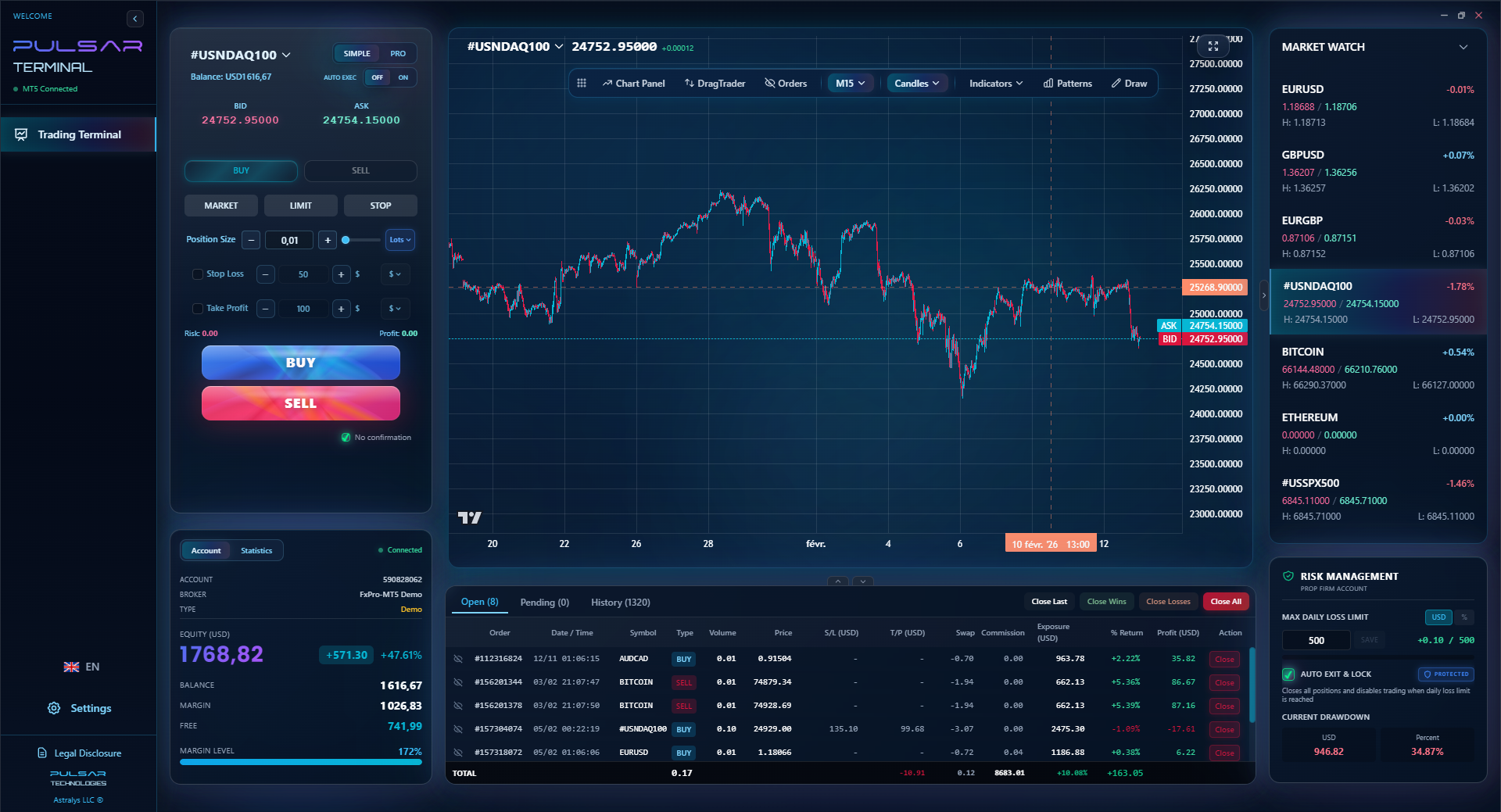
Managing trades in volatile markets requires quick, precise actions like moving stops to breakeven or scaling out profits, which Pulsar Terminal automates seamlessly within your MT5 platform.
Pulsar Terminal
La herramienta MT5 todo-en-uno: órdenes drag-and-drop, multi-TP/SL, trailing stop, grid trading, Volume Profile y protección prop firm. Usado por más de 1.000 traders diariamente.
Volatility plays with your mind. It creates FOMO (Fear Of Missing Out) when prices rocket, and panic when they crash. Here's how to keep your head.
The FOMO Trap: You see USD/NGN jump 200 pips in an hour. You feel a physical urge to get in. That's your lizard brain screaming. My rule? If I didn't have a plan for the move before it happened, I don't trade it. The first move is for the prepared. The second move (the retracement) is for the patient.
Panic and Revenge Trading: You get stopped out on a volatile whip-saw. The loss stings. The market immediately reverses and goes your way. The urge to jump back in to 'get your money back' is overwhelming. This is revenge trading, and it's an account killer. After a bad stop-out, I close the charts for at least an hour. Go for a walk. The market will still be there.
Embracing the Boredom: Low volatility periods are boring. You might check the charts every 10 minutes and see nothing. This is when undisciplined traders force trades out of boredom, creating unnecessary risk. See it as a break. Do your research, review your journal, and wait. The market will wake up eventually. A scalping strategy might seem tempting here, but without the requisite volatility, it often leads to death by a thousand cuts.
“If I didn't have a plan for the move before it happened, I don't trade it.”
Let's walk through a recent trade I took on XAU/USD (Gold), a commodity known for its volatility, to illustrate the process.
Context: March 2024. The ATR (14) on the 4-hour chart was 250 pips ($25). Higher than its 3-month average of 200, indicating elevated volatility.
The Setup: Price had been in a strong uptrend but pulled back to a clear support zone around $2150. The RSI indicator was dipping near 40 (showing a pullback, not a breakdown). This was a potential trend-continuation setup.
The Plan:
- Entry: Buy limit order at $2152.
- Stop-Loss: Placed at $2130. That's 220 pips ($22) risk. Why there? It was below the recent swing low and about 0.9 x the current ATR, a sensible distance.
- Take-Profit 1: $2172 (200 pips / $20). A modest target for a partial close.
- Take-Profit 2: $2195 (430 pips / $43). Near the previous high.
Execution & Management: My order filled. I risked 1% of my account ($100 on a $10k account). Price moved up, hitting TP1. I closed 50% of my position, banking $10. I then moved my stop-loss to breakeven ($2152) on the remaining position. The trade was now risk-free. Price continued to rally and hit TP2 two days later. Total gain: $10 + $21.50 = $31.50 (3.15% on risked capital).
Why It Worked:
- I acknowledged the high volatility (high ATR) and used a wide stop.
- I had a clear plan based on price action, not emotion.
- I used a partial close (TP1) to lock in profit and a breakeven stop to eliminate risk, letting the runner (TP2) capture the volatile trend move. This is a core principle for managing volatile assets like gold, detailed further in our XAU/USD guide.
The volatility didn't guarantee success, but my plan for managing it did.
FAQ
Q1Is forex trading legal in Nigeria given the volatile Naira?
Yes, forex trading is legal for individuals in Nigeria. The Central Bank of Nigeria (CBN) oversees the market. However, there's a regulatory gap for local retail brokers. Most Nigerian traders use internationally regulated brokers like Exness or IC Markets, which is a common and accepted practice. The volatility of the Naira is a market condition, not a legal barrier.
Q2What is the most volatile forex pair for Nigerian traders?
USD/NGN is typically the most volatile due to its direct exposure to local CBN policy, oil prices, and dollar demand. Its moves can be sharp and news-driven. GBP/NGN is also highly volatile. For context, major pairs like EUR/USD have significantly lower and more predictable volatility, which is why many start there.
Q3How do I calculate my position size in a volatile market?
You must use a position size calculator that accounts for volatility. First, determine the distance to your stop-loss in pips. Then, check the pair's Average True Range (ATR) to see if your stop is realistically placed. If the ATR is 150 pips, a 30-pip stop will likely fail. Finally, decide what percentage of your account you're willing to risk (e.g., 1%). The calculator will tell you the exact lot size. Never skip this step.
Q4What's the biggest mistake traders make with volatility?
They confuse high volatility with a high-probability trading signal. They see a big green candle and FOMO in, or they see a crash and try to catch the falling knife. Volatility is a measure of risk, not a directional indicator. The second biggest mistake is using a position size and stop-loss designed for a calm market during a volatile one, guaranteeing they'll be stopped out by normal market noise.
Q5Can I make money scalping during high volatility?
You can, but it's extremely difficult and risky. High volatility often comes with widened spreads and slippage, which can instantly turn a would-be profitable scalp into a loss. Scalping requires tight stops, which are easily taken out by volatile whipsaws. It's generally better for experienced traders with very fast execution. For most, swing trading or waiting for volatility to settle into a pattern is safer.
Q6How does news from the CBN affect forex volatility?
Massively. Announcements on interest rates, FX market reforms, or liquidity measures are the primary drivers of short-term volatility for the Naira. The market reacts instantly, often in an exaggerated way. The key is to not trade the initial headline. Wait 15-30 minutes for the initial panic or euphoria to settle, then assess the new price level and structure for a more reasoned trade.
Lección del Prof. Winston
Puntos clave:
- ✓Use the 14-period ATR to define a pair's normal daily range.
- ✓Cut your position size by 50% during periods of high volatility.
- ✓Place stops based on market structure, not arbitrary pip counts.
- ✓Move your stop to breakeven after a 1-1.5 x ATR move in your favor.
¿Te resultó útil este artículo?
Haz clic en una estrella
Análisis Trading Semanal
Análisis y estrategias semanales gratis. Sin spam.
Sobre el autor
Olumide Adeyemi
Pionero del Trading en África Occidental
Uno de los educadores de trading forex más activos de Nigeria. 8 años de experiencia operando desde Lagos. Especialista en estrategias de bajo capital y desafíos de prop firms para traders africanos.
Comentarios
Aviso de riesgo
El trading de instrumentos financieros conlleva un riesgo significativo y puede no ser adecuado para todos los inversores. El rendimiento pasado no garantiza resultados futuros. Este contenido tiene fines educativos únicamente y no debe considerarse asesoramiento de inversión. Siempre realice su propia investigación antes de operar.
También te puede interesar

Cara Trading Forex Sukses: 7 Prinsip dari Trader Profesional
Cara trading forex sukses dengan 7 prinsip trader pro: manajemen modal, disiplin, journal trading, backtest. Data nyata, bukan janji profit palsu.
Jam Trading Forex Terbaik untuk Trader Indonesia: Panduan Lengkap dengan Tabel Waktu
Panduan jam trading forex untuk trader Indonesia. Tabel 4 sesi dunia, jam emas 20:00-00:00, sesi mana yang harus dihindari. Data akurat + tips dari trader berpengalaman.
Top 5 Sàn Forex Uy Tín Nhất 2026: Review Jujur dari Trader Indonesia
Top 5 sàn forex uy tín 2026 untuk trader Indonesia. Review jujur: spread, deposit, withdraw, dukungan lokal. Exness, XM, IC Markets & lebih.
Obtener Pulsar Terminal
Todas estas calculadoras están integradas en Pulsar Terminal con datos en tiempo real de su cuenta MT5.
Obtener Pulsar Terminal