


Here's a stat that got my attention: in 2019, daily forex trading volumes in South Africa hit roughly $2.21 billion.

David van der Merwe
Trader de Mercados Emergentes ·  South Africa
☕ 12 min de lectura
Lo que aprenderás:
- 1What Exactly Is a Zero Spread Account? (It's Not What You Think)
- 2The Real Costs for South African Traders
- 3Best FSCA-Regulated Brokers Offering Zero Spread Accounts
- 4Who Should Actually Use a Zero Spread Account? (And Who Shouldn't)
- 5Hidden Fees and Common Pitfalls to Watch For
- 6Setting Up and Managing Your Account
- 7Final Verdict: Is a Zero Spread Account Right for You?
Here's a stat that got my attention: in 2019, daily forex trading volumes in South Africa hit roughly $2.21 billion. With that much action, it's no wonder brokers are pushing 'zero spread' accounts hard. They sound like a dream, right? Trade with no spread, just pure market prices. I fell for the marketing hype years ago and opened one without doing the math. Let me save you the headache I had. A forex zero spread account isn't free trading. It's just a different, and sometimes sneakier, way of charging you. We'll unpack exactly how they work for us here in SA, which FSCA-regulated brokers offer the real deal, and more importantly, when you should actually use one.
Alright, let's clear this up first. A standard forex account makes money from the spread - the difference between the buy (ask) and sell (bid) price. If EUR/USD is quoted at 1.0850/1.0852, that 2-pip difference is the spread, and it's the broker's fee.
A zero spread account, sometimes called a raw spread or ECN account, removes that markup. The quote might show as 1.0851/1.0851. Zero pips difference. Beautiful. But here's the kicker: instead of the spread, you pay a fixed commission per lot traded. The broker's fee is now completely transparent, but it's still very much there.
Think of it like this: a regular account is a car with a higher sticker price but 0% financing. The zero spread account is the same car with a lower sticker price but you're paying a hefty bank fee. The total cost might be similar, or even higher, depending on how you drive. The big appeal is predictability. With a standard account, spreads can widen massively during news events. With a zero spread plus commission model, your cost per trade stays the same, which is gold for certain strategies like scalping.

Warning: 'Zero spread' never means zero cost. If a broker claims it's completely free, run. They're either lying about the spreads (they'll be huge) or they're a bucket shop taking the other side of your trade. Legitimate brokers make money; they just choose how to charge you.
“A forex zero spread account isn't free trading. It's just a different, and sometimes sneakier, way of charging you.”
This is where you need to grab a calculator. Let's use real numbers from brokers available to us. Remember, commissions are usually quoted per standard lot (100,000 units) and are a 'per side' fee. You pay it to open and to close the trade.
Commission Breakdown
Here’s what you’re actually looking at with some popular FSCA-regulated brokers:
| Broker | Account Type | Commission (per side, per lot) | Effective Round-Turn Cost |
|---|---|---|---|
| Tickmill | Pro Account | $2 | $4 |
| FP Markets | Raw Account | $3 | $6 |
| HFM | Zero Spread Account | $3 | $6 |
| Exness | Raw Spread Account | $3.50 | $7 |
Now, let's translate that into pips to compare it to a standard account. On EUR/USD, 1 pip on a standard lot is worth $10. If you pay a $4 round-turn commission, that's equivalent to a 0.4 pip spread ($4 / $10 per pip). A $6 commission is like a 0.6 pip spread.
So, your 'zero spread' account actually has an effective spread of 0.4 to 0.7 pips once you factor in the commission. The question is: can you get a standard account with a spread lower than that? Often, yes. The average EUR/USD spread across all brokers is about 0.6 pips. For a scalping strategy where you're in and out for 5-10 pips, that half-a-pip saving matters. For a swing trading holding for 100 pips? Not so much.
The ZAR Factor
Don't forget currency conversion. If your broker account is in USD but you fund it with Rands, your bank or payment provider will charge a fee and give you a poor exchange rate. This is a hidden cost on every deposit and withdrawal. This is why I prefer brokers like HFM or local ones like Khwezi Trade that offer ZAR-denominated accounts. It simplifies everything. I learned this the hard way losing a few hundred Rand on conversions before switching.

Example: You want to scalp EUR/USD and take 10 trades a day of 1 lot each. On a Zero Spread account with a $4 round-turn commission, your daily commission cost is 10 trades x $4 = $40. On a standard account with a 0.8 pip average spread (costing $8 per trade), your daily spread cost is 10 x $8 = $80. The zero spread account saves you $40 a day. That's the math that makes it worthwhile.

💡 Consejo de Winston
The 'effective spread' is your true cost. Always add the round-turn commission (in dollars) to the displayed spread (in pips) to compare apples to apples with standard accounts. A $6 commission on EUR/USD is a 0.6 pip effective spread, period.
“For the average South African retail trader starting out, a standard account is simpler and often cheaper.”
This is critical. Always, always choose an FSCA-regulated broker. The FSCA (Financial Sector Conduct Authority) is our local watchdog. If something goes wrong with an offshore broker, the FSCA can't help you. I've heard too many horror stories. Regulation means client fund segregation, proper conduct, and a place to complain. Here are the top contenders that are properly regulated and offer these accounts.
Exness is a major player here. Their Raw Spread account is solid, and they're fully regulated by the FSCA. The minimum deposit for their premium accounts is higher, around $500, but you're getting a serious platform. You can read our full deep dive in the Exness review.
HFM (HotForex) is another strong, well-regulated option (FSP No. 46632). Their Zero Spread account has a super low minimum deposit of about R450, which is great for starting out. They also offer ZAR accounts, which is a massive plus.
Tickmill gets a lot of love from professional traders. Their Pro Account commission is among the lowest at $2 per side. Their execution is excellent, which is vital when you're trading on raw spreads. They're also FSCA-regulated.
FP Markets is known for its raw ECN pricing. Their Raw Account is a true institutional-grade feed. They're a bit more geared towards experienced traders, but their offering is top-tier. Check out how they stack up in our FP Markets review.
A Local Alternative: Khwezi Trade Don't overlook local brokers. Khwezi Trade is FSCA-regulated and offers spreads from 0.4 pips with zero commission. This is a hybrid model that can sometimes be cheaper than a pure zero-spread-plus-commission account. Their platform is MT4/MT5, and funding in Rands is seamless.
“For the average South African retail trader starting out, a standard account is simpler and often cheaper.”
Based on my 12 years and plenty of trial and error, these accounts are a specialist tool, not a one-size-fits-all solution.
You SHOULD consider a zero spread account if:
- You are a high-volume scalper. If you're taking dozens of trades a day aiming for 5-10 pips each, the lower effective spread directly boosts your profitability. Every pip saved is money in your pocket.
- You trade major currency pairs almost exclusively (like EUR/USD or GBP/USD). The zero-spread promise is usually only on these liquid pairs. Exotic pairs will still have wide spreads.
- You use automated trading systems (Expert Advisors) that are sensitive to spread costs. A fixed commission makes your backtesting and live results more consistent.
- You trade during high volatility news events. While spreads on standard accounts can blow out to 10-20 pips, your commission on a zero spread account stays the same. I remember trading a Fed announcement on a standard account years ago; the spread widened so much I was in a losing position the second I clicked buy. Never again.
You should probably AVOID a zero spread account if:
- You are a new trader or trade with a small account. The commission can eat a large percentage of your potential profits on small position sizes. Use a position size calculator to see the impact.
- You are a long-term swing trader. If you're holding trades for days or weeks aiming for 100+ pips, a 1-2 pip difference in spread is negligible. A standard account with no commission is simpler and often cheaper.
- You mainly trade exotic pairs, indices, or commodities. The zero spread benefit vanishes, and you'll just be paying commissions on top of naturally wider markets. For something like XAU/USD (gold), a standard account is usually the way to go.
- You infrequently place large trades. The math just won't work in your favor.
💡 Consejo de Winston
Test the liquidity in a demo first. Raw spreads can look great, but if your orders get slipped during fast markets, the savings vanish. Execution quality matters more than the quoted spread.
“The fixed commission can be a significant burden on small accounts or infrequent traders.”
Brokers are clever. The advertised 'from 0.0 pips' is the hook, but the fine print holds the sinker. Here’s what catches traders out.
1. The 'From' is a Lie (Kind of) Spreads 'from 0.0 pips' are usually only on the most liquid pairs (EUR/USD) during the London/New York overlap. At 3 AM South African time on a Sunday night, that spread won't be zero. It might be 0.2 or 0.3. That's fine, but know that 'zero' isn't a 24/7 guarantee.
2. Inactivity Fees This one stung me. I opened a fancy raw spread account with a $500 minimum, then got busy with life for three months. I was hit with a $15 monthly inactivity fee. Some brokers charge these after just one month of no trading. Always check the fee schedule.
3. Deposit and Withdrawal Fees Your broker might not charge, but your bank or payment gateway will. EFTs within SA are usually fine, but international wire transfers can cost R200+ each way. Using a credit card might incur a cash advance fee. Stick to local payment methods or brokers with ZAR accounts.
4. Swap/Financing Rates If you hold trades overnight, you pay or receive swap. On zero spread accounts, these rates can be less favorable because the broker isn't making money on your spread. It's a minor point for day traders, but for anyone holding positions, check the swap rates in your platform.
5. Minimum Trade Sizes Some zero spread accounts have a higher minimum trade size, like 0.1 lots (a mini lot). If you're a nano-lot trader starting out, you might not even be allowed to use the account.

Pro Tip: Before you fund an account, open a demo version of their zero spread offering. Track the live spreads on the pairs you trade for a week, at the times you trade. Then, add the commission. That's your true cost. Compare it to a demo of their standard account. The numbers don't lie.
“The fixed commission can be a significant burden on small accounts or infrequent traders.”
So you've done the math and a zero spread account fits your style. Here's how to get started on the right foot.
Step 1: Choose Your Broker & Platform Stick to the FSCA-regulated list above. Most will offer MetaTrader 4 or 5, which is perfect. Some, like IC Markets, also offer cTrader, which is built for commission-based accounts. Our IC Markets review details their setup. Download the platform and get familiar with it on demo first.
Step 2: Understand the Order Ticket This is crucial. When you place a trade on MT4/MT5 with a commission-based account, the order ticket will show a spread of 0.0 or 0.1. It won't show the commission. The commission will be deducted from your balance once the trade closes. Don't panic when you see $6 missing from your balance after a trade - that's just the pre-disclosed fee.
Step 3: Adjust Your Risk Management Because the commission is a fixed cost, it represents a larger percentage of your stop-loss on very short-term trades. If you scalp for a 5-pip target ($50 on a standard lot), a $4 commission is 8% of your profit. You need to factor this in. Your strategy must have a high enough win rate or risk/reward to absorb this fixed cost. A tool like our position size calculator is non-negotiable here.
Step 4: Tax Implications (SARS) The South African Revenue Service (SARS) views net profits from forex trading as taxable income. Your commission is a deductible expense. Keep careful records of all your trade statements, which will clearly show commissions paid. This makes tax time much easier than trying to deduce spreads from standard account statements.
Managing Trades Effectively With raw spreads, price movement can be faster and more volatile. Having tight, disciplined orders is key. This is where advanced trading tools shine. Setting multiple take-profit levels or a trailing stop manually can be stressful and slow.
💡 Consejo de Winston
Never trade a zero spread account without a strict risk management rule. The temptation to overtrade because costs seem low is immense. Your risk per trade should be based on your equity, not on perceived cheap fees.
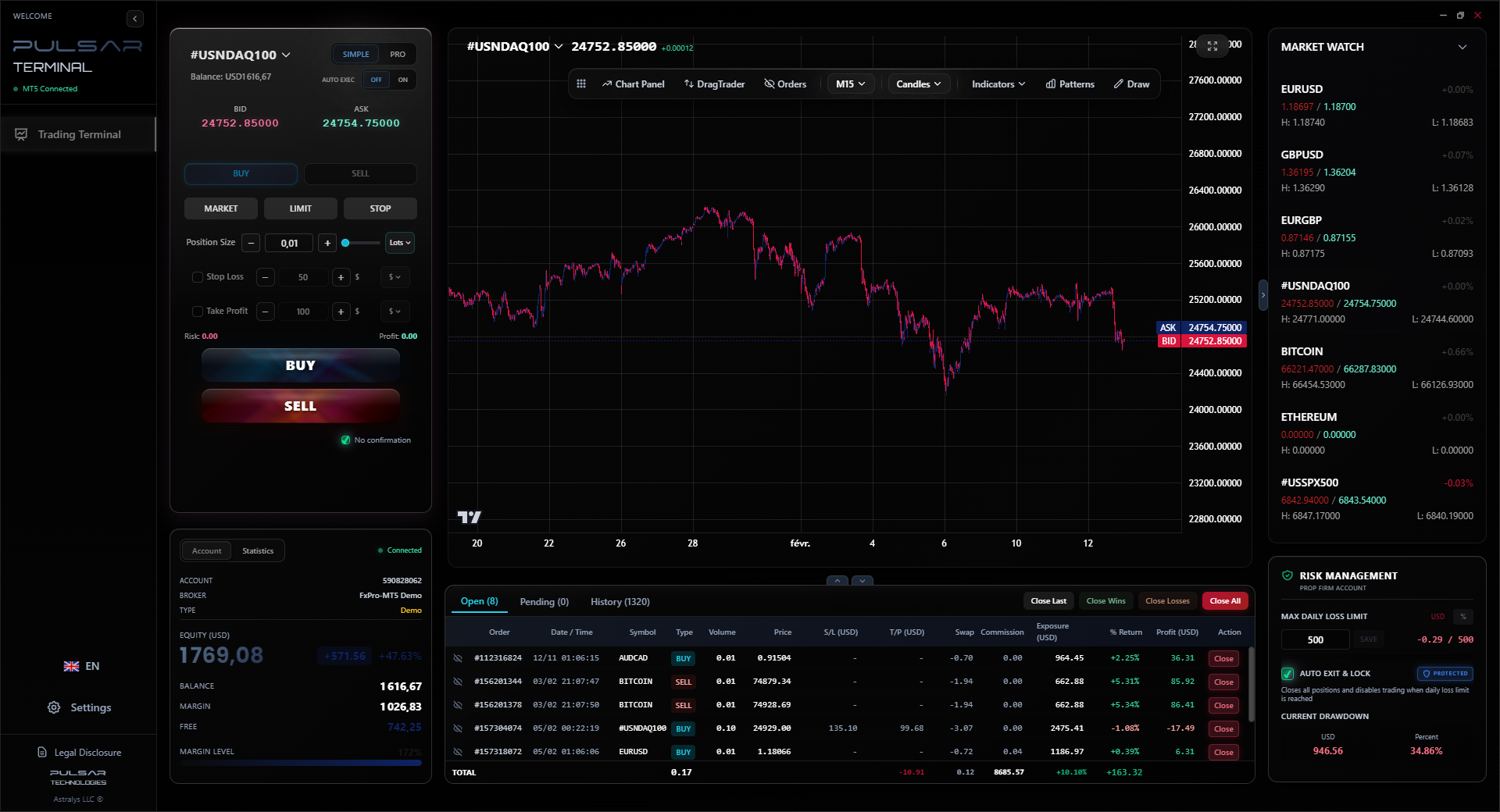
Managing precise entries, multiple take-profits, and trailing stops on a fast-moving zero spread account is where a tool like Pulsar Terminal, which integrates directly with MT5, becomes a game-saver for serious traders.
Pulsar Terminal
La herramienta MT5 todo-en-uno: órdenes drag-and-drop, multi-TP/SL, trailing stop, grid trading, Volume Profile y protección prop firm. Usado por más de 1.000 traders diariamente.
“Always, *always* choose an FSCA-regulated broker. If something goes wrong with an offshore broker, the FSCA can't help you.”
Let's be brutally honest. For the average South African retail trader starting out, a standard account is simpler and often cheaper. The allure of 'zero' is a powerful marketing trick that obscures the real cost.
However, for a specific type of trader - the active scalper, the news trader, the algorithmic system user - a forex zero spread account from a reputable FSCA broker is an essential professional tool. It provides cost predictability and transparency that can make or break a high-frequency strategy.
My own journey taught me this: I started on standard accounts, moved to zero spread when I began scalping seriously, and saw my consistency improve because my costs were predictable. But I also have a standard account for my longer-term swing trading ideas on indices. Use the right tool for the job.
Don't get swept up by the hype. Do the commission math, compare it to realistic spreads on standard accounts, and test everything on demo first. And for goodness' sake, only use an FSCA-regulated broker. Your future self will thank you when you don't have to fight an offshore entity to get your money back. Trade smart, trade safe, and always know what you're really paying for.
FAQ
Q1Are zero spread accounts really free to trade on?
No, absolutely not. They replace the variable spread with a fixed commission per lot traded. You always pay to trade; it's just a different, more transparent fee structure. The term 'zero spread' refers only to the bid/ask difference, not the overall cost.
Q2Which South African brokers offer true zero spread accounts?
Several FSCA-regulated brokers do, including Exness (Raw Spread Account), HFM (Zero Spread Account), Tickmill (Pro Account), and FP Markets (Raw Account). It's vital to choose an FSCA-regulated broker for investor protection.
Q3How do I calculate if a zero spread account is cheaper for me?
Multiply the broker's round-turn commission (open + close fee) by your average number of trades per lot size. Then, estimate the average spread cost on a standard account for the same trading volume. For example, a $4 commission equals a 0.4 pip effective spread on EUR/USD. If your standard account's average spread is above that, the zero spread account may be cheaper.
Q4What is the minimum deposit for a zero spread account in South Africa?
It varies. HFM's Zero Spread account starts around R450, while Exness's premium raw accounts require about $500 (roughly R9,000+). Local broker Khwezi Trade offers low-spread accounts with a R500 minimum but no commission, which can be a good alternative.
Q5Do I pay tax on profits from a zero spread account in South Africa?
Yes. SARS treats net profits from forex trading as taxable income. The commissions you pay on a zero spread account are considered deductible business expenses, so keep all your trading statements for your tax return.
Q6Can I use a zero spread account for scalping?
Yes, that's one of the primary use cases. The predictable, low cost (effective spread) is ideal for strategies that target small, frequent profits. However, ensure your broker explicitly allows scalping and has reliable execution with no requotes.
Q7What's the biggest downside of a zero spread account?
The fixed commission can be a significant burden on small accounts or infrequent traders. If you're only placing a few trades a week with small position sizes, the commission as a percentage of your profit can be very high, making a standard account with a slightly wider spread more cost-effective.
Lección del Prof. Winston
Puntos clave:
- ✓Zero spread = fixed commission, not free trades.
- ✓Calculate the 'effective spread' to compare costs.
- ✓Ideal for scalpers, bad for small/infrequent traders.
- ✓Only use FSCA-regulated brokers in South Africa.
¿Te resultó útil este artículo?
Haz clic en una estrella
Análisis Trading Semanal
Análisis y estrategias semanales gratis. Sin spam.
Sobre el autor
David van der Merwe
Trader de Mercados Emergentes
Trader con sede en Johannesburgo con 11 años en divisas de mercados emergentes. Especialista en pares ZAR, trading regulado por la FSCA y análisis del mercado sudafricano.
Comentarios
Aviso de riesgo
El trading de instrumentos financieros conlleva un riesgo significativo y puede no ser adecuado para todos los inversores. El rendimiento pasado no garantiza resultados futuros. Este contenido tiene fines educativos únicamente y no debe considerarse asesoramiento de inversión. Siempre realice su propia investigación antes de operar.
También te puede interesar

Cara Trading Forex Sukses: 7 Prinsip dari Trader Profesional
Cara trading forex sukses dengan 7 prinsip trader pro: manajemen modal, disiplin, journal trading, backtest. Data nyata, bukan janji profit palsu.
Jam Trading Forex Terbaik untuk Trader Indonesia: Panduan Lengkap dengan Tabel Waktu
Panduan jam trading forex untuk trader Indonesia. Tabel 4 sesi dunia, jam emas 20:00-00:00, sesi mana yang harus dihindari. Data akurat + tips dari trader berpengalaman.
Top 5 Sàn Forex Uy Tín Nhất 2026: Review Jujur dari Trader Indonesia
Top 5 sàn forex uy tín 2026 untuk trader Indonesia. Review jujur: spread, deposit, withdraw, dukungan lokal. Exness, XM, IC Markets & lebih.
Obtener Pulsar Terminal
Todas estas calculadoras están integradas en Pulsar Terminal con datos en tiempo real de su cuenta MT5.
Obtener Pulsar Terminal