


You're probably staring at your MT4 chart right now, wondering which of the dozens of free indicators will actually give you a reliable buy or sell signal.

David van der Merwe
Trader de Mercados Emergentes ·  South Africa
☕ 11 min de lectura
Lo que aprenderás:
- 1What 'Free Indicators' Actually Mean (And What They Cost You)
- 2The Core Trend Indicators: Finding the Direction
- 3Momentum Oscillators for Entry Timing
- 4Volume & Market Structure Tools (The Unsung Heroes)
- 5Building a Simple South African Trading System
- 6Common Pitfalls & How to Avoid Them
- 7Putting It Into Practice in South Africa
You're probably staring at your MT4 chart right now, wondering which of the dozens of free indicators will actually give you a reliable buy or sell signal. I get it. When I started trading with my first R5,000 deposit back in 2012, I downloaded every free indicator I could find, convinced one of them held the secret. Most were useless. Some were dangerous. A few, however, became the foundation of everything I do. Let's cut through the noise and talk about the free forex indicators of buy and sell that actually work for us here in South Africa, factoring in our market hours, our brokers, and our rand.
First, let's be clear. When we talk about free forex indicators of buy and sell, we're usually talking about the tools built into your trading platform. MetaTrader 4 and 5 come packed with them. TradingView has a massive library. They don't cost extra cash, but that doesn't mean they're free.
The real cost is in how you use them. A bad signal from a free indicator can cost you real rands just as easily as a paid one. I learned this the hard way in 2015. I was using a common momentum oscillator on USD/ZAR, got a perfect-looking buy signal, and entered without checking the broader context. A surprise SARB announcement hit, and that 'free' signal cost me R1,200 in about ten minutes. The indicator wasn't wrong; my reliance on it was.
For us in South Africa, using these tools also means understanding our trading windows. The most volatile periods for pairs like EUR/USD often overlap with our afternoon (European session) and late evening (US session). That's when indicators tend to be most responsive. During our morning, when liquidity is thinner, those same signals can be much noisier and less reliable.

Warning: An indicator giving a signal is not permission to trade. It's a suggestion to start your analysis. Always confirm with price action and market context.
The best free indicators are the ones you understand inside and out. Don't collect them like trading cards. Master a handful. Your broker's platform - whether it's Exness with its MT5 or IC Markets with cTrader - has more than enough to build a strong system.
“The real cost of a free indicator isn't in rands, it's in how you misuse it.”
You can't talk about buy and sell signals without knowing the trend. Trading against it is the quickest way to blow up a small account. These are my go-to free tools for figuring out which way the wind is blowing.
Moving Averages (The Workhorse)
The humble Moving Average (MA) is your best friend. I use two: a fast one (like the 20-period) and a slow one (like the 50-period). The classic buy signal? When the fast MA crosses above the slow one. A sell signal is the opposite. But here's the South African twist: on a pair like GBP/ZAR, which can be jumpy, I widen those periods to 30 and 100 to filter out some of the political noise.
I keep it on the daily chart to define the primary trend. If price is above both MAs, I'm only looking for buy setups on lower timeframes. It's that simple. This one rule saved me from countless bad trades during the 'Nenegate' volatility.
Average Directional Index (ADX)
The ADX doesn't tell you direction, it tells you strength. A reading above 25 suggests a strong trend is in play. This is crucial. If the ADX is low (say, below 20), those moving average crossovers are likely to be fakeouts. I got whipsawed to death in 2017 ignoring this. I'd see a nice crossover on EUR/USD, enter, and then watch the pair go nowhere for days. Now, I won't take a trend-following signal unless the ADX confirms there's actual power behind the move.

Pro Tip: On MT4/MT5, overlay a 20-period and 50-period Simple Moving Average (SMA) on your chart. Then, add the ADX (default 14 period) below. Only consider trades in the direction of the MA crossover when the ADX is rising and above 20. This filters out at least 50% of the rubbish signals.
These tools form the bedrock. Before you even think about an entry, you should know if you're in a trending or ranging market. Your entire approach to the next set of indicators depends on it.

💡 Consejo de Winston
A professor once told me, 'The map is not the territory.' Your indicators are the map. Price action is the real territory. Never confuse the two.
“An indicator giving a signal is not permission to trade. It's a suggestion to start your analysis.”
Okay, so you know the trend. Now, when do you pull the trigger? That's where momentum oscillators come in. They help you spot when a move is overextended (and might reverse) or gathering steam.
Relative Strength Index (RSI)
The RSI indicator is probably the most famous. Readings above 70 suggest overbought (potential sell), below 30 oversold (potential buy). But blindly selling at 70 in a strong uptrend is a recipe for disaster. The trend will steamroll you.
My method? In an uptrend (confirmed by our MAs), I look for the RSI to dip back to 40 or 50 and then start turning back up. That's my buy signal. In a downtrend, I look for a bounce to 60 or 50 and then a turn down to sell. This is called trading with the trend's momentum.
Moving Average Convergence Divergence (MACD)
The MACD indicator is a powerhouse. It gives you trend and momentum in one. The classic signal is when the MACD line (fast) crosses the signal line (slow). A buy on a cross above, a sell on a cross below. But the secret sauce is in the histogram bars and divergence.
If the price is making a new high but the MACD histogram is making a lower high, that's bearish divergence - a warning the uptrend is weakening. I spotted this on USD/ZAR in late 2023 before a 150-pip drop. The price was creeping up, but the MACD histogram was fading. It was a clear sell signal that paid out nicely.

Example: Let's say EUR/USD is in an uptrend above its 50 MA. The RSI dips to 45 and hooks up. At the same time, the MACD histogram is above its zero line and starts rising again. That's a high-probability, confirmed buy signal using three free indicators together.
Remember, these are for timing. Use them to find better entry prices within the established trend from your core indicators. Never let an oscillator signal make you reverse your entire trend bias.
“An indicator giving a signal is not permission to trade. It's a suggestion to start your analysis.”
Most new traders skip these. Big mistake. Price can lie, but volume often tells the truth. It shows you if a move has conviction or if it's just a fakeout.
On-Balance Volume (OBV)
OBV is a simple, free volume indicator. It adds volume on up days and subtracts it on down days. The key is divergence, just like with the MACD. If price hits a new high but OBV fails to make a new high, it's a sign that the buying volume isn't there to support the move. It's a powerful early warning of a potential reversal. I missed a major top in gold (XAU/USD) once because I ignored OBV divergence. Never again.
Support and Resistance (The Ultimate Free Tool)
This isn't an indicator you add from a menu; it's a skill you develop. Drawing horizontal lines at previous swing highs and lows is the single most important thing you can do. A buy signal from your RSI or MACD that occurs at a clear level of support? That's gold. A sell signal at a resistance level? Equally strong.
Combine this with a basic understanding of the Volume Profile concept (which shows where most trading activity happened). Areas of high volume often become future support or resistance. While full Volume Profile tools are often premium, the idea is free and can be applied by just watching where price consolidates.
These tools answer the question: 'Is anyone else buying/selling here?' They add a layer of reality to the mathematical signals from your oscillators.
💡 Consejo de Winston
In trading, simplicity compounds. Complexity decays. A system with two strong indicators you understand perfectly will outperform a tangled web of ten every single time.
“The most dangerous indicator is the one that just worked perfectly for you. It creates overconfidence.”
Let's put this all together into a practical, 3-step system you can test on a demo account today. This is a simplified version of what I use for swing trading major pairs.
Step 1: The Trend Filter (Daily Chart)
- Open the daily chart of your chosen pair (EUR/USD is a good start).
- Apply a 20-period and 50-period SMA.
- Is price above both MAs? Bias = BUY. Is price below both? Bias = SELL. If price is between them, the market is choppy - stay out.
- Check the ADX. Is it above 25? Good, the trend has strength.
Step 2: The Entry Signal (4-Hour or 1-Hour Chart)
- Zoom to your entry timeframe.
- Wait for price to pull back towards the 20-period SMA or a key drawn support/resistance level.
- Look for your momentum signal: RSI bouncing from 40-50 (for a buy) or from 50-60 (for a sell), OR a MACD line crossing back in the direction of the trend.
Step 3: The Trade Management
- This is where most fail. Your entry is less than half the battle.
- Place your stop-loss on the other side of the support/resistance level you used for entry. Never base your stop purely on a random number of pips. Use the market's structure.
- Use at least a 1:1.5 risk-to-reward ratio. If you risk R100, aim for R150.
- Consider using a trailing stop to lock in profits as the trend moves. Manually moving your stop to breakeven once you're up 1.5x your risk is a solid, simple habit.
I used this exact framework on a USD/CAD trade last month. Daily trend was up. On the 4-hour, it pulled back to the 20 SMA and support. The RSI hit 48 and turned up. Entered at 1.3600, stopped at 1.3570 (30 pips risk). Took half profit at 1.3650 (50 pips) and let the rest run with a trailing stop. Ended with an average gain of 55 pips. Simple, mechanical, and effective.
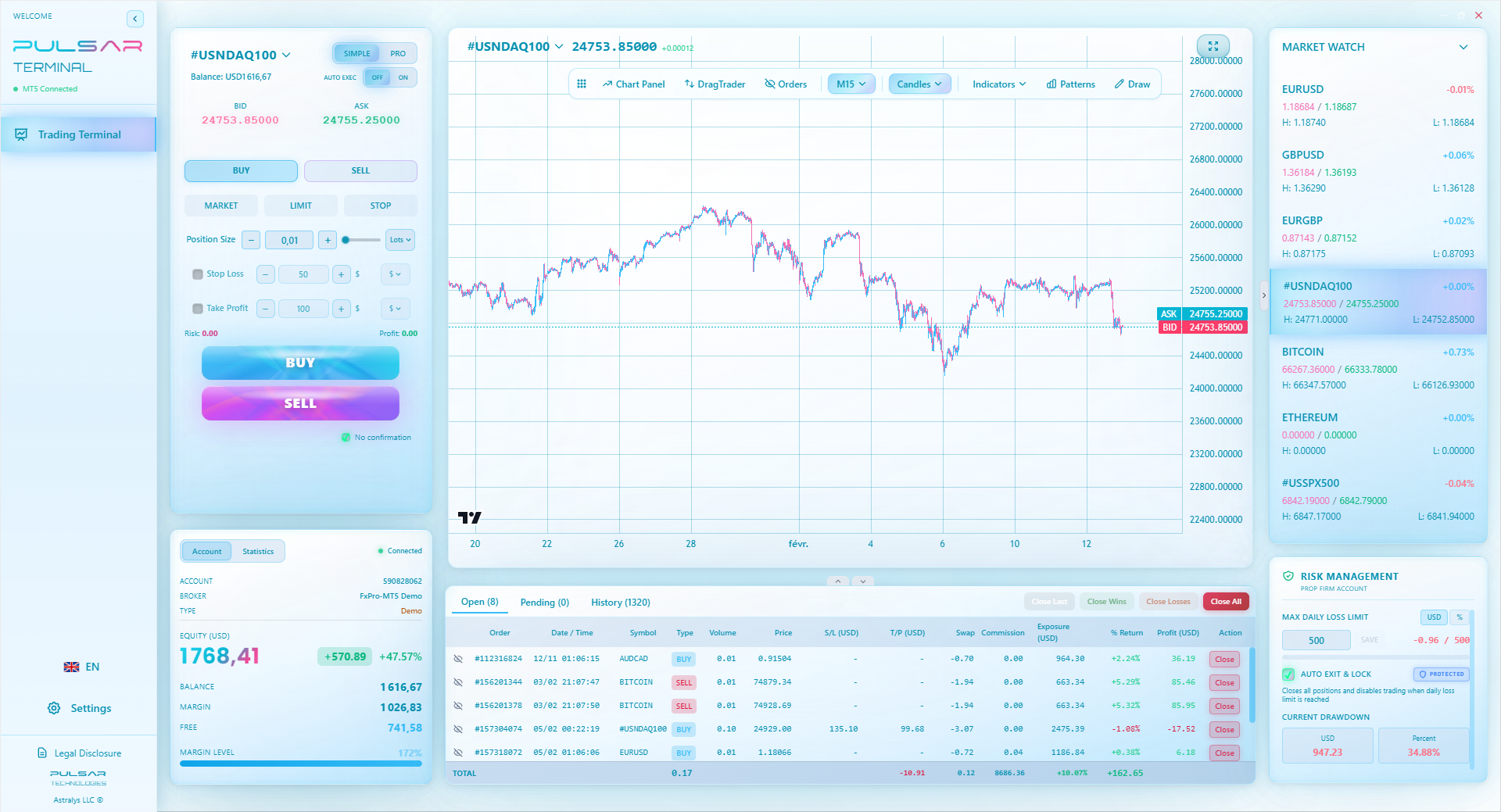
Managing multiple take-profit levels and moving stops to breakeven manually is a hassle; Pulsar Terminal automates this directly on your MT5 chart, so you can focus on your indicator signals.
Pulsar Terminal
La herramienta MT5 todo-en-uno: órdenes drag-and-drop, multi-TP/SL, trailing stop, grid trading, Volume Profile y protección prop firm. Usado por más de 1.000 traders diariamente.
“The most dangerous indicator is the one that just worked perfectly for you. It creates overconfidence.”
I've made every mistake in the book so you don't have to. Here's what to watch for.
Indicator Overload: This is the biggest killer. You'll see charts with 10 different indicators all saying different things. It's paralyzing. Stick to 2-4 complementary tools. A trend tool, a momentum tool, and volume/structure. That's it.
Chasing Lagging Signals: Indicators are lagging. They tell you what has happened. By the time your MACD gives a perfect crossover, the move might be half over. That's why you use them to catch pullbacks within a trend, not to catch the very first pip of a new trend.
Ignoring the Spread: That beautiful buy signal on your chart? It's based on the mid-price. You buy at the ASK, which is higher. On a pair with a 2-pip spread, your trade is already 2 pips in the red the second you enter. This is critical for scalping strategy. Always factor in your broker's spread. This is why I prefer brokers like Pepperstone or XM for their tight spreads on majors.
Forgetting About Risk: No indicator has a 100% win rate. You will have losses. If you risk 5% of your R10,000 account on every trade based on a 'sure thing' signal, five losses in a row (which happens) will wipe out 25%. It's a brutal math game. Use a position size calculator religiously. I never risk more than 1% of my account on a single trade, ever. This is the only way to survive long enough to let your edge work.
Warning: The most dangerous indicator is the one that just worked perfectly for you. It creates overconfidence. The market humbles overconfidence without fail. Stick to your system, especially after a big win.
💡 Consejo de Winston
The market's job is to make your indicators look foolish at the worst possible moment. Your job is to have a plan for when that happens. That plan is your stop-loss.
“Clean charts lead to clear decisions. More indicators just create more confusion.”
So, you've got the knowledge. How do you make it work here, with rand deposits, FSCA-regulated brokers, and our unique challenges?
Start with a Proper Demo Account: Don't use a R500 live account to 'test' things. That's not testing, that's gambling. Open a fully-funded demo account with an FSCA-regulated broker like those we've mentioned. Practice your 3-step system for at least 100 trades. Log every single one. Only go live when you're consistently profitable on demo over a few months.
Understand the Costs: 'Free' trading isn't free. You pay via the spread, commissions, and swap fees. When backtesting your indicator strategy, you must account for the spread. If your backtest shows a 10-pip win, but the average spread on that pair is 2 pips, your real win is 8 pips. This changes everything.
Choose Your Pairs Wisely: As a South African, you might be drawn to ZAR pairs. They can be great, but they often have wider spreads and are more susceptible to local political shocks. I recommend starting with the major pairs (EUR/USD, GBP/USD, USD/JPY) where spreads are tightest and indicators behave more predictably. You can graduate to XAU/USD (gold) or EUR/USD later.
Protect Your Capital: This is non-negotiable. The FSCA is there to protect you from broker fraud, but it can't protect you from your own poor risk management. The statistic that 70-80% of retail traders lose money is real. Be in the minority. Use stops. Size correctly. The free indicators give you the signals, but strict discipline keeps you in the game long enough to use them.
FAQ
Q1What is the single best free forex indicator for buy and sell signals?
There isn't one. Anyone who tells you there is, is selling something. Trading is about confluence. The 'best' system uses a combination, like a moving average for trend direction and the RSI for entry timing. Relying on a single indicator is a surefire path to losses.
Q2Can I make consistent profits using only free MT4/MT5 indicators?
Absolutely, yes. I have for years. The tools built into MT4/5 are incredibly powerful. The barrier to success isn't the cost of your indicators; it's the quality of your strategy, your risk management, and your psychology. A simple strategy with a 55% win rate and good risk management, using free tools, will outperform a complex, expensive system every time.
Q3How do I know if a free indicator download is safe or a scam?
Stick to the indicators that come with your platform or are from the official MetaTrader Market/MQL5 community. Be extremely wary of websites offering a 'secret' 100% accurate indicator for free - they're often collecting your data, injecting malware, or trying to get you onto a dodgy broker. If it sounds too good to be true (e.g., 'Never Lose Again!'), it is.
Q4Why do my indicator signals work on demo but fail on my live account?
This is classic. Two main reasons: 1. Psychology: On demo, that RSI oversold signal is easy to take. On live, with real money, you hesitate, enter late, and mess up the trade. 2. Execution: Demo accounts often have perfect, instant execution and sometimes ignore spreads. Live accounts have slippage and real spreads. A signal that gives you a 5-pip profit on demo might be a 1-pip loss live after the spread. Always test with realistic conditions.
Q5What's a good starting capital amount in Rands to test these strategies?
For serious practice, I'd say no less than R5,000 in a live account, but only after proving yourself on demo. With R5,000, risking 1% (R50) per trade, you can manage your position size properly on most major pairs. Starting with R500 or R1,000 often forces you to take oversized risks or trade micro lots on exotic pairs with huge spreads, which distorts your strategy entirely.
Q6How many indicators should I have on my chart at once?
As few as possible. I rarely use more than three: one for trend (like an MA), one for momentum (like RSI or MACD), and I draw my own support/resistance lines. More than that creates 'analysis paralysis' and conflicting signals. Clean charts lead to clear decisions.
Lección del Prof. Winston
Puntos clave:
- ✓Use 2-4 complementary indicators max
- ✓Always define trend before seeking entries
- ✓Risk never more than 1% per trade
- ✓Confirm signals with price structure
- ✓Factor in the real spread cost
¿Te resultó útil este artículo?
Haz clic en una estrella
Análisis Trading Semanal
Análisis y estrategias semanales gratis. Sin spam.
Sobre el autor
David van der Merwe
Trader de Mercados Emergentes
Trader con sede en Johannesburgo con 11 años en divisas de mercados emergentes. Especialista en pares ZAR, trading regulado por la FSCA y análisis del mercado sudafricano.
Comentarios
Aviso de riesgo
El trading de instrumentos financieros conlleva un riesgo significativo y puede no ser adecuado para todos los inversores. El rendimiento pasado no garantiza resultados futuros. Este contenido tiene fines educativos únicamente y no debe considerarse asesoramiento de inversión. Siempre realice su propia investigación antes de operar.
También te puede interesar

Cara Trading Forex Sukses: 7 Prinsip dari Trader Profesional
Cara trading forex sukses dengan 7 prinsip trader pro: manajemen modal, disiplin, journal trading, backtest. Data nyata, bukan janji profit palsu.
Jam Trading Forex Terbaik untuk Trader Indonesia: Panduan Lengkap dengan Tabel Waktu
Panduan jam trading forex untuk trader Indonesia. Tabel 4 sesi dunia, jam emas 20:00-00:00, sesi mana yang harus dihindari. Data akurat + tips dari trader berpengalaman.
Top 5 Sàn Forex Uy Tín Nhất 2026: Review Jujur dari Trader Indonesia
Top 5 sàn forex uy tín 2026 untuk trader Indonesia. Review jujur: spread, deposit, withdraw, dukungan lokal. Exness, XM, IC Markets & lebih.
Obtener Pulsar Terminal
Todas estas calculadoras están integradas en Pulsar Terminal con datos en tiempo real de su cuenta MT5.
Obtener Pulsar Terminal