


Most traders in South Africa get fundamental analysis completely wrong.

David van der Merwe
Trader de Mercados Emergentes ·  South Africa
☕ 12 min de lectura
Lo que aprenderás:
- 1What Fundamental Analysis Forex Really Is (And Isn't)
- 2The South African Economic Calendar: What Actually Moves the ZAR
- 3A Practical Setup for Trading the News
- 4ZAR-Specific Factors You Can't Ignore
- 5How to Combine Fundamentals with Technicals
- 6Common Pitfalls for South African Traders
- 7Building Your Weekly Fundamental Routine
Most traders in South Africa get fundamental analysis completely wrong. They think it's about reading news headlines and guessing. That's a sure way to blow your account. Real fundamental analysis forex is a structured process of connecting economic data to market psychology and price action. It's how you understand why the Rand moves, not just that it moved. I'll show you the specific South African data points that matter, how to interpret them, and how to build a trading plan around them, not against them.
Let's clear this up first. Fundamental analysis isn't fortune-telling. It's the study of economic, social, and political forces that drive supply and demand for a currency. For us in South Africa, it's about understanding why the USD/ZAR pair might move from R18.50 to R19.20, not just drawing a line on a chart and hoping.
It's not a replacement for technical analysis. Think of it this way: fundamentals give you the direction of the major tide. Technicals help you find the best wave to surf. Ignoring fundamentals while trading a volatile currency like the ZAR is like surfing without checking the weather report. You might catch a wave, but a storm could wipe you out.
The core idea is interest rates. Money flows to where it's treated best. If the South African Reserve Bank (SARB) is hiking rates to fight inflation, and the US Fed is holding steady, that yield differential can attract capital flows into ZAR assets. That's a fundamental driver. But here's the catch: the market prices in expectations. The actual event is often an anticlimax. I learned this the hard way early on.

Example: In early 2023, the market was pricing in a 50-basis-point hike from the SARB. I went long USD/ZAR, thinking a 'buy the rumor, sell the news' play would work. The SARB hiked by 50bps exactly as expected, but the statement was unexpectedly hawkish, talking about persistent inflation risks. The ZAR strengthened sharply. I lost 85 pips in minutes because I traded the headline number, not the market's interpretation of the entire message. That's the nuance of fundamental analysis forex.
This process is about connecting data releases (CPI, GDP, mining production) to central bank policy, to market sentiment, and finally to price. It's a chain, and you need to understand every link, especially when trading ZAR pairs where local data has an outsized impact.

💡 Consejo de Winston
The market's first reaction to news is often an emotional overrejection. Wait for the 5 or 15-minute chart to close after the release before you commit. Let the amateurs pay for the initial volatility.
Not all data is created equal. You can ignore half the releases on the calendar. Your job is to focus on the high-impact events that change the narrative around the Rand. Here’s your cheat sheet.
Tier 1: Market Movers
These can cause immediate, volatile moves in USD/ZAR, EUR/ZAR, and GBP/ZAR.
- SARB Interest Rate Decision (MPC): The big one. It’s not just the rate change (25bps, 50bps), but the Monetary Policy Committee statement and the quarterly projection model. Watch for changes in the inflation and growth forecasts. The press conference afterward is pure gold for nuance.
- Consumer Price Index (CPI) Inflation: The SARB’s primary mandate is price stability. A CPI print significantly above or below the 4.5% midpoint of their target range (3-6%) forces their hand. Core CPI is often watched more closely.
- Budget Speech & Medium-Term Budget Policy Statement (MTBPS): This is huge for ZAR. It outlines the government's fiscal plan. Traders look for credible debt stabilization plans, spending cuts, or tax hikes. A lack of fiscal discipline sends the ZAR tumbling, as we've seen repeatedly.
Tier 2: Important Context Setters
These shape the medium-term trend and confirm or contradict the Tier 1 story.
- Gross Domestic Product (GDP): Growth data. Weak growth limits the SARB's ability to hike rates, which is ZAR negative.
- Balance of Trade / Current Account: South Africa often runs a current account deficit. It needs foreign capital inflows to fund it. A widening deficit is a ZAR vulnerability.
- Retail Sales & Manufacturing Production: Gauge of domestic economic health.
- Mining & Gold Production: A significant sector for export earnings. Surprises here can flow through to trade data and growth.

Warning: Never trade the actual data release against the forecast blindly. You must know the market's positioning. If everyone is already short ZAR expecting bad data, and the data is merely 'bad' and not 'terrible', you can get a short squeeze rally. I use a simple rule: I don't enter a new trade within 5 minutes of a Tier 1 release. Let the initial volatility settle.
You also need to watch key data from our major trading partners. US Non-Farm Payrolls and Fed decisions move USD/ZAR. Chinese PMI data (China is our biggest trading partner) can move commodity-driven pairs like ZAR/JPY or AUD/ZAR. Fundamental analysis forex for a South African means having a global dashboard.
“Real fundamental analysis forex is a structured process of connecting economic data to market psychology and price action.”
Here's a concrete example of how I structure a trade around a fundamental event. Let's use the SARB interest rate decision.
Week Before the Event:
- Assess Expectations: Check the Reuters poll of economists. What's the consensus hike? 25bps or 50bps? What are the market-implied probabilities from forward-rate agreements (FRAs)?
- Review the Context: What was the last CPI print? What has the SARB Governor been saying recently? Is the Rand under severe pressure?
- Form a Baseline View: My baseline for this example: Consensus is 50bps hike. CPI is still above target. ZAR has weakened 5% since the last meeting. I expect a 50bps hike with a hawkish tone to support the currency.
Day of the Event (1-2 Hours Before):
- Check Price Action: Where is USD/ZAR trading? Has it already rallied in anticipation (buy the rumor)? Or is it flat?
- Define Scenarios:
- Scenario 1 (Hawkish): 50bps hike + upward revision to inflation forecast + tough talk on future hikes. → Trade Idea: Look to SELL USD/ZAR on a post-announcement spike (if it happens).
- Scenario 2 (Dovish): 50bps hike but guidance suggests this is the last hike. → Trade Idea: Look to BUY USD/ZAR on any ZAR strength.
- Scenario 3 (Surprise): 75bps hike (very hawkish) or 25bps hike (dovish shock). → Trade Idea: Fade the initial extreme move after 10-15 minutes.
- Set Alerts and Orders: I do NOT have a live order waiting. That's gambling. I set price alerts above and below the current price. When the news hits, I watch the 5-minute candle close and the market's reaction for 2-3 minutes.
After the Release: I wait for the initial spike or drop. I look for a rejection candle (a pin bar or a strong bearish/bullish engulfing) on the 5-minute chart in the direction of my fundamental view. Only then do I enter, with a tight stop-loss just beyond that rejection candle.

Pro Tip: Use a position size calculator religiously for news trades. Volatility is high, so your position size must be smaller than for a normal swing trading setup. A 50-pip stop might be normal for a swing, but it's too wide for a news trade where the move can be 100 pips in your favor or against you in minutes.
This method requires patience and discipline. You'll miss the very first spike, but you'll avoid the whipsaws that kill most news traders. I've found my win rate on these structured setups is around 60-65%, far better than the coin-flip of pre-news orders.
Trading the Rand is a different beast. Global risk sentiment and local politics are often bigger drivers than pure economics.
1. Risk-On / Risk-Off (RORO): The ZAR is a classic risk-sensitive, high-yielding 'carry' currency. When global investors are optimistic (risk-on), they borrow in low-yield currencies like JPY or CHF and invest in higher-yielding assets like South African bonds. This creates demand for ZAR. When panic hits (risk-off), they unwind these trades fast. USD/ZAR can rocket higher in a matter of days during a market crisis. Watch the S&P 500 and the VIX index ('fear gauge') as much as you watch local data.
2. Domestic Politics and Policy: This is the wildcard. Ratings agency reviews, election uncertainty, and major government policy announcements (like land reform or Eskom bailouts) directly impact investor confidence. A Moody's downgrade can trigger a 3-5% move in USD/ZAR overnight. You need to follow local financial news (Business Day, Moneyweb) not just the economic calendar.
3. Commodity Prices: We're a major exporter of platinum, gold, iron ore, and coal. Strong commodity prices improve our terms of trade and support the ZAR, all else being equal. Keep an eye on the Bloomberg Commodity Index or specific commodity charts. Sometimes, a rally in gold prices can provide a floor for ZAR weakness driven by local politics.
The SARB's Dilemma: They often have to choose between supporting a weak currency (by hiking rates) and supporting a stagnant economy (by holding or cutting). Their statements constantly walk this tightrope. Reading between the lines of the MPC statement is a crucial skill for any fundamental analysis forex approach focused on ZAR.
Brokers like Exness and IC Markets, popular here, often have good ZAR liquidity, but spreads can widen dramatically during these local political events. I've seen the USD/ZAR spread on my XM account blow out from 8 pips to over 50 pips during a major cabinet reshuffle announcement. That's a quick way to get stopped out if you're not careful.
💡 Consejo de Winston
Keep a 'fundamentals journal.' For every major trade, write one sentence on the core fundamental driver. In six months, you'll see which types of news events you trade best, and which consistently fool you.
“Trading the Rand is a different beast. Global risk sentiment and local politics are often bigger drivers than pure economics.”
This is where the magic happens. Fundamentals tell you what to trade (buy ZAR or sell ZAR). Technicals tell you when and where.
My Simple Fusion Method:
- Fundamental Bias First: Based on the upcoming CPI data and SARB expectations, my bias is BEARISH on USD/ZAR (I expect ZAR strength).
- Find the Technical Confluence: I won't just sell anywhere. I go to the daily chart.
- Is price approaching a major resistance level? (Perfect).
- Is there a key Fibonacci retracement level (e.g., 61.8%) nearby?
- Is a key moving average (like the 200-day EMA) acting as resistance?
- Are momentum indicators like the RSI indicator showing overbought conditions?
- Wait for the Setup: I need at least two technical factors to align with my fundamental bias. If my fundamental view is bearish, and price is at daily resistance with an overbought RSI, that's my signal to start looking for an entry on a lower timeframe.
- Execute on Lower Timeframe: I'll drop to the 1-hour or 4-hour chart. I might wait for a bearish MACD indicator crossover or a break of a minor support trendline. Then I enter.
Real Trade Example (2024): Fundamental Bias: Hawkish SARB meeting just passed. Bias: ZAR Strength (Sell USD/ZAR). Technical Setup: USD/ZAR had rallied to R18.90, which was the 78.6% Fibonacci retracement of the prior down move. Daily RSI was at 68 (not extreme but elevated). Entry: I waited for a 4-hour close below the prior session's low at R18.82. Entered short at R18.80. Stop Loss: Placed at R19.02 (above the Fibonacci level). Take Profit: Targeted the previous support zone at R18.40. Result: Trade ran for a week, hit target for a 400-pip gain. The fundamental catalyst gave me the conviction to hold through minor bounces.
This approach filters out a lot of noise. It stops you from selling just because a headline looks bad, when price is already sitting at a massive technical support level ready to bounce.
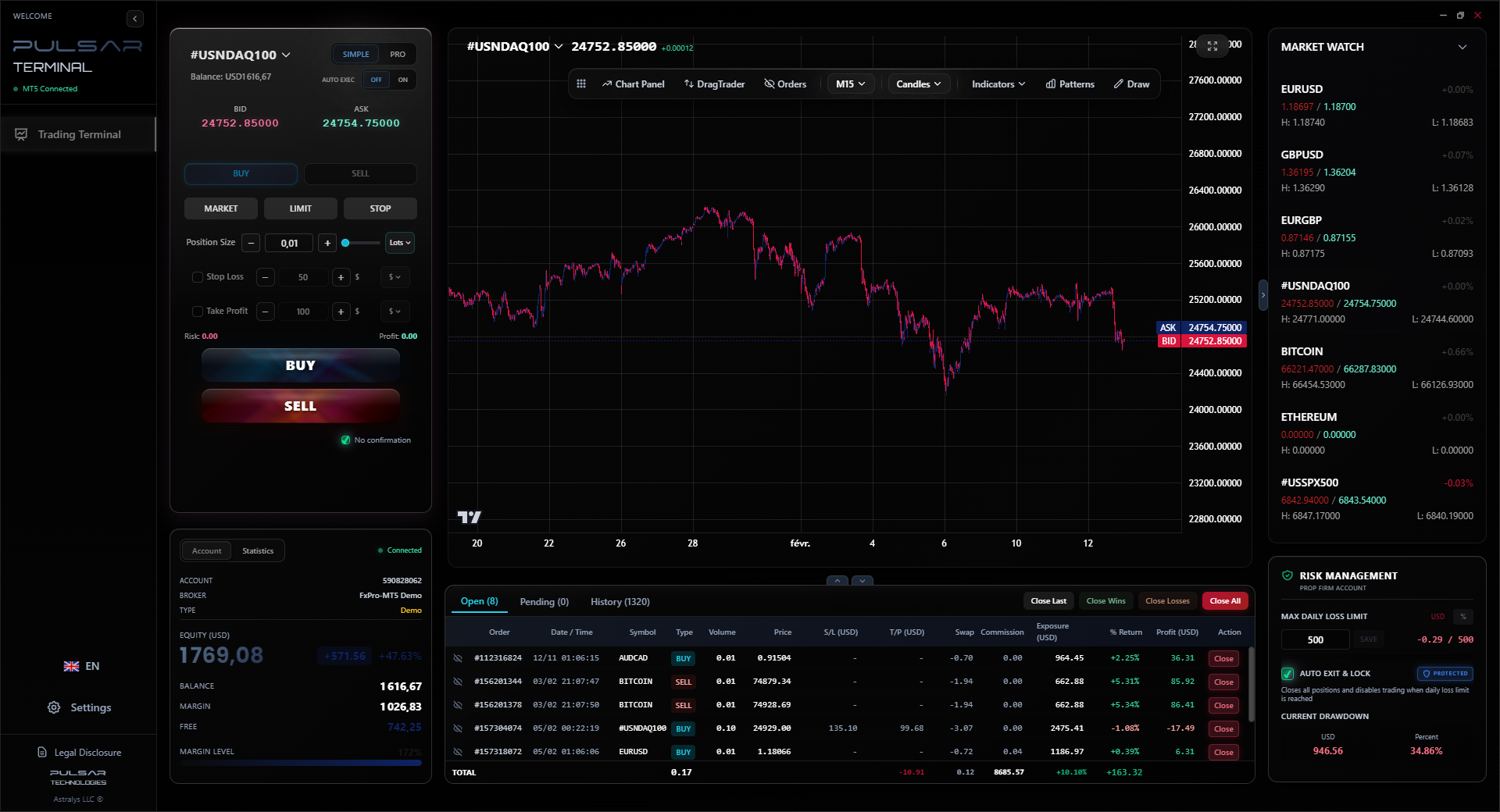
When trading fundamental breakouts, managing multiple take-profit levels and a trailing stop is critical, and Pulsar Terminal lets you set this complex order structure with a single drag-and-drop on your MT5 chart.
Pulsar Terminal
La herramienta MT5 todo-en-uno: órdenes drag-and-drop, multi-TP/SL, trailing stop, grid trading, Volume Profile y protección prop firm. Usado por más de 1.000 traders diariamente.
We make unique mistakes here. Let's avoid them.
Pitfall 1: Over-Trading Local News. We feel connected to South African news, so we trade every minor data release. Most are noise. Stick to the Tier 1 calendar I outlined.
Pitfall 2: Ignoring Global Context. You can have perfect local data, but if the US Fed is in a hawkish frenzy causing a global dollar rally, USD/ZAR is going up. The ZAR doesn't trade in a vacuum. Your fundamental analysis forex framework must be global.
Pitfall 3: Letting Politics Override Price. We all have political opinions. Don't let your hope for a competent government translate into a long ZAR trade that has no technical support. The chart is the final truth of all known information, including politics. Trade the price, not your prayer.
Pitfall 4: Chasing Liquidity During Events. As mentioned, ZAR pairs can get illiquid during local crises. If you must trade, use a limit order, not a market order. A market order during a margin call cascade could get you filled at a disastrous price.
Pitfall 5: Not Accounting for Broker Differences. Your broker's quoted price for USD/ZAR might differ from another's during volatile news. Their spread widening can trigger your stop-loss prematurely. Know your broker's policy. Some brokers like Pepperstone offer specific account types with fixed spreads for news traders, which can be worth the extra commission for peace of mind.
“Your fundamental view is just a hypothesis. The market's price action is the experiment that proves or disproves it.”
Consistency beats genius. Here’s a 30-minute daily routine to stay on top of fundamentals.
Morning (Before Market Open):
- 5 mins: Scan a global economic calendar. Flag any Tier 1 events for the day (SA, US, EU, China).
- 10 mins: Read headlines from two sources: one global (Reuters Markets, Bloomberg) and one local (Business Day Live). Don't read opinions, just facts.
- 5 mins: Check the overnight price action in USD/ZAR, EUR/USD, and Gold (XAU/USD guide). Did anything gap? Why? (Link it to a news item you just saw).
Evening (After Market Close):
- 10 mins: Review the day. Did any trades work based on fundamentals? Why or why not? Was the market's reaction to data rational or emotional? Jot down one observation in a journal.
Weekly (Sunday Evening):
- 15 mins: Plan your week. Identify the 2-3 major fundamental events. Write down your baseline expectations and the key levels on the chart to watch. This is your trading roadmap.
This isn't about becoming an economist. It's about building context. Over time, you'll start to see patterns. You'll notice how USD/ZAR tends to weaken in the week before a risky MTBPS, or how it often finds a bottom when gold prices spike. That pattern recognition, built on a foundation of fundamental understanding, is what separates a gambler from a trader.
Finally, remember that all this analysis filters into one thing: price. Your fundamental view is just a hypothesis. The market's price action is the experiment that proves or disproves it. Be ready to abandon your beautiful fundamental story if the chart tells a different one. I've saved thousands of Rands by walking away from a 'sure thing' trade that just wouldn't trigger my technical entry.
💡 Consejo de Winston
If you can't explain the fundamental reason for your trade in one clear sentence ('I'm buying ZAR because the SARB is likely to be more hawkish than the Fed next month'), you don't have a reason. You have a hope.
FAQ
Q1Is fundamental analysis or technical analysis better for forex trading in South Africa?
Neither is 'better.' They're tools for different jobs. For trading ZAR pairs, you can't ignore fundamentals because local politics and data cause big, sudden moves. Use fundamentals to get your directional bias (should I be looking to buy or sell ZAR?). Then use technical analysis to find the precise entry, exit, and stop-loss levels. Ignoring fundamentals on the Rand is like driving with a blindfold on.
Q2What's the most important South African economic data for trading the ZAR?
The top three are: 1) The SARB Interest Rate Decision and MPC statement, 2) CPI Inflation data, and 3) The Budget Speech / MTBPS. These have the highest probability of causing sustained, trend-moving changes in the ZAR's value. GDP and trade data are important for context, but rarely cause the same instant volatility.
Q3How can I practice fundamental analysis without risking real money?
Open a demo account with a broker that offers a good economic calendar and news feed (most do). For weeks, don't place a single trade. Just go through the routine: before a data release, write down your expectation and the market's expectation. After the release, watch how the price reacts for an hour. Note if it did what you thought, and why/why not. This 'paper trading' of news reactions is useful and costs you nothing.
Q4Why does the ZAR sometimes weaken on good South African economic news?
This is the 'buy the rumor, sell the fact' dynamic in action. If the market has already priced in a great CPI number by buying ZAR in the days before, when the good news actually hits, traders who bought earlier take profits. This selling pressure can cause a short-term drop. It highlights that you're trading the market's expectation vs. reality, not just the raw data.
Q5What's a good broker in South Africa for trading based on fundamentals?
Look for an FSCA-regulated broker with tight spreads on ZAR pairs, a reliable platform during news events, and integrated economic calendars and news. Brokers like IC Markets and Pepperstone are popular for their raw spreads and MT4/MT5 access. Also check if they offer swap-free accounts if you're considering a longer-term fundamental swing trading position, as overnight swap fees on ZAR pairs can add up.
Q6Can I use fundamental analysis for short-term trading like scalping?
It's tricky. Pure scalping strategy relies on tiny timeframes (1-minute, 5-minute) where order flow and technicals dominate. However, knowing the fundamental backdrop is crucial. You wouldn't want to be scalping long USD/ZAR right before a potentially hawkish SARB announcement. Use fundamentals to tell you when not to scalp, or which direction the higher-probability scalps might be in during a news session.
Lección del Prof. Winston
Puntos clave:
- ✓Focus only on Tier 1 data: SARB decisions, CPI, and the Budget.
- ✓Always know the market consensus before a news release.
- ✓Never enter a trade in the first 5 minutes of a high-impact news event.
- ✓Combine fundamental bias with at least two technical confirmations.
- ✓The ZAR is a risk-on currency; watch the S&P 500 and VIX daily.
¿Te resultó útil este artículo?
Haz clic en una estrella
Análisis Trading Semanal
Análisis y estrategias semanales gratis. Sin spam.
Sobre el autor
David van der Merwe
Trader de Mercados Emergentes
Trader con sede en Johannesburgo con 11 años en divisas de mercados emergentes. Especialista en pares ZAR, trading regulado por la FSCA y análisis del mercado sudafricano.
Comentarios
Aviso de riesgo
El trading de instrumentos financieros conlleva un riesgo significativo y puede no ser adecuado para todos los inversores. El rendimiento pasado no garantiza resultados futuros. Este contenido tiene fines educativos únicamente y no debe considerarse asesoramiento de inversión. Siempre realice su propia investigación antes de operar.
También te puede interesar

Cara Trading Forex Sukses: 7 Prinsip dari Trader Profesional
Cara trading forex sukses dengan 7 prinsip trader pro: manajemen modal, disiplin, journal trading, backtest. Data nyata, bukan janji profit palsu.
Jam Trading Forex Terbaik untuk Trader Indonesia: Panduan Lengkap dengan Tabel Waktu
Panduan jam trading forex untuk trader Indonesia. Tabel 4 sesi dunia, jam emas 20:00-00:00, sesi mana yang harus dihindari. Data akurat + tips dari trader berpengalaman.
Top 5 Sàn Forex Uy Tín Nhất 2026: Review Jujur dari Trader Indonesia
Top 5 sàn forex uy tín 2026 untuk trader Indonesia. Review jujur: spread, deposit, withdraw, dukungan lokal. Exness, XM, IC Markets & lebih.
Obtener Pulsar Terminal
Todas estas calculadoras están integradas en Pulsar Terminal con datos en tiempo real de su cuenta MT5.
Obtener Pulsar Terminal