


For years, I thought trading high impact news forex was about speed.

Olumide Adeyemi
Pionero del Trading en África Occidental ·  Nigeria
☕ 10 min de lectura
Lo que aprenderás:
For years, I thought trading high impact news forex was about speed. Get in right as the number hits, ride the volatility, and cash out. I lost a lot of money proving myself wrong. The truth is, trading the news isn't about reacting faster than everyone else; it's about preparation, understanding what the market really cares about, and having the discipline to sometimes do nothing at all. Let me walk you through what I learned the hard way, so you don't have to fund your broker's next bonus with your own capital.
Not every economic report moves the market. In Nigeria, we're bombarded with news, but only a handful of events cause the kind of volatility that can make or break your week. A high impact news event is a scheduled data release or announcement that has a proven history of causing significant, immediate price movement in a currency pair.
For a forex trader in Lagos or Port Harcourt, you need to focus on two categories: global and local.
The Global Heavy Hitters (USD, EUR, GBP)
These move everything, including USD/NGN pairs indirectly. The big ones are:
- US Non-Farm Payrolls (NFP): First Friday of every month. This jobs report can send the US Dollar into a frenzy. I've seen EUR/USD swing 80 pips in 10 seconds on a surprise number.
- US Consumer Price Index (CPI) & Federal Reserve Rate Decisions: Inflation and interest rates are everything now. A 0.1% miss on CPI can be catastrophic for a directional bet.
- European Central Bank (ECB) and Bank of England (BoE) Meetings: Major drivers for EUR and GBP pairs.
The Local Catalysts (NGN)
This is where you can find an edge if you understand the local context. The Central Bank of Nigeria (CBN) Monetary Policy Committee (MPC) meetings are our version of the Fed. A surprise change in the Monetary Policy Rate (MPR) or CRR will shock the Naira. Other key local data includes inflation reports (which are almost always high, but the trend matters) and GDP figures.

Warning: Don't confuse high frequency with high impact. A tweet might cause a blip, but scheduled data with concrete numbers is what institutions trade on. That's where the real volume and momentum come from.
The key is using an economic calendar. Most brokers like Exness or IC Markets provide them. Filter for 'High' impact events. That's your weekly roadmap.

💡 Consejo de Winston
The economic calendar is your friend, but the 'whisper number' (the real expectation among big traders) is your best friend. The published forecast is often old news.
Here's the painful lesson. In October 2023, the US CPI came in hotter than expected. I was watching EUR/USD. The number dropped, and price instantly spiked down 40 pips. My brain screamed 'SELL!'. I hit the sell button, market order. By the time my order filled, price had already dropped another 15 pips. Then it reversed. Violently. It ripped back up 70 pips in the next minute, stopping me out for a 55-pip loss. I was right on the direction initially, but my timing, execution, and psychology were destroyed.
I was trying to react to the news. The big players don't react. They position. They have orders in the market waiting to catch the liquidity from people like me. My trade was pure gambling, not trading.
That loss taught me the first rule of high impact news forex: If you're placing a market order in the 5 seconds after a release, you're the liquidity. You're not taking a trade; you're being taken. The spreads widen to insane levels (I've seen 20+ pips on EUR/USD), and slippage can be brutal. Your planned 20-pip stop loss can get hit at a 35-pip loss before the market even looks at your order.
Now, I have two simple rules for the immediate aftermath:
- I do not touch the chart for the first 90 seconds after a red-highlight news release.
- I do not place any market orders for at least 5 minutes.
This forces me to miss the initial, chaotic spike. That's okay. I'm not a supercomputer. I'm a retail trader. My job is to trade the reaction to the reaction, not the headline itself.
“Some weeks, my trading plan tells me 'No Trade' for every single news item. That's a successful week.”
After blowing up that account, I went back to the drawing board. I found three methods that turned news trading from a casino game into a strategic process.
1. The Pre-News Positioning Strategy
This is for the patient trader. You analyze the expectations (the 'forecast') and the market's likely reaction. You place your trade before the news, with a wider stop loss to absorb the initial volatility. The goal is to catch the sustained move that happens after the chaos settles.
My Example: Before a recent ECB meeting, expectations were firmly for a 50bps hike. I bought EUR/USD 2 hours before the announcement at 1.0720. My stop was 60 pips away at 1.0660. The news came, there was whipsaw, but it never hit my stop. The press conference was hawkish, and price trended up to 1.0820 over the next 4 hours. I took profit at 1.0800 for an 80-pip gain. The key was the wide stop and the conviction in the broader trend.
2. The Post-News Retracement Play
This is my favorite now. After the news drops and the initial spike fades, price often retraces back to a key level. It might test the pre-news breakout point or a Fibonacci level. You wait for this retracement and then enter in the direction of the initial news-driven move.
This requires using tools like the RSI indicator to spot overextensions and waiting for price action confirmation (like a pin bar or engulfing candle) at your level. It's a classic swing trading entry, just on a faster timeframe.
3. The Volatility Fade (Advanced)
This is risky and requires serious skill. Sometimes, the initial spike is so extreme it becomes unsustainable. The move 'fades' back. You're betting that the first move was an overreaction. I only do this with very small position sizes and only when price hits a major, multi-week support or resistance zone. Never try this in the middle of nowhere on the chart.

Pro Tip: Whichever approach you use, always use a position size calculator. News volatility magnifies risk. If you normally risk 1% of your account, consider dropping to 0.5% for a news trade. Surviving is more important than the size of the win.
Normal risk management rules go out the window during news. Here’s your survival checklist:
- Expect Slippage: Your stop loss is not a guarantee. It's an order. If price gaps past it, you'll be filled at the next available price, which could be much worse. Always assume your actual loss could be 1.5x your planned risk.
- Avoid Pending Orders Too Close: If you place a buy stop order above the market to catch a breakout, and the news spikes through it, you'll get the worst possible entry. If you must use pending orders, place them far away from the current price to avoid being caught in a false, thin-liquidity spike.
- Beware of the Margin Call: Increased volatility means increased margin requirements. Some brokers will hike margin requirements significantly before major news. If you're over-leveraged, a small move against you can trigger a margin call. Check with your broker (XM and Pepperstone are good about warnings) and reduce use beforehand.
- The 15-Minute Rule: I don't hold a news trade open for more than 15 minutes unless it's a clear, strong trend. Most news-driven moves have their main energy in the first few minutes. After that, the market digests and often reverses. Take partial profits quickly.
A practical table for adjusting your trade:
| Normal Condition | High Impact News Adjustment |
|---|---|
| Stop Loss: 20 pips | Stop Loss: 40-60 pips (or don't trade) |
| Risk per Trade: 1% | Risk per Trade: 0.5% |
| Use Market Orders | Use Limit Orders only, if any |
| Trade 1-2 lots | Trade 0.5 lots |
This isn't about being timid. It's about respecting the market's power. I learned this after a GBP CPI report where my 25-pip stop on a scalping strategy turned into a 42-pip loss before I could blink. The trade was right eventually, but I was already out.
💡 Consejo de Winston
If you feel your heart pounding as the clock counts down to a news release, you have no business placing a trade. Master your psychology first, then the market.
“Trading the news isn't about reacting faster than everyone else; it's about preparation and having the discipline to sometimes do nothing at all.”
Trading Naira pairs around CBN announcements is a different beast. Liquidity can dry up, and moves can be political as much as economic. Here’s what you won’t find in a generic forex guide.
When the MPC announces the MPR, the market isn't just looking at the rate change. It's parsing the Governor's tone. Is the CBN sounding more hawkish (prioritizing fighting inflation) or dovish (prioritizing growth)? A hold on rates with a hawkish statement can strengthen the Naira more than a small hike with a dovish outlook.
A Real Trade: In early 2024, the CBN hiked rates aggressively. Everyone expected it. USD/NGN actually dipped slightly on the news ('buy the rumor, sell the fact'). But in the following days, as the implications for dollar liquidity set in, the pair resumed its uptrend. The immediate news reaction was a fakeout. The smarter trade was to wait for that post-news dip to add to a position, not trade the headline minute.
Also, remember that local banks and corporations have massive orders to fulfill. Their flow can dominate the market around these times, creating moves that seem illogical to a retail chart reader. My advice? With CBN news, consider longer timeframes. Don't try to scalp the 1-minute chart. Look for the daily or 4-hour chart structure and use the news as a catalyst for a swing trade that lasts days.
Warning: Be extra cautious with your broker's quoted spreads on USD/NGN or other Naira pairs around 2 PM on MPC announcement days. I've seen spreads blow out to hundreds of pips, making any trade instantly underwater. Sometimes, the best trade is to watch and learn.
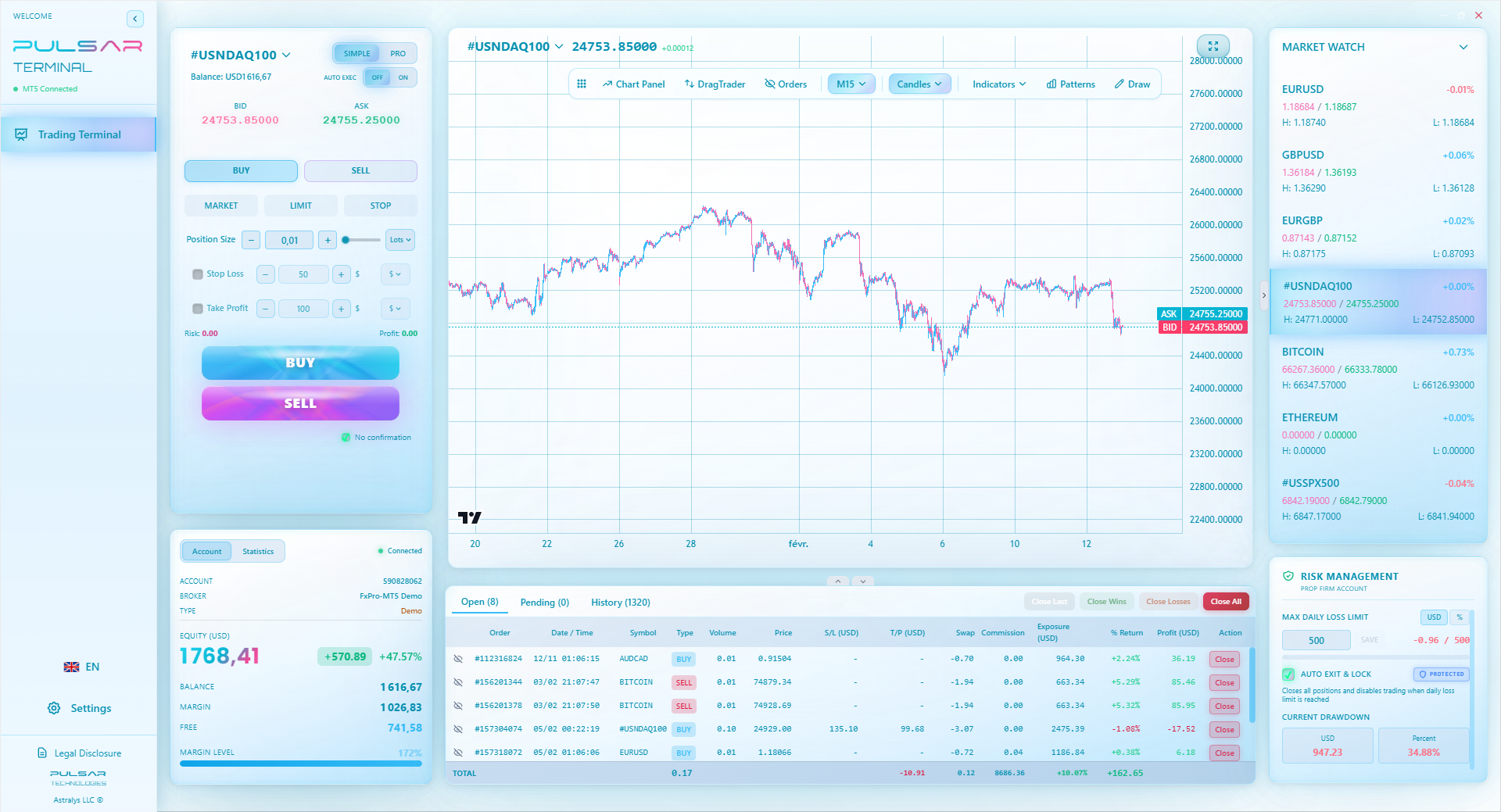
Managing multiple trades and setting precise stops around volatile news events is stressful, which is why I use Pulsar Terminal's drag-and-drop order system and multi-take-profit features directly on my MT5 charts.
Pulsar Terminal
La herramienta MT5 todo-en-uno: órdenes drag-and-drop, multi-TP/SL, trailing stop, grid trading, Volume Profile y protección prop firm. Usado por más de 1.000 traders diariamente.
This is the routine I follow for every major event now. Discipline here saved my account.
1. The Day Before:
- Check the calendar. Identify the time of the release (adjust for WAT).
- Know the forecast number and the previous number.
- Analyze the chart. Where are the key support/resistance levels? What is the broader trend?
- Decide: Will I trade this? If yes, which of the three approaches? If no, I mark the time and stay away.
2. One Hour Before:
- Close any unrelated trades that could be affected by volatility.
- Calculate my position size based on 0.5% risk and a realistic wider stop.
- Set price alerts at key levels, not orders.
- Do nothing else. No last-minute analysis.
3. Five Minutes Before to Five Minutes After:
- I am not trading. I am observing.
- I watch the initial spike, the retracement, and where price settles.
- I note the volume and the speed of the move.
4. The Trade (If it Forms):
- I only enter after I see a clear level hold or break on the 5 or 15-minute chart.
- I enter with a limit order, not a market order.
- I set my stop loss based on the new, post-news chart structure.
- I set a tight first profit target (e.g., take 50% off at 1:1 risk-reward) to bank some profit quickly.
5. The Review:
- After the trade, win or lose, I journal what happened. What did I miss? How did price react compared to the forecast? This is how you build intuition.
This process removes emotion. It turns a chaotic event into a checklist. Some weeks, the checklist tells me 'No Trade' for every single news item. That's a successful week.
FAQ
Q1What is the most important high impact news for forex?
For global markets, US Non-Farm Payrolls (NFP) and Consumer Price Index (CPI) are the kings. They directly influence Federal Reserve policy, which drives the US Dollar and every major pair. For Nigerian traders, the CBN's Monetary Policy Committee (MPC) announcements are the local equivalent for Naira pairs.
Q2Should I trade right when the news is released?
Almost never. The first 1-2 minutes are dominated by institutional algorithms, wild spreads, and extreme slippage. As a retail trader, you are at a massive disadvantage. It's better to wait for the initial volatility to settle and trade the clearer direction that emerges, often 5-15 minutes later.
Q3How do I know if the news was 'good' or 'bad' for a currency?
It's not about the number being high or low in isolation. It's about the number relative to the market's expectation (the forecast). A high inflation number is 'bad,' but if it was expected to be even higher, the currency might actually rally ('sell the rumor, buy the fact'). Always compare the actual release to the forecast.
Q4Why did the price move opposite to what the news suggested?
This is common and usually one of two things: 1) 'Buy the rumor, sell the fact' – the expected move was already priced in before the announcement. 2) The market is focusing on a different aspect (e.g., future guidance from a central bank rather than the past data released). The headline number is just one piece of the puzzle.
Q5Can I trade news with a small account?
You can, but you must be extremely careful. The volatility can easily stop you out. Use a micro or nano account (if available), reduce your position size to the absolute minimum, and widen your stop loss significantly. Consider it a learning exercise before committing real capital. A margin call happens much faster to a small, over-leveraged account.
Q6What's the best forex pair to trade during news?
The major pairs with the highest liquidity: EUR/USD, GBP/USD, USD/JPY. They have the tightest spreads under normal conditions and, while spreads will widen on news, they recover faster than exotic pairs. Avoid exotics and minor pairs during major news events.
Q7How does news affect gold (XAU/USD)?
Gold is heavily influenced by US news, especially CPI and Fed decisions, because it's priced in USD and is seen as an inflation hedge. A strong USD (from hawkish Fed news) typically hurts gold, while weak USD data can boost it. For a deeper look, check our XAU/USD guide.
Lección del Prof. Winston
Puntos clave:
- ✓Wait 90 seconds after news before even considering a trade.
- ✓Risk 0.5% on news trades, not your standard 1%.
- ✓Trade the retracement, not the initial spike.
- ✓A 'No Trade' decision is a valid and profitable outcome.
¿Te resultó útil este artículo?
Haz clic en una estrella
Análisis Trading Semanal
Análisis y estrategias semanales gratis. Sin spam.
Sobre el autor
Olumide Adeyemi
Pionero del Trading en África Occidental
Uno de los educadores de trading forex más activos de Nigeria. 8 años de experiencia operando desde Lagos. Especialista en estrategias de bajo capital y desafíos de prop firms para traders africanos.
Comentarios
Aviso de riesgo
El trading de instrumentos financieros conlleva un riesgo significativo y puede no ser adecuado para todos los inversores. El rendimiento pasado no garantiza resultados futuros. Este contenido tiene fines educativos únicamente y no debe considerarse asesoramiento de inversión. Siempre realice su propia investigación antes de operar.
También te puede interesar

Cara Trading Forex Sukses: 7 Prinsip dari Trader Profesional
Cara trading forex sukses dengan 7 prinsip trader pro: manajemen modal, disiplin, journal trading, backtest. Data nyata, bukan janji profit palsu.
Jam Trading Forex Terbaik untuk Trader Indonesia: Panduan Lengkap dengan Tabel Waktu
Panduan jam trading forex untuk trader Indonesia. Tabel 4 sesi dunia, jam emas 20:00-00:00, sesi mana yang harus dihindari. Data akurat + tips dari trader berpengalaman.
Top 5 Sàn Forex Uy Tín Nhất 2026: Review Jujur dari Trader Indonesia
Top 5 sàn forex uy tín 2026 untuk trader Indonesia. Review jujur: spread, deposit, withdraw, dukungan lokal. Exness, XM, IC Markets & lebih.
Obtener Pulsar Terminal
Todas estas calculadoras están integradas en Pulsar Terminal con datos en tiempo real de su cuenta MT5.
Obtener Pulsar Terminal