


The screen was a sea of red.

David van der Merwe
Trader de Mercados Emergentes ·  South Africa
☕ 11 min de lectura
Lo que aprenderás:
- 1The First Step: Mindset, Not Money
- 2Getting Legal: Picking a SA Broker
- 3Your Trading Playbook: Finding a Strategy
- 4The Psychology of Surviving Week One
- 5Risk Management: Your Real Edge
- 6From Demo to Live: The Transition
- 7Common Pitfalls for SA Traders (And How to Avoid Them)
- 8Putting It All Together: Your First Year

The screen was a sea of red. It was March 2020, and the USD/ZAR had just ripped through R18.50. My phone was buzzing with margin call alerts from my broker. I’d been cocky, over-leveraged on what I thought was a sure thing. That week, I lost R42,000 - a brutal lesson that being a forex trader isn't about finding a secret code. It's about survival. If you're in South Africa asking 'how can I be a forex trader?', this isn't a get-rich-quick manual. It's a journal from the trenches, written in rands and cents.
Everyone thinks the first step is opening an account. It's not. The first step is accepting that you will be wrong. A lot. The market doesn't care about your opinion, your analysis, or your need to make rent. I learned this the hard way in 2014, trying to 'outsmart' the EUR/USD during the Greek debt crisis. I was convinced it would collapse. It rallied for three straight weeks. I blew my first R5,000 deposit because my ego was tied to every trade.
Your mindset needs to be that of a probability manager, not a prophet. You're not predicting the future. You're placing calculated bets where the odds are in your favour, knowing you'll lose some. This means every trade plan must include where you're wrong (your stop-loss) before you even think about profit. It sounds simple, but I've watched dozens of new traders in Johannesburg and Cape Town ignore this. They focus only on the potential win. That's a surefire way to get a margin call.

Warning: The biggest trap for new South African traders is comparing themselves to the 'gurus' on social media showing off luxury cars. They never show the losses, the blown accounts, or the sheer boredom of waiting for a setup. Your goal isn't glamour. Your goal is consistent, small growth.
This is where you can't cut corners. Trading with an unregulated offshore broker is asking for trouble. In South Africa, the Financial Sector Conduct Authority (FSCA) is our watchdog. Always, always check if your broker is FSCA licensed. It's your only real protection.
What to Look For in a Broker
You need to look beyond the flashy ads. Here’s what actually matters for a South African:
- Local Support & ZAR Accounts: Can you call them? Do they offer a local ZAR trading account to avoid crazy bank conversion fees? This saved me a fortune compared to funding in USD or EUR.
- Real Spreads on ZAR Pairs: The USD/ZAR is our home game. Check the average spread during our market hours (8am-5pm SAST). A good broker will have spreads around 25-40 pips on the major ZAR pairs. I’ve seen some push 80+ pips, which is just theft.
- Deposit/Withdrawal Ease: Instant EFT, Ozow, PayFast? These are non-negotiables. Waiting 5 business days for a bank wire is ancient history.
I’ve personally traded with a few over the years. Exness has solid ZAR account options and local support. IC Markets offers raw spreads which are great for scalping. XM and Pepperstone are also FSCA-regulated and popular here. Do your own homework, but start with their FSCA license number.

Pro Tip: Open a demo account with at least two brokers. Trade the USD/ZAR at 8:30am (when liquidity kicks in) and again at 3pm. Compare the actual spreads and execution speed. The demo tells the real story.

💡 Consejo de Winston
Your first R10,000 profit is the most dangerous. It convinces you you've cracked the code. That's when you're most likely to triple your position size and give it all back.
“I lost more trades than I won, but I still made money. That's the magic of risk management.”
You have a broker. Now what? You need a rule-based system. Not a feeling. I cycled through every strategy under the sun until I realized a painful truth: a simple strategy you follow perfectly beats a complex one you follow poorly.
Let me give you two examples from my own books:
What Worked (Eventually): Price Action & Key Levels I stopped overloading my charts. Now, I just mark major support/resistance (places where price has reversed before) and watch how price reacts there. On the 4-hour USD/ZAR chart, if price approaches a major level and forms a clear rejection candle (like a pin bar), that's a signal. I enter on a break of that candle's high/low, with a stop-loss just beyond the level. It's boring. It requires patience. But it's repeatable.
What Didn't Work (Cost Me Money): Chasing news headlines. In 2022, I tried to trade SARB interest rate announcements live. The volatility was insane. The spread widened to 120 pips for a moment, I got slippage, and a trade that should have been a R500 loss became a R2,000 loss in seconds. I don't do that anymore.
Your playbook must answer these questions:
- What pair and time frame do I trade? (Start with one. Maybe USD/ZAR 4H).
- What are my exact entry conditions? (e.g., "RSI above 50 AND price bounce off trend line").
- Where is my stop-loss? (Always defined in pips).
- Where is my take-profit? (Use a risk-reward ratio of at least 1:1.5).
A tool like our position size calculator is essential here. It turns your risk percentage (e.g., 1% of your account) into a specific lot size based on your stop-loss distance. This is the math that keeps you alive.
Your first week with real money is a psychological warzone. Every tick feels personal. Here’s what nobody tells you: you will feel the urge to break your own rules. The market will test you.
I remember my first 'real' trade on GBP/JPY. My stop-loss was 30 pips away. Price drifted towards it, hovering 5 pips above. My heart was pounding. The logical part of my brain said, 'The rule is the rule.' The emotional, fearful part screamed, 'Move the stop! Just give it more room!' I moved it. Price then dropped 60 pips past my original stop. That R800 loss became a R1,900 loss because I couldn't handle the discomfort of being wrong.
The Two Biggest Emotional Killers:
- Revenge Trading: After a loss, you immediately jump into another trade to win the money back. This is trading with anger, not analysis. It's how accounts blow up in an afternoon.
- Overconfidence After a Win: You have three winning trades in a row. You start feeling invincible. You increase your lot size from 0.1 to 0.5 because 'you're on a roll.' The next trade wipes out all three previous wins.
The fix? A trading journal. Not just 'bought EUR/USD, made money.' I write down: 'Felt anxious during drawdown. Considered moving stop. Didn't. Good.' Or 'Felt greedy after win, wanted to trade outside my hours. Closed platform instead.' This builds self-awareness, which is your greatest psychological tool.

Example: My journal entry from a bad day: "Loss on USD/ZAR: -R1200. Cause: Ignored daily resistance level because I was bored. Emotion: Impatience. Consequence: Breached daily loss limit. Action: Stop trading for the week. Review rules."
“Your first-year goal is not Lamborghini money. It's survival.”
Forget fancy indicators. This is the only 'edge' you have full control over. Professional traders aren't better at predicting prices. They are ruthless about managing risk.
The Non-Negotiable Rules:
- Risk Per Trade: Never risk more than 1-2% of your total account balance on a single trade. On a R10,000 account, that's R100-R200. This means if you have a string of 10 losses (which happens), you're down 10-20%, not 80%.
- Daily/Weekly Loss Limit: Set a hard stop for yourself. Mine is 5% of my account in a day. If I hit it, I shut down the platform. No debates. This prevents one terrible day from destroying a month's work.
- Use Stop-Losses. Always. A trade without a stop-loss is a gamble, not a trade. It's like driving without a seatbelt.
Let me show you the power of this with real numbers from my 2023 book. I had a 40% win rate. Sounds terrible, right? But my average winning trade was R350, and my average loser was R150 (a 2.33:1 reward-to-risk ratio).
| Metric | Result |
|---|---|
| Total Trades | 100 |
| Winning Trades | 40 |
| Losing Trades | 60 |
| Total Profit (Wins) | 40 x R350 = R14,000 |
| Total Loss (Losses) | 60 x R150 = R9,000 |
| Net Profit | R5,000 |
I lost more trades than I won, but I still made money. That's the magic of risk management. It's why you must master the position size calculator before you master any strategy.
💡 Consejo de Winston
If you can't explain your trade setup in one simple sentence to a friend, it's too complicated. Complexity is the enemy of execution.
Demo trading feels like playing a video game with unlimited lives. Live trading is the real deal, with real consequences. The transition is where most fail.
My Method for Transitioning:
- Trade a Micro Account: Don't jump into a standard account. Fund a live account with the absolute minimum - maybe R1,000 or R2,000. Trade micro lots (0.01). The money is real enough to feel the emotion, but small enough that a total loss won't cripple you.
- Prove Consistency First: Your goal on this micro account isn't to get rich. It's to achieve consistency. Can you follow your rules for 20 trades in a row? Can you end two consecutive months in profit, even if it's just R100? If not, you're not ready to add more capital.
- The 'Real' Test: Once you're consistently profitable on micro, then - and only then - consider funding a larger account. But scale up slowly. Move from 0.01 lots to 0.02, not to 1.0.
I made the mistake of going from a demo where I 'made' R50,000 in a month to funding a R20,000 live account. The pressure was immense. I traded scared, then reckless, and was back to a R15,000 balance in two weeks. The psychological weight of the larger sum broke my discipline. Start small. Earn the right to trade bigger.
“A trade without a stop-loss is a gamble, not a trade. It's like driving without a seatbelt.”
We face some unique challenges here at the bottom of Africa.
Pitfall 1: Chasing 'Black Tax' Returns. Many of us trade to support family. This creates immense pressure to perform quickly. You start aiming for 20% returns a month, taking insane risks. The market doesn't care about your obligations. Trade your plan, not your bills. Build capital slowly.
Pitfall 2: Ignoring Load Shedding. Your trade is open and the lights go out. No internet. I’ve been there. Solution: Always have a contingency. A mobile router with data. A laptop charged. Use guaranteed stop-losses (if your broker offers them) on trades you can't monitor during high-risk periods. Better yet, don't hold trades over known load-shedding slots if you can't manage them.
Pitfall 3: Forex vs. The JSE. Friends will tell you to just buy Naspers or Prosus shares and forget it. Forex is 24/5, leveraged, and volatile. It's a different beast entirely. Don't use long-term JSE investing logic for short-term forex swing trading. The skills don't directly transfer.
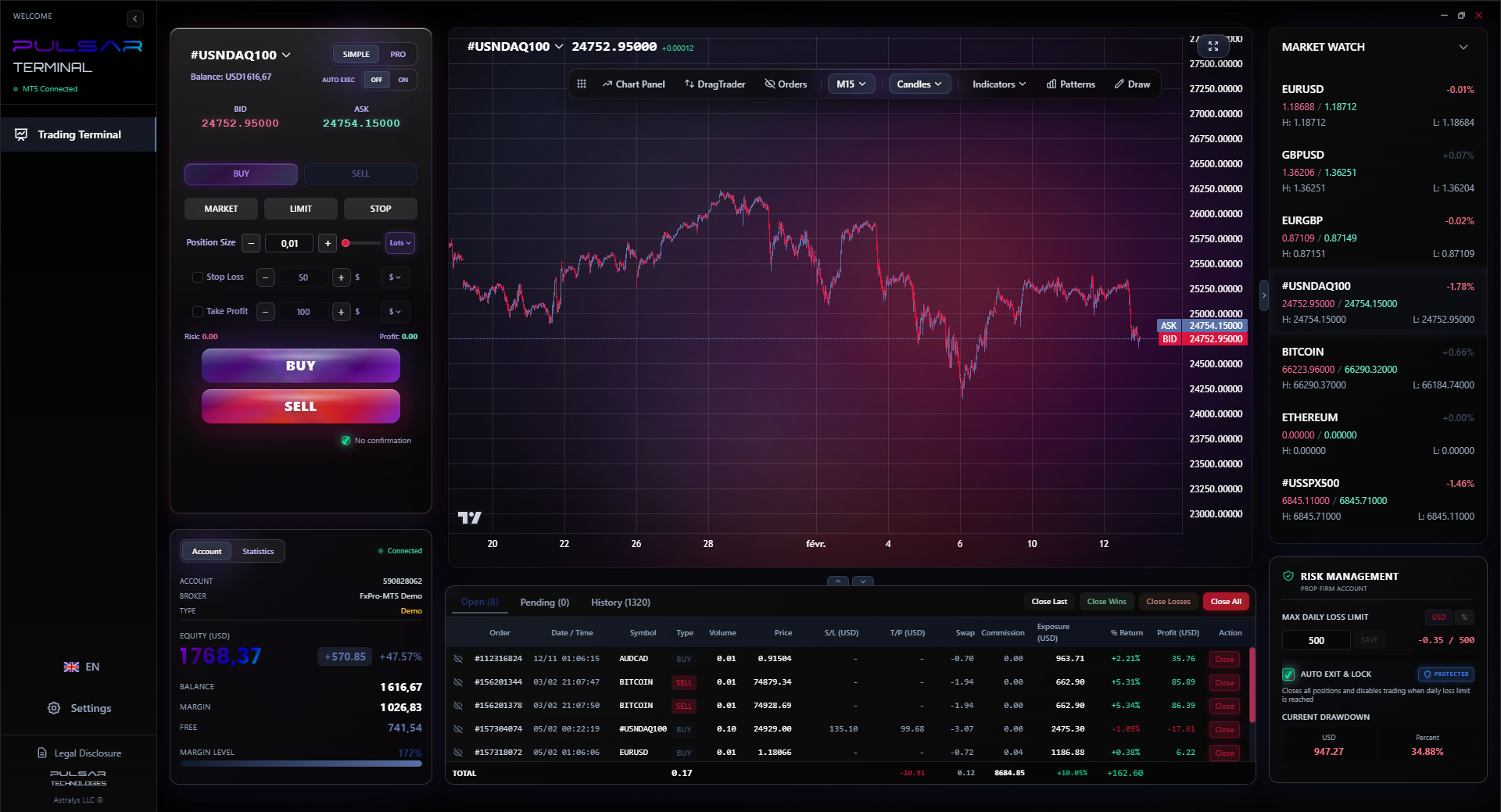
Pitfall 4: The Prop Firm Mirage. Prop firm challenges are everywhere. They sell a dream: pass a test, trade their R1 million account. The reality? Their rules (like daily drawdown limits) are designed for you to fail. I’ve blown two challenges. The stress of their restrictive rules made me trade worse. Focus on building your own real capital first. If you do go the prop route, you need surgical risk management, which is where tools that automate protection levels become almost mandatory to handle the psychological pressure.
💡 Consejo de Winston
The market will always offer another opportunity. The missed trade you're kicking yourself over? There will be ten more just like it this month. Patience isn't a virtue here; it's a survival mechanism.
Managing the strict rules of a prop firm challenge requires flawless execution, which is where a tool like Pulsar Terminal can automate your stop-loss and take-profit levels directly on MT5, removing emotional decisions.
Pulsar Terminal
La herramienta MT5 todo-en-uno: órdenes drag-and-drop, multi-TP/SL, trailing stop, grid trading, Volume Profile y protección prop firm. Usado por más de 1.000 traders diariamente.
So, how can you be a forex trader? Let's map out a realistic first year.
Months 1-3: The Learning Phase.
- Read, watch, learn. But paper trade (demo) only.
- Pick ONE major pair (EUR/USD is great for beginners) or USD/ZAR if you want local focus. Study its personality.
- Build and test a simple strategy. Write down the rules.
- Get comfortable with your platform and a position size calculator.
Months 4-6: The Micro-Live Phase.
- Fund a micro account with R1,000-R2,000.
- Your sole goal: execute your plan for 50 trades. Track everything in a journal.
- Focus on process, not profit. Did you follow your rules? That's your success metric.
Months 7-9: The Evaluation Phase.
- Analyze your 50-trade journal. What's your win rate? Your average win vs. loss? Are you emotionally consistent?
- Tweak your strategy SLOWLY. Change one variable at a time.
- If you're not consistently breaking even or making a small profit, go back to demo. You have a leak in your process.
Months 10-12: The Scaling Phase.
- If you have a proven, positive track record on micro, you can consider adding more capital.
- Increase size by no more than 50% at a time. From 0.01 lots to 0.015, not to 0.1.
- This is where you might explore other instruments, like XAU/USD (gold), but add them one at a time.
Your first-year goal is not Lamborghini money. It's survival. It's ending the year with more knowledge and the same (or slightly more) capital than you started with. If you can do that, you're already ahead of 90% who try. You've learned how to be a forex trader who lasts.
FAQ
Q1How much money do I need to start forex trading in South Africa?
Technically, you can start with as little as R500-R1000 on a micro account with a broker like XM or Exness. But realistically, I'd advise R5,000-R10,000. This allows you to trade micro lots (0.01) with proper risk management without your account being too sensitive to a single loss. Remember, the amount is less important than the percentage you risk per trade.
Q2Is forex trading taxable in South Africa?
Yes. SARS views forex trading profits as income if you're trading frequently (seen as a revenue-generating activity). You need to declare it on your annual tax return. Keep careful records of all your trades, deposits, and withdrawals. It's boring admin, but not doing it can lead to serious penalties later.
Q3What's the best time to trade forex from South Africa?
Our 8am to 5pm (SAST) overlaps with the European session (7am-4pm SAST) and the latter part of the Asian session. This is when liquidity is high for pairs like EUR/USD and GBP/USD. The US session opens at 3:30pm our time, creating high volatility until around 11pm. For USD/ZAR specifically, the most active times are during our business hours and when US traders are active.
Q4Can I make a living from forex trading in SA?
A small percentage do, but it takes years of discipline, a significant proven track record, and substantial capital. Don't quit your job. Start as a side hustle. The goal for the first few years should be to generate consistent supplemental income and grow your trading capital. Thinking you'll replace a salary in month six is a recipe for disaster.
Q5Which is better for beginners: MT4 or MT5?
Both are fine. MT4 is simpler and what most South African brokers support. MT5 has more timeframes and built-in indicators. I'd say start with MT4. It's less overwhelming. All the core concepts - placing orders, setting stops, drawing lines - are the same. You can always switch to MT5 later if you need its advanced features.
Q6How do I handle losses emotionally?
You pre-accept them. Before you enter any trade, you know exactly what the loss will be (your stop-loss) and that it's a possible outcome. It's a cost of doing business, like a shop owner accepts theft or spoilage. Journaling your emotional state after each loss helps detach the feeling from the event. Also, having a strict daily loss limit (e.g., 5%) means a bad day has a defined end, which reduces panic.
Q7Are automated trading robots (EAs) worth it?
In my 12 years, I've never seen a 'set and forget' robot that works long-term. Markets change. Conditions that worked in 2021 won't work in 2024. EAs can be useful tools for executing specific parts of your strategy (like closing partial positions), but you should never hand over full control. The learning you do by manually executing trades is useful. You need to understand the 'why' behind the trade.
Lección del Prof. Winston
Puntos clave:
- ✓Risk only 1-2% of your capital per trade.
- ✓Define your stop-loss before every entry.
- ✓A 40% win rate can be profitable with good risk/reward.
- ✓Trade a micro account with real money first.
- ✓Journal your trades and your emotions.
¿Te resultó útil este artículo?
Haz clic en una estrella
Análisis Trading Semanal
Análisis y estrategias semanales gratis. Sin spam.
Sobre el autor
David van der Merwe
Trader de Mercados Emergentes
Trader con sede en Johannesburgo con 11 años en divisas de mercados emergentes. Especialista en pares ZAR, trading regulado por la FSCA y análisis del mercado sudafricano.
Comentarios
Aviso de riesgo
El trading de instrumentos financieros conlleva un riesgo significativo y puede no ser adecuado para todos los inversores. El rendimiento pasado no garantiza resultados futuros. Este contenido tiene fines educativos únicamente y no debe considerarse asesoramiento de inversión. Siempre realice su propia investigación antes de operar.
También te puede interesar

Cara Trading Forex Sukses: 7 Prinsip dari Trader Profesional
Cara trading forex sukses dengan 7 prinsip trader pro: manajemen modal, disiplin, journal trading, backtest. Data nyata, bukan janji profit palsu.
Jam Trading Forex Terbaik untuk Trader Indonesia: Panduan Lengkap dengan Tabel Waktu
Panduan jam trading forex untuk trader Indonesia. Tabel 4 sesi dunia, jam emas 20:00-00:00, sesi mana yang harus dihindari. Data akurat + tips dari trader berpengalaman.
Top 5 Sàn Forex Uy Tín Nhất 2026: Review Jujur dari Trader Indonesia
Top 5 sàn forex uy tín 2026 untuk trader Indonesia. Review jujur: spread, deposit, withdraw, dukungan lokal. Exness, XM, IC Markets & lebih.
Obtener Pulsar Terminal
Todas estas calculadoras están integradas en Pulsar Terminal con datos en tiempo real de su cuenta MT5.
Obtener Pulsar Terminal