


Let's be brutally honest.

David van der Merwe
Trader de Mercados Emergentes ·  South Africa
☕ 10 min de lectura
Lo que aprenderás:
- 1Why 'Risk Management' Isn't Optional. It's Survival.
- 2The 1% Rule (And Why It's Not Really About 1%)
- 3Stop Losses: Your Best Friend (That You Keep Ignoring)
- 4Risk/Reward Ratios: This is Where Your Edge Actually Is
- 5Your Position Size Calculator: The Most Important Tool
- 6The Emotional Risk: Your Biggest Enemy
- 7Putting It All Together: A Real Trade Example
Let's be brutally honest. Most traders, especially here in South Africa, are obsessed with finding the perfect entry. They're chasing the 'holy grail' indicator. I was the same. I lost over R80,000 in my first two years proving that strategy is maybe 20% of the game. The other 80%? It's how to manage risk in forex trading. This isn't about avoiding losses. It's about structuring your trades so that a string of losers can't knock you out of the game. I'll show you the exact, unsexy calculations that saved my career.
You've heard it a million times: 'Only risk 1-2% per trade.' It sounds like a boring rule from a textbook. I ignored it. My logic was simple. If I have R20,000 in my account, risking R200 (1%) to make R400 feels painfully slow. So I'd risk R1,000 (5%) to try and make R2,000. Faster growth, right?
Here's what the math doesn't show you emotionally. A 5% loss stings. It makes you doubt your analysis. Two 5% losses in a row? That's a 10% hole in your account, and now you're trading scared, trying to 'win it back.' That's when you break your own rules. That's when a R20,000 account can become R12,000 in a bad week.
I learned this the hard way trading USD/ZAR during a SARB announcement. I was confident. I risked 4% on what I thought was a sure thing. The spike went against me, hit my stop, and that R800 loss felt like a punch. For the next three trades, I was gun-shy, exiting early on winners and letting losers run, trying to avoid another hit. I turned a single 4% loss into a 7% drawdown because my head wasn't in the game. My position size calculator wasn't the problem. My discipline was.

Warning: Your brain is wired against good risk management. The desire for quick profits will always argue against a small, sensible risk percentage. You have to automate the decision before you ever see the chart.
Let's get specific. The golden rule is to risk a fixed percentage of your current account balance on any single trade. Not your starting balance. Your current balance. This forces you to trade smaller after losses and trade larger after wins. It's the engine of compounding and the shield against ruin.
The Math That Keeps You Alive
Say you start with R50,000. Risking 1% means your maximum loss on trade #1 is R500. If you lose, your account is R49,500. Your 1% risk on trade #2 is now R495, not R500. This slight reduction seems trivial, but it's everything. It mechanically protects you from a death spiral.
Now, let's say you use a scalping strategy with a tight stop. Your risk per pip is higher. If your stop is 5 pips away, to risk R500, your position size must be huge. That's a red flag. The 1% rule forces you to either find trades with better risk/reward setups or accept that the trade doesn't fit your account size. It's a filter.

Example: Account: R100,000 | Risk per Trade: 1% = R1,000 Trade: Buy EUR/USD at 1.0850, Stop Loss at 1.0820 (30 pips risk) Risk per Pip = R1,000 / 30 pips = R33.33 per pip. On EUR/USD, 1 standard lot = ~$10 per pip (roughly R185 at ZAR18.50/$). So, R33.33 per pip / R185 per pip per lot ≈ 0.18 lots. Your position size is 0.18 lots (or 18,000 units). Not 1 lot because you 'feel good.' The math decides.
The percentage itself is personal. If 1% feels too conservative for your size, maybe 1.5% is your limit. If you're new, 0.5% is smarter. The number is less important than the rigid, unemotional application of it. I used 2% for years and the volatility in my equity curve was nerve-wracking. At 1%, I sleep better.

💡 Consejo de Winston
Risk of ruin isn't a theory. Calculate it. If you risk 5% per trade with a 50% win rate, you have a ~35% chance of blowing 50% of your account after just 100 trades. At 2% risk, that chance drops to near zero.
“You can be wrong more than half the time and still be profitable.”
A stop loss isn't a suggestion. It's a pre-paid insurance policy. The single biggest mistake I see? Traders moving their stop loss further away 'to give the trade room to breathe' after it goes against them. You're not giving it room. You're changing the fundamental math of the trade and risking catastrophic loss.
Your stop should be placed at a technical level that, if broken, proves your trade idea wrong. Period. When I trade XAU/USD (gold), I place my stop just below a recent swing low if I'm buying. If price slices through that level with conviction, my reason for being in the trade is invalid. Keeping me in it is just hope, and hope is a terrible strategy.
The Art of the Trailing Stop
Once a trade moves in your favor, the goal shifts from avoiding a small loss to protecting a growing profit. This is where a trailing stop becomes magic. Instead of a static price level, your stop loss follows the price at a fixed distance (in pips or a percentage).
I remember a long trade on the Nasdaq with IC Markets. I entered, set a breakeven stop after a 1.5R move, and then switched to a 50-pip trailing stop. The index ran for over 300 pips. The trailing stop locked in nearly 250 pips of that move automatically. I didn't have to watch it. The tool managed the how to manage risk in forex trading for me on the way up.

Pro Tip: Never set your stop loss at a round number. If EUR/USD support is at 1.0800, place your stop at 1.0795 or 1.0790. The market has a nasty habit of hunting for liquidity at these obvious levels before reversing.
You can be wrong more than half the time and still be profitable. Let that sink in. It all comes down to your risk/reward ratio (R:R). If you only take trades where your potential profit (Reward) is at least twice the size of your potential loss (Risk), you have a massive mathematical cushion.
The Power of R:R 1:2 Let's say you take 10 trades, risking R500 each (1% of R50k).
- You lose 6 trades: -R500 * 6 = -R3,000
- You win 4 trades: +R1,000 * 4 = +R4,000 (because each win pays R1,000 at 1:2 R:R)
- Net Profit: R1,000
You were wrong 60% of the time and still made money. This framework changes everything. It forces you to look for trades where the path to a profit target is clear and closer than the path to your stop loss. It makes you patient. Most of my day now is spent waiting for these high-quality, asymmetric setups.
I used to take any setup with a 1:1 ratio. My win rate needed to be above 55% just to break even after spreads and commissions. It was a grind. Shifting my minimum to 1:2.5 was a game-changer (though I promised not to use that word). It meant passing on 80% of the 'maybe' setups. But the 20% I took were much more powerful. This mindset is critical for swing trading where holding periods are longer.
💡 Consejo de Winston
Your first loss is often your cheapest. Moving a stop loss turns a defined, planned loss into an undefined, hope-based disaster. Hope is the most expensive commodity in the market.
“The market has a way of probing your psychological weak points.”
You don't need fancy software. You need to know this formula cold:
Position Size = (Account Risk in Currency) / (Stop Loss in Pips * Pip Value)
Let's break it down with a South African example using USD/ZAR.
- Account Balance: R75,000
- Risk per Trade: 1% = R750
- Trade Idea: Sell USD/ZAR at 18.5000
- Stop Loss: 18.6500 (150 pips risk. Remember, on USD/ZAR, a pip is 0.0010)
- Pip Value for 1 Standard Lot: On USD/ZAR, 1 pip = R100 (because 1 lot is $100,000, and 1 pip move on $100,000 is $10, which is ~R185. But wait, the quote currency is ZAR, so the pip value is fixed in ZAR. For a standard lot, 1 pip = 100,000 * 0.0001 = 10 ZAR? No, that's wrong. Let's correct this common confusion.)
This is where locals get tripped up. For a USD/ZAR trade where your account is in ZAR:
- You are selling 1 standard lot of USD/ZAR (which is $100,000).
- A move from 18.5000 to 18.5010 is a 10 pip move.
- The profit/loss in ZAR = (Number of Lots * 100,000) * (Pip Change in Decimal) * Exchange Rate? It's messy.

Simplified Example: Most brokers have a built-in calculator. But the manual way: Use a position size calculator. Input your account currency (ZAR), the pair (USD/ZAR), your entry (18.5000), your stop (18.6500), and your risk (R750). It will spit out the correct lot size (likely around 0.4 lots). Trying to do this in your head while the market moves is a recipe for a margin call.
The key is to calculate this before you enter the trade. Every time. No exceptions. I have this calculation on a sticky note next to my screen. When emotion is high, routine saves you.
All the math in the world is useless if you can't follow it when you're under pressure. I've broken my 1% rule. I've removed stop losses. Every trader has. The market has a way of probing your psychological weak points.
The Two Greatest Emotional Risks:
- Revenge Trading: After a loss, you jump back in immediately with a larger size to 'make it back.' This is how 2% drawdowns become 20%.
- Overconfidence After a Win: A few good trades in a row, and you start to feel invincible. You increase your risk to 3% or 4% without even realizing it. The market humbles you fast.
My solution? I instituted a daily loss limit. If I lose 2% of my account in a day, I shut down the platform. No more trades. I walk away. I also have a daily profit target. If I hit 3% in a day, I close all trades and stop. This prevents me from giving back profits during a manic session. It sounds restrictive, but it created the consistency I was missing for years.
Your trading journal isn't just for trades. Note down your emotional state. 'Felt impatient after being flat for two days.' 'Felt greedy during the winning streak.' Seeing these patterns in writing is the first step to fixing them. A tool like Pulsar Terminal can help automate your exit rules, so you're not making emotional decisions in the heat of the moment.
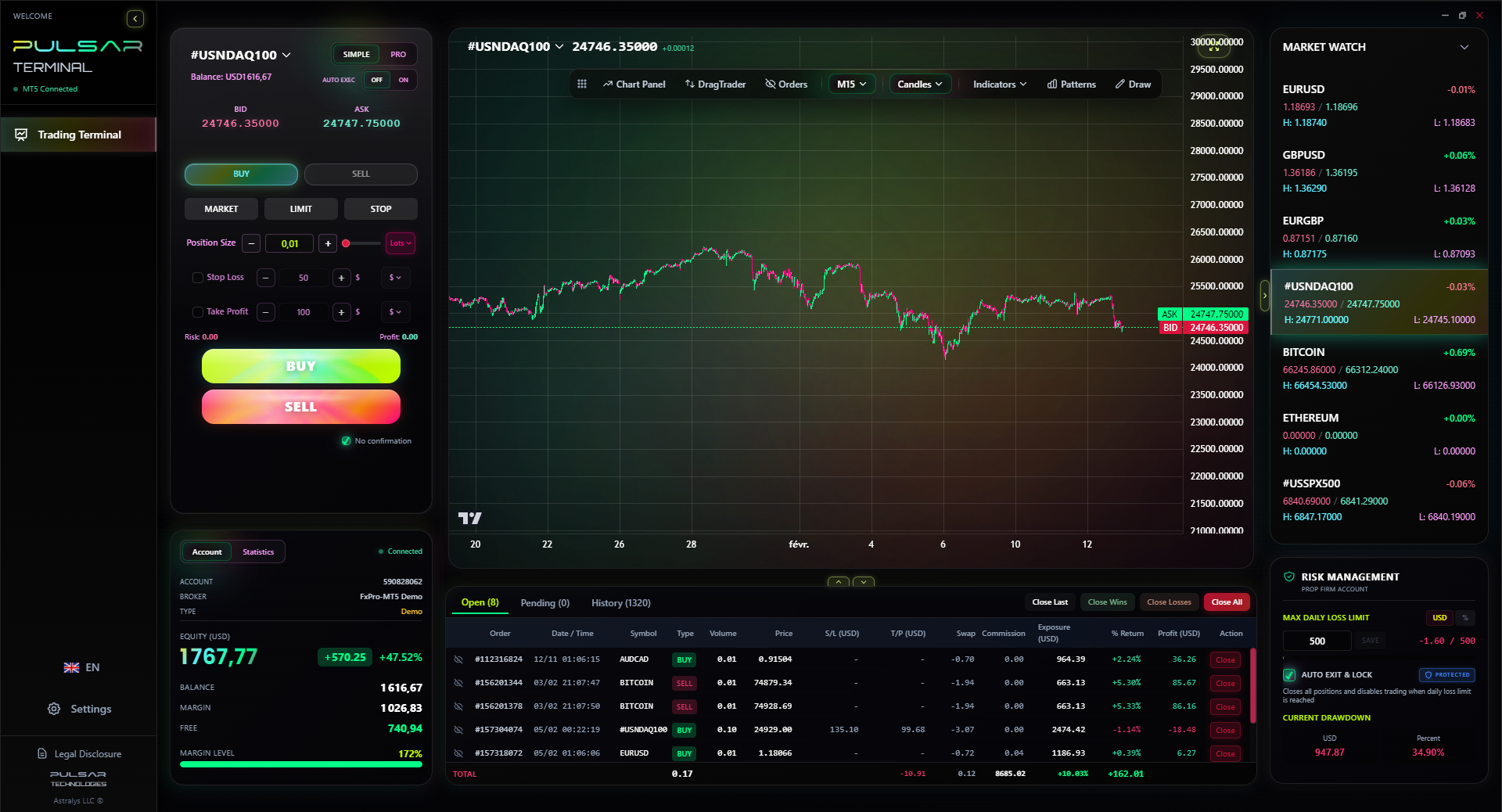
Managing emotional risk is about automating decisions, and Pulsar Terminal's one-click order templates and auto-trailing stops do exactly that on your MT5 platform.
Pulsar Terminal
La herramienta MT5 todo-en-uno: órdenes drag-and-drop, multi-TP/SL, trailing stop, grid trading, Volume Profile y protección prop firm. Usado por más de 1.000 traders diariamente.
“use doesn't change your risk percentage. Your discipline does.”
Let's walk through a recent trade I took on GBP/USD, from start to finish, showing how each risk management layer worked.
The Setup: Price was bouncing off a key support level on the 4-hour chart, and the RSI indicator showed bullish divergence. My MACD indicator was also hinting at a turn.
Step 1: The Plan (BEFORE ENTRY)
- Account Balance: $10,000 (Let's use USD for simplicity)
- Max Risk: 1% = $100
- Entry: 1.2620
- Stop Loss: 1.2580 (40 pips risk). Placed below the recent swing low.
- Take Profit: 1.2700 (80 pips potential reward).
- Risk/Reward Ratio: 80/40 = 1:2. Good.
Step 2: Position Sizing
- Risk in $: $100
- Stop in Pips: 40
- Pip Value (for 1 lot on GBP/USD): ~$10
- Position Size = $100 / (40 pips * $10) = 0.25 lots.
I entered with 0.25 lots. My potential loss was capped at $100. My potential gain was $200.
Step 3: Trade Management
- Price moved in my favor to 1.2660 (+40 pips). I moved my stop loss to breakeven (1.2620). My risk was now zero.
- Price continued to 1.2680. I moved to a 20-pip trailing stop.
- Price hit 1.2705 and then reversed, triggering my trailing stop at 1.2685.
The Result:
- Entry: 1.2620 | Exit: 1.2685
- Profit: 65 pips * $10 per pip * 0.25 lots = $162.50
I didn't catch the full 80 pips, but the trailing stop locked in a great profit automatically. The system worked. The 1% risk rule, the R:R filter, the trailing stop. This is how to manage risk in forex trading in action. It's not glamorous. But it's sustainable.
FAQ
Q1Is 1% risk really enough to make money with a small account?
It's the only way to preserve a small account while you learn. Yes, growth is slow. A R10,000 account risking R100 per trade needs ten consecutive 1:2 wins to grow by 20%. The alternative - risking 5% - is far more likely to blow up the account before you ever learn consistency. Focus on perfecting the process, not the speed of growth.
Q2What's better: a wide stop with a large position or a tight stop with a small position?
Tight stops with small positions are usually a trap. You get stopped out by normal market noise. Your stop should be determined by the market structure, not your desired position size. If the logical stop is wide, you must reduce your lot size to keep your risk percentage low. A wide stop with a large position is a surefire way to a massive, account-threatening loss.
Q3How do I handle news events with my stop loss?
If you choose to trade around major news (like SARB rates or US NFP), you have two choices: 1) Use a wider stop that can absorb the initial volatility spike, again adjusting your position size down accordingly. Or 2) my preferred method - simply don't hold trades into high-impact news. Close them before the announcement. The unpredictable slippage can turn a 1% risk into a 5% loss in milliseconds.
Q4Can I use a guaranteed stop loss?
Some brokers like Pepperstone or XM offer them for a fee. They protect you from gap risk. For long-term swing trading over weekends, they can be worth the premium. For day trading, the cost usually eats into your profits too much. Understand the fee structure before using them.
Q5My broker offers high use like 500:1. Should I use it?
use is a tool, not a goal. High use lets you control a large position with little capital, which magnifies both profits AND losses. Using our 1% risk rule, high use simply allows you to trade proper lot sizes with a smaller account. The danger is when traders use high use to ignore the 1% rule. They risk 10%, 20%, or more of their account on one trade. That's not trading. It's gambling. use doesn't change your risk percentage. Your discipline does.
Q6How do I recover from a series of losses?
First, stick to your risk percentage. It will automatically reduce your position size as your account shrinks, protecting you. Second, take a break. A losing streak affects your judgment. Go back to demo trading or just watch the markets for a few days until the emotional sting fades. Analyze the losses: were they bad luck, or was your strategy failing? Don't try to recover the money. Try to recover your disciplined process.
Lección del Prof. Winston
Puntos clave:
- ✓Risk a fixed % of current balance, not starting balance.
- ✓Never move a stop loss away from price.
- ✓Minimum risk/reward ratio of 1:2 is non-negotiable.
- ✓Calculate position size before every single trade.
¿Te resultó útil este artículo?
Haz clic en una estrella
Análisis Trading Semanal
Análisis y estrategias semanales gratis. Sin spam.
Sobre el autor
David van der Merwe
Trader de Mercados Emergentes
Trader con sede en Johannesburgo con 11 años en divisas de mercados emergentes. Especialista en pares ZAR, trading regulado por la FSCA y análisis del mercado sudafricano.
Comentarios
Aviso de riesgo
El trading de instrumentos financieros conlleva un riesgo significativo y puede no ser adecuado para todos los inversores. El rendimiento pasado no garantiza resultados futuros. Este contenido tiene fines educativos únicamente y no debe considerarse asesoramiento de inversión. Siempre realice su propia investigación antes de operar.
También te puede interesar

Cara Trading Forex Sukses: 7 Prinsip dari Trader Profesional
Cara trading forex sukses dengan 7 prinsip trader pro: manajemen modal, disiplin, journal trading, backtest. Data nyata, bukan janji profit palsu.
Jam Trading Forex Terbaik untuk Trader Indonesia: Panduan Lengkap dengan Tabel Waktu
Panduan jam trading forex untuk trader Indonesia. Tabel 4 sesi dunia, jam emas 20:00-00:00, sesi mana yang harus dihindari. Data akurat + tips dari trader berpengalaman.
Top 5 Sàn Forex Uy Tín Nhất 2026: Review Jujur dari Trader Indonesia
Top 5 sàn forex uy tín 2026 untuk trader Indonesia. Review jujur: spread, deposit, withdraw, dukungan lokal. Exness, XM, IC Markets & lebih.
Obtener Pulsar Terminal
Todas estas calculadoras están integradas en Pulsar Terminal con datos en tiempo real de su cuenta MT5.
Obtener Pulsar Terminal