


I remember watching my screen in late 2024 as the Naira absolutely tanked against the dollar.

Olumide Adeyemi
Pionero del Trading en África Occidental ·  Nigeria
☕ 12 min de lectura
Lo que aprenderás:
I remember watching my screen in late 2024 as the Naira absolutely tanked against the dollar. My phone was buzzing non-stop with Instagram notifications from 'gurus' I followed, all screaming about the 'generational wealth opportunity' in USD/NGN pairs. One guy posted a screenshot of a $50,000 profit from a single trade, urging his followers to join his 'VIP signal group' for ₦50,000. I felt the FOMO, I really did. But something smelled off. That moment made me step back and really look at the whole environment of Instagram forex traders in Nigeria. What you see on the 'gram is rarely the full story, and today, I'm giving you the real one.
Let's be real, the appeal is obvious. With inflation eating into savings and the Naira's volatility, the idea of making money in a stable foreign currency like USD or EUR is incredibly attractive. Traditional investment avenues here can feel slow or out of reach for the average young Nigerian. Enter forex, marketed as the fast track.
Instagram became the perfect stage. It's visual, immediate, and thrives on aspiration. When you're scrolling and see a guy your age posing next to a fancy car, captioning it 'Forex funded this lifestyle,' it hits different than a dry financial textbook. The platform made trading look sexy, accessible, and, crucially, profitable from day one.
The regulatory vacuum here supercharged this. Unlike in the UK or EU, where retail forex is tightly controlled, Nigeria's framework is... let's call it developing. The SEC and CBN are more focused on the institutional market. This lack of specific rules for online retail trading means almost anyone can set up a page, call themselves a mentor, and start selling dreams with very little oversight. It created a wild west where genuine educators and outright scammers operate side-by-side.

Warning: Just because forex trading is legal in Nigeria doesn't mean every person offering to teach you or trade for you is operating legally. The onus is on you to check.
This environment is why you need to be extra careful. The promise of high use - I've seen brokers offer 1:2000 to Nigerian clients - is a double-edged sword. It can amplify gains in those slick screenshots, but it wipes out accounts just as fast. Most people don't show you those losses. Remember, brokers like Exness and HFM might offer those crazy leverages, but that doesn't mean you should use them all.

💡 Consejo de Winston
A screenshot of a trade is a snapshot of luck. A verified, multi-year track record is a report card of skill. Always ask for the report card.
“Instagram made trading look sexy, accessible, and, crucially, profitable from day one.”
Not all Instagram forex traders are bad. But you need to know how to sort the wheat from the chaff. They usually fall into a few categories.
The Signal Seller
This is the most common. They post charts with arrows pointing at entries, often with impressive win rates like '92% accurate!' They charge a monthly fee for access to these signals. Here's my experience: I paid ₦30,000 for a month of signals from a popular page in 2023. Out of 15 signals, 7 hit their take-profit, 5 hit stop-loss, and 3 just sat there doing nothing. The math? I was barely break-even after spreads and the subscription cost. The problem? Signals lack context. They don't teach you why to take the trade, what the market structure is, or how to manage it if it goes sideways. You're just a button-pusher.
The Mentor/Course Seller
These folks sell education. For a one-time fee (anywhere from ₦100,000 to over ₦1,000,000), you get video courses, PDFs, and maybe some group coaching. Some are legitimate educators who've put in the work. Many, however, are just repackaging free information from Babypips or YouTube. The red flag? When their entire sales pitch is about the lifestyle the course will get you, not the skills it will teach you.
The Prop Firm "Expert"
This is a huge trend now. They show payouts from prop firms like FTMO or The5%ers. It's compelling because it shows 'real' money. But beware of the ones who claim to have a 'secret strategy' to pass the challenges easily. I fell for this once. Bought a 'prop firm blueprint' for $200. The 'secret' was basically a conservative scalping strategy with a high win rate but very low risk-reward. It wasn't magic; it was just basic trading dressed up. Passing a challenge requires discipline more than a secret sauce. Tools that help manage the strict rules, like automatic daily loss protection, are more valuable than any guru's promises.
The Outright Scammer
This is the darkest corner. They operate fake investment schemes (Ponzi/pyramid), ask you to send money directly to them to trade on your behalf, or promote unregulated 'brokers' that simply disappear with deposits. If anyone asks for direct cash transfers to a personal account, run. Use a broker's official copy-trading feature instead, where your funds stay in your regulated account.

Pro Tip: A genuine trader will show you losses, not just wins. They'll talk about risk management, psychology, and the grind. If a page only shows luxury and perfect trades, it's marketing, not trading education.
“The regulatory vacuum here supercharged this. It created a wild west where genuine educators and outright scammers operate side-by-side.”
Let's talk numbers, the boring but essential ones that never make the highlight reel.
First, taxes. Yeah, it's not glamorous. In Nigeria, you're subject to a 10% Capital Gains Tax on your gross trading profits. It doesn't matter if your broker is in Seychelles or Cyprus; if you're a Nigerian resident, you're liable. You need to file with FIRS. I learned this the hard way after my first profitable year - had to scramble to sort my returns.
Now, the brutal stats. Globally, something like 70-80% of retail traders lose money. In high-use, hype-driven environments, that failure rate can creep even higher. Why? People treat it like gambling, not a business. They risk 10% of their account on a single trade because an Instagram trader said 'go big or go home.' That's a surefire way to get a margin call.
Your real costs as a trader:
| Cost | Typical Range | What it Means for You |
|---|---|---|
| Spread | 0.6 - 1.6 pips on EUR/USD | Your first hidden cost. On a Zero account, you might pay 0.0 pips + a commission. |
| Commission | $3 - $7 per lot | Charged on raw/ECN accounts. Affects your scalping strategy profitability. |
| Swap/Rollover | Varies by pair & broker | The cost of holding a position overnight. Can be positive or negative. |
| Payment Fees | 1-3% or fixed fee | Depositing/withdrawing in Naira can have charges, especially with cards. |
Let me give you a real example from my journal. I took a swing trading position on XAU/USD (gold). Entry at $1835, stop loss at $1828 (7 pip risk). My position size, calculated with a position size calculator, meant I was risking 1% of my account. The trade went my way and I took profit at $1850. The gross profit was 15 pips. But after the spread (0.8) and a small negative swap for holding 3 days, my net was closer to 13.5 pips. Those small costs add up massively over a year. No Instagram post mentions the swap fee.
“The regulatory vacuum here supercharged this. It created a wild west where genuine educators and outright scammers operate side-by-side.”
This is your most important line of defense. An Instagram trader might recommend a broker because they get a kickback (affiliate commission), not because it's the best for you.
Regulation is Key: Since local online retail forex regulation is light, you must look for strong international regulation. Top-tier regulators include the UK's FCA, Australia's ASIC, Cyprus's CySEC, and South Africa's FSCA. The CMA in Kenya is also a good regional one. If a broker is only regulated in offshore zones with minimal oversight, be cautious. Always verify the license number on the regulator's website.
Naira-Friendly Features: This is crucial for us. Look for:
- NGN Accounts: Brokers like Exness and HFM offer them. This lets you deposit, hold, and withdraw in Naira, avoiding bank conversion fees.
- Local Payment Methods: Can you fund with your bank transfer, Verve card, or e-wallets like Opay? Check the broker's deposit page. The ease of getting money in and out is a big deal here.
- Local Support: Does the broker have a Nigerian phone number or WhatsApp support? It makes a world of difference when you have an issue.
Platform & Tools: Most of us use MT4 or MT5. They're reliable. But think about the tools you'll need. If you're following a strategy that uses the MACD indicator or RSI indicator, make sure the platform supports it well. Some advanced traders need more, like Volume Profile or advanced order types. That's where companion apps come in, adding power to your basic MT5.
My Broker Journey: I started with a flashy broker promoted by an Instagram guy. Spreads were wide (2+ pips on EUR/USD) and withdrawals took weeks. I switched to a well-regulated broker with tighter spreads (now I use one with averages under 1 pip on majors), and it was like a weight lifted. Do your own research. Read our deep XM review and Pepperstone review to see how they stack up for Nigerian traders specifically.
💡 Consejo de Winston
The most expensive lesson in trading is learning risk management after you've already lost your capital. Define your risk per trade before you define your profit target.
“Psychology is 80% of the game. Instagram sells excitement. Real trading is about patience, discipline, and handling boredom.”
Relying on Instagram forex traders for signals makes you dependent forever. Building your own competency is the only path to real, lasting success. It's a slower burn, but it's yours.
Start with the absolute, non-negotiable basics. You must understand what a pip definition is, how use works, and what the spread definition means for your entries and exits. Babypips' free 'School of Pipsology' is still the best starting point, period.
Then, paper trade. Don't put real money in until you can consistently be profitable on a demo account for at least 3 months. I paper traded for 6 months before going live, and I still blew my first small live account. It's humbling, but it taught me more than any course.
Develop a simple, rules-based strategy. It could be based on price action, or a couple of indicators like the RSI indicator for overbought/oversold levels. Test it. Refine it. Your strategy must include crystal-clear risk management: never risk more than 1-2% of your account per trade, and always know your exit points before you enter.
Psychology is 80% of the game. Instagram sells excitement. Real trading is about patience, discipline, and handling boredom. You'll sit for hours waiting for your setup. You'll have losing streaks. No one posts that. Keeping a detailed trading journal - recording not just trades, but your emotions - is the single best tool for improvement.
Finally, diversify your learning. Don't just follow Nigerian Instagram traders. Read books by classic traders (Mark Douglas's Trading in the Zone is essential). Follow international analysts. The goal is to develop your own perspective, not parrot someone else's.

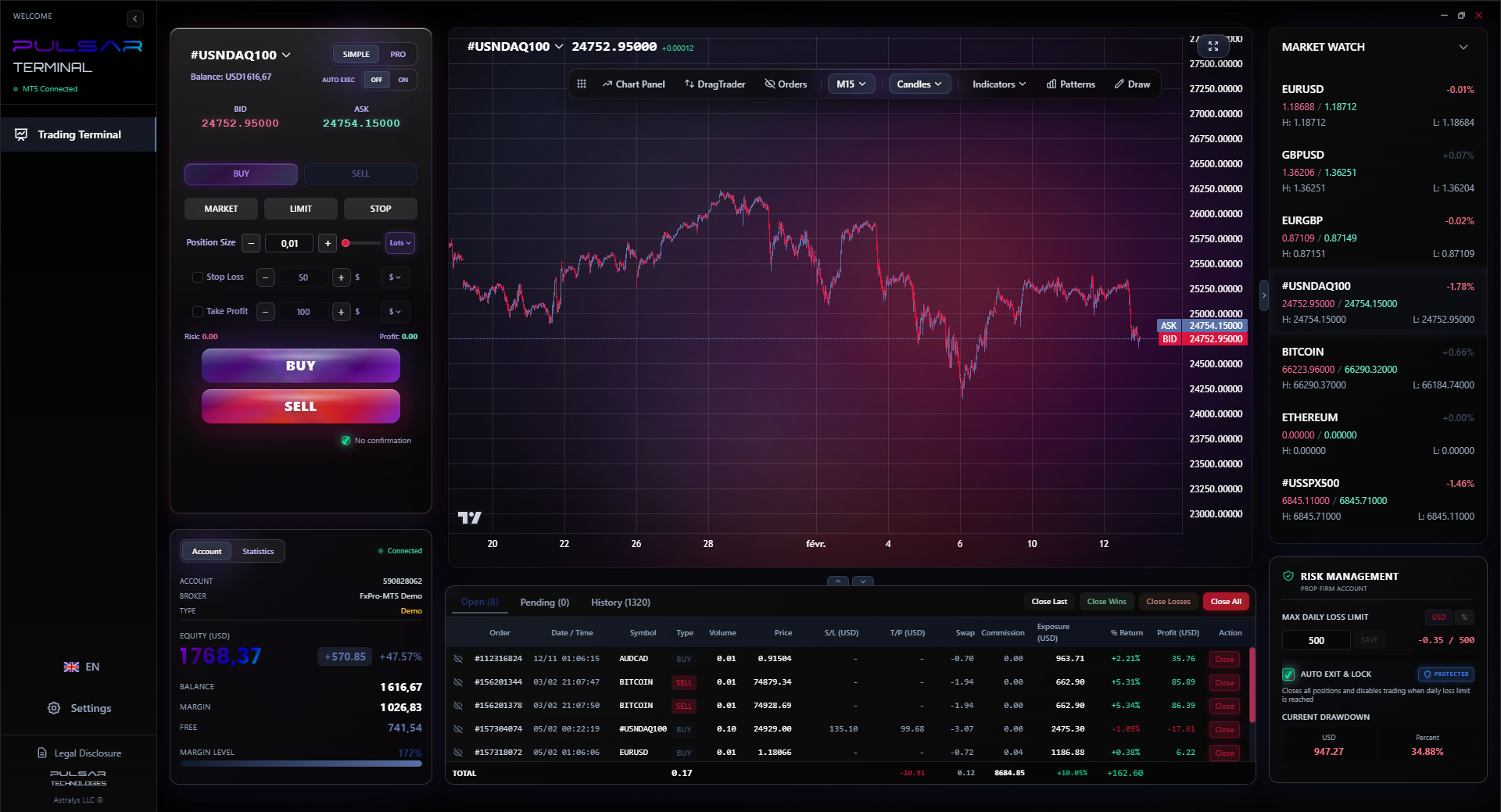
When you're building your own strategy and managing trades, having the right tools to execute complex orders and manage risk automatically is a game-saver.
Pulsar Terminal
La herramienta MT5 todo-en-uno: órdenes drag-and-drop, multi-TP/SL, trailing stop, grid trading, Volume Profile y protección prop firm. Usado por más de 1.000 traders diariamente.
“Psychology is 80% of the game. Instagram sells excitement. Real trading is about patience, discipline, and handling boredom.”
Your spidey-sense should tingle when you see these:
- Guaranteed Profits: 'Make 50% monthly guaranteed!' Trading has no guarantees. This is the hallmark of a scam.
- Pressure to Act NOW: 'Offer expires in 24 hours!' 'Only 10 slots left!' This is classic FOMO marketing, not education.
- Vague or No Track Record: If they can't show a verifiable, long-term history of results (like a Myfxbook link), they're likely just selling hype.
- Direct Money Requests: As stated, never send money to a personal account. Ever.
- Over-the-Top Lifestyle: If the content is 90% private jets and watches and 10% actual chart analysis, their business is selling a dream, not teaching trading.
Protect Yourself:
- Start Small: If you do buy a course or signals, start with the smallest offering. Don't jump into the 'VIP Platinum' package.
- Verify Withdrawal Proof: Anyone can fake a trade screenshot. Ask for proof of consistent withdrawals from their broker. A real trader will have this.
- Use Regulated Copy Trading: If you want to follow someone, use the copy-trading feature on a platform like eToro or within brokers like AvaTrade. Your capital stays in your regulated account, and you can stop copying anytime.
- Trust Your Gut: If it feels too good to be true, it almost certainly is. The market is difficult. Anyone making it look easy is lying.
Warning: The biggest red flag is anyone who downplays risk. If they don't spend as much time talking about protecting your capital as they do about making profits, walk away.
💡 Consejo de Winston
If you wouldn't take financial advice from someone based on their Instagram car pics, don't take trading advice from them for the same reason. Separate the signal from the noise.
“Your foundation must be built on education, disciplined practice, and rock-solid risk management.”
So, where does that leave you? Instagram can be a starting point for inspiration, but it cannot be your foundation. Your foundation must be built on education, disciplined practice, and rock-solid risk management.
Treat trading like a business from day one. That means keeping records for taxes, having a business plan (your trading plan), and managing your capital (your risk parameters). The 10% taxman doesn't care if you found the trade on Instagram.
Choose your tools wisely. Pick a reputable, well-regulated broker that suits your Nigerian needs. Learn your platform inside out. Whether you're trading EUR/USD or XAU/USD, understand the specifics of that instrument.
Connect with other serious traders, but do it in spaces focused on learning, not flexing. Some Telegram groups or forums can be valuable for sharing ideas and keeping each other accountable.
Finally, be patient with yourself. I lost money for two years before I found my groove. It's a skill, and skills take time to develop. Unfollow the accounts that make you feel inadequate or greedy. Follow the ones that teach, that show the process, and that respect the market's power. Your journey is unique. Build it on your terms, not on someone else's curated feed.
FAQ
Q1Is it illegal to follow Instagram forex traders in Nigeria?
No, it's not illegal to follow them. Forex trading itself is legal in Nigeria. The risk isn't legality; it's the quality and honesty of the advice. Many Instagram traders operate in an unregulated space for financial advice, so you have no protection if their guidance leads you to lose money. The responsibility for due diligence is entirely on you.
Q2What is the minimum amount I need to start forex trading in Nigeria?
You can start with very little. Many international brokers accept Nigerian clients with minimum deposits as low as $5 (roughly ₦7,500). However, starting with a very small amount often leads to overtrading and poor risk management just to see meaningful gains. A more realistic starter amount that allows for proper practice is between $100 - $500. Remember, the minimum isn't about what you can afford to lose, but what you need to trade properly.
Q3How do I know if an Instagram trader's profit screenshots are real?
It's very hard. Screenshots can be easily faked with editing software or demo accounts. Ask for a verified, live track record. A genuine trader might share a link to a third-party verification service like Myfxbook, which connects directly to their trading account and shows a real-time, uneditable history of all trades, including drawdowns and losses. If they only post static images, be highly skeptical.
Q4Can I get in trouble with FIRS for forex trading with an international broker?
Yes, you can. The Federal Inland Revenue Service (FIRS) requires you to declare and pay a 10% Capital Gains Tax on your gross trading profits, regardless of where your broker is based. It is your responsibility as a Nigerian tax resident to file an annual return. Not declaring this income could lead to penalties and back-tax demands if discovered.
Q5What's better: buying signals or learning to trade myself?
Learning to trade yourself is infinitely better in the long run. Buying signals makes you dependent, often expensive, and you never learn the 'why' behind a trade. When the signals eventually have a losing streak (and they all do), you'll have no framework to understand why or how to adjust. Investing in your own education, while slower, gives you control, adaptability, and a skill you own for life.
Q6Are there any legit Nigerian forex traders on Instagram to follow?
There are some who focus more on education than hype. Look for accounts that regularly discuss risk management, trading psychology, journaling, and show realistic trade analyses - including their losers. They often provide free educational content (live chart analysis, Q&As) and are transparent about their approach. Avoid those whose feed is purely motivational quotes and luxury photos.
Lección del Prof. Winston
Puntos clave:
- ✓Verify track records, not just screenshots.
- ✓Prioritize international broker regulation.
- ✓Risk a maximum of 1-2% per trade.
- ✓You owe FIRS 10% on gross profits.
- ✓Build your own strategy; dependency is failure.
¿Te resultó útil este artículo?
Haz clic en una estrella
Análisis Trading Semanal
Análisis y estrategias semanales gratis. Sin spam.
Sobre el autor
Olumide Adeyemi
Pionero del Trading en África Occidental
Uno de los educadores de trading forex más activos de Nigeria. 8 años de experiencia operando desde Lagos. Especialista en estrategias de bajo capital y desafíos de prop firms para traders africanos.
Comentarios
Aviso de riesgo
El trading de instrumentos financieros conlleva un riesgo significativo y puede no ser adecuado para todos los inversores. El rendimiento pasado no garantiza resultados futuros. Este contenido tiene fines educativos únicamente y no debe considerarse asesoramiento de inversión. Siempre realice su propia investigación antes de operar.
También te puede interesar

Cara Trading Forex Sukses: 7 Prinsip dari Trader Profesional
Cara trading forex sukses dengan 7 prinsip trader pro: manajemen modal, disiplin, journal trading, backtest. Data nyata, bukan janji profit palsu.
Jam Trading Forex Terbaik untuk Trader Indonesia: Panduan Lengkap dengan Tabel Waktu
Panduan jam trading forex untuk trader Indonesia. Tabel 4 sesi dunia, jam emas 20:00-00:00, sesi mana yang harus dihindari. Data akurat + tips dari trader berpengalaman.
Top 5 Sàn Forex Uy Tín Nhất 2026: Review Jujur dari Trader Indonesia
Top 5 sàn forex uy tín 2026 untuk trader Indonesia. Review jujur: spread, deposit, withdraw, dukungan lokal. Exness, XM, IC Markets & lebih.
Obtener Pulsar Terminal
Todas estas calculadoras están integradas en Pulsar Terminal con datos en tiempo real de su cuenta MT5.
Obtener Pulsar Terminal