


Let's cut through the noise right now.

David van der Merwe
Trader de Mercados Emergentes ·  South Africa
☕ 10 min de lectura
Lo que aprenderás:
- 1How SARS Sees Your Forex Trading: Income vs. Capital
- 2What You'll Pay (And What You Can Claim Back)
- 3Provisional Tax: The System That Catches Everyone
- 4Brokers, Regulation, and the ZAR Account Advantage
- 5Building an Audit-Proof Record-Keeping System
- 6Legal Tax Shelters: TFSA and Retirement Annuities
- 7Costly Mistakes I've Seen (And Made)
Let's cut through the noise right now. If you're trading forex from South Africa and you think you can hide your profits from SARS, you're setting yourself up for a world of financial pain. I've seen too many 'students' get burned by this fantasy. Forex trading is 100% taxable here, and the rules are clearer than you think. In this guide, I'll show you exactly how SARS views your trading, what you'll owe, and the smart moves you can make to keep more of your hard-earned money. Ignorance isn't a defense, it's just an expensive lesson waiting to happen.
This is the single most important concept you need to get straight. SARS doesn't care what you call it; they look at what you do. If you're actively trading, opening and closing positions frequently to profit from short-term price movements, SARS will almost certainly classify your profits as ordinary revenue. That means it gets added to your salary, rental income, and any other cash you make, and taxed at your full marginal rate. It's treated like a business.
Now, if you're buying a currency pair and holding it for years as a long-term investment (good luck with that volatility), you might argue it's a capital asset. In that rare case, only a portion (40%) of the gain is included in your taxable income and taxed at a maximum effective rate of 18%. But let's be real, most of us aren't doing that. We're in and out of trades. SARS knows it.
I learned this the hard way in my third year. I made about R220,000 in profits from scalping the EUR/USD. Come tax time, I tried to file it as a capital gain. My accountant just laughed. He said, 'Show me your trade history.' Hundreds of trades over the year. 'That's income, mate.' It pushed me into a higher tax bracket and the bill was a gut punch.

Warning: Don't assume you're a 'capital' trader. If you're reading a trading guide, you're almost definitely a revenue trader in SARS's eyes. Plan for the higher tax rate from day one.

💡 Consejo de Winston
Your first profitable trade isn't profit. It's a tax liability with a float. Set aside 35% of every win immediately into a separate 'SARS' account. The discipline to pay the taxman is as important as the discipline to take profits.
The Tax Rates That Will Bite You
Your forex profits get stacked on top of your other income. Here’s the 2024/2025 scale. Remember, these thresholds get adjusted a bit each year.
| Taxable Income (R) | Rate of Tax (R) |
|---|---|
| 1 – 237,100 | 18% of taxable income |
| 237,101 – 370,500 | 42,678 + 26% of amount above 237,100 |
| 370,501 – 512,800 | 77,362 + 31% of amount above 370,500 |
| 512,801 – 673,000 | 121,475 + 36% of amount above 512,800 |
| 673,001 – 857,900 | 179,147 + 39% of amount above 673,000 |
| 857,901 – 1,817,000 | 251,258 + 41% of amount above 857,900 |
| 1,817,001 and above | 644,489 + 45% of amount above 1,817,000 |
So, if you earn a salary of R500,000 and make an additional R150,000 from trading, your total taxable income is R650,000. That extra trading profit gets taxed at 36% and 39%. Ouch.
The Good News: Deductible Expenses
You can subtract legitimate business expenses from your gross trading profits. This is how you soften the blow. Keep receipts for everything.
- Platform & Data Fees: Broker commissions, subscription fees for trading tools or news services.
- Hardware & Software: A portion of your computer cost, monitors, trading software licenses.
- Education: Courses, books, seminars (if they directly relate to improving your trading).
- Home Office: A calculated portion of rent, electricity, and internet if you trade from home.
- Bank Charges: Fees for deposits and withdrawals.

Example: Gross Trading Profit: R200,000. Deductible Expenses: R15,000 (software, data, home office). Taxable Trading Income: R185,000. That R15k deduction just saved you between R2,700 and R6,750 in tax, depending on your bracket.
One more option: trading through a company. The corporate tax rate is a flat 27%. If you're a high-volume trader consistently in the top personal brackets (41% or 45%), incorporating could save you a bundle. But it comes with admin costs and complexity. Talk to a tax professional who understands trading.
“If you're trading forex from South Africa and think you can hide your profits from SARS, you're setting yourself up for a world of financial pain.”
Here’s where most new traders get completely blindsided. When you earn a salary, your employer withholds tax via PAYE. Trading profits? No one withholds anything for you. You are now a provisional taxpayer. This means you must estimate your total year's tax liability and pay it to SARS in advance, in instalments.
You have to make at least two payments a year:
- First Payment: By the end of August.
- Second Payment: By the end of February.
- Top-up Payment: If you still underpaid, by the end of September (after you've done your actual tax return).
If you don't do this, SARS slaps you with penalties and interest. It's not a maybe, it's a guarantee. I once forgot a second provisional payment on a smaller side account. The penalty wasn't huge, but the interest they charged felt like a personal insult. It's an avoidable mistake.
You need to be disciplined. Set aside a percentage of every single winning trade for tax. Open a separate savings account and call it 'SARS'. When those provisional payment dates roll around, the money must be there. A good rule of thumb is to set aside 30-40% of your net profits immediately. Use a position size calculator that factors in your risk, but your profit-taking strategy should also factor in the taxman's cut.
Your choice of broker matters for more than just spreads. For peace of mind and easier reconciliation with SARS, I strongly recommend using an FSCA-regulated broker or a reputable international one that welcomes South Africans. Your funds should be in segregated accounts. Check our reviews for brokers like Exness, IC Markets, or Pepperstone to see their specific offerings for ZA clients.
A massive local advantage is the ZAR-denominated account. Many top brokers offer this. Why does it matter? If you deposit and withdraw in Rands, you eliminate foreign exchange conversion fees and complexities on your bank statements. Your profit and loss is in Rands from the get-go. This makes your record-keeping for SARS infinitely simpler. You're not trying to figure out what the USD/ZAR rate was on the day you made a withdrawal three months ago.
Be aware of the FSCA's use cap of 30:1 for retail clients. Some offshore brokers might offer 500:1. That higher use is a double-edged sword - it can amplify losses just as fast as gains and can lead to a margin call if you're not careful. The 30:1 limit is there for a reason, and for most traders, it's more than enough.

Pro Tip: When you sign up, choose a ZAR account. Fund it via a local method like PayFast or Ozow if available. Your monthly statements will be in Rands, creating a perfect audit trail for SARS. It's one less headache.
💡 Consejo de Winston
A ZAR trading account isn't just convenient, it's a defensive accounting tool. It turns forex volatility into a simple Rand profit/loss statement, which is exactly what SARS wants to see. Simplify their job to simplify yours.
“Your first profitable trade isn't profit. It's a tax liability with a float.”
If SARS ever asks questions (and they might), you need to produce records. Not excuses, records. This isn't optional.
What you must keep, for at least 5 years:
- Monthly Broker Statements: These are your primary source of truth. Download and save them in PDF format every single month. Don't rely on the broker's website holding them forever.
- Trade History Logs: Your platform's detailed history of every entry, exit, spread paid, commission, and swap. Export this quarterly.
- Bank Statements: Showing all deposits to and withdrawals from your broker.
- Receipts for Expenses: For software, courses, hardware - scan them and file them digitally.
I use a simple but brutal system: a dedicated Google Drive folder for each tax year (2024, 2025, etc.). Inside, I have subfolders: 01_Broker_Statements, 02_Bank_Statements, 03_Expense_Receipts. Every month, as soon as the statement is available, it gets saved. Takes 5 minutes. This habit saved me hours of panic when my accountant needed to reconcile a discrepancy.
Consider using a simple spreadsheet to track your running total for the year: Gross Profit, Total Expenses, Net Taxable Income. Update it weekly. This gives you a real-time view of your estimated tax liability, so the provisional payments aren't a scary surprise. Good tools can help with analysis, but the filing is basic discipline. A tool like Pulsar Terminal can help you manage trades efficiently, but the record-keeping is on you.
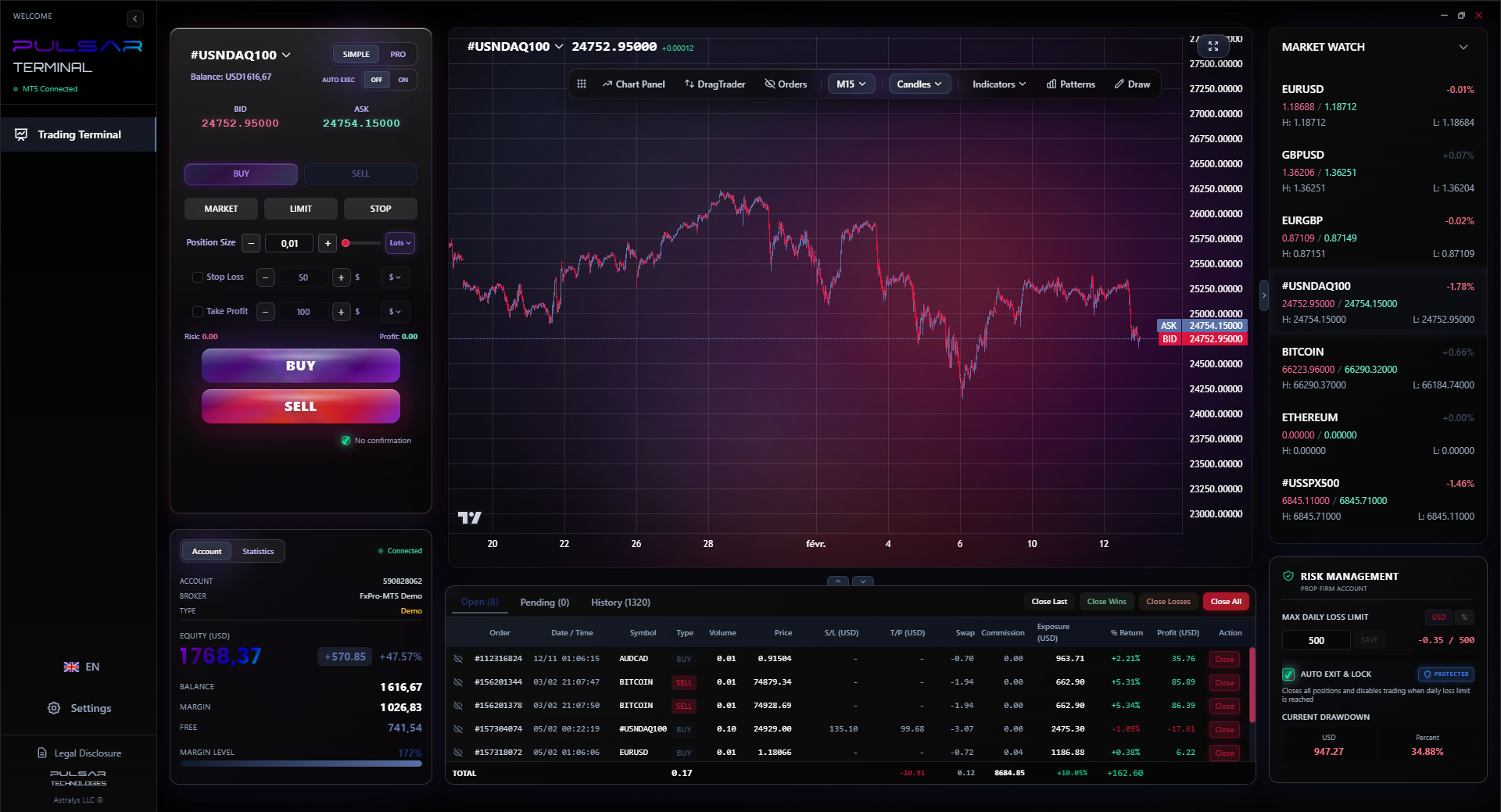
Managing dozens of trades for tax reporting is a nightmare; Pulsar Terminal's advanced trade management and detailed history logs on MT5 create the clean, auditable record SARS demands.
Pulsar Terminal
La herramienta MT5 todo-en-uno: órdenes drag-and-drop, multi-TP/SL, trailing stop, grid trading, Volume Profile y protección prop firm. Usado por más de 1.000 traders diariamente.
You can't avoid tax on your active trading profits, but you can be smart with the money you keep. South Africa offers two powerful, legal structures to shield investment growth from tax.
1. Tax-Free Savings Account (TFSA): This is a no-brainer. You contribute with after-tax money (money you've already paid tax on, like your net trading profits), but all growth and withdrawals are completely tax-free. The limits are key:
- Annual Contribution Limit: R36,000 (for the 2024/2025 year).
- Lifetime Contribution Limit: R500,000.
You can invest in ETFs, unit trusts, and certain shares through a TFSA. It's not for active forex trading, but it's a perfect place to park and grow your trading capital long-term, tax-free. Max this out every year if you can.
2. Retirement Annuity (RA): Contributions to an RA are deductible from your taxable income, up to 27.5% of your annual earnings or R350,000, whichever is lower. This is huge. If you have a big trading year, pumping money into your RA can lower your taxable income and save you a fortune in immediate tax. The money is locked until retirement, but it grows tax-free. It's a forced savings plan with a massive tax incentive.
Here’s my personal strategy: I use my trading profits to max out my TFSA contribution each February (after I know my annual numbers). Any surplus beyond that, I discuss with my financial advisor about putting into my RA to manage my tax bracket. It turns tax planning from a defensive chore into an offensive wealth-building strategy.
“The most expensive trading course you'll ever take is the one SARS gives you after an audit.”
Let me be the cautionary tale so you don't have to be.
Mistake 1: The 'Offshore Broker Loophole' Fantasy. Thinking that because your broker is in Cyprus or the Seychelles, SARS won't know. They will. When you withdraw profits to your South African bank account, that's a red flag for a paper trail. SARS has exchange control data. If you're audited and can't explain large deposits, you're in trouble.
Mistake 2: Ignoring Provisional Tax. This is the biggest one. You have a great year, spend all the profits, and then February comes. You owe SARS R80,000 and your account is empty. The penalties and interest will compound your misery. It feels unbelievably stupid when it happens (ask me how I know).
Mistake 3: Poor Record-Keeping. Scrambling through a year's worth of emails and browser history to find statements when SARS sends a letter. The stress is immense, and you will likely miss something, which could lead to them disallowing expenses or worse.
Mistake 4: Mixing Personal and Trading Money. Using the same bank account for groceries, rent, and trading deposits/withdrawals. It's an accounting nightmare. Open a separate, dedicated bank account solely for your trading business. Every Rand in and out should flow through there. It makes everything clean.
The bottom line? Trading is hard enough. Don't make it infinitely harder by being sloppy with the legal and tax side. Get a good accountant who gets trading, even if it costs a few grand. It's cheaper than a SARS audit.
💡 Consejo de Winston
The most expensive trading course you'll ever take is the one SARS gives you after an audit. Spend money on a good accountant now, not on penalties and interest later. It's a business expense. Claim it.
FAQ
Q1Do I pay tax on forex trading if I make a loss?
You still need to declare your trading activity to SARS, even if you have a net loss for the year. The loss can be carried forward to offset against future trading profits, which can reduce your tax bill down the line. But you must declare it to claim it.
Q2What is the tax-free threshold for forex trading in South Africa?
There is no specific 'tax-free' threshold for trading income. Your forex profits are added to your other income (like your salary). The first R95,750 of your total annual taxable income is effectively tax-free due to the primary rebate, but your trading profits themselves are fully taxable from the first Rand.
Q3Can I trade forex tax-free in a Tax-Free Savings Account (TFSA)?
No. You cannot conduct active, leveraged forex trading within a TFSA. TFSAs are for approved investments like ETFs, unit trusts, and shares. Your active forex trading account is separate and fully taxable.
Q4How does SARS know about my forex profits?
Primarily through bank statements. Large, regular deposits from a known forex broker are a clear indicator. SARS also has data-sharing agreements with many countries and can request information from foreign brokers. It's safer to assume they can find out.
Q5Is trading through an international broker a way to avoid South African tax?
Absolutely not. South Africa taxes its residents on their worldwide income. Where your broker is located is irrelevant. If you are tax-resident in South Africa, you must declare all your trading income, regardless of where it was generated or which broker held it.
Q6What's the difference between income tax and capital gains tax on forex?
Income tax applies to frequent trading profits and is taxed at your full marginal rate (up to 45%). Capital Gains Tax (CGT) might apply to very infrequent, long-term holdings; only 40% of the gain is taxed, at a max effective rate of 18%. SARS will likely challenge any active trader claiming CGT.
Q7When are the provisional tax deadlines for forex traders?
For individuals: First payment (estimated half of total tax) by end of August. Second payment (revised estimate) by end of February. A final top-up payment, if needed, by end of September. Mark these dates in your calendar.
Lección del Prof. Winston
Puntos clave:
- ✓Forex trading profits are taxable income, not capital gains, for active traders.
- ✓Use a ZAR-denominated account to simplify record-keeping for SARS.
- ✓You are a provisional taxpayer: pay SARS in August and February.
- ✓Keep detailed records of all trades, statements, and expenses for 5 years.
- ✓Maximize your TFSA (R36k/year) to grow wealth tax-free outside trading.
¿Te resultó útil este artículo?
Haz clic en una estrella
Análisis Trading Semanal
Análisis y estrategias semanales gratis. Sin spam.
Sobre el autor
David van der Merwe
Trader de Mercados Emergentes
Trader con sede en Johannesburgo con 11 años en divisas de mercados emergentes. Especialista en pares ZAR, trading regulado por la FSCA y análisis del mercado sudafricano.
Comentarios
Aviso de riesgo
El trading de instrumentos financieros conlleva un riesgo significativo y puede no ser adecuado para todos los inversores. El rendimiento pasado no garantiza resultados futuros. Este contenido tiene fines educativos únicamente y no debe considerarse asesoramiento de inversión. Siempre realice su propia investigación antes de operar.
También te puede interesar

Cara Trading Forex Sukses: 7 Prinsip dari Trader Profesional
Cara trading forex sukses dengan 7 prinsip trader pro: manajemen modal, disiplin, journal trading, backtest. Data nyata, bukan janji profit palsu.
Jam Trading Forex Terbaik untuk Trader Indonesia: Panduan Lengkap dengan Tabel Waktu
Panduan jam trading forex untuk trader Indonesia. Tabel 4 sesi dunia, jam emas 20:00-00:00, sesi mana yang harus dihindari. Data akurat + tips dari trader berpengalaman.
Top 5 Sàn Forex Uy Tín Nhất 2026: Review Jujur dari Trader Indonesia
Top 5 sàn forex uy tín 2026 untuk trader Indonesia. Review jujur: spread, deposit, withdraw, dukungan lokal. Exness, XM, IC Markets & lebih.
Obtener Pulsar Terminal
Todas estas calculadoras están integradas en Pulsar Terminal con datos en tiempo real de su cuenta MT5.
Obtener Pulsar Terminal