


Here's a number that might surprise you: in the 2023/24 tax year, over 500,000 people in the UK filed a self-assessment tax return that included capital gains.

Sarah Collins
Estratega de Trading ·  United Kingdom
☕ 12 min de lectura
Lo que aprenderás:
- 1The Short Answer: Spread Betting vs. CFDs
- 2HMRC's View: Are You an Investor or a Trader?
- 3Capital Gains Tax (CGT): The Numbers
- 4Spread Betting: The 'Tax-Free' Loophole
- 5Broker Costs, Fees, and What to Look For
- 6Practical Steps and Record-Keeping
- 7Common Mistakes and How to Avoid Them
- 8Final Thoughts and Your Next Move
Here's a number that might surprise you: in the 2023/24 tax year, over 500,000 people in the UK filed a self-assessment tax return that included capital gains. A good chunk of those were traders. So, let's cut through the noise. Is forex trading tax free in the UK? The short, frustrating answer is: it depends. Not on your luck, but on what you're trading and how HMRC sees you. I've been through the self-assessment wringer myself, and I'll tell you exactly how it works, what to watch for, and how to not get a nasty letter from the taxman.
Right, let's get the big one out of the way first. The only commonly available way to get tax-free forex trading profits in the UK is through spread betting. That's it. It's not a trick. Profits from financial spread betting are generally exempt from Capital Gains Tax (CGT) and Stamp Duty for UK residents. It's treated as gambling, which sounds bad but has this one massive perk.
Now, the catch (there's always a catch). If you trade Contracts for Difference (CFDs) or spot forex, you're in a different world. Those profits are not automatically tax-free. They're typically subject to Capital Gains Tax once you exceed your annual allowance. This is the first and most critical fork in the road.
Why does this matter? Well, the instrument you choose directly answers the question 'is forex trading tax free in UK' for you. I made the switch years ago. I was purely a CFD trader, loving the raw pricing on an ECN account with a broker like IC Markets. Then I did the maths on a £15,000 profitable year. At a 20% CGT rate, that was £3,000 going to HMRC. I started moving a portion of my trading to a spread betting account, and that tax bill vanished. It's a real, tangible difference.

Warning: The 'gambling' classification for spread betting means losses are not tax-deductible. You can't offset a bad spread bet against your CFD gains. With CFDs, you can carry losses forward to offset future gains. It's a trade-off: tax-free profits vs. no loss relief.
This is where it gets personal. HMRC doesn't have a checkbox for 'Forex Trader'. They fit you into existing boxes: are you a private investor or running a trading business? They use something called the 'badges of trade' to figure it out. Think of them as clues HMRC looks for.
If you look like a private investor, your forex/CFD profits are subject to Capital Gains Tax. This is most retail traders. You're doing it alongside your day job, not living off the profits. Your trades might be based on news, technical analysis from your MACD indicator, or a scalping strategy you run in the evenings.
If you look like a business, it's a whole different ball game. HMRC might decide you're a self-employed trader. This happens if trading is your main gig, you trade very frequently (think hundreds of trades a month), you have sophisticated systems, or you're advertising your services. In this case, your profits are taxed as Income Tax, not Capital Gains.
Why This Classification is a Big Deal
The tax rates are wildly different. Let's say you make £50,000 in a year from trading CFDs.
- As an Investor (CGT): After your £3,000 annual exempt amount (for 2024/25), you pay 20% on £47,000 = £9,400 in tax.
- As a Trader (Income Tax): That £50,000 is added to your other income. If it pushes you into the 40% band, you could be looking at £20,000 in tax, plus National Insurance contributions on top.

Example: I know a full-time trader who got reclassified. He was trading multiple times daily, had a dedicated office, and his only income was from the markets. HMRC deemed it a trade. His effective tax rate nearly doubled overnight. He wasn't breaking any rules, he just crossed an invisible line in HMRC's eyes.
The lesson? If you're going big, keep detailed records of your activity. And if profits start becoming your primary income, get professional tax advice before HMRC comes knocking.
“If HMRC decides you're a business, your profits are taxed as Income Tax, not Capital Gains. That can double your tax rate overnight.”
Alright, let's talk brass tacks. If you're a CFD/spot forex investor, this is your tax regime. You only pay CGT on your net gains above an annual allowance.
The Annual Exempt Amount (AEA): This is your tax-free slice.
- 2023/24: £6,000
- 2024/25: £3,000
- 2025/26: £3,000 (planned)
Yes, it's been cut in half. That means more traders will be paying tax sooner.
CGT Rates for Financial Assets (like forex/CFDs):
- Basic rate taxpayers: 10%
- Higher or additional rate taxpayers: 20%
Don't get confused with the 18% and 24% rates you might hear about; those are for residential property and carried interest. For our world, it's 10% and 20%.
How it works in practice: Let's say you're a higher-rate taxpayer. In the 2024/25 tax year, you make a net profit of £20,000 from CFD trading (after subtracting all your losses).
- Subtract your AEA: £20,000 - £3,000 = £17,000 taxable gain.
- Apply the 20% rate: £17,000 x 0.20 = £3,400 owed in CGT.
You report this on a self-assessment tax return. The key is 'net profit'. You must add up all your closed profitable trades and subtract all your closed losing trades across all your CFD accounts in the tax year. This is where a good trading journal or broker statements are worth their weight in gold. If you're not using a position size calculator, start now - it makes tracking your risk (and thus your potential tax liability) much cleaner.

Pro Tip: You can carry forward CFD losses indefinitely to offset future gains. Had a rough year? Those losses aren't wasted. They can shield your profits next year when you (hopefully) bounce back.

💡 Consejo de Winston
The £3,000 CGT allowance isn't a target. I've seen traders take stupid risks in December just to 'use it up'. Your goal is net profit, not tax optimisation on losses.
This is the golden ticket for UK residents, but you've got to understand the fine print. When you place a spread bet, you're not buying the asset. You're making a bet on whether its price will go up or down. Because it's a bet, it falls under gambling law, not investment law. Hence, no CGT.
The Good:
- No Capital Gains Tax on profits.
- No Stamp Duty.
- Available on thousands of markets: forex, indices, shares, commodities.
- Offered by all major FCA brokers like IG, CMC Markets, and Pepperstone.
The Not-So-Good:
- Losses are not tax-deductible. You can't use a losing spread bet to reduce your tax bill from other income.
- The 'spread' (the difference between buy and sell price) is often wider than on a raw CFD account. This is how the broker makes money instead of charging a commission.
- The psychological factor is real. Knowing losses can't be offset can make a drawdown feel worse.
My Experience: I use both. I'll swing trade longer-term ideas on major pairs like EUR/USD or XAU/USD via spread betting for the tax advantage. But for my high-frequency, tight scalping where every pip counts, I stick to a low-commission CFD account. The raw spread and commission structure often works out cheaper than the wider spread bet spread, even after accounting for tax.
One final, crucial point: HMRC can challenge the tax-free status if they believe your spread betting has crossed into a 'trading business'. If you're doing it full-time, with immense volume and sophistication, they might still come after you for Income Tax. It's rare, but it's their nuclear option.
“A 100% loss is still 100%, tax-free or not. Risk management always comes first.”
Tax is one cost. Your broker's fees are another, and they hit you every single day. Choosing the right broker in the UK isn't just about regulation (though that's non-negotiable - always use an FCA broker like Exness UK, XM, or the others listed). It's about understanding the fee structure that matches your style.
For Spread Betting: You're looking at the spread. There's usually no commission. A typical EUR/USD spread bet might have a spread of 0.8 to 1.2 pips. Compare that to the underlying market spread of maybe 0.1 pips. That difference is your cost.
For CFD/Spot Forex: You have two main account types:
- Standard Account: Wider spread, no commission. Good for beginners or smaller accounts.
- Raw/ECN Account: Tighter spread (often from 0.0 pips), plus a commission per lot.
Let's compare with some real 2026 examples:
| Broker | Account Type | Avg. EUR/USD Spread | Commission | Best For... |
|---|---|---|---|---|
| Pepperstone | Razor (Raw) | 0.0 pips | $3.50 per lot, per side | Scalpers, high-volume traders |
| IC Markets | cTrader Raw | 0.0 pips | $3.00 per lot, per side | Traders who prefer cTrader platform |
| Vantage | Standard STP | 1.0 pips | $0 | New traders, casual investors |
| CMC Markets | Spread Bet | 0.7 pips | $0 | Traders prioritizing tax-free profits |
Other Hidden Fees:
- Swap/Overnight Funding: Interest paid or received for holding a position past 5pm NY time. Crucial for long-term holds.
- Inactivity Fees: Some brokers charge if you don't trade for 6-12 months.
- Guaranteed Stop-Loss Fees: You pay a premium for this protection.
Your trading style dictates the best account. A scalper making 20 trades a day will get murdered on a standard account's wide spreads. They need a raw account. A position trader holding for weeks might prefer the simplicity of a standard account or a spread bet.
Example: On a 10-lot EUR/USD trade, a 1-pip spread costs you $100. A 0.1-pip spread with a $7 round-turn commission costs you $10 + $7 = $17. The raw account saves $83 on that single trade entry and exit. It adds up fast.
💡 Consejo de Winston
If you're trading over £50k capital, the tax difference between spread betting and CFDs is material. Do the maths each year. It might justify running two broker accounts side-by-side.
You can't manage your tax if you don't know your numbers. When I started, my record-keeping was a mess of scribbled notes and screenshots. Don't be like old me. HMRC can ask for records going back 5-6 years.
What you MUST keep:
- All statements from every broker account (spread betting and CFD).
- A detailed trading journal. This should include date, instrument, direction, entry/exit price, position size, profit/loss, and the rationale for the trade.
- Records of all deposits and withdrawals to/from your trading accounts.
- Calculations of your net profit/loss for each tax year (April 6 to April 5).
Software can save you: Most brokers let you download annual tax statements or full trade history in CSV format. Use a spreadsheet (Excel, Google Sheets) to consolidate everything. There are also dedicated trading journal apps that can connect to some brokers via API and auto-import trades.
The Annual Ritual:
- After April 5, gather all your statements.
- Calculate your total net profit/loss for CFDs/spot forex.
- If your net gains exceed the £3,000 Annual Exempt Amount, you need to declare it via self-assessment.
- For spread betting, you don't need to declare the profits, but keep the records safe in case HMRC has questions.
This process forces you to review your year. It's painful but enlightening. You'll see exactly which strategies worked, which pairs were profitable, and where you got sloppy. It's the best post-mortem you can do.
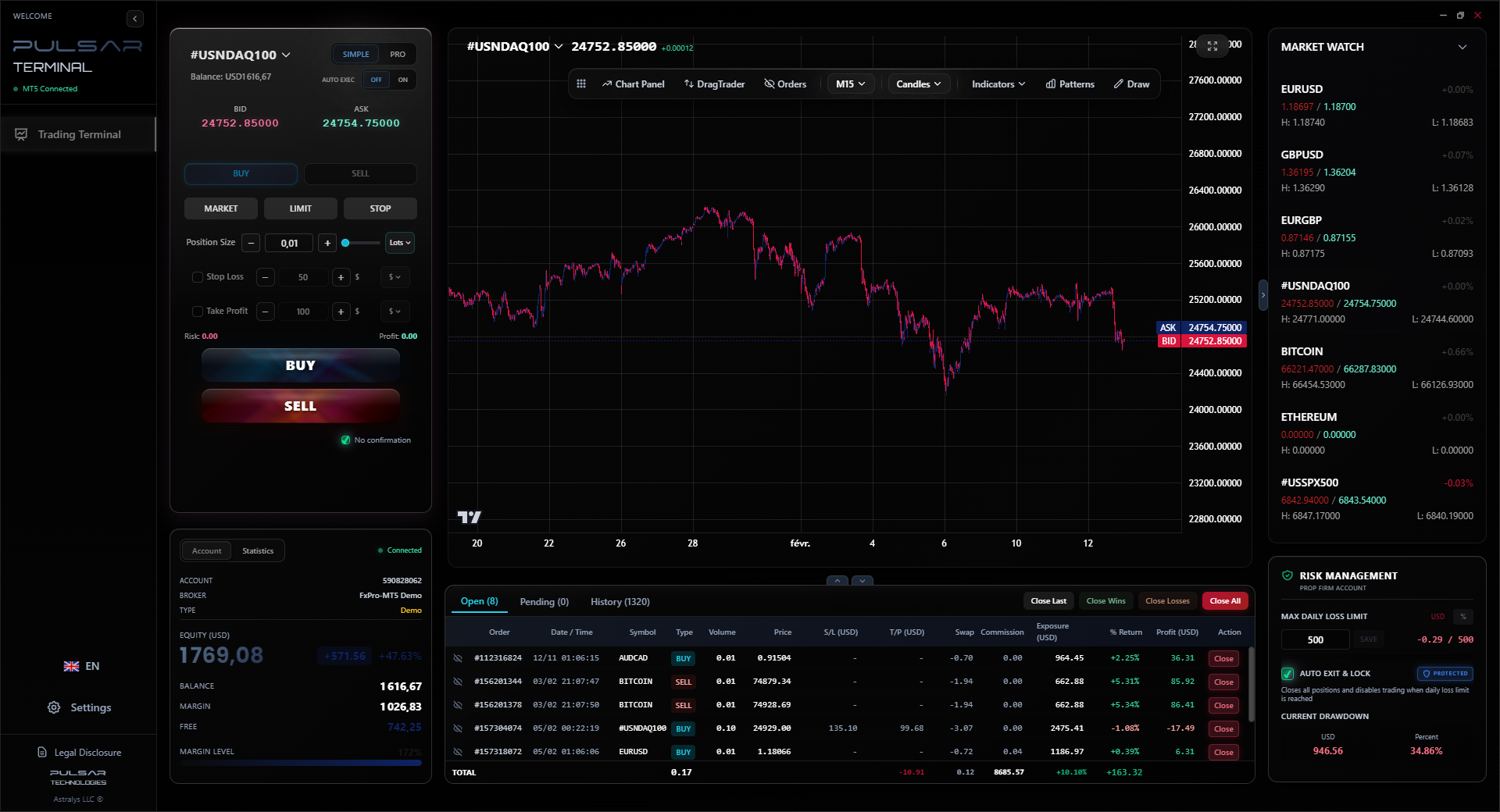
Keeping a precise trading journal for tax purposes is easier when your platform automatically logs every entry, exit, and adjustment, just like Pulsar Terminal does on MT5.
Pulsar Terminal
La herramienta MT5 todo-en-uno: órdenes drag-and-drop, multi-TP/SL, trailing stop, grid trading, Volume Profile y protección prop firm. Usado por más de 1.000 traders diariamente.
“The goal isn't to pay zero tax; it's to pay the correct amount legally, while keeping as much of your hard-earned profit as possible.”
I've made a few of these, and I've seen friends get tripped up. Learn from our errors.
1. Mixing Personal and Trading Money: Never fund your trading account from your main current account if you can help it. Open a dedicated bank account for trading transfers. It makes tracking deposits/withdrawals infinitely easier and looks more professional if HMRC ever enquires.
2. Ignoring Losses: 'If I don't look at it, it didn't happen.' Wrong. You must account for every closed loss. Those CFD losses are an asset - they reduce your future tax bill. I once forgot about a small account with a £2,000 loss. Remembering it the next year saved me £400 in tax.
3. Assuming Spread Betting is Always Better: It's not. If you have a losing year spread betting, you get no tax benefit. If you have a losing year with CFDs, you get a loss to carry forward. For inconsistent traders, CFDs can sometimes be the more pragmatic choice long-term.
4. Not Understanding the 'Badges of Trade': If you quit your job to trade full-time, scale up your volume massively, and start making consistent profits, you might inadvertently trigger a change in your HMRC status. There's no form to fill out; it's a grey area. If in doubt, consult a specialist accountant who deals with traders.
5. Over-Leveraging Because of Tax-Free Profits: This is a psychological trap with spread betting. Because the profits are tax-free, there's a temptation to size up recklessly. Remember, a 100% loss is still 100%, tax-free or not. Risk management always comes first. I've seen more people blow up accounts chasing tax efficiency than from any tax bill.
Warning: Never try to hide trading profits. HMRC's data-gathering powers are extensive. They get information from banks and brokers. The penalty for evasion is far worse than the tax bill.
💡 Consejo de Winston
Your trading journal is your first line of defence in a tax enquiry. A detailed log with rationale shows organisation and supports your 'investor' status if HMRC ever asks.
So, is forex trading tax free in the UK? For most people, the answer is a conditional 'yes, but only if you use spread betting'. For CFD traders, it's 'no, but you get a decent tax-free allowance and can offset losses.'
Your next steps are simple:
- Classify yourself. Are you a casual investor or a potential business? Be honest.
- Choose your instrument. Decide if spread betting or CFDs (or a mix) suit your strategy and tax situation.
- Pick the right broker account. Match the fee structure to your trading frequency.
- Start keeping impeccable records today. Not tomorrow, not next tax year. Today.
- Use a position size calculator for every trade. Know your risk in pounds and pence before you click.
Tax is a cost of doing business, but it's a manageable one. The goal isn't to pay zero tax; it's to pay the correct amount legally, while keeping as much of your hard-earned profit as possible. A well-planned approach to your trading instruments and record-keeping is just as important as your RSI indicator settings. Now go make some taxable (or tax-free) profits.
FAQ
Q1Do I have to pay tax on forex trading profits in the UK?
It depends. Profits from spread betting are generally tax-free. Profits from trading CFDs or spot forex are subject to Capital Gains Tax (CGT) if your total net gains in a tax year exceed the Annual Exempt Amount (£3,000 for 2024/25).
Q2What is the tax-free allowance for forex trading in the UK?
For CFD/forex trading treated as an investment, you have a Capital Gains Tax Annual Exempt Amount. This is £3,000 for the 2024/25 and 2025/26 tax years. You only pay CGT on gains above this amount. Spread betting profits are entirely tax-free, but there is no allowance for losses.
Q3Can HMRC find out about my forex trading?
Yes, absolutely. FCA-regulated brokers are required to report certain information. HMRC also has extensive data-sharing agreements and can request information directly from financial institutions. It is not worth the risk to hide trading income.
Q4Is it better to spread bet or trade CFDs for tax?
Spread betting is better for tax if you are consistently profitable, as profits are tax-free. However, CFD trading allows you to offset losses against future gains for tax purposes, which can be a major advantage if you have volatile performance. CFD accounts also often have lower trading costs (tighter spreads + commission), which may outweigh the tax benefit for high-frequency traders.
Q5Do I need to do a tax return for small forex profits?
You only need to file a self-assessment tax return for CFD/forex profits if your total net taxable gains (after subtracting losses) exceed the Annual Exempt Amount (£3,000). If you only trade spread bets, you do not need to declare the profits, regardless of size. However, you must always keep records.
Q6What happens if I make a loss trading forex?
For CFD/spot forex trading, you can carry the net capital loss forward indefinitely to offset against future capital gains. This reduces your future tax bill. For spread betting, losses are not tax-deductible and cannot be offset against other income or gains.
Q7Can I trade tax-free in an ISA or SIPP?
No. You cannot trade forex, CFDs, or spread bets within a Stocks and Shares ISA or a Self-Invested Personal Pension (SIPP). These accounts are for buying and holding shares, funds, and other approved investments, not for leveraged derivative trading.
Lección del Prof. Winston
Puntos clave:
- ✓Spread betting = tax-free profits, but no loss relief.
- ✓CFD trading = CGT after £3k allowance, losses are deductible.
- ✓HMRC classifies you as an 'investor' or a 'trader' (business).
- ✓Trader status means Income Tax (up to 45%) not CGT (20%).
- ✓Keep detailed records for 6 years. No excuses.
¿Te resultó útil este artículo?
Haz clic en una estrella
Análisis Trading Semanal
Análisis y estrategias semanales gratis. Sin spam.
Sobre el autor
Sarah Collins
Estratega de Trading
Estratega de trading con sede en Londres y 12 años en mercados financieros. Exanalista en una correduría de la City de Londres. Cubre pares GBP, mercados europeos y trading regulado por la FCA.
Comentarios
Aviso de riesgo
El trading de instrumentos financieros conlleva un riesgo significativo y puede no ser adecuado para todos los inversores. El rendimiento pasado no garantiza resultados futuros. Este contenido tiene fines educativos únicamente y no debe considerarse asesoramiento de inversión. Siempre realice su propia investigación antes de operar.
También te puede interesar

Cara Trading Forex Sukses: 7 Prinsip dari Trader Profesional
Cara trading forex sukses dengan 7 prinsip trader pro: manajemen modal, disiplin, journal trading, backtest. Data nyata, bukan janji profit palsu.
Jam Trading Forex Terbaik untuk Trader Indonesia: Panduan Lengkap dengan Tabel Waktu
Panduan jam trading forex untuk trader Indonesia. Tabel 4 sesi dunia, jam emas 20:00-00:00, sesi mana yang harus dihindari. Data akurat + tips dari trader berpengalaman.
Top 5 Sàn Forex Uy Tín Nhất 2026: Review Jujur dari Trader Indonesia
Top 5 sàn forex uy tín 2026 untuk trader Indonesia. Review jujur: spread, deposit, withdraw, dukungan lokal. Exness, XM, IC Markets & lebih.
Obtener Pulsar Terminal
Todas estas calculadoras están integradas en Pulsar Terminal con datos en tiempo real de su cuenta MT5.
Obtener Pulsar Terminal