


I remember staring at my screen in late 2021, watching the USD/ZAR spike to R16.45.

David van der Merwe
Trader de Mercados Emergentes ·  South Africa
☕ 13 min de lectura
Lo que aprenderás:
- 1What 'JSE Forex Trading' Really Means (And What It Doesn't)
- 2The Rules of the Game: FSCA, SARB, and Your Money
- 3The Real Costs of Trading in South Africa
- 4Choosing a Broker and Getting Your Money In & Out
- 5Trading the ZAR Pairs: A Local's Edge
- 6Building a Simple, Realistic Trading Plan
- 7Common Pitfalls (And How I Fell Into Them)
- 8Your Next Steps: From Reading to Trading
I remember staring at my screen in late 2021, watching the USD/ZAR spike to R16.45. My phone was buzzing with messages from other traders, everyone trying to figure out if this was the big move. I had a small short position, and for a moment, it looked like a genius play. Then the SARB made a comment, the market reversed hard, and I got stopped out for a R2,300 loss. That trade taught me more about trading the Rand in our market than any book ever could. Let's talk about what JSE forex trading really means for you, sitting right here in SA.
First things first, let's clear up a common confusion. When people say 'JSE forex trading,' they're often talking about two different things. The JSE itself, the Johannesburg Stock Exchange, doesn't offer the spot forex trading you're probably thinking of. You can't log into a platform and buy euros with rands directly on the JSE like you would with a broker.
What the JSE does offer are currency derivatives. Think of them as formal contracts to buy or sell a currency at a set price on a future date. They're used a lot by big companies (like mining firms) to hedge their international earnings, and by serious speculators. It's a more institutional market.
The 'JSE forex trading' you hear about from mates is almost always retail spot forex trading through an FSCA-regulated broker, many of which are based right here. These brokers give you access to the global interbank market. So, you're trading the live price of the USD/ZAR, EUR/ZAR, or GBP/ZAR, but you're doing it through a broker's platform, not directly on the JSE's systems.

Warning: Be very careful with brokers claiming to be 'JSE-licensed' for spot forex. The JSE licenses derivatives traders. For spot forex, you want an FSCA license number you can verify on the FSCA's website. It's your first line of defence.
Why does this matter? Because the rules, costs, and mechanics are different. Retail forex through a broker is where you'll find use, tight spreads, and the ability to start with a few hundred rand. That's likely where you'll begin your journey, just like I did.

💡 Consejo de Winston
The Rand is a moody beast, driven by gold, politics, and global fear. Trade it on the 4-hour chart or higher to avoid its noisy tantrums.
Trading forex here is completely legal, but it's not the wild west. We have a solid regulatory framework, and ignoring it is a sure way to get burned.
The main player is the Financial Sector Conduct Authority (FSCA). They're the ones who license and oversee the brokers. Always, and I mean always, check your broker's FSCA license number. I learned this the hard way early on with a 'broker' that vanished with a R5,000 deposit. Poof, gone. Now, I only trade with firms like AvaTrade or XM that have clear local regulation.
Then there's the South African Reserve Bank (SARB). They control the flow of money in and out of the country. This affects you directly when you fund your account. Your local bank is an 'Authorised Dealer' for SARB. If you try to send R2 million to an offshore broker without the proper tax clearance, they'll block it. For most starters, the Single Discretionary Allowance (R1 million per year) is more than enough, but be aware of the rules.
Taxes on Trading Profits
This isn't a hobby for SARS. Profits from trading are considered income from a business (if you trade regularly) or capital gains. You need to keep careful records of every trade - entry, exit, profit/loss. I use a simple spreadsheet. When you withdraw profits, that's not the end of it. You must declare it on your annual tax return. Talk to an accountant who understands trading; it's worth the fee.
use rules have also tightened. For retail traders, many FSCA brokers now cap use at 1:30 for major pairs. It might feel low, but it's there to protect you from wiping out your account in two bad trades. You can apply for 'professional' status for higher use, but that comes with its own set of requirements and risks.
“I blew up my first R8,000 account in 2009 by using maximum use. It's a rite of passage you can avoid.”
Let's talk numbers. This is where many new traders get a nasty surprise. The cost isn't just the spread; it's a combination of fees that eats into your profits.
Spreads: This is the difference between the buy and sell price. On the USD/ZAR, a good spread might be around 50-80 pips during active London or New York sessions. On the EUR/USD, top brokers offer averages from 0.2 to 0.9 pips. A broker like IC Markets or Pepperstone might offer raw spreads from 0.0 pips, but then you pay a commission.
Commissions: Often charged on 'raw' or ECN accounts. It's usually a fee per lot traded. For example, $3.50 per side for a 100k lot. So, opening and closing a trade costs you $7. That's about R130 at current rates. You need to win just to cover that.
Overnight Financing (Swap): If you hold a trade past 10 PM SA time (when the trading day rolls over), you pay or receive interest. This is crucial for a swing trading strategy. Going long on a high-interest currency (like the ZAR sometimes) against a low-interest one (like the JPY) might earn you a small daily credit. The opposite costs you money. These rates change, so check your broker's schedule.
Payment Fees: Funding your account isn't always free. Some brokers absorb EFT costs, but card deposits might have a 1-2% fee. Withdrawals can sometimes incur a bank fee. Always check the small print.

Example: Let's say you trade 2 standard lots of EUR/USD on a commission-based account.
- Spread: 0.2 pips = $2 (0.2 * $10 per pip * 2 lots)
- Commission: $7 per round turn * 2 = $14
- Total cost to enter and exit: $16 or roughly R300. You need the market to move over 1.6 pips in your favour just to break even on costs alone. This is why a position size calculator is non-negotiable.
Picking your broker is your most important first decision. Don't just go for the one with the flashiest ads on social media.
Local vs. International: A broker with a strong local presence (FSCA license, ZAR accounts, local support) makes life easier. Depositing in rands avoids foreign exchange fees from your bank. Brokers like XM and AvaTrade offer this. International giants like IG are also solid, but you might fund in USD or EUR.
The Platform: MetaTrader 4 (MT4) is king here. MT5 is gaining ground. Make sure your broker offers it. The platform is your cockpit; you need to be comfortable with it. I've used MT4 for a decade and still find new tricks.
Funding Methods:
- EFT (Electronic Funds Transfer): The most common way. Direct from your SA bank account to the broker's local (or international) bank account. Usually takes 1-3 business days.
- Credit/Debit Card: Instant, but sometimes has lower limits and fees.
- Digital Wallets: Skrill, Neteller, and PayPal (through FNB) are popular. Faster than EFT, but check both your bank's and the broker's fees.
Withdrawals: This is the true test of a broker. A good broker processes withdrawals back to your original funding method within 24 hours. If they make it difficult, see it as a red flag. I once waited 3 weeks for a withdrawal from a dodgy outfit. Never again.
use and Account Types: Start with a demo, then a cent account or a micro account if available. Don't jump straight into a standard account with 1:500 use. Most brokers offer a few account types - a standard with wider spreads but no commission, and a raw/ECN with tight spreads plus commission. Choose based on your trading style. A scalping strategy needs the raw account. A longer-term trader might prefer the standard.
💡 Consejo de Winston
Your first goal isn't to make a million. It's to survive six months without blowing up your account. That's a win.
“The cost to enter and exit a trade isn't just the spread; it's the silent killer of many trading accounts.”
This is where you, as a South African, have a potential advantage. You live the news that moves the Rand.
The major pairs are USD/ZAR (Dollar-Rand), EUR/ZAR (Euro-Rand), and GBP/ZAR (Pound-Rand). The USD/ZAR is the most liquid and traded.
What Moves the Rand?
- Commodity Prices: We're a resource economy. Strong gold, platinum, and coal prices often strengthen the ZAR. I watch the XAU/USD (gold) chart almost as closely as the USD/ZAR.
- SA Political & Economic News: ANC policy announcements, budget speeches, SOE drama (Eskom, Transnet), and credit rating reviews. These cause volatility. The day a major rating agency hinted at a downgrade, the USD/ZAR jumped 80 pips in an hour.
- Global Risk Sentiment: When global markets are scared (like during a banking crisis), investors flee emerging market currencies like the Rand. It's called a 'risk-off' move.
- US Dollar Strength: The USD/ZAR is often a function of dollar weakness or strength globally. You have to watch the EUR/USD as a guide.
My Experience: In 2023, I caught a nice swing on the GBP/ZAR. The UK inflation data came out hotter than expected, boosting the Pound. At the same time, SA had some positive mining output numbers. I went long at R23.10 and rode it to R23.85 over a week, banking about R750 per lot. The key was combining global news (UK data) with local resilience (SA data).

Pro Tip: The ZAR pairs are volatile. They can move 200-300 pips in a day easily. Use wider stop-losses than you would on the EUR/USD. A 50-pip stop on USD/ZAR will get hit by normal market noise. I rarely use stops tighter than 100 pips on these pairs.
You wouldn't drive from Joburg to Cape Town without a map. Don't trade without a plan. Here's a basic framework you can adapt.
1. Your Strategy: Will you be a scalper, day trader, or swing trader? Start with one. I started trying to scalp and swing trade simultaneously and failed at both. Pick a time frame. For swing trading ZAR pairs, the 4-hour and daily charts are your friends.
2. Risk Management (The Most Important Part):
- Risk per Trade: Never risk more than 1-2% of your account on a single trade. If you have a R10,000 account, that's R100-R200 max risk.
- Stop-Loss: Always know where your stop is BEFORE you enter. Use the position size calculator to work out how many lots you can trade based on your stop distance.
- Take Profit: Have a target. A good starting ratio is to aim for at least 1.5 times what you're risking. Risk R100 to make R150.
3. Tools & Analysis:
- Keep it simple. I use price action (support/resistance) and two indicators: the RSI indicator to spot overbought/oversold conditions, and the MACD indicator for trend momentum. That's it. More indicators just create confusion.
- Draw your lines. Mark key highs and lows on your chart.
4. Journal Everything: Write down every trade. Why you took it, your emotion, the outcome. I review my journal every Sunday. It's painful but necessary. It showed me I was losing most trades on Monday mornings, so I now avoid trading the first few hours of the week.
Avoiding a Margin Call: This is when your broker closes your trades because your losses have eaten up your available funds. It's a disaster. The way to avoid it is simple: use sensible use and don't over-trade. If you have a R10k account, trading 5 lots of USD/ZAR is a ticket to a margin call. Start with 0.01 or 0.1 lots.
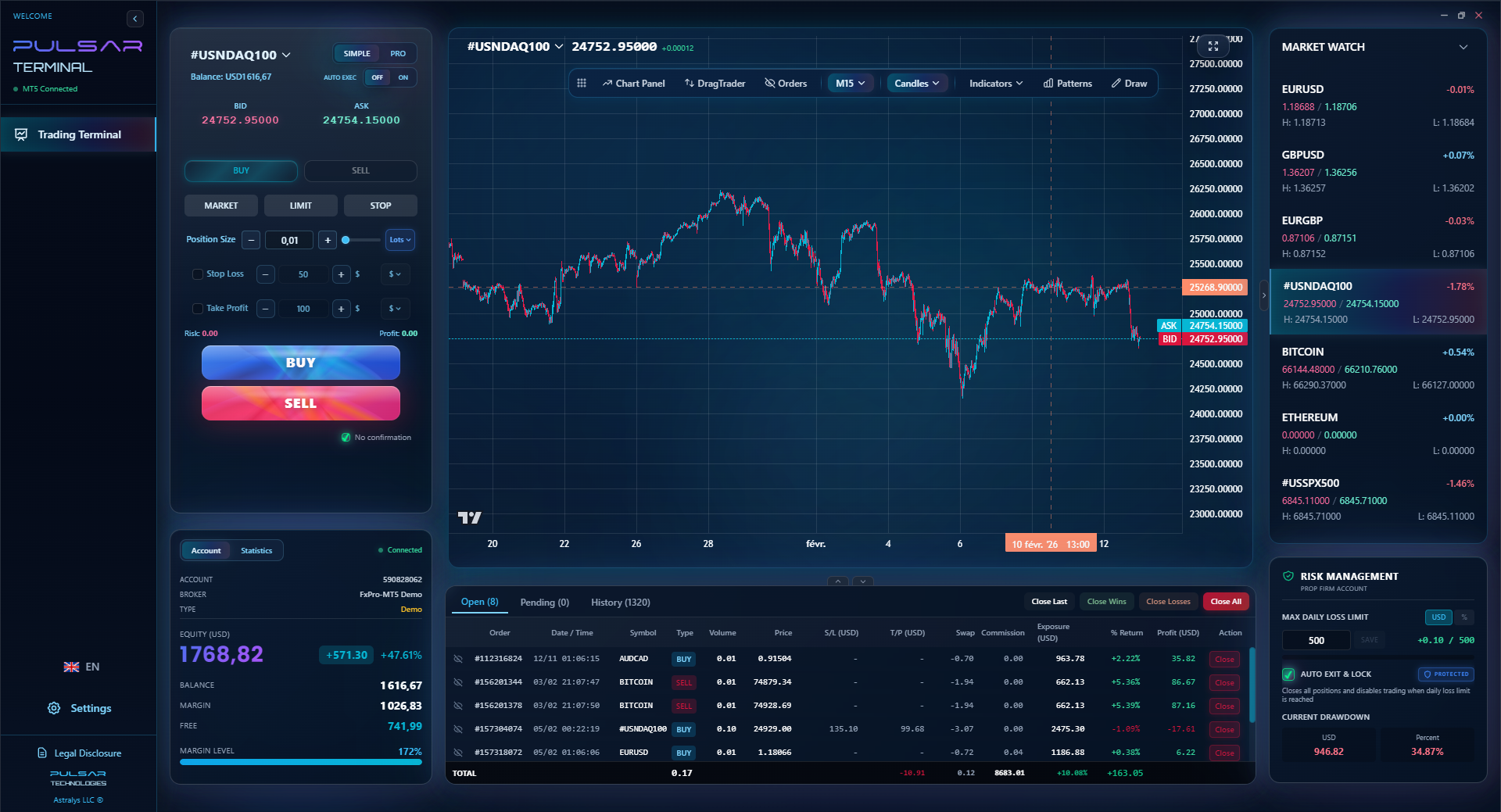
Managing multiple trades and setting precise stop-losses on volatile ZAR pairs is complex, but tools like Pulsar Terminal automate this directly on your MT5 platform.
Pulsar Terminal
La herramienta MT5 todo-en-uno: órdenes drag-and-drop, multi-TP/SL, trailing stop, grid trading, Volume Profile y protección prop firm. Usado por más de 1.000 traders diariamente.
“Your advantage as a South African trader is that you live the news that moves the Rand. Use that insight.”
Let me save you some money and heartache by sharing my classic mistakes.
Chasing the News: You see a headline: 'Rand Plummets!' and you jump in to sell. By the time you get in, the big move is over, and the market reverses (this is called 'buy the rumor, sell the news'). I've been caught in this whipsaw more times than I care to admit. Wait for the initial spike to settle, then look for a retracement to enter.
Over-leveraging: This is the killer. With R5,000 and 1:500 use, you control R2.5 million. A 0.2% move against you wipes out your entire account. It feels like you're making money fast, but you lose it faster. I blew up my first R8,000 account in 2009 this way. Stick to 1:10 or 1:20 while you're learning.
Revenge Trading: You have a bad loss. You're angry. You jump right back in with a bigger position to 'make it back.' This is emotional gambling, not trading. After a big loss, I now have a rule: I shut down the platform for the rest of the day. Go for a walk. The market will still be there tomorrow.
Ignoring the Spread: Trying to scalp with a broker that has a 5-pip spread on the EUR/ZAR is a losing game. Your trade starts 5 pips in the red. Know your costs. Choose your broker and account type accordingly.
Not Having a Life: Trading can consume you. I used to sit for 14 hours a day staring at screens. It's unhealthy and leads to bad decisions. Schedule your trading time. Have hobbies. The best trades often happen when you're not micromanaging them.
💡 Consejo de Winston
If you can't explain your trade in one sentence ('I'm buying USD/ZAR because price bounced off this support with a bullish RSI divergence'), you shouldn't be in it.
Alright, you've got the lay of the land. Here's a practical to-do list to get you started on the right foot.
- Education First: Don't deposit real money yet. Understand what a pip is, how use works, what a stop-loss is. The FSCA has some basic investor education material. Use it.
- Open a Demo Account: Pick two brokers from our list, like Exness and IC Markets. Open a demo account with each. Practice for at least two months. Treat the virtual money like it's real. This is where you test your plan without risk.
- Start a Trading Journal: From day one on the demo, journal. Use a notebook, a Google Doc, or specialised software.
- Make Your First Small Deposit: After two profitable demo months, fund a live account with the minimum amount. For many brokers, that's $5 or $100. Trade with 0.01 lots. Your goal in the first six months is not to get rich; it's to not lose money. It's to learn the feel of real trading with real emotion.
- Find a Community (Carefully): Join a local trading forum or Telegram group, but be sceptical. Avoid 'gurus' selling guaranteed signals. Look for groups that discuss analysis and psychology, not just bragging about profits.
Remember, this is a marathon, not a sprint. It took me three years of consistent study, demo trading, and small live losses before I had my first consistently profitable year. The market isn't going anywhere. Focus on learning the craft, managing your risk, and staying in the game. Good luck, and trade safely.
FAQ
Q1Is forex trading legal in South Africa?
Yes, it's completely legal. It's regulated by the Financial Sector Conduct Authority (FSCA). You must trade with an FSCA-regulated broker to ensure your funds are protected and you have legal recourse if something goes wrong.
Q2What is the minimum amount I need to start forex trading in SA?
You can start with very little. Some brokers like XM allow a minimum deposit of $5 (about R90). Others like Tickmill or AvaTrade require $100 (about R1800). However, just because you can start with R90 doesn't mean you should. You need enough capital to withstand normal market movements without over-leveraging. A more realistic starter amount is R2,000 - R5,000.
Q3Do I pay tax on my forex trading profits?
Yes. The South African Revenue Service (SARS) views consistent trading profits as income. You are required to declare these profits on your annual tax return. Keep detailed records of all your trades, deposits, and withdrawals. It's highly recommended to consult with a tax professional.
Q4What's the difference between trading on the JSE and with a forex broker?
The JSE offers currency futures and derivatives - formal contracts for future delivery, used heavily for hedging. Trading with a forex broker (like AvaTrade, IG, etc.) is spot forex trading: you're buying and selling the live currency pairs (like USD/ZAR) on the global market with immediate settlement, often using use. Most retail traders start with spot forex through a broker.
Q5Which currency pairs should a South African beginner trade?
Start with the major pairs that involve your home currency, as you'll understand the news flow. USD/ZAR is the most liquid. Also, consider trading the global majors like EUR/USD, which often have tighter spreads and more predictable patterns. Avoid exotic pairs until you have more experience.
Q6Can I use my South African bank card to fund a forex trading account?
Yes, most brokers accept Visa/Mastercard deposits from South African banks, and it's usually instant. You can also use EFT (Electronic Funds Transfer), which is very popular, or digital wallets like Skrill/Neteller. Be aware that your bank may charge a small fee for international transactions.
Q7What is a safe use level for a beginner?
Stick to very low use. Even if your broker offers 1:500, don't use it. A safe starting point is no more than 1:10 or 1:20. This means with R10,000, you control R100,000-R200,000 worth of currency. This gives the market room to move without immediately triggering a margin call on a small fluctuation.
Lección del Prof. Winston
Puntos clave:
- ✓Verify your broker's FSCA license. Always.
- ✓Risk a maximum of 1-2% of your capital per trade.
- ✓Start with use no higher than 1:20.
- ✓Journal every single trade, especially the losers.
- ✓Trade the USD/ZAR on the 4-hour chart, not the 1-minute.
¿Te resultó útil este artículo?
Haz clic en una estrella
Análisis Trading Semanal
Análisis y estrategias semanales gratis. Sin spam.
Sobre el autor
David van der Merwe
Trader de Mercados Emergentes
Trader con sede en Johannesburgo con 11 años en divisas de mercados emergentes. Especialista en pares ZAR, trading regulado por la FSCA y análisis del mercado sudafricano.
Comentarios
Aviso de riesgo
El trading de instrumentos financieros conlleva un riesgo significativo y puede no ser adecuado para todos los inversores. El rendimiento pasado no garantiza resultados futuros. Este contenido tiene fines educativos únicamente y no debe considerarse asesoramiento de inversión. Siempre realice su propia investigación antes de operar.
También te puede interesar

Cara Trading Forex Sukses: 7 Prinsip dari Trader Profesional
Cara trading forex sukses dengan 7 prinsip trader pro: manajemen modal, disiplin, journal trading, backtest. Data nyata, bukan janji profit palsu.
Jam Trading Forex Terbaik untuk Trader Indonesia: Panduan Lengkap dengan Tabel Waktu
Panduan jam trading forex untuk trader Indonesia. Tabel 4 sesi dunia, jam emas 20:00-00:00, sesi mana yang harus dihindari. Data akurat + tips dari trader berpengalaman.
Top 5 Sàn Forex Uy Tín Nhất 2026: Review Jujur dari Trader Indonesia
Top 5 sàn forex uy tín 2026 untuk trader Indonesia. Review jujur: spread, deposit, withdraw, dukungan lokal. Exness, XM, IC Markets & lebih.
Obtener Pulsar Terminal
Todas estas calculadoras están integradas en Pulsar Terminal con datos en tiempo real de su cuenta MT5.
Obtener Pulsar Terminal