


Let's cut the crap.

David van der Merwe
Trader de Mercados Emergentes ·  South Africa
☕ 9 min de lectura
Lo que aprenderás:
Let's cut the crap. Everyone talks about maximum use in forex like it's a magic wand for turning R500 into a Lamborghini. It's not. It's a chainsaw. Handled by a pro, it's a powerful tool. Handled by a rookie, it's a guaranteed trip to the bankruptcy court. I've seen both sides. In this guide, I'll show you exactly how the big boys use insane use to their advantage, why the FSCA limits it for a damn good reason, and the one calculation you must do before every single trade.
use is a loan from your broker. That's it. If you have 100:1 use, you're borrowing 99% of the trade's value. Think of it like buying a R5 million house with a R50,000 deposit. Sounds great until the market drops 2% and you've just lost R100,000 – double your entire initial capital. Your broker isn't being generous out of the kindness of their heart. They're offering you a loaded gun because they know most people will eventually shoot themselves in the foot with it, generating nice spreads and commissions for them along the way.
Here’s the math that matters: use magnifies everything. Profits, yes. But more importantly, losses. A 1% move against you with 100:1 use wipes out 100% of your margin. Game over. I learned this the hard way in 2015. I got cocky on a EUR/USD short with 200:1 use. Price spiked 50 pips on some ECB news. My R10,000 account took a R9,800 hit in about 90 seconds. I was left with dust and a very expensive lesson.

Warning: Never confuse high use with high skill. They are inversely related. The better you are, the less use you typically need to make serious money.

💡 Consejo de Winston
use is a multiplier for your IQ. If you're a genius, it makes you a billionaire. If you're a fool, it bankrupts you instantly. Know which one you are before you touch it.
Back in the wild west days, you could find brokers offering 2000:1 use to South African traders. It was a bloodbath. The Financial Sector Conduct Authority (FSCA) finally stepped in and set a maximum use limit for retail clients. As of now, it's aligned with European ESMA standards.
The Current use Limits
The caps aren't flat across all instruments. They're risk-based.
| Instrument Type | Maximum use for Retail Clients |
|---|---|
| Major Currency Pairs (e.g., EUR/USD) | 30:1 |
| Minor Pairs, Gold, Major Indices | 20:1 |
| Commodities (excluding Gold) & Minor Indices | 10:1 |
| Cryptocurrencies (where offered) | 2:1 |
This wasn't done to spoil your fun. It was a direct response to the staggering number of retail accounts being vaporized. The FSCA saw a systemic risk. A trader blowing up his R20,000 life savings might not crash the economy, but 10,000 traders doing it creates social and financial instability. These rules force you to put up more of your own skin in the game, which naturally makes you think twice.
The Professional Client Loophole
You can apply for 'Professional Client' status. This bypasses the use caps, letting you access 100:1, 200:1, or even 500:1 again. But to qualify, you need to meet two of these three criteria: 1) Have done large-volume trades (10+ per quarter), 2) Have a financial portfolio over R8.5 million, or 3) Work in the financial sector. It's not for beginners. If you're reading this guide to understand the basics, you are not ready for professional status. Stick to the retail limits and thank the FSCA later.
Some international brokers like Exness or IC Markets might still show higher use options to SA clients. Be careful. If they're not FSCA-licensed, you're operating in a regulatory grey area with zero protection if things go south.
“Maximum use isn't a reward for being a good trader; it's a test of your risk management.”
This is where the magic happens. Pros don't just crank use to the max and hope. They use it with surgical precision, usually in two specific scenarios.
1. The Micro-Position Scalp: This is my bread and butter. Let's say I have a R100,000 account. I identify a near-perfect setup on the 1-minute chart for EUR/USD. My system says risk 0.1% of my account, or R100. The stop loss is only 5 pips away. To risk only R100 on a 5-pip stop with a standard lot (where 1 pip = roughly R150), the math doesn't work. So, I use high use (effectively trading a smaller position size) to make the trade possible.
- Calculation: R100 risk / 5 pips = R20 per pip.
- Action: I enter a 0.13 lot position (which, with high use, requires minimal margin). My risk is now precisely R19.50 per pip (0.13 lots * ~R150 per pip per lot). My stop at 5 pips = R97.50 risk. Perfect.
I used a position size calculator to figure that out in seconds. The high use allowed me to tailor my position to my exact risk tolerance on a very tight stop. I closed that trade for +8 pips, a R156 gain. Small in rand value, but a 1.56% gain on my account in minutes. That's the power of controlled, high-use scalping.
2. The Margin Efficiency Play: A pro with a large account might use higher use not to increase risk, but to free up capital. If their system requires 10 open swing trades, using 30:1 instead of 10:1 means less margin is tied up per trade. This leaves more buying power available for other opportunities. It's about portfolio efficiency, not gambling.

Pro Tip: Your use setting should be the last thing you adjust. First, determine your entry, stop loss, and the rand amount you're willing to lose. Then, use a calculator to see what lot size that requires. The use needed to open that lot size is your answer.
Forget the use ratio on your platform. The only number that matters is your Effective use on the trade.
Effective use = (Total Position Value) / (Your Account Equity)
Example: You have a R10,000 account. You open 1 standard lot on EUR/USD (position value ~R1,850,000 with current rates).
Effective use = R1,850,000 / R10,000 = 185:1.
It doesn't matter if your account is set to 500:1 or 30:1. On this trade, you are effectively leveraged 185 times. That is astronomically high. A 0.54% move against you wipes out your entire account. This is why you get a margin call.
Contrast that with a professional approach. Same R10,000 account. They want to risk 1% (R100) on a trade with a 20-pip stop.
- They'd trade a 0.07 lot position (Position Value ~R129,500).
- Effective use = R129,500 / R10,000 = 13:1.
See the difference? 185:1 vs. 13:1. The second trader can weather a storm. The first trader is one gust of wind from capsizing. Always, always calculate your effective use post-trade. If it's over 10:1, you're likely gambling. Tools like Pulsar Terminal can show this in real-time, which is a game-saver.
💡 Consejo de Winston
The only 'maximum use' you should care about is the one that doesn't give you a stomach ache when you look at your open P&L. If you're sweating, it's too high.
“If your effective use is over 10:1, you're not trading. You're buying a lottery ticket with terrible odds.”
Not all use is created equal. An offshore broker offering 1000:1 usually has wider spreads and sneaky fees to compensate for the risk they are taking by lending you so much. A reputable, regulated broker like Pepperstone or XM offering 30:1 will likely have razor-sharp spreads because their client base is more sophisticated and they have lower default risk.
Here's the trap: You go for the 500:1 broker to 'maximize your potential'. But their spread on EUR/USD is 2 pips instead of 0.1. On a 1-lot trade, you're paying R300 just to enter and exit, instead of R15. That extra R285 is a massive, silent tax on your trading. Over 100 trades, you've paid R28,500 in extra spreads. That's an entire account blown on fees, not bad trades.
Higher use also often comes with higher margin call levels. A broker might liquidate your position the second you hit 50% margin, leaving you no chance for a recovery. A more conservative broker might have a 100% margin call policy. Read the fine print. The promise of maximum use in forex is the shiny lure. The spreads and execution are the hook.
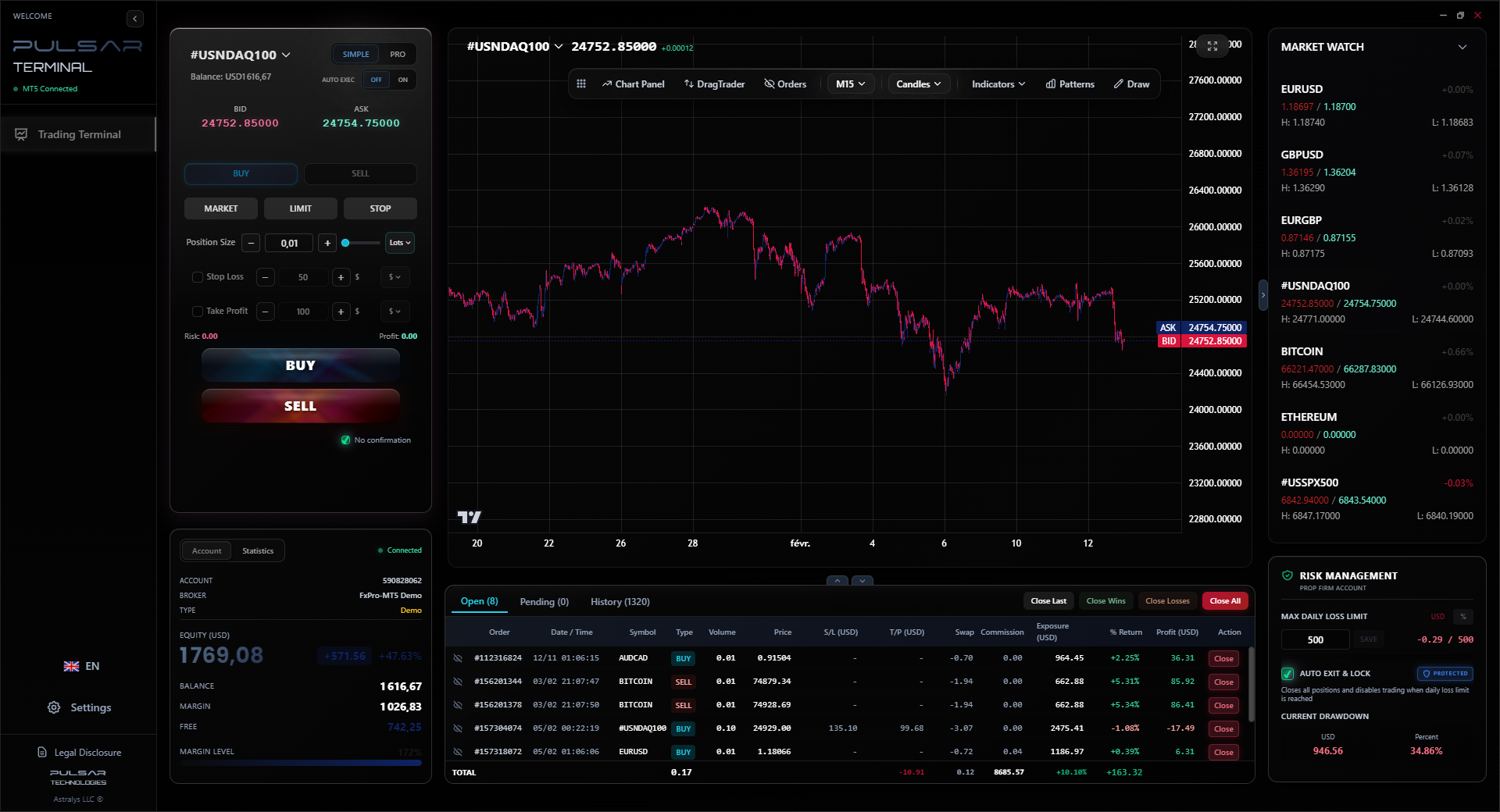
Manually calculating effective leverage for every trade is a chore. Pulsar Terminal displays it in real-time on your MT5 chart, so you always know exactly how much firepower you're playing with.
Pulsar Terminal
La herramienta MT5 todo-en-uno: órdenes drag-and-drop, multi-TP/SL, trailing stop, grid trading, Volume Profile y protección prop firm. Usado por más de 1.000 traders diariamente.
After blowing up and rebuilding, here's the simple framework I live by. It's boring. It works.
Step 1: Determine Core Account use. I keep my account use setting at the broker's maximum (e.g., 30:1 for FSCA brokers). This isn't for using, it's for having flexibility. I then mentally impose my own limits.
Step 2: The 5% Rule. No single trade can have an Effective use greater than 5:1. This is my iron law. For a R100,000 account, my total position value across all open trades should never exceed R500,000. This automatically limits my lot size.
Step 3: Strategy-Specific Adjustments.
- Scalping: I might allow effective use up to 10:1, but only because my stops are incredibly tight (3-10 pips). The rand risk is still capped at 0.5% of my account.
- Swing Trading: Effective use stays below 3:1. These trades have wider stops (50-200 pips), so the position size must be tiny to keep risk low.
- Trading XAU/USD (Gold): I'm even more conservative. Gold is volatile. I halve my usual position size, which halves my effective use on that instrument.
Step 4: The Daily Drawdown Cut-off. If my account is down 3% in a day, I stop trading. No exceptions. This prevents 'revenge trading' where you're tempted to double down with higher use to win back losses. That's the express train to ruin.
This framework turns use from a weapon of mass destruction into a calibrated tool. It forces discipline. It makes you focus on the quality of your setup, not the size of your potential payday.
“The FSCA's use caps aren't there to hold you back. They're there to hold your money in your account.”
-
Leveraging Up on a Losing Streak: This is suicide. Your judgment is impaired, your system might be broken, and you're emotional. Increasing use to 'get back to even' is like pouring petrol on a fire. I did this in 2017. After three losing trades, I quadrupled my position size on a fourth 'sure thing.' It wasn't. I wiped out a month's gains in one hour.
-
Ignoring Volatility Events: Trading with your usual use right before a major news event (like SARB interest rate decisions, US Non-Farm Payrolls) is Russian roulette. The spread can widen to 50 pips, and price can gap 100 pips in milliseconds. Your stop loss won't save you; you'll be filled at a catastrophic price. I learned to either close positions before high-impact news or reduce my use by 80% if I must trade.
-
Confusing Low Margin with Low Risk: Just because a broker only requires R500 margin to open a R100,000 position doesn't mean you're only risking R500. You're risking your entire account balance. This is the most seductive and dangerous illusion in trading. Use indicators like the RSI or MACD to confirm your bias, but never let them justify over-leveraging a weak setup.
FAQ
Q1What is the maximum legal use for forex in South Africa?
For retail clients, the FSCA caps it at 30:1 for major currency pairs like EUR/USD, 20:1 for minors and gold, 10:1 for other commodities, and just 2:1 for cryptocurrencies. These are the hard limits for any broker licensed here.
Q2Can I get more than 30:1 use as a South African trader?
Yes, but only if you qualify as a 'Professional Client' with an FSCA broker (requires meeting strict financial or experience criteria), or if you use an unregulated offshore broker. The first route is legitimate but risky; the second leaves you with zero legal protection.
Q3Is higher use better for beginner traders?
Absolutely not. It's the worst thing for them. Beginners need to learn how to trade and manage risk, not how to lose money faster. The FSCA's 30:1 limit is still too high for someone just starting out. I'd recommend practicing with effective use under 5:1.
Q4How does use affect my profit and loss?
It multiplies them based on the ratio. With 30:1 use, a 1% favorable price move gives you a 30% return on your margin. However, a 1% move against you results in a 30% loss of your margin. A 3.34% move against you wipes out 100% of your invested capital.
Q5What's more important, use or position size?
Position size, 100 times over. use is just a facility that allows you to open a position. Your focus must always be on calculating your position size based on your account risk (e.g., 1% of your balance) and your stop loss distance. The required use is a byproduct of that calculation.
Q6Do professional traders always use high use?
No, they use appropriate use. For most of their swing or position trades, they use relatively low effective use (2:1 to 5:1). They reserve higher use for very specific, high-probability, short-term setups where they can control risk with extremely tight stops.
Lección del Prof. Winston
Puntos clave:
- ✓Effective use > Account use. Calculate it.
- ✓Never risk more than 1-2% of capital per trade.
- ✓Use a position size calculator before every entry.
- ✓High use amplifies spreads & slippage costs.
- ✓If you need 100:1 to make money, your strategy is flawed.
¿Te resultó útil este artículo?
Haz clic en una estrella
Análisis Trading Semanal
Análisis y estrategias semanales gratis. Sin spam.
Sobre el autor
David van der Merwe
Trader de Mercados Emergentes
Trader con sede en Johannesburgo con 11 años en divisas de mercados emergentes. Especialista en pares ZAR, trading regulado por la FSCA y análisis del mercado sudafricano.
Comentarios
Aviso de riesgo
El trading de instrumentos financieros conlleva un riesgo significativo y puede no ser adecuado para todos los inversores. El rendimiento pasado no garantiza resultados futuros. Este contenido tiene fines educativos únicamente y no debe considerarse asesoramiento de inversión. Siempre realice su propia investigación antes de operar.
También te puede interesar

Cara Trading Forex Sukses: 7 Prinsip dari Trader Profesional
Cara trading forex sukses dengan 7 prinsip trader pro: manajemen modal, disiplin, journal trading, backtest. Data nyata, bukan janji profit palsu.
Jam Trading Forex Terbaik untuk Trader Indonesia: Panduan Lengkap dengan Tabel Waktu
Panduan jam trading forex untuk trader Indonesia. Tabel 4 sesi dunia, jam emas 20:00-00:00, sesi mana yang harus dihindari. Data akurat + tips dari trader berpengalaman.
Top 5 Sàn Forex Uy Tín Nhất 2026: Review Jujur dari Trader Indonesia
Top 5 sàn forex uy tín 2026 untuk trader Indonesia. Review jujur: spread, deposit, withdraw, dukungan lokal. Exness, XM, IC Markets & lebih.
Obtener Pulsar Terminal
Todas estas calculadoras están integradas en Pulsar Terminal con datos en tiempo real de su cuenta MT5.
Obtener Pulsar Terminal