


You hear it all the time: "The market is bullish on the dollar" or "Sentiment is turning bearish on the Naira." But what does that actually mean for your trades? If you're just starting out, these terms can feel like vague trader jargon.

Olumide Adeyemi
Pionero del Trading en África Occidental ·  Nigeria
☕ 8 min de lectura
Lo que aprenderás:

You hear it all the time: "The market is bullish on the dollar" or "Sentiment is turning bearish on the Naira." But what does that actually mean for your trades? If you're just starting out, these terms can feel like vague trader jargon. They're not. Understanding bullish and bearish sentiment is the difference between guessing and making an informed decision. It's about reading the market's mood, and more importantly, figuring out which way the crowd is likely to push price next. Let's break it down, no fluff, just what you need to know to spot opportunities and avoid getting run over.
At its core, it's simple. A bullish market is one that's going up. The buyers (bulls) are in control, pushing prices higher. Think of a bull attacking with its horns upward. A bearish market is going down. The sellers (bears) are dominant, forcing prices lower. Picture a bear swiping its paw downward.
But here's where new traders get tripped up. Being bullish doesn't just mean you think the price will go up. It means your trading plan is built around that belief. You're looking to buy (go long) because you expect to sell at a higher price later. Being bearish means your plan is to sell (go short) first, aiming to buy back cheaper.
I made the mistake early on of saying "I'm bullish on GBP/NGN" while my account was empty. My mentor called me out. "You're not bullish," he said, "you're just optimistic. You're only bullish when your money is on the line." That stuck with me. The real meaning of bullish and bearish in forex is about commitment, not just opinion.

Warning: Don't confuse a short-term price bounce in a downtrend with a new bullish trend. That's often just a pullback or a bull trap. The overall trend is still bearish until proven otherwise.
You can't just feel it. You need to see it on the chart. Here’s how I identify the mood.
Price Action is King
Look at the highs and lows. In a bullish trend, the chart makes a series of higher highs and higher lows. Each peak is higher than the last, and each dip doesn't fall as low as the previous one. The buyers keep stepping in at increasingly higher prices. In a bearish trend, it's the opposite: lower highs and lower lows. Every rally fails to reach the last peak, and each drop breaks to a new low.
Using Simple Tools
You don't need fancy indicators to start. A moving average can help. If the price is consistently trading above a key moving average (like the 50 or 200-period), the bias is bullish. If it's stuck below, the bias is bearish. The MACD indicator crossing above or below its signal line is another classic gauge of momentum shift.
A Real Example from My Journal
Back in 2021, I was watching USD/NGN. It had been in a strong bullish trend for months. Then, it started making lower highs. The price would rally, but couldn't break past the previous peak. That was my first clue the bullish momentum was fading. I waited for it to also print a lower low. When it did, I took a small bearish position around ₦415, expecting a pullback. It fell to ₦403 over the next two weeks. The shift from higher highs to lower highs was the story.

💡 Consejo de Winston
A trend isn't what you hope for. It's what the chart shows you. If you find yourself arguing with the price, you've already lost.

“If everyone who wants to sell has already sold, who's left to push the price lower?”
This is where it gets interesting. Bullish and bearish aren't just about charts; they're about people. Market sentiment is the overall attitude of all traders toward a particular currency pair.
When sentiment is extremely bullish, almost everyone is buying. The news is positive, analysts are upgrading forecasts, and your trader WhatsApp groups are buzzing with excitement. This is often when a trend is near its end. I learned this the hard way. During the crypto boom, sentiment for Bitcoin was euphorically bullish. I bought near the top, ignoring the fact that everyone was already in. The reversal was brutal.
Conversely, when sentiment is deeply bearish, fear takes over. The news is awful, people are predicting doom, and selling seems like the only logical move. This is frequently a contrarian indicator. If everyone who wants to sell has already sold, who's left to push the price lower? This creates a potential bottom.

Pro Tip: Use the RSI indicator to gauge sentiment extremes. An RSI above 70 suggests overbought (excess bullish) conditions, while below 30 suggests oversold (excess bearish) conditions. It's not a timing signal, but it tells you when the crowd might be getting too greedy or too fearful.
Your strategy should change based on whether you're in a bullish or bearish environment. Trying to force a scalping strategy designed for a ranging market into a strong trend is a recipe for losses.
In a Clear Bullish Trend:
- Your primary strategy should be buying the dips. Wait for the price to pull back to a support level (like a previous higher low or a moving average) and then enter.
- Avoid trying to pick the top. I've blown many profits by shorting too early in a bull market, thinking "it has to reverse." It didn't.
- Consider using a trailing stop loss to let your profits run. This locks in gains as the price moves in your favor.
In a Clear Bearish Trend:
- Your play is selling the rallies. Look for the price to bounce up to a resistance level (a previous lower high) and then enter your short trade.
- Don't try to catch the falling knife by buying too early. Wait for the trend structure to actually break.
In a Ranging (Non-Trending) Market: When there's no clear bullish or bearish bias, the price chops sideways. Here, you'd look to buy near the bottom of the range and sell near the top. This is a different skill set entirely, more suited to swing trading within defined boundaries. A mistake I see often is traders assuming a range will hold forever. Always have a plan for when the price breaks out, as that's when a new strong trend (bullish or bearish) often begins.
💡 Consejo de Winston
The most expensive lesson is trying to prove you're smarter than the market. If it's bullish, buy. If it's bearish, sell. Save the intellectual debates for later.
“Your trading timeframe determines your bias. The market can be bullish and bearish at the same time.”
We've all been here. Recognizing these pitfalls will save you money.
1. Confusing a Pullback with a Reversal. This is the big one. In a strong bullish trend, a 2-3 day drop doesn't mean it's now bearish. It's just a pullback. I once sold EUR/USD during a pullback in a massive uptrend, convinced the top was in. The trend resumed and my short position hit its stop loss, costing me 2% of my account. The trend is your friend until it ends. Wait for the structure (those higher highs/lows) to break before calling a reversal.
2. Letting Sentiment Override Your Plan. Just because everyone on TV is screaming "BUY THE DOLLAR!" doesn't mean you should. Your chart might be showing a bearish divergence. Always cross-check public sentiment with your own technical analysis.
3. Not Adjusting Position Size. The meaning of bullish and bearish in forex should directly impact your risk. In a strong, clear trend, you might be comfortable with a slightly larger position (using sound risk management, of course). In a choppy, uncertain market, your position size should be smaller. Always use a position size calculator to keep your risk consistent.
4. Ignoring the Higher Timeframe. You might see a beautiful bearish setup on the 15-minute chart, but if the weekly chart is screaming bullish, you're fighting the tide. I check the daily chart direction first, always. It keeps me on the right side of the larger move.
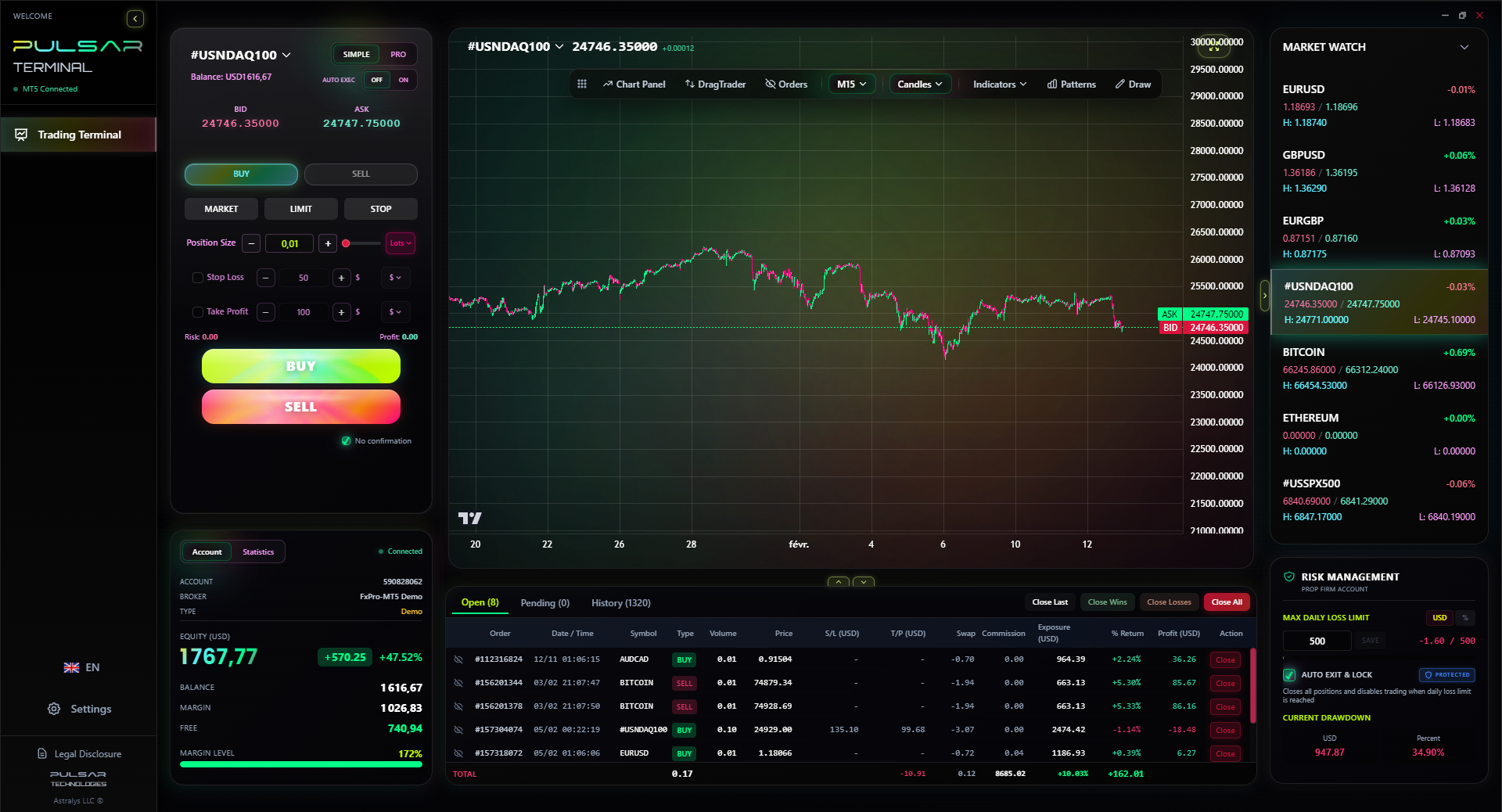
Managing multiple trades in a strong trend is easier with tools that let you set partial take-profits and trailing stops automatically, like Pulsar Terminal does on MT5.
Pulsar Terminal
La herramienta MT5 todo-en-uno: órdenes drag-and-drop, multi-TP/SL, trailing stop, grid trading, Volume Profile y protección prop firm. Usado por más de 1.000 traders diariamente.
So, how do you use this every day? Here's my simple 3-step checklist.
Step 1: Determine the Trend (Bullish/Bearish/Range).
- Look at the Daily chart. Are we making higher highs and lows? Lower highs and lows? Or is price moving sideways between two levels? This is your primary bias. Write it down: "Primary Trend: Bullish."
Step 2: Find Your Confluence. Don't rely on one signal. Look for areas where multiple things agree. For a bullish entry in an uptrend, I want:
- Price at a support level (like the 50-period EMA or a previous higher low).
- A bullish price action pattern (like a pin bar or engulfing candle).
- Maybe an oversold reading on the RSI on a lower timeframe. When 2-3 of these line up, your probability improves.
Step 3: Manage the Trade Based on the Bias.
- If your bias is bullish and you're in a long trade, your stop loss goes below the recent higher low. If that level breaks, your bullish thesis is wrong. Get out.
- Your profit target should be measured in terms of the trend. Look for the next area of historical resistance.
- Be aware of a margin call if you're over-leveraged in a volatile counter-trend move.
This framework forces you to define the market's condition before you trade. It turns vague terms into a concrete, actionable plan.
💡 Consejo de Winston
Your first loss in a trend is often your smallest. Don't double down trying to prove your initial bias right if the structure has clearly broken.

FAQ
Q1Can a market be both bullish and bearish at the same time?
On different timeframes, absolutely. This is very common. The weekly chart might be in a long-term bullish trend, while the 1-hour chart is in a short-term bearish correction. Your trading timeframe determines your bias. A day trader might be bearish selling the rallies on the 1-hour chart, while a long-term investor remains bullish and is buying the same dip on the weekly chart.
Q2What's the difference between 'bearish' and a 'downtrend'?
Good question. 'Bearish' is the adjective describing the condition or sentiment. A 'downtrend' is the specific market structure that results from that bearish sentiment - the series of lower highs and lower lows. You can have a bearish outlook on a market that's currently ranging, anticipating it will enter a downtrend.
Q3How do I know if a bullish trend is ending?
Look for a break in the structure. The most reliable early sign is the price failing to make a new higher high. Then, it breaks below the most recent higher low. This creates the first lower low, confirming the trend shift. Also, watch for momentum indicators like the MACD showing bearish divergence (price makes a higher high, but MACD makes a lower high).
Q4Is forex always either bullish or bearish?
No. Markets spend a significant amount of time in consolidation or ranging phases, where there's no clear directional bias. Price moves sideways between support and resistance. In these phases, the terms 'bullish' and 'bearish' aren't very helpful. Your strategy shifts to range-bound trading until a breakout occurs.
Q5What's more important, bullish/bearish news or chart patterns?
For me, the chart wins every time. The chart reflects the sum total of all news, rumors, and sentiment. A piece of bullish news might cause a spike, but if the chart is in a strong bearish structure, that spike often becomes a great selling opportunity. The price action tells you whether the market agrees with the news headline.
Q6How does the spread affect my bullish/bearish trade?
The spread definition is critical, especially for short-term trades. In a highly bullish market with low volatility, spreads are often tight. But if you're trying to enter a bearish trade during a major news event, spreads can widen dramatically. This means the market needs to move further in your direction just for you to break even. Always check the spread before entering.
Lección del Prof. Winston
Puntos clave:
- ✓Identify trend by higher highs/lows (bullish) or lower highs/lows (bearish).
- ✓Trade with the trend: buy dips in uptrends, sell rallies in downtrends.
- ✓Use multiple timeframes to confirm your bias and avoid traps.
- ✓Let price action, not headlines, define bullish or bearish conditions.
¿Te resultó útil este artículo?
Haz clic en una estrella
Análisis Trading Semanal
Análisis y estrategias semanales gratis. Sin spam.
Sobre el autor
Olumide Adeyemi
Pionero del Trading en África Occidental
Uno de los educadores de trading forex más activos de Nigeria. 8 años de experiencia operando desde Lagos. Especialista en estrategias de bajo capital y desafíos de prop firms para traders africanos.
Comentarios
Aviso de riesgo
El trading de instrumentos financieros conlleva un riesgo significativo y puede no ser adecuado para todos los inversores. El rendimiento pasado no garantiza resultados futuros. Este contenido tiene fines educativos únicamente y no debe considerarse asesoramiento de inversión. Siempre realice su propia investigación antes de operar.
También te puede interesar

Cara Trading Forex Sukses: 7 Prinsip dari Trader Profesional
Cara trading forex sukses dengan 7 prinsip trader pro: manajemen modal, disiplin, journal trading, backtest. Data nyata, bukan janji profit palsu.
Jam Trading Forex Terbaik untuk Trader Indonesia: Panduan Lengkap dengan Tabel Waktu
Panduan jam trading forex untuk trader Indonesia. Tabel 4 sesi dunia, jam emas 20:00-00:00, sesi mana yang harus dihindari. Data akurat + tips dari trader berpengalaman.
Top 5 Sàn Forex Uy Tín Nhất 2026: Review Jujur dari Trader Indonesia
Top 5 sàn forex uy tín 2026 untuk trader Indonesia. Review jujur: spread, deposit, withdraw, dukungan lokal. Exness, XM, IC Markets & lebih.
Obtener Pulsar Terminal
Todas estas calculadoras están integradas en Pulsar Terminal con datos en tiempo real de su cuenta MT5.
Obtener Pulsar Terminal