


Let's be honest, most traders chasing the most volatile forex pairs are just looking for a quick way to blow up their account.

David van der Merwe
Trader de Mercados Emergentes ·  South Africa
☕ 11 min de lectura
Lo que aprenderás:
- 1What Actually Makes a Forex Pair Volatile?
- 2The Most Volatile Pairs Right Now (And Why)
- 3How to Trade Volatile Pairs Without Getting Slaughtered
- 4The Real Cost of Trading Volatility in South Africa
- 5Practical Strategies for Volatile Conditions
- 6Mistakes I've Made (So You Don't Have To)
- 7Picking the Right Broker in South Africa
Let's be honest, most traders chasing the most volatile forex pairs are just looking for a quick way to blow up their account. I've seen it a hundred times. But here's the controversial truth: volatility isn't your enemy, it's your raw material. The real skill isn't finding the wildest pair, it's building a cage strong enough to hold it. For South African traders, this game is personal - our own Rand is often centre stage in the chaos. I'll show you which pairs move the most, why they do it, and how you can trade them without becoming another cautionary tale.
Forget the textbook definitions. Volatility, in the trenches, is just a measure of how much a currency pair can hurt you in a short amount of time. It's the difference between a gentle slope and a cliff face. The main drivers are liquidity (or lack thereof), economic surprise, and good old-fashioned panic.
Pairs with lower trading volumes, like exotics involving emerging market currencies, have thinner order books. A few large trades can shove the price around like a bully in a schoolyard. This is why the USD/ZAR can swing hundreds of pips on a political rumour from Pretoria. Major pairs like EUR/USD have a deep ocean of liquidity, so it takes a tsunami to move them the same distance.
The other big factor is interest rate differentials and central bank drama. A pair like GBP/JPY is a volatility classic because it pits the Bank of England against the Bank of Japan - two central banks with often wildly different policies. When one sneezes, the other catches a cold, and the pair goes for a run.

Warning: High volatility does NOT equal high profitability. It equals high risk. Mistaking one for the other is the fastest route to a margin call. I learned this the hard way in 2016, shorting USD/TRY during a 'stable' period, only for a sudden central bank intervention to wipe out 40% of my account in 90 minutes. The move was predictable in hindsight, but my position size was a fantasy.

💡 Consejo de Winston
Volatility is a fee, not a reward. The market charges it via wider spreads and larger stop losses. Your edge must be big enough to pay this fee and still turn a profit.
Based on average daily range and the capacity for explosive news-driven moves, here are the pairs that demand your respect (and larger stop losses).
The Exotic Heavy-Hitters (Where the Rand Plays)
These are the local heroes and villains. They're volatile because the economies behind them are sensitive.
- USD/ZAR (US Dollar / South African Rand): This is our home game. It's volatile due to SA's load-shedding, political uncertainty, and commodity price swings. A bad GDP print or a cabinet reshuffle can easily trigger a 2-3% move in a day. It's personal, it's emotional, and it's where many local traders start (and often finish).
- USD/TRY (US Dollar / Turkish Lira): A masterclass in hyper-volatility driven by unorthodox monetary policy and geopolitics. The spreads are wide, the moves are vicious, and it's not for the faint-hearted.
- GBP/ZAR (British Pound / South African Rand): Double the volatility fun. You're exposed to both UK political drama (Brexit fallout, elections) and South African domestic issues. The daily range can be enormous.
The Cross-Currency Kings
These pairs don't involve the USD but are famous for their wide swings.
- GBP/JPY (The 'Widowmaker'): Often crowns the list. In 2024, it averaged over 150 pips of movement per day. It combines the volatility of Sterling with the safe-haven flows of the Yen. A perfect storm for swing trading opportunities (and disasters).
- AUD/JPY & NZD/JPY: The 'risk barometers'. When global sentiment sours, these pairs tank as traders flee the commodity currencies (AUD, NZD) for the safety of the JPY. The moves are sharp and trend-driven.
Volatile Majors (Yes, They Exist)
Even the big pairs have their moments.
- GBP/USD: Still reacts sharply to Bank of England meetings and UK inflation data. It's more predictable than exotics but can still pack a punch.
- USD/JPY: Driven by the US-Japan yield differential. When the Fed talks tough, this pair can rocket. It's a favourite for trend followers.

Example: Let's say GBP/JPY has an average true range (ATR) of 150 pips. Placing a 20-pip stop loss on this pair is practically a donation to the market. Your stop should be in line with the instrument's normal noise, often at least 50-70 pips for a short-term trade.
“Trading volatile pairs isn't about courage; it's about careful calculation.”
This is where amateurs and pros separate. Trading volatile pairs isn't about courage; it's about careful calculation. Here’s the survival guide.
1. Position Sizing is Your #1 Priority. This is non-negotiable. A volatile pair will test your stop loss more often. You must size your position so that a full stop-loss hit doesn't damage your account. I use a hard rule: never risk more than 1% of my account on any single trade, and on exotics like USD/ZAR, I often dial it back to 0.5%. Use a position size calculator religiously. Don't guess.
2. Widen Your Stop Losses. Trying to apply a 10-pip stop to GBP/JPY is like using a paper umbrella in a hurricane. Your stop must be placed beyond the pair's normal daily fluctuation. Use the ATR indicator to gauge this. If the ATR(14) is 120 pips, your stop should be a multiple of that, not a fraction.
3. Embrace Higher Timeframes. The noise on a 1-minute or 5-minute chart for these pairs is unbearable. You'll get whipsawed to death. Move to the 1-hour or 4-hour chart to see the actual trend, not just the market's nervous twitches. My most successful USD/ZAR trades have all been based on daily chart structure.
4. Know the Economic Calendar. Volatility often spikes around data releases. For USD/ZAR, you MUST know when SA CPI, SARB rate decisions, or US Non-Farm Payrolls are due. Trading blindly into these events is gambling. I once got caught long GBP/USD during a surprise Brexit headline; the 80-pip gain reversed to a 120-pip loss in seconds. I didn't check the news timeline. My fault entirely.
5. Choose Your Broker Wisely. During high volatility, spreads can widen dramatically. Some brokers are notorious for this. You need a broker with reliable execution and clear policies. For South Africans, FSCA-regulated brokers like IC Markets or Exness offer good access to these pairs with stable pricing. Check their average spreads on the exotic pairs you want to trade.
Volatility is expensive, and not just in risk. The costs will eat you alive if you're not careful.
Spreads: This is the big one. While you might get 0.8 pips on EUR/USD with a broker like XM, expect much wider spreads on volatile pairs. USD/ZAR can easily have a 50-80 pip spread during off-hours or high volatility. That means the price has to move 80 pips just for you to break even. On a standard lot, that's R800 gone before you start.
Commissions: Some ECN brokers charge commissions. It might be $5 per lot per side. Factor this into your profit targets.
Swap Rates (Overnight Fees): Holding volatile pairs overnight can incur significant swap charges, especially if you're trading against a high-interest-rate currency. Always check the swap long and swap short rates before holding a trade for multiple days.
The FSCA use Cap: Remember, the FSCA caps use at 30:1 for retail traders. This is a good thing. It prevents you from taking absurdly large positions on these wild pairs. A 30:1 cap on USD/ZAR is still plenty to do damage if you're reckless.
Funding & Withdrawals: Using a ZAR-denominated account with a local broker can save you currency conversion fees. International withdrawals can cost $25 or more. Local EFTs are usually free. I use a broker that offers ZAR accounts and local EFT deposits to keep costs predictable.
💡 Consejo de Winston
When trading pairs like USD/ZAR, your first profit target should at least cover the spread and your broker's commission. If it doesn't, your trade idea isn't good enough.
“A 30:1 use cap on USD/ZAR is still plenty to do damage if you're reckless.”
You can't just use your normal EUR/USD strategy on GBP/JPY. Here are a few adjustments that work.
Breakout Trading: Volatile pairs love to break out of consolidation ranges. Use horizontal support/resistance lines on the 4H or Daily chart. Wait for a strong candle to close beyond the level, then enter on a retest. Place your stop on the other side of the range. This works well on USD/ZAR after periods of consolidation.
Momentum Following with Trend Filter: Use a slow-moving average (like a 50-period EMA on the 1H chart) to define the trend. Only take trades in the direction of the trend. Use an indicator like the RSI indicator to look for pullbacks within that trend. For instance, in a strong GBP/JPY uptrend, wait for the RSI to dip near 40, then look for a long entry. This keeps you from fighting the freight train.
News Trading (Advanced): This is high-risk. The idea is to position yourself before a major news release (like a SARB decision) based on your forecast. The safer approach is to wait for the news to hit, let the initial spike and volatility settle (the 'sting'), and then trade the resulting directional move once liquidity returns. I prefer the latter. Trying to guess the news is a mug's game.

Pro Tip: Avoid scalping strategy on highly volatile exotics. The spread costs alone will kill your edge. Scalping is for high-liquidity, low-spread majors like EUR/USD. For GBP/JPY or USD/ZAR, aim for larger moves over hours or days.
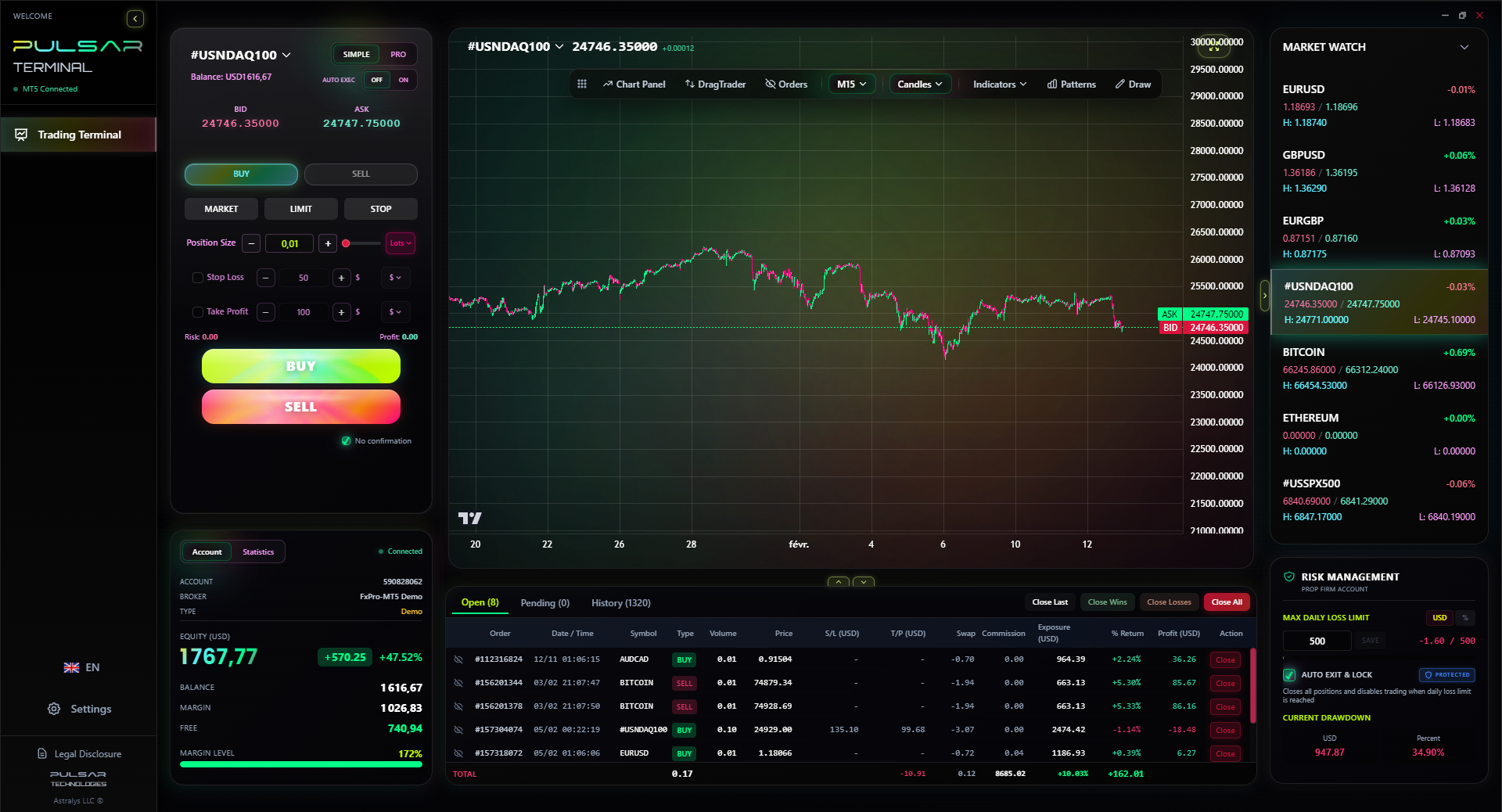
Managing multiple profit targets and trailing stops on a fast-moving pair like GBP/JPY is stressful, which is why tools like Pulsar Terminal that automate these orders directly on your MT5 chart are a game-saver.
Pulsar Terminal
La herramienta MT5 todo-en-uno: órdenes drag-and-drop, multi-TP/SL, trailing stop, grid trading, Volume Profile y protección prop firm. Usado por más de 1.000 traders diariamente.
Let's get vulnerable. I've paid my tuition to the volatility gods.
1. Chasing the Move: USD/TRY is ripping higher, up 300 pips! I FOMO'd in near the top, convinced it would go forever. It reversed. I lost 180 pips before I cut it. Lesson: Volatile pairs have violent reversals. Never chase. Wait for a pullback and a proper setup.
2. Ignoring the Spread: I placed a precision trade on GBP/AUD with a 25-pip stop. The spread was 12 pips at the time. The market moved 20 pips against me, hit my stop, and then reversed to my original target. The spread alone accounted for nearly half my risk. I was technically right on direction but lost money. Always calculate your risk from the ask price if buying, or the bid if selling.
3. Overleveraging on 'Sure Things': It was a classic setup on USD/ZAR. Resistance, bearish pin bar, everything looked perfect. I was so confident I risked 3% of my account. A surprise commodity rally sent the Rand strengthening, and my stop was hit. A 1% loss would have been a lesson. A 3% loss was a major setback. Stick to your 1% rule, no exceptions.
4. Not Accounting for Gaps: Volatile pairs can gap over the weekend. I held a long USD/MXN position over a weekend due to a Mexican election. It gapped down 400 pips on Sunday open. My stop was useless. Now, I either close risky positions before major weekend events or use a broker with guaranteed stop losses (which cost extra).
💡 Consejo de Winston
The best time to analyze a volatile pair is when the market is closed. Plan in calm, execute in chaos. Emotional decisions in fast markets are always expensive.
“I was technically right on direction but lost money to the spread. That one hurt.”
Your broker is your lifeline in volatile markets. Here’s what to look for as a South African.
1. FSCA Regulation: This is non-negotiable. It ensures client fund segregation and a degree of oversight. Check the FSP number on the FSCA website.
2. Stable Spreads on Exotics: Test their demo account during South African market hours and see what the spreads are like on USD/ZAR and GBP/ZAR. Do they balloon to 100+ pips?
3. ZAR Account Option: This lets you deposit and withdraw in Rands, avoiding nasty conversion fees. Brokers like Khwezi Trade (fully local) and many international ones like Pepperstone offer this.
4. Platform & Tools: You'll need a strong platform. MT4/MT5 is standard. Does the broker offer good charting tools and fast execution? For managing the inherent risk of these trades, advanced order types are key. The ability to set a trailing stop or take multiple profit levels automatically is a huge advantage.
5. Realistic Minimum Deposits: You don't need R50,000 to start. Brokers like XM or FBS allow you to start small, which you should. Start with a cent account or a micro account to test your strategy in real conditions without real danger. Here’s a quick comparison of a few relevant brokers:
| Broker | FSCA Regulated | Min. Deposit (ZAR approx.) | Key Feature for Volatility |
|---|---|---|---|
| IC Markets | Yes | ~R3,700 ($200) | Raw spreads, very fast execution |
| Exness | Yes | ~R185 ($10) | Flexible accounts, good local support |
| Khwezi Trade | Yes | R500 | Purely South African, ZAR accounts |
| XM | Yes | ~R90 ($5) | Low minimum, many account types |
Start small, test their execution with volatile pairs, and only then commit more capital.
FAQ
Q1What is the most volatile forex pair in 2024?
Based on average daily range, GBP/JPY (British Pound/Japanese Yen) is often the most volatile major cross, averaging over 150 pips of movement per day. For South African traders, USD/ZAR (US Dollar/South African Rand) is consistently one of the most volatile exotic pairs due to local economic and political factors.
Q2Is it a good idea for beginners to trade volatile forex pairs?
Generally, no. It's a terrible idea. Beginners lack the discipline for strict risk management, and volatile pairs punish small mistakes with large losses. Start with major pairs like EUR/USD to learn the basics of order execution, pip definition, and risk management. Once you can consistently protect your capital on calm pairs, then consider dipping a toe into more volatile waters.
Q3Why is USD/ZAR so volatile?
The South African Rand is a commodity currency heavily influenced by global risk sentiment, local political stability (or lack thereof), electricity supply (load-shedding), and domestic economic data like GDP and inflation. Sudden changes in any of these factors can cause large, rapid moves in the USD/ZAR pair.
Q4What is the safest volatile pair to trade?
That's an oxymoron, but the least dangerous of the volatile bunch are the major pairs with higher volatility, like GBP/USD or USD/JPY. They have much higher liquidity than exotics, meaning tighter spreads and more predictable slippage. They're still risky but operate in a more orderly market than something like USD/TRY.
Q5How much use should I use on volatile pairs?
Less than you think. The FSCA caps it at 30:1 for retail traders, and you should often use even less. On a pair like GBP/JPY or USD/ZAR, I rarely exceed 10:1. High volatility combined with high use is the perfect recipe for a margin call. Your position size, determined by your stop loss, is far more important than your use ratio.
Q6Can I use technical analysis on very volatile pairs?
Yes, but you must adapt. Use higher timeframes (1-hour or above) to filter out noise. Use wider indicators - a 20-period Bollinger Band is useless; try a 50-period. Focus on major support/resistance levels and trend structure rather than small MACD indicator crossovers. The principles work, but the settings and your patience need to adjust.
Lección del Prof. Winston
Puntos clave:
- ✓Volatility is measured in cost: mind the spread.
- ✓Position size trumps everything. Use a calculator.
- ✓Trade the 4H chart, not the 5M, on wild pairs.
- ✓The FSCA's 30:1 use cap is a safety net, not a target.
¿Te resultó útil este artículo?
Haz clic en una estrella
Análisis Trading Semanal
Análisis y estrategias semanales gratis. Sin spam.
Sobre el autor
David van der Merwe
Trader de Mercados Emergentes
Trader con sede en Johannesburgo con 11 años en divisas de mercados emergentes. Especialista en pares ZAR, trading regulado por la FSCA y análisis del mercado sudafricano.
Comentarios
Aviso de riesgo
El trading de instrumentos financieros conlleva un riesgo significativo y puede no ser adecuado para todos los inversores. El rendimiento pasado no garantiza resultados futuros. Este contenido tiene fines educativos únicamente y no debe considerarse asesoramiento de inversión. Siempre realice su propia investigación antes de operar.
También te puede interesar

Cara Trading Forex Sukses: 7 Prinsip dari Trader Profesional
Cara trading forex sukses dengan 7 prinsip trader pro: manajemen modal, disiplin, journal trading, backtest. Data nyata, bukan janji profit palsu.
Jam Trading Forex Terbaik untuk Trader Indonesia: Panduan Lengkap dengan Tabel Waktu
Panduan jam trading forex untuk trader Indonesia. Tabel 4 sesi dunia, jam emas 20:00-00:00, sesi mana yang harus dihindari. Data akurat + tips dari trader berpengalaman.
Top 5 Sàn Forex Uy Tín Nhất 2026: Review Jujur dari Trader Indonesia
Top 5 sàn forex uy tín 2026 untuk trader Indonesia. Review jujur: spread, deposit, withdraw, dukungan lokal. Exness, XM, IC Markets & lebih.
Obtener Pulsar Terminal
Todas estas calculadoras están integradas en Pulsar Terminal con datos en tiempo real de su cuenta MT5.
Obtener Pulsar Terminal