


Here's a number that should make you pause: only about 7% of traders in prop firm evaluations ever see a payout.

James Mitchell
Analista de Trading Sénior
☕ 12 min de lectura
Lo que aprenderás:
- 1What Exactly Is an Options Trading Prop Firm?
- 2The 2026 Legal Minefield: Why Your Firm Might Vanish
- 3The Real Costs & Profit Splits (What They Don't Highlight)
- 4How to Actually Pass the Challenge (It's Not About Being a Genius)
- 5How to Vet a Prop Firm in 2026 (Red Flags & Green Lights)
- 6The Mindset Shift: Trading Options With Someone Else's Money
- 7Is a Prop Firm Your Only Option? (Pun Intended)
Here's a number that should make you pause: only about 7% of traders in prop firm evaluations ever see a payout. That's not a typo. While the dream of trading a firm's capital for options is intoxicating, the path is littered with regulatory landmines, brutal statistics, and firms that are shutting down left and right. I've traded with firm capital for years, and the game has changed completely since 2024. This isn't about getting rich quick; it's about understanding if you can even survive in a market where the rules are being rewritten as we speak.
Let's strip away the marketing fluff. An options trading prop firm gives you access to their capital to trade options (and usually other instruments) in exchange for a cut of your profits. You're not a customer in the traditional broker sense; you're more like a contractor using their tools and bankroll.
The classic model works in two phases. First, you pay a fee to enter an "evaluation" or "challenge." This is where they see if you can trade profitably under specific, often strict, rules. If you pass, you get a "funded account" - that's the firm's real money - and start earning a profit split.
It sounds straightforward, but here's the catch: the firm's primary incentive isn't always your success. Their revenue comes from those evaluation fees. When you realize that the pass rate is famously low (we're talking 5-10%), the business model starts to look different. It's a filter designed to find the exceptionally disciplined, not to educate the masses.

Warning: Don't confuse prop firms with traditional brokers like Interactive Brokers. You're not depositing your own money to trade. You're trying to qualify to trade theirs, which comes with a completely different set of rules and psychological pressures.

💡 Consejo de Winston
A prop firm's evaluation rules are a direct test of emotional discipline, not trading IQ. The fastest way to fail is to treat a daily loss limit as a suggestion rather than a law.
“Only about 7% of traders in prop firm evaluations ever see a payout.”
This is the most critical part of the conversation right now. The regulatory ground is shifting violently, and many firms aren't built to withstand it. If you're not paying attention to this, you could wake up one day to find your funded account and pending payout are just... gone.
The SEC's New "Dealer" Rules
In early 2024, the SEC dropped a bombshell with new rules that massively expand who has to register as a "dealer." The compliance deadline is hitting in 2025/2026. The goal? To force more proprietary trading firms under the formal oversight of the SEC and FINRA. This means capital requirements, regular exams, and a mountain of compliance paperwork. For smaller firms operating on thin margins, this cost alone could be a death sentence.
The CFTC's Looming CTA Classification
This is the big one for futures and options on futures. By 2026, the CFTC is expected to formally classify evaluation-based prop firms as Commodity Trading Advisors (CTAs). This isn't a minor tweak; it's an existential change. CTAs must register, meet strict capital rules, and provide formal risk disclosures. The entire "pay a fee for a challenge" model might not survive this reclassification in its current form. I've spoken with ops people at these firms, and the anxiety is palpable.
The Great Shakeout of 2024-2025
It's already happening. Estimates say between 80 and 100 prop firms shut down in 2024. Part of this was triggered by MetaQuotes (the company behind MT4/MT5) cutting off some firms, forcing a chaotic scramble to new platforms. More closures are expected in 2025. When you're choosing a firm, you're not just judging its rules, you're betting on its ability to navigate this regulatory hurricane and stay solvent. Always check how long they've been in business and if they're proactively discussing these regulations.
“The regulatory ground is shifting violently, and many firms aren't built to withstand it.”
Let's talk numbers, because the advertised "90% profit split" is only part of the story. You need to understand the full financial sinkhole before you pay a single evaluation fee.
First, the upfront costs. You'll see evaluation fees from as low as $35 for a tiny account to over $1,500 for a $200,000 challenge. Then, some firms hit you with an "activation fee" once you pass, which can be another $0 to $140. That's just to start.
Now, the hidden, ongoing costs. You think you're getting a platform for free? Think again. Most firms charge monthly platform and data fees. For professional-grade CME data (essential for trading /ES or /NQ options), you could be looking at $100+ per month, out of your pocket, before you make a single profitable trade.
Here's a breakdown of a typical cost structure for a $100k account:
| Cost Type | Typical Range | Note |
|---|---|---|
| Evaluation Fee | $200 - $600 | Often discounted, non-refundable |
| Activation Fee | $0 - $100 | One-time fee after passing |
| Monthly Platform/Data | $50 - $150 | Mandatory, even if you don't trade |
| Profit Split | 70% - 90% to you | Usually paid after a minimum threshold |

Example: Let's say you pay a $400 eval fee, a $50 activation fee, and $100/month for data. You need to generate over $550 in net profit just to break even on your costs in the first month. That doesn't even account for the profit target you had to hit during the evaluation itself.
The profit splits are real, but they often have tiers. A common structure is 80/20 for the first few months, scaling to 90/10 after consistent profitability. A few, like Topstep, have a cool model where you keep 100% of the first $10k. That's the exception, not the rule. The key is to read the profit split agreement line by line. Are there withdrawal fees? Minimum payout amounts? How often can you request a payout? These details make all the difference.
I learned this the hard way early on. I passed a challenge with a firm (that's now defunct), traded a $50k account to a $4,200 profit in six weeks. My 80% split was $3,360. Then they deducted a $100 processing fee and had a $500 minimum wire transfer. My first "big" payout was a wire for $2,760. After my sunk costs, my actual hourly rate was pathetic. It was a brutal lesson in reading the fine print. Now, I use a position size calculator to model my net profit after all fees before I even take a trade.
💡 Consejo de Winston
When calculating your potential payout, always deduct all monthly fees first. A 90% split on paper can quickly become a 70% net split after platform and data costs.
“The regulatory ground is shifting violently, and many firms aren't built to withstand it.”
Passing the evaluation has almost nothing to do with complex strategies and everything to do with discipline and risk management. The firms aren't testing for brilliance; they're testing for obedience and consistency under pressure.
The rules are designed to fail you. You'll have a daily loss limit (e.g., 5% of the account), a max trailing drawdown (e.g., 10%), and a profit target (e.g., 10% over a month). The moment you breach any rule, you're out. Your fee is gone.
My biggest mistake in my first few attempts? I treated it like my personal account. I'd get a hot hand, hit my daily profit target by lunch, and then break my own rules by taking "just one more" high-probability trade. I'd give back half the day's profits and violate the daily loss limit from the peak. Game over. I blew three challenges in a row doing that.
What finally worked was a boring, mechanical approach:
- Define Your Risk Per Trade: This is non-negotiable. I risk no more than 0.5% of the account's starting balance on any single options position. For a $100k challenge, that's $500. This makes the daily and max drawdown limits almost impossible to hit accidentally.
- Have a Clear Exit Plan Before Entry: For every options trade, know your exact stop-loss (in dollars, not just a technical level) and your profit target. Use bracket orders if the platform allows it. This removes emotion.
- Treat the Daily Loss Limit as a Hard Stop: If you hit 80% of your daily loss limit, you're done for the day. Close the platform. Walk away. This single habit is what got me through my first successful evaluation.
- Choose Your Battles: During an eval, you're not trying to catch every move. You're trying to execute a high-probability swing trading plan 5-10 times. That's it. Overtrading is the fastest route to failure.

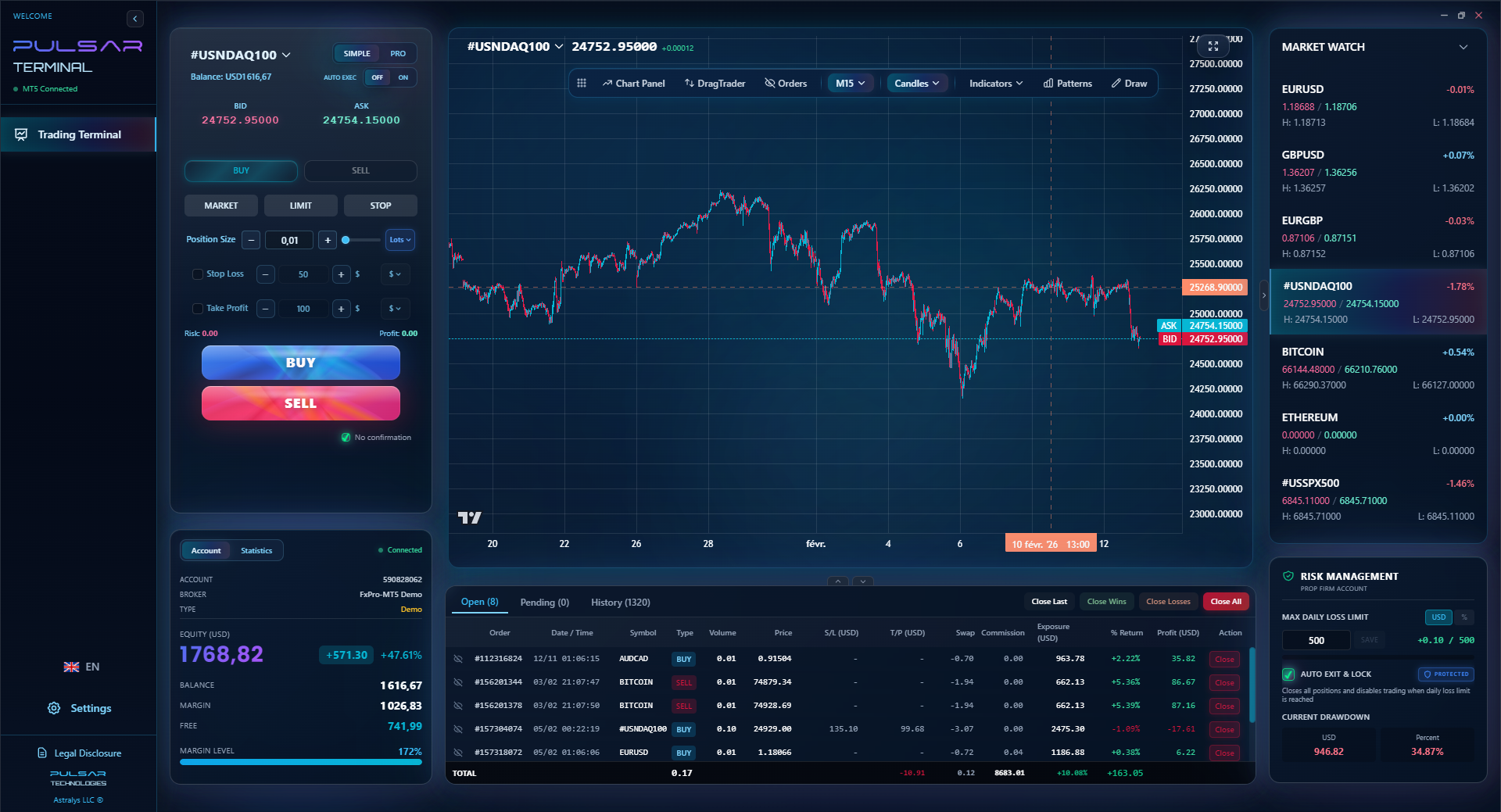
Pro Tip: The goal of the challenge is to prove you can manage risk, not maximize returns. A 10% profit target over 30 days is only 0.33% per day. You don't need home runs. You need consistent singles. A tool that automates your risk, like setting a hard daily stop, is useful. This is where a platform companion like Pulsar Terminal shines - it can enforce these discipline rules right on your MT5 chart, so you can't cheat yourself.
Passing a prop firm challenge requires robotic discipline with daily loss limits, which is exactly what Pulsar Terminal's risk guardrails automate on your MT5 platform.
Pulsar Terminal
La herramienta MT5 todo-en-uno: órdenes drag-and-drop, multi-TP/SL, trailing stop, grid trading, Volume Profile y protección prop firm. Usado por más de 1.000 traders diariamente.
“Passing the evaluation has almost nothing to do with complex strategies and everything to do with discipline.”
With firms closing and regulations changing, due diligence is more important than ever. Here’s my checklist.
Red Flags (Run Away):
- No clear information on regulatory status or corporate address. If they're dodgy about who they are, they'll be dodgy with your payout.
- Overly aggressive marketing. "Get funded in 3 days!" "No rules trading!" This is a sign of a firm that survives on eval fees, not successful traders.
- Unrealistically high use for options. Options are volatile enough. Excessive use is a risk management failure waiting to happen.
- Poor or vague payout terms. If it takes more than 5 business days to get your money, or they have a long list of payout fees, be wary.
- No community or transparent track record. Look for firms where funded traders are active and vocal in Discord or forums.
Green Lights (Good Signs):
- Transparent about 2024/2026 regulations. A good firm is proactively explaining how they're adapting. Silence is a bad sign.
- Offers a variety of platforms (ThinkorSwim, NinjaTrader, DXtrade), not just MT4/5. This shows infrastructure investment.
- Clear, published payout history. Some firms have leaderboards or publicly share payout stats.
- Responsive support. Test their customer service before you pay with a technical question.
- Scaling plan. They should have a clear, attainable path to grow your account size based on performance, not more fees.
Based on my experience and the current climate, I tend to look more favorably at established, diversified firms that offer futures and equities alongside options, like a Pepperstone partner model, or those with their own strong technology. They're more likely to weather the regulatory storm.
💡 Consejo de Winston
In this regulatory climate, the most important metric for a prop firm is not its profit split, but its likelihood of still being in business 12 months from now.
“Passing the evaluation has almost nothing to do with complex strategies and everything to do with discipline.”
When you finally get that funded account, the psychology changes. It feels like play money, but the pressure to perform is immense. You have to deliver consistent results to keep the account and get paid.
I found my trading became both more conservative and more strategic. I stopped chasing lottery-ticket, out-of-the-money options plays. Instead, I focused on higher-probability, defined-risk strategies like credit spreads, iron condors, and buying in-the-money options for directional plays with high delta. The name of the game is steady, manageable growth, not explosive wins.
Risk management becomes your religion. You must understand the Greeks, especially Theta (time decay) and Vega (volatility sensitivity), intimately. A sudden spike in implied volatility can blow through your stop-loss if you're not careful. I once had a beautiful credit spread on SPX that was well-defined risk, but an unexpected news event caused a volatility crush that inverted my position's value for a day. I held my nerve because my risk was defined, but it was a white-knuckle reminder that options have unique risks.
You also need to be a master of your platform. Knowing how to set multi-leg option orders efficiently, how to analyze the options chain for liquidity, and how to use tools like Volume Profile to find key support/resistance levels for your strikes is crucial. This isn't the place to learn on the fly.
Finally, embrace the grind. Your first payout is a milestone, not the finish line. The real goal is to scale your capital allocation within the firm. That's where the life-changing money can be - not in your first $10k payout, but in consistently managing a $500k or $1M slice of the firm's capital.
“Prop firms are a tool, not a destination. They are not a shortcut to skill.”
Let's be real: the prop firm path isn't for everyone. The low pass rates, the fees, and the regulatory uncertainty are significant barriers. What are the other paths to trading options with more than your own bankroll?
- Build Your Own Track Record: This is the slow, traditional path. Trade your own account (even a small one) with extreme discipline for 12-24 months. Document every trade. Build a verifiable track record through a service like Myfxbook or a broker statement. Then, use that to approach smaller hedge funds, family offices, or even wealthy individuals as a potential capital allocator. It's harder to get in the door, but you skip the evaluation fee circus.
- Join an Established Trading Desk: Some physical prop firms or trading arcades still exist in major financial centers. You often get direct mentorship, shared infrastructure, and a different culture than the online evaluation model. It's more like a job interview than a video game challenge.
- Master a Niche Strategy: Become an absolute expert in one thing - like VIX options, weekly expirations on certain ETFs, or dividend capture strategies with options. Extraordinary specialization can make you attractive to firms or investors looking for that specific edge.
- Grow Your Own Capital Slowly: This is the most overlooked option. If you have a solid scalping strategy or options income strategy, focus on compounding a small account with ruthless risk management. A 2% average monthly return on a $10k account turns into $12k in a year. Do that consistently, and you'll have your own prop firm.
The bottom line? Prop firms are a tool, not a destination. They can be a fantastic accelerator if you have the skill and discipline but lack the capital. But they are not a shortcut to skill. If you can't profitably trade your own $5k account, you almost certainly won't pass a $100k challenge. Start there, be honest with yourself, and then decide if the prop firm route is the right use for your existing edge.
FAQ
Q1What's the biggest mistake new traders make with options prop firms?
They focus entirely on the profit target and ignore the daily loss limit. Blowing the daily loss is the #1 reason people fail challenges. You can be up 8% for the month but if you have one bad day where you lose 6% from your peak, you're often disqualified. Managing daily drawdown is more important than hitting the monthly target.
Q2Are options trading prop firms legal in the US?
Yes, but it's a gray area that's rapidly clarifying - and that's the problem. The SEC and CFTC are actively working to bring them under formal regulation (as dealers or CTAs) by 2026. A firm operating legally today might be operating illegally tomorrow if it doesn't adapt. Always choose a firm that is transparent about its legal structure and regulatory compliance efforts.
Q3How much can I realistically make with a funded options account?
It depends entirely on your strategy and risk. A conservative, consistent trader might aim for 3-5% per month on a funded account. On a $100k account, that's $3k-$5k gross, with 80% going to you ($2.4k-$4k). After platform fees, it's less. The real money comes from scaling. If you prove yourself, you might get your allocation increased to $500k. 3% of that is $15k gross per month. That's the realistic path: consistent small percentages on growing capital.
Q4What's the difference between a prop firm and a broker like Robinhood?
A massive difference. On Robinhood, you deposit your own money, and you keep 100% of your profits (and losses). You are the customer. With a prop firm, you are qualifying to trade the firm's capital. They set strict rules, take a cut of your profits, and can terminate your account for rule violations. You have more use but less control and no ownership of the capital.
Q5Do I need to know advanced options strategies to pass?
Absolutely not. In fact, complex strategies often increase your risk of a mistake. Firms care about risk management, not sophistication. Mastering one or two simple, defined-risk strategies (like put/call credit spreads or buying in-the-money calls/puts) is far more effective than trying to execute detailed iron butterflies or ratio spreads under evaluation pressure.
Q6Can I trade during earnings reports or major news events?
Check your firm's rules! Many explicitly prohibit holding positions through major economic news releases (like NFP, CPI) or during earnings announcements for the underlying stock. The volatility can instantly blow through your drawdown limits. Even if it's allowed, it's an extremely high-risk move during an evaluation where survival is the goal.
Q7What happens if the prop firm goes out of business?
You lose your funded account and any unpaid profits. This is the single biggest risk in 2025-2026. This is why vetting the firm's longevity, transparency, and regulatory preparedness is now more important than analyzing its profit split percentage. Choose firms that look built to last.
Lección del Prof. Winston
Puntos clave:
- ✓The 7% payout rate is the most important stat.
- ✓2026 CTA regulations will kill many current firms.
- ✓Monthly fees can erase 20% of your profit split.
- ✓Daily loss limits matter more than profit targets.
- ✓Vet for firm survival, not just the best split.
¿Te resultó útil este artículo?
Haz clic en una estrella
Análisis Trading Semanal
Análisis y estrategias semanales gratis. Sin spam.
Sobre el autor
James Mitchell
Analista de Trading Sénior
Con sede en Nueva York y más de 9 años de experiencia en trading. Se enfoca en pares USD principales, desafíos de prop firms y el panorama regulatorio estadounidense.
Comentarios
Aviso de riesgo
El trading de instrumentos financieros conlleva un riesgo significativo y puede no ser adecuado para todos los inversores. El rendimiento pasado no garantiza resultados futuros. Este contenido tiene fines educativos únicamente y no debe considerarse asesoramiento de inversión. Siempre realice su propia investigación antes de operar.
También te puede interesar

Cara Trading Forex Sukses: 7 Prinsip dari Trader Profesional
Cara trading forex sukses dengan 7 prinsip trader pro: manajemen modal, disiplin, journal trading, backtest. Data nyata, bukan janji profit palsu.
Jam Trading Forex Terbaik untuk Trader Indonesia: Panduan Lengkap dengan Tabel Waktu
Panduan jam trading forex untuk trader Indonesia. Tabel 4 sesi dunia, jam emas 20:00-00:00, sesi mana yang harus dihindari. Data akurat + tips dari trader berpengalaman.
Top 5 Sàn Forex Uy Tín Nhất 2026: Review Jujur dari Trader Indonesia
Top 5 sàn forex uy tín 2026 untuk trader Indonesia. Review jujur: spread, deposit, withdraw, dukungan lokal. Exness, XM, IC Markets & lebih.
Obtener Pulsar Terminal
Todas estas calculadoras están integradas en Pulsar Terminal con datos en tiempo real de su cuenta MT5.
Obtener Pulsar Terminal