


Everyone in Mumbai's trading circles talks about prop firms like they're a golden ticket.

Rajesh Sharma
Analista Forex Sénior ·  India
India
☕ 12 min de lectura
Lo que aprenderás:
- 1What Prop Trading Really Means in Mumbai (It's Not What You Think)
- 2The Legal & Tax Minefield (Don't Skip This)
- 3Real Numbers: Fees, Splits, and How You Actually Get Paid
- 4Why 90% of Traders Blow the Challenge (The Psychology)
- 5Firms Accessible to Indian Traders (2026 Overview)
- 6Trading Platforms & Getting Your Money In/Out
- 7Honest Alternatives: Is a Prop Firm Even Right For You?
- 8The Final Verdict for Mumbai Traders in 2026
Everyone in Mumbai's trading circles talks about prop firms like they're a golden ticket. Pay a fee, pass a challenge, and trade millions of the firm's money. It sounds perfect. I'm here to tell you that for 95% of traders, it's a fast track to blowing up your own capital on evaluation fees. The model isn't a scam, but the marketing preys on desperation. Let's cut through the hype and look at the real mechanics, the legal grey areas, and whether this path is actually worth your time and rupees.
When you hear 'prop trading firm in Mumbai,' you're probably imagining a slick office in BKC where you get a desk, capital, and mentorship. That's the old-school model, and it's rare. What's exploded online is the 'funded challenge' model. You pay a one-time or monthly fee to take a simulated trading test. Pass it, and you get a funded account where you keep a large chunk of the profits.
The key thing most guys miss is this: the firm is not hiring you. You're not an employee. You're a contractor using their capital under very strict, algorithmically-enforced rules. Your success is their profit. Your failure? They keep your evaluation fee. It's a business model with a very clever risk transfer.
From a regulatory standpoint, it's a bit of a dance. SEBI regulates proprietary trading by registered brokers and institutions. These online challenge-based firms often operate in a service-model grey zone. They argue you're paying for an evaluation service, not for trading services. This is why many international firms have started restricting Indian clients, especially for forex, to avoid tangling with RBI's 'alert list' for unauthorized platforms.

Warning: Don't confuse a prop firm challenge with a job. You have zero job security, no benefits, and you can be 'fired' (account terminated) for hitting a daily loss limit. It's a performance-based contract, pure and simple.

💡 Consejo de Winston
The evaluation fee is the firm's real profit center. They are selling you a dream, and the house always wins on volume. Your goal is to be the statistical outlier.
This is where most traders in Mumbai get blindsided. They focus on the trading rules and ignore the compliance rules, which can bite much harder.
The Regulatory Players
You've got three main watchdogs. SEBI calls the shots on the securities markets. The RBI controls anything involving foreign exchange and cross-border money movement. The FIU-IND watches for shady money flows. When you trade with an international prop firm, you're stepping into all three of their jurisdictions.
The rules are tightening. In early 2026, the RBI made it harder and more expensive for brokers to get credit for prop trading. This squeezes the traditional players. For you, the retail trader using an offshore firm, the bigger issue is the Liberalized Remittance Scheme (LRS). Every rupee you send out for an evaluation fee or every dollar of profit you bring back counts against your $250,000 annual limit. You must declare these international transactions.
The Tax Truth
Here's a brutal first-person lesson. In 2022, I received a payout from a prop firm. I treated it as 'bonus' income. My CA nearly had a heart attack. Income from trading, whether your capital or someone else's, is classified as 'Business Income' or 'Income from Other Sources' in India. You must maintain proper books, declare it in your ITR, and pay tax at your applicable slab rate. If the firm is offshore, you're dealing with foreign income. Not declaring it risks action under the Black Money Act. The onus is 100% on you. The prop firm won't send you a Form 16.

Pro Tip: Before you send a single rupee to a prop firm, talk to a chartered accountant who understands financial markets. Budget 30% of any profit for taxes. It's not optional.
Using a solid position size calculator is pointless if you haven't calculated your tax liability first.
“Income from trading, whether your capital or someone else's, is taxable in India. The onus is 100% on you.”
Let's talk numbers, because the advertised '90% profit split' is a headline grabber that hides the real economics.
The Evaluation Fee Trap: You'll see fees from ₹6,000 for a small account to ₹80,000+ for a $200,000 challenge. This is a sunk cost. You lose it if you fail. Firms often run 'discount' sales, which should tell you something about their margin on these fees. I once got overconfident and bought a $100k challenge during a sale for about ₹55,000. I blew the daily loss limit in 3 days on a single bad EUR/USD trade. That was an expensive lesson in humility.
Profit Splits - The Fine Print: Yes, splits can go up to 90%, sometimes even 100% with a fee top-up. But this is only on the profit. You must first hit the profit target (often 10%) to get funded. Then, you usually have to hit another profit target for your first payout. The split is applied after any fees or commissions. If they offer a 90% split but charge high commissions on XAU/USD trades, your net take-home is much lower.
The Payout Process: This is a operational headache. Most international firms pay via crypto (USDT) or international wire. Converting USDT to INR involves using a crypto exchange, which creates another taxable event and a paper trail. Bank wires attract fees and require you to explain the foreign inward remittance to your bank. It's not as simple as a UPI credit.
| Cost Element | Typical Range | What It Means For You |
|---|---|---|
| Evaluation Fee | ₹6,000 - ₹80,000+ | Sunk cost. Gone if you fail. |
| Profit Target (Evaluation) | 8% - 12% | The hurdle you must clear before getting 'funded'. |
| Daily Loss Limit | 3% - 5% | The most common reason for failure. Hit it, account is dead. |
| Profit Split | 70% - 90% | Of profits only, after commissions. |
| First Payout Threshold | Often 1% of account after funding | You need to make more profit before you see any cash. |
Your success depends entirely on managing these constraints, which is why a strict scalping strategy or swing trading plan is non-negotiable.
The challenge isn't a test of your best trading. It's a test of your most disciplined, robotic trading under extreme pressure. The rules are designed to find traders who won't lose the firm's money, not necessarily traders who can make the most money.
The Maximum Daily Loss is the killer. It's usually a tiny 3-5%. Let's say you take a $50,000 account. Your daily loss limit is $1,500 to $2,500. That's nothing. A few bad lots in a volatile market, and you're done. The pressure to not hit that limit causes overtrading, early exits on good trades, and the avoidance of any sensible risk.
I failed my first two challenges not on a massive loss, but on death by a thousand cuts. I'd be down $800, feel the pressure, take a sub-par trade to 'get back to even,' lose another $400, panic, and then violate a rule. The platform auto-liqudates you. No warning. No margin call. Just a notification that your challenge is over.
The profit target forces you to take just enough risk to get there, but not so much that you ever approach the daily loss. It's a mental prison. You're not learning to trade the market; you're learning to trade the firm's rulebook. This is why passing a challenge often has little correlation with long-term trading success. It's a specific, stressful game. Tools that help automate risk, like setting a hard stop based on your daily max, are crucial. This is where a platform that enforces rules can save you from yourself.
💡 Consejo de Winston
If you can't explain your edge in one sentence and back it up with 100+ trades of live data, you're gambling, not trading. A prop firm challenge just makes it more expensive gambling.
“If you can't grow a ₹50,000 account consistently, you cannot handle a $50,000 prop account. The pressure will destroy you.”
The landscape shifts constantly due to regulatory pressure. Here’s a snapshot of models available. Remember, accessibility doesn't equal endorsement.
1. The International Giants (Often Forex/CFD Focused): These are the household names like FTMO, The5%ers, and FundedNext. Crucially, many have restricted or stopped accepting Indian clients for their standard forex accounts due to regulatory concerns. Some might offer 'futures' challenges on regulated exchanges which have a different legal standing. Always check their latest terms. They typically use brokers like IC Markets or Pepperstone for execution.
2. The Emerging Indian-Oriented Firms: A new wave of firms is tailoring offerings for the Indian market. They might offer challenges on indices like NIFTY or BANKNIFTY, which trade on the regulated NSE. They're more likely to accept UPI for evaluation fees and structure payouts in INR. Examples include platforms like Tradeday, Funded Engineer, and Alpha Capital. Their longevity and payout reliability are still being proven.
3. The Instant Funding Model: Firms like Blue Guardian or Aqua Funding skip the lengthy challenge. You pay a higher fee for immediate 'funded' status, but the risk rules (daily loss, drawdown) are still active and often tighter. It's appealing if you hate the challenge phase, but it's a more expensive entry with the same core risk of blowing the account.
How to Vet a Firm:
- Payout Proof: Don't watch YouTube highlights. Search for consistent, mundane payout screenshots in community forums.
- Broker Link: Who is the executing broker? Is it a reputable name like XM or Exness, or a no-name entity?
- Rule Clarity: Are the rules for drawdown calculation crystal clear? Is it based on balance or equity? This is a classic point of failure.
- Customer Support: Test their response time before you pay.
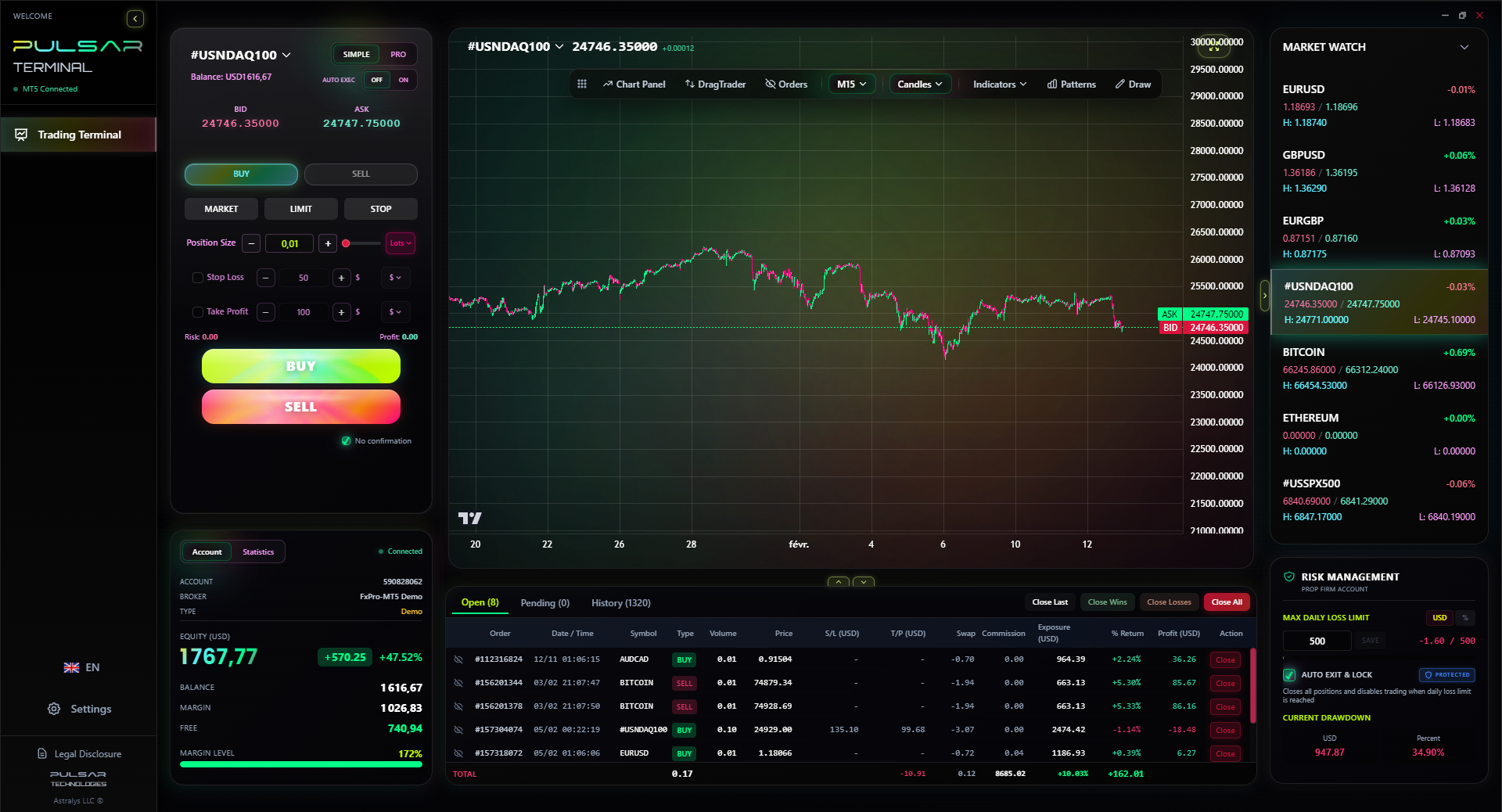
Managing the brutal daily loss limits of a prop firm challenge requires robotic discipline, which is exactly what Pulsar Terminal's automated trade management tools enforce on your MT5 platform.
Pulsar Terminal
La herramienta MT5 todo-en-uno: órdenes drag-and-drop, multi-TP/SL, trailing stop, grid trading, Volume Profile y protección prop firm. Usado por más de 1.000 traders diariamente.
You won't have a choice of platform. The prop firm provides it. Thankfully, most use industry standards.
MetaTrader 5 (MT5) is the most common. It's strong, supports algorithmic trading, and is familiar. Some firms are moving to TradeLocker or DXtrade for faster execution and better modern charting. You'll need to be comfortable with the platform's order entry system. Slippage on a market order during news can be the difference between passing and failing a challenge.
Payment Methods - The Practical Guide:
- Funding the Challenge (INR -> USD/EUR): Indian-oriented firms may accept UPI. This is easiest. For international firms, you'll use credit/debit cards (forex markup applies), bank transfer (slow), or sometimes crypto. Using your LRS limit here is clean for tracking.
- Receiving Profits (USD/EUR -> INR): This is trickier. Crypto (USDT) is the most common. You'll transfer to a Indian crypto exchange, sell for INR, and then bank transfer. Each step has fees and creates a record. International wire to your INR account involves bank charges and paperwork. Services like Wise or Payoneer are sometimes offered, but check if they support INR settlements.

Example: You earn a $1,000 profit on an 80% split. You get $800. The firm sends $800 USDT to your wallet. You transfer to an exchange, sell at a 0.1% fee, get ~₹66,400 (assuming rate). You transfer to bank (maybe ₹15 fee). You've netted ~₹66,385. Now you must declare this ₹66,385 as income and pay tax. Your net, after 30% tax, is ~₹46,470. That $1,000 profit just became about $560.
“Treat a prop firm challenge as a costly verification exam, not a business plan.”
Chasing a funded account is a distraction for most developing traders. Here’s a hard truth: if you can’t grow a ₹50,000 account to ₹1,00,000 consistently with your own money, you absolutely cannot handle a $50,000 prop account. The pressure will destroy you.
Alternative Path 1: Build Your Own Track Record. Trade a small, real account for 12-18 months. Use a journal. Get the data. This verifiable track record is worth more than any passed challenge. You can approach private investors or family offices in Mumbai with real proof, not a certificate from a website. You keep 100% of the profit (after giving investors their cut) and have negotiated terms.
Alternative Path 2: Algorithmic Trading. If you have a coding edge, this is a cleaner path. SEBI is formalizing rules for algo trading. You can develop a system, back-test it, and run it on a small live account. A proven, automated strategy is a tangible asset you can license or use to manage capital.
Alternative Path 3: The Education Route. Use the money you'd spend on 5-10 failed challenges (easily ₹2-3 lakhs) on proper education, a trading coach, and funding your own small account. Learn price action, market structure, and real risk management. A tool that helps you visualize market dynamics, like the Volume Profile in advanced platforms, can be a better investment than another evaluation fee.
The prop firm model works for a specific type of trader: one who is already consistently profitable, psychologically rock-solid, and needs capital scaling. It is not a learning platform. It's an execution platform for finished products. Starting your journey with one is like trying to qualify for Formula 1 before you've mastered driving a manual car in traffic.
💡 Consejo de Winston
Your first profit target should always be to recover your evaluation fee. Until then, you're just working for the firm for free.
The allure of prop trading firms in Mumbai is powerful. It promises capital, legitimacy, and a community. The reality is more sobering.
The regulatory environment is tightening, not loosening. SEBI defining prop trading and RBI tightening credit are signals. The era of the wild west might be closing. For you, this means increased scrutiny on your cross-border financial activity.
Economically, the model only makes sense if you are a high-probability passer. If you have a 70%+ chance of passing a challenge on your first attempt, and you can do it with a sizeable account, the math works. For everyone else, it's a subscription service for disappointment.
My advice? Treat a prop firm challenge as a costly verification exam, not a business plan. Before you ever consider one, you must have a trading plan so mechanical you could code it. You must know your win rate, your average risk/reward, and your maximum consecutive losses. You must have practiced trading with a hard daily loss limit on a demo account for months.
If you're still determined, start with the smallest, cheapest challenge you can find. Not to make money, but to test your psychology under their rules. The ₹6,000 you lose on a small account will be the best trading education you ever buy, because it will show you, unequivocally, whether you're built for this game. If you pass, then you can think bigger. But never, ever, risk money on a challenge that you can't afford to light on fire with zero return. That's the first and most important rule of all.
FAQ
Q1Are prop trading firms legal in India?
The activity exists in a grey area. Proprietary trading by registered entities is legal and regulated by SEBI. The online 'funded challenge' model is not explicitly licensed by SEBI. Indian traders using international firms operate under the Liberalized Remittance Scheme (LRS), and all income must be declared for taxes. SEBI has warned that some firm models may violate local laws.
Q2How much does it cost to join a prop firm in Mumbai?
Evaluation fees typically range from ₹6,000 to over ₹80,000, depending on the account size you're challenging for (e.g., $10,000 vs. $200,000). This is a one-time fee you lose if you fail the challenge. There are no monthly salaries; you only earn a percentage of profits (usually 70-90%) after passing.
Q3Which prop firms are best for Indian traders?
There's no single 'best' firm. Some international giants have restricted Indian clients. A new wave of firms now offers challenges on Indian indices (NIFTY) and accepts UPI. Focus less on the 'best' and more on a firm with transparent rules, reliable payout proof, and a reputable executing broker. Always check their latest terms for Indian client eligibility.
Q4How do I get paid from a prop firm in India?
Payouts are usually in USD or EUR via cryptocurrency (like USDT) or international bank wire. You then convert to INR, which involves crypto exchanges or bank processes, fees, and creating a clear audit trail for tax purposes. Some India-focused firms may offer direct INR bank transfers.
Q5What is the biggest reason traders fail prop firm challenges?
The Maximum Daily Loss limit (typically 3-5%). It's an extremely tight leash that creates intense psychological pressure, leading to overtrading, fear, and rule violations. Most traders fail not from one big loss, but from a series of small losses that hit this daily ceiling.
Q6Do I need to pay tax on prop trading profits in India?
Yes, absolutely. All trading profits, whether from your capital or a prop firm's, are taxable income in India. Income from international prop firms is considered foreign income and must be declared in your Income Tax Return (ITR). Failure to do so can lead to severe penalties under the Income Tax Act and Black Money Act.
Q7Is it better to trade my own money or use a prop firm?
If you are not consistently profitable with your own capital, a prop firm is a waste of money. Use the fees you'd spend on challenges to fund your own small account and get real education. Prop firms are for traders who have already proven their strategy and need scale, not for learning how to trade.
Lección del Prof. Winston
Puntos clave:
- ✓The Daily Loss Limit (3-5%) is the #1 account killer.
- ✓Budget 30% of any profit for Indian taxes immediately.
- ✓A passed challenge proves discipline, not necessarily skill.
- ✓Your own ₹1 lakh track record is better than a $100k funded account.
¿Te resultó útil este artículo?
Haz clic en una estrella
Análisis Trading Semanal
Análisis y estrategias semanales gratis. Sin spam.
Sobre el autor
Rajesh Sharma
Analista Forex Sénior
Más de 10 años operando en mercados indios y del sur de Asia. Comenzó con derivados de divisas en el NSE antes de pasar al forex internacional. Especialista en USD/INR y pares de mercados emergentes.
Comentarios
Aviso de riesgo
El trading de instrumentos financieros conlleva un riesgo significativo y puede no ser adecuado para todos los inversores. El rendimiento pasado no garantiza resultados futuros. Este contenido tiene fines educativos únicamente y no debe considerarse asesoramiento de inversión. Siempre realice su propia investigación antes de operar.
También te puede interesar

Cara Trading Forex Sukses: 7 Prinsip dari Trader Profesional
Cara trading forex sukses dengan 7 prinsip trader pro: manajemen modal, disiplin, journal trading, backtest. Data nyata, bukan janji profit palsu.
Jam Trading Forex Terbaik untuk Trader Indonesia: Panduan Lengkap dengan Tabel Waktu
Panduan jam trading forex untuk trader Indonesia. Tabel 4 sesi dunia, jam emas 20:00-00:00, sesi mana yang harus dihindari. Data akurat + tips dari trader berpengalaman.
Top 5 Sàn Forex Uy Tín Nhất 2026: Review Jujur dari Trader Indonesia
Top 5 sàn forex uy tín 2026 untuk trader Indonesia. Review jujur: spread, deposit, withdraw, dukungan lokal. Exness, XM, IC Markets & lebih.
Obtener Pulsar Terminal
Todas estas calculadoras están integradas en Pulsar Terminal con datos en tiempo real de su cuenta MT5.
Obtener Pulsar Terminal