


I remember staring at my screen in late 2021, watching EUR/USD.

Olumide Adeyemi
Pionero del Trading en África Occidental ·  Nigeria
☕ 12 min de lectura
Lo que aprenderás:
I remember staring at my screen in late 2021, watching EUR/USD. I was short from 1.1600, convinced the downtrend would continue. It didn't. It ripped 150 pips against me in under an hour, triggered my stop-loss, and then immediately reversed to go where I'd originally thought. That single trade wiped out two weeks of careful gains. It wasn't a bad analysis; it was a complete failure of risk management in forex trading. In Nigeria, where the Naira's volatility makes forex seem like a lifeline, this story repeats daily. Most traders focus on the next big win. The pros focus on not losing.
Let's cut the nonsense. The main reason accounts go to zero here isn't lack of a 'secret indicator' or bad internet. It's a cultural and psychological mismatch with the market's reality.
First, there's the use trap. Seeing brokers offer 1:1000 or 'unlimited' use feels like a shortcut. With 50,000 NGN (about $33), you can control a $33,000 position. One bad 50-pip move against you can wipe that deposit. I've seen it happen more times than I can count. A guy I mentored once put his entire $200 deposit on one GBP/JPY trade using 1:500 use. He was right on the direction, but a 40-pip retracement hit his stop before the trend resumed. Game over.
Then there's the 'Naira hedge' mentality. When the local currency is unstable, there's a desperate urge to convert savings into USD or trade forex to 'beat inflation.' This turns trading from a calculated business into an emotional scramble for survival. You stop thinking in pips and percentages and start thinking in 'how many months of rent this loss represents.' That's when you double down on losing trades, praying for a miracle that rarely comes.

Warning: Using high use to compensate for a small account is like using a magnifying glass to start a campfire in a dry forest. You might get a flame, but you're almost guaranteed to burn everything down.
The stats don't lie. Globally, between 70% and 80% of retail traders lose money. In high-use, high-emotion environments, I believe that number is even higher for new entrants. The market doesn't care about your rent or your plans to buy a new phone. It's a probability machine. Your job is to build a system that survives its random punches.
Choosing a broker is your first real risk management decision. Don't just go for the one with the flashiest ads on Instagram. Check their regulation. Are they licensed by the FSCA, ASIC, or CySEC? Do they offer negative balance protection? This is non-negotiable. It means you can't lose more than you deposited, which saved my skin back in 2015 during the Swiss Franc crash. I was with a broker that had it, and while my account took a massive hit, I didn't owe them money. Others weren't so lucky. Do your homework with our detailed Exness review and IC Markets review to see how they stack up on safety.

💡 Consejo de Winston
Your stop-loss is the price you pay for information. If the market hits it, you've paid to learn your idea was wrong. That's a good trade. Refusing to pay that price leads to bankruptcy.
“use amplifies your position size, not your risk-per-trade. Your 1% rule should stay the same regardless.”
Forget the entry price for a second. Before you click 'buy' or 'sell,' three numbers must be set in stone. This is the core of risk management in forex trading.
1. Risk-Per-Trade: Your 1% Rule
This is your single most important rule. Never, ever risk more than a fixed percentage of your current account balance on one trade. For beginners, that's 1%. For experienced traders with a proven system, maybe 2%. I use 1.5%.
What does 'risk' mean? It's the distance in pips from your entry to your stop-loss, multiplied by the value of your position. If your account is $1,000 (about 1.5 million NGN), a 1% risk is $10. So, you must size your trade so that if your stop-loss is hit, you lose only $10.
Let's say you're trading GBP/USD. Your analysis says buy at 1.2600 with a stop-loss at 1.2570. That's a 30-pip risk. How do you calculate the position size so you only lose $10? You need a position size calculator. Manually, it's tedious. On a $1,000 account, risking $10 on a 30-pip move means each pip must be worth $0.333. For GBP/USD, a standard lot (100,000 units) has a pip value of about $10. So, you'd trade a micro lot (1,000 units), where a pip is worth about $0.10. To get a pip value of $0.33, you'd trade roughly 3,300 units. See? Use a calculator.
2. Stop-Loss: Your Life Raft
Your stop-loss isn't a suggestion. It's a pre-planned admission that your trade idea is wrong. Place it at a technical level that, if broken, invalidates your reason for entering. Don't place it based on how much money you're willing to lose ('I can only afford to lose 5,000 NGN'). That's backwards. First, find a logical technical stop. Then, use your risk-per-trade to adjust your position size to fit that stop.
I learned this the hard way early on. I'd place my stop too tight, just beyond the recent noise, to keep my position size big. The market would take me out and then rocket in my direction. I was right on the market, but wrong on my own psychology.
3. Take-Profit: Your Exit Strategy
Your take-profit should be based on a logical target, like the next resistance level or a measured move. More importantly, your risk-to-reward ratio (RRR) should be positive before you enter. Aim for at least 1:1.5. If you're risking 30 pips, your target should be 45 pips away. This means you can be wrong more than half the time and still break even or profit.

Example: Account: $1,000 | Risk per trade: 1% ($10). Trade: Buy EUR/USD at 1.0850, Stop-Loss at 1.0820 (30 pips risk), Take-Profit at 1.0900 (50 pips reward). RRR = 50/30 = 1:1.67. Position size is calculated so a 30-pip loss = $10. If you win, you gain $16.67. Win just 4 out of 10 trades like this, and you're profitable.
This disciplined approach is what separates a gambler from a trader. It forces you to think in terms of probabilities over the long run, not just the outcome of one trade. For a deeper look at a popular pair, see our EUR/USD guide for common volatility and key levels.
“The market doesn't care about your rent or your plans to buy a new phone. It's a probability machine.”
use is borrowed capital from your broker. It's not inherently evil, but it's a tool that must be handled with extreme care, like a power saw.
Here’s the simple, brutal math most ignore: use amplifies your position size, not your risk-per-trade. Your risk-per-trade (that 1-2%) should stay the same regardless of use. The higher use just lets you trade smaller position sizes with less margin locked up.
Let's break it down with a Nigerian context. Say you deposit 150,000 NGN (roughly $100).
- The Gambler's Way (Wrong): You see 1:500 use. You think, 'Great! I can control $50,000!' You buy 0.5 lots of USD/NGN (or a USD pair). A move of just 20 pips against you could wipe out a huge chunk of your capital. You've let use dictate your risk.
- The Trader's Way (Right): You have $100. You decide to risk 2% ($2) on a trade. Your stop-loss is 25 pips away. Using a calculator, you find you should trade a position size of about 800 units (a micro lot is 1,000). The required margin for this tiny position at 1:500 is negligible. The high use is irrelevant because you've already capped your risk at $2.
The recent CBN guidelines and the new Nigeria FX Code are pushing for more structured markets. While aimed at institutions, the principle trickles down: uncontrolled use is a systemic risk. As a retail trader, you must be your own regulator.

Pro Tip: In your MT4 or MT5 platform, once you've calculated your correct position size, look at the 'Margin' field. If the margin required is more than 5-10% of your account balance for a single trade, you're probably over-leveraged, even if your risk-per-trade seems okay. It leaves you no room for other opportunities or market gaps.
Brokers like XM and Pepperstone offer different account types with varying use. Choose one that allows you to use low use comfortably, not one that tempts you with the highest number. Your goal is to stay in the game, not make a million Naira tomorrow.
💡 Consejo de Winston
In Nigeria, the biggest edge isn't a better indicator. It's the discipline to use 1:10 use when everyone else is using 1:500. Survive the volatility they won't.
“Your initial stop-loss is sacred. Moving it is the silent killer of trading accounts.”
Risk management isn't just about charts. It's about the entire environment of your trading in Nigeria.
Payment Methods & Currency Risk: Funding your account with a Naira card can be smooth, but be aware of CBN restrictions on international transactions. I once had a withdrawal delayed for weeks because my bank flagged it for 'extra scrutiny.' Now, I use a combination of a reputable e-wallet (like Skrill) for speed and a local transfer option from brokers that offer it. Always check your broker's specific deposit/withdrawal page for Nigeria. Also, if your broker doesn't offer a NGN-denominated account, you have currency risk between your USD trading account and your Naira life. A profitable month in USD could be less so if the Naira strengthens unexpectedly.
The 10% Capital Gains Tax: This is real. The FIRS expects 10% of your gross profits. Most international brokers won't deduct this for you. You must track your profits and declare them. I keep a simple spreadsheet: date, profit/loss per trade. At the end of the year, I total the profits and set aside 10%. Not doing this is a financial risk that could lead to serious penalties. Factor this into your overall profitability. If your system makes 15% a year, after tax it's 13.5%. Plan accordingly.
Platform Knowledge: MT4 and MT5 are powerful, but do you know how to set a trailing stop? Or modify a stop-loss after entry? Not knowing your tools is a risk. During a fast-moving gold trade, I fumbled to move my stop to breakeven and missed the window. Price reversed and took me out for a loss. I should have set a breakeven order automatically. Learn the order types. Practice on a demo. Your platform is your cockpit; you wouldn't fly a plane without knowing what all the buttons do. For strategies that depend on quick moves, understanding your platform is key, as outlined in our scalping strategy guide.
“Your initial stop-loss is sacred. Moving it is the silent killer of trading accounts.”
You can have the best rules in the world, and your own brain will try to sabotage them. This is where most risk management plans fail.
The Revenge Trade: You take a loss. Anger and embarrassment kick in. You jump right back in with a double-sized position to 'make it back fast.' This is the fastest path to a margin call. My rule now: after a significant loss (say, 3% of my account), I shut down the platform for the day. No exceptions.
Moving Stop-Losses: This is the silent account killer. Your stop is hit... in your mind. But the price is only a few pips past it. 'It'll come back,' you think. You delete the stop. Then it goes 20 pips further. Now your planned $10 loss is a $50 loss. I've done this. The solution? Use a broker that allows 'Stop-Out' levels only, or better yet, develop the discipline to walk away once the trade is on. Your initial stop is sacred.
Overconfidence After a Win: You nail three trades in a row. You feel unstoppable. You start ignoring your rules, taking bigger risks, entering on a 'hunch.' The market humbles you quickly. I now have a 'max daily loss' rule (3%) but also a 'max daily win' rule (5%). If I hit 5% profit in a day, I stop. It prevents me from giving back profits during afternoon noise.
These emotional cycles are why a trading journal is non-negotiable. Write down not just your entry and exit, but your emotional state. 'Felt anxious after morning news, entered early.' Over time, you'll see your own destructive patterns. This self-awareness is the ultimate risk management tool. For longer-term trades where psychology is tested over days, the principles in our swing trading guide can help build patience.
💡 Consejo de Winston
Keep two balances: your trading account balance and your 'stress balance.' If a potential loss would cause you panic, your position is too large, regardless of the 1% rule. Reduce it.
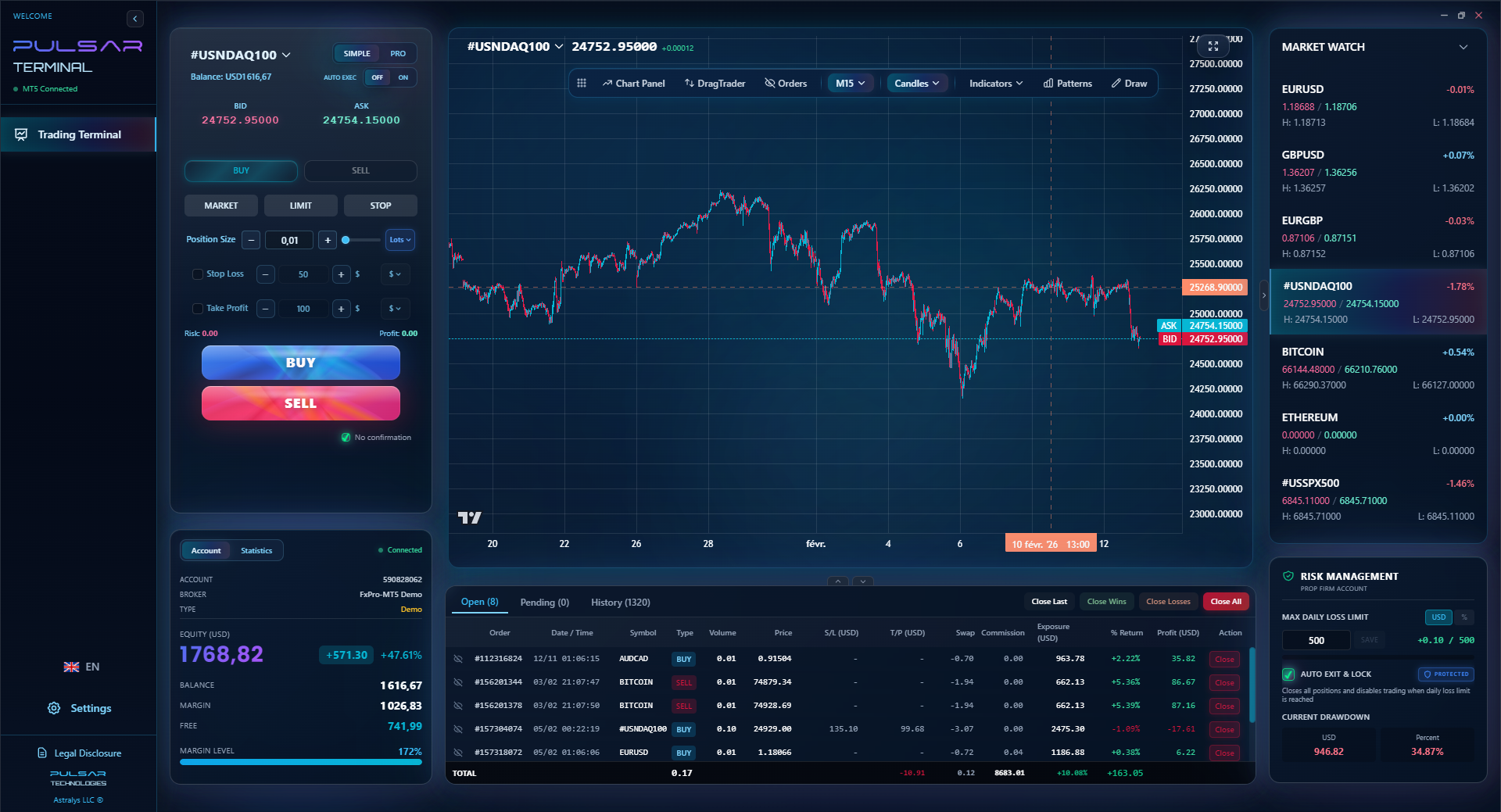
Managing the emotional risk of manually moving stops is a huge challenge, which is why automating risk rules with a tool like Pulsar Terminal directly on your MT5 can be a game-saver.
Pulsar Terminal
La herramienta MT5 todo-en-uno: órdenes drag-and-drop, multi-TP/SL, trailing stop, grid trading, Volume Profile y protección prop firm. Usado por más de 1.000 traders diariamente.
“Boring, systematic trading is profitable trading. Excitement is expensive.”
Before you trade a single Naira, this should be your routine. Print it out.
Pre-Trade (The 'Can I Trade?' Check):
- Market State: Is the market in a clear session (London, NY)? Is news volatility high? Check an economic calendar.
- Mental State: Am I tired, emotional, or desperate? If yes, walk away.
- Trade Idea: Do I have a clear technical or fundamental reason for this trade? Is it aligned with my strategy?
Trade Setup (The 'How I Trade' Check):
- Key Levels Identified: Where is entry, stop-loss (SL), and take-profit (TP)?
- Risk Calculated: What is the pip distance from entry to SL? (e.g., 25 pips).
- Position Sized: Using my account balance and my 1% risk rule, what is my exact position size? (Use a calculator!).
- RRR Checked: Is my reward (entry to TP) at least 1.5 times my risk? If not, is the trade worth it?
- Orders Set: Have I placed the entry, SL, and TP orders correctly in the platform? Have I double-checked they are 'Buy Stop'/'Sell Stop' if needed?
Post-Trade (The 'Hands-Off' Check):
- Walk Away: Once the trade is live, I do not modify the SL unless moving to breakeven based on a pre-defined rule (e.g., after price moves 1.5x my risk in my favor).
- Journal Entry: I record the trade, the reasoning, the outcome, and my emotion.
- Review: At week's end, I review all trades. What worked? What didn't? Was my risk management followed?
This process turns trading from a reactive emotional activity into a boring, systematic business. And boring is profitable. The recent Nigerian FX Code's emphasis on 'Risk Management and Compliance' for institutions is a mirror we should hold up to ourselves. Managing risk isn't about avoiding losses; it's about ensuring no single loss, or series of losses, can knock you out of the market. That's how you survive long enough to let your edge work. For a market that requires its own unique risk approach, consider the insights in our XAU/USD guide on trading gold.
FAQ
Q1What is the most important rule of risk management in forex trading for a beginner in Nigeria?
The 1% rule. Never risk more than 1% of your total trading account capital on a single trade. This means if you have 300,000 NGN (approx. $200), your maximum loss on any trade should be 3,000 NGN ($2). This protects you from blowing up your account with a few bad trades.
Q2Is forex trading legal in Nigeria, and how does that affect my risk?
Yes, forex trading is legal. It's regulated by the CBN and SEC. The legal risk comes from using unregulated or fraudulent brokers. Your first risk management step is choosing a broker regulated by a reputable authority (like FSCA, CySEC) that offers negative balance protection. This legally safeguards your deposit from being completely lost if the broker fails.
Q3How do I calculate my position size in forex?
You need three things: your account balance in USD, your risk percentage (e.g., 1%), and your stop-loss in pips. The formula is: (Account Balance x Risk %) / (Stop-Loss in Pips x Pip Value). This is cumbersome manually. Always use a free online position size calculator. Input your numbers, and it tells you exactly how many units or lots to trade.
Q4What's a good risk-to-reward ratio for a Nigerian trader?
Aim for a minimum of 1:1.5. This means for every 1 pip you risk, your target profit is 1.5 pips away. With this ratio, you can be wrong more often than you're right and still be profitable. For example, if you lose 4 trades (losing 4 pips total) and win 3 trades (gaining 4.5 pips total), you're still up 0.5 pips.
Q5Do I pay tax on my forex trading profits in Nigeria?
Yes. The Federal Inland Revenue Service (FIRS) requires a 10% Capital Gains Tax on your gross trading profits. Your international broker won't deduct this. You are responsible for tracking your annual profits, calculating the 10%, and declaring/remitting it to the FIRS. Failing to do so carries financial and legal risk.
Q6How does use increase my risk?
use itself doesn't increase risk if you control your position size. The danger is that high use tempts you to trade a position size that's too large for your account. If you have $100 and use 1:500 use, you could control $50,000. A tiny 0.2% move against you would wipe out your $100. The key is to use use to free up margin, not to maximize position size. Always let your 1% risk rule dictate your position size first.
Q7What should I do after a big losing trade?
Stop trading for the day. This is a critical rule. The urge for a 'revenge trade' is overwhelming and leads to disastrous decision-making. Close the platform. Go do something else. Review the trade objectively tomorrow with a clear head. Your risk management system includes managing your emotional state, not just your money.
Lección del Prof. Winston
Puntos clave:
- ✓Risk only 1% of capital per trade
- ✓Always use a stop-loss order
- ✓Aim for a 1:1.5 risk-reward minimum
- ✓Never trade after a big loss
- ✓Tax 10% of profits for FIRS
¿Te resultó útil este artículo?
Haz clic en una estrella
Análisis Trading Semanal
Análisis y estrategias semanales gratis. Sin spam.
Sobre el autor
Olumide Adeyemi
Pionero del Trading en África Occidental
Uno de los educadores de trading forex más activos de Nigeria. 8 años de experiencia operando desde Lagos. Especialista en estrategias de bajo capital y desafíos de prop firms para traders africanos.
Comentarios
Aviso de riesgo
El trading de instrumentos financieros conlleva un riesgo significativo y puede no ser adecuado para todos los inversores. El rendimiento pasado no garantiza resultados futuros. Este contenido tiene fines educativos únicamente y no debe considerarse asesoramiento de inversión. Siempre realice su propia investigación antes de operar.
También te puede interesar

Cara Trading Forex Sukses: 7 Prinsip dari Trader Profesional
Cara trading forex sukses dengan 7 prinsip trader pro: manajemen modal, disiplin, journal trading, backtest. Data nyata, bukan janji profit palsu.
Jam Trading Forex Terbaik untuk Trader Indonesia: Panduan Lengkap dengan Tabel Waktu
Panduan jam trading forex untuk trader Indonesia. Tabel 4 sesi dunia, jam emas 20:00-00:00, sesi mana yang harus dihindari. Data akurat + tips dari trader berpengalaman.
Top 5 Sàn Forex Uy Tín Nhất 2026: Review Jujur dari Trader Indonesia
Top 5 sàn forex uy tín 2026 untuk trader Indonesia. Review jujur: spread, deposit, withdraw, dukungan lokal. Exness, XM, IC Markets & lebih.
Obtener Pulsar Terminal
Todas estas calculadoras están integradas en Pulsar Terminal con datos en tiempo real de su cuenta MT5.
Obtener Pulsar Terminal