


I paid $1,200 for a 'straight to funded' $100k account.

James Mitchell
Analista de Trading Sénior
☕ 10 min de lectura
Lo que aprenderás:
- 1What Are "Straight to Funded" Prop Firms, Really?
- 2The Real Cost of Skipping the Line
- 3The US Regulatory Gray Area (And Why It Matters to You)
- 4Who Should Actually Consider Instant Funding? (It's a Short List)
- 5Red Flags and How to Vet a Firm
- 6The Smarter, Cheaper Alternative Path
- 7My Final Verdict: A Solution in Search of a Problem

I paid $1,200 for a 'straight to funded' $100k account. I was up $3,800 in the first week, feeling like a genius who'd beaten the system. Then, on a quiet Tuesday, a rogue news spike on the EUR/USD wiped out my entire daily loss limit in 90 seconds. Account gone. No reset, no refund. Just a $1,200 lesson in why skipping the line often means you're not ready for what's at the front of it. Let's talk about whether these instant-access deals are your golden ticket or just a very expensive mistake.
Forget the traditional two-step evaluation. The standard prop firm model has you pay a fee (say, $150), pass a challenge hitting profit targets without blowing a daily or max loss, then get a funded account where you split profits. It's a filter.
Straight to funded prop firms remove that filter. You pay a significantly higher upfront fee - anywhere from $300 to over $2,000 - and you get immediate access to a simulated trading account with the firm's "capital." There's no proving period. You start trading for a profit split from day one.
Here's the critical thing to understand: In almost all cases, you are not trading real money in a live market from the start. You're trading in a simulated environment. The firm only risks its actual capital once you've proven you can be consistently profitable within their system, which usually means after your first payout or a certain time period. You're paying a premium for the label of being funded, not necessarily for the immediate transfer of real economic risk to the firm.

Warning: The term "funded" is a marketing tool here. You are buying a high-stakes demo account with a potential path to real payouts. Don't confuse the label with the reality.
“You're paying a premium for the label of being funded, not necessarily for the immediate transfer of real economic risk.”
Let's talk numbers, because this is where the math gets interesting (and often painful).
A standard two-phase evaluation for a $100k account might cost you $150. If you blow it, you can often reset for a fraction of that cost. The straight to funded price for that same $100k account? Easily $600 to $1,200. You're paying 4 to 8 times more upfront.
Why would you do that? The argument is time and psychological relief. No more stress of hitting a profit target under a time limit. But let's reframe that cost. That extra $450-$1,050 you're paying is dead money if you fail. It's a sunk cost with no reset option. With a standard eval, your $150 loss buys you education and a reset chance. With the straight to funded model, your four-figure loss might buy you one bad trading day.
I saw a firm offering a $400k "instant funding" account for $1,651. That's a serious chunk of change. For that money, you could buy over ten standard eval attempts at a reputable firm and have a far higher statistical chance of eventually getting funded through the traditional route. The straight to funded model banks on your impatience and overconfidence.

Example:
- Traditional Route: $150 eval fee. Pass rate ~10%. You can afford 6-7 attempts for the price of one instant account.
- Straight to Funded: $1,000 one-time fee. If your funded account success rate is less than 10% (industry data suggests it is), this is a terrible expected value bet.
The profit split is usually the same (80/90% to you), so you're not buying better terms. You're buying a bypass with a much higher entry toll. Before you pay it, ask if your trading is truly consistent enough to warrant that premium. If it is, why not just pass a cheap eval and keep the extra grand in your pocket? Using a solid position size calculator from day one in a standard eval is a far cheaper way to prove your discipline.

💡 Consejo de Winston
A trader who pays to avoid a test is confessing they cannot pass it. The market's test is coming regardless, and it costs more.
“If you can't pass a standard evaluation, you will almost certainly fail in a straight to funded account.”
This is the part most traders gloss over, but it's the bedrock of risk. In the US, prop firms have historically operated in a regulatory gray area. They're not brokers (like IC Markets or Pepperstone), so they're not registered with the CFTC or SEC as Futures Commission Merchants or broker-dealers. They position themselves as educational services or firms trading their own capital.
This has allowed them to set their own rules: profit targets, loss limits, restricted instruments, and crucially, rules on withdrawals and what constitutes a violation. When you're in a gray area, the firm's Terms of Service are king. There is no regulatory body you can appeal to if they shut your account for a "violation" you dispute.
Now, the winds are shifting. The SEC and CFTC are sniffing around. There's talk of potentially requiring some of these firms to register, especially those offering futures or crypto. The Digital Asset Market Clarity Act (CLARITY Act) could force crypto prop firms under CFTC oversight. What does this mean for you in 2025/2026?
Potential for Change: Rules could become more standardized and trader-friendly. But there's also a real risk that some firms, especially smaller ones, could fold or radically change their models if new capital or compliance requirements hit. That "straight to funded" account you paid for could simply vanish if the firm's legal structure is challenged. Your fee is likely non-refundable.

Pro Tip: Always, always read the Terms of Service. Look for clauses on "right to amend terms," "force majeure," and account termination. Your money and effort are at the mercy of that document.

“If you can't pass a standard evaluation, you will almost certainly fail in a straight to funded account.”
I'm not saying these models are universally bad. For a very specific type of trader, they can make sense. But you need to be brutally honest with yourself.
The Disciplined, Proven Consistent Trader
You have at least 12-18 months of verified, consistent profitability in your own live account or in a traditional prop firm account. You have a rock-solid risk management system (max 1-2% risk per trade) and your equity curve is smooth, not spiky. You're not looking for a shortcut; you're looking for efficient capital allocation. The higher fee is just a cost of business to access more size without the hassle of another eval. Your edge is so well-defined that paying the premium is a calculated business expense.
The Psychologically Blocked Trader
Some traders have a mental block with evaluations. The pressure of the profit target creates self-sabotage. Once funded, they trade flawlessly. If you have concrete evidence this is you (e.g., you've failed 5+ evals near the target but have a long demo track record of steady gains), then the straight to funded route might be a psychological workaround. It's expensive therapy, but it could work.
For everyone else - especially newcomers or traders still refining their system - this is a capital incinerator. If you're still experimenting with strategies like scalping or swing trading frameworks, or if you don't know your win rate and risk-reward ratio cold, you are donating your money. Start with a standard eval or, better yet, a small live account. The pain of losing real money in a $500 account will teach you more than any instant-funded sim account ever will.
💡 Consejo de Winston
Regulatory gray areas are where retail money goes to turn into firm revenue. Seek clarity, not clever loopholes.
“The straight to funded model banks on your impatience and overconfidence.”
If you're in that narrow category of trader for whom this makes sense, here’s how to pick a firm without getting scammed.
Major Red Flags:
- Overly Generous use: Offering 1:500 on a $200k instant account? That's a risk trap, not a benefit. It's designed to make you blow up faster.
- Vague or Buried Terms: If you can't easily find the full rules on daily loss, maximum drawdown, and restricted news trades, run.
- "Guaranteed" Payouts or Bonuses: This is gambling marketing, not professional trading.
- No Verifiable Payout Proof: A reputable firm will have a transparent track record of paying traders. Look for consistent, recent payout evidence on independent forums, not just testimonials on their site.
- Unrealistic Profit Splits: 100% profit splits from day one are often gimmicks with huge hidden caps or conditions.
What to Look For:
- Clear, Consistent Rules: The best firms have simple, transparent rules. A daily loss limit based on your balance (e.g., 5%), a max trailing drawdown (e.g., 10%), and a clear list of what you can and can't trade.
- Realistic Scaling Plans: How do you grow from a $50k to a $200k account? It should be based on consistent profit milestones, not more fees.
- Responsive Support: Test their customer service before you buy. Ask a detailed question about their rules. Slow or copy-paste answers are a bad sign.
- Popular, Time-Tested Instruments: They should offer major forex pairs like EUR/USD, major indices, and commodities like XAU/USD. Be wary of firms that only offer obscure instruments.
Your first line of defense is your own due diligence. Don't get sold by a slick website.
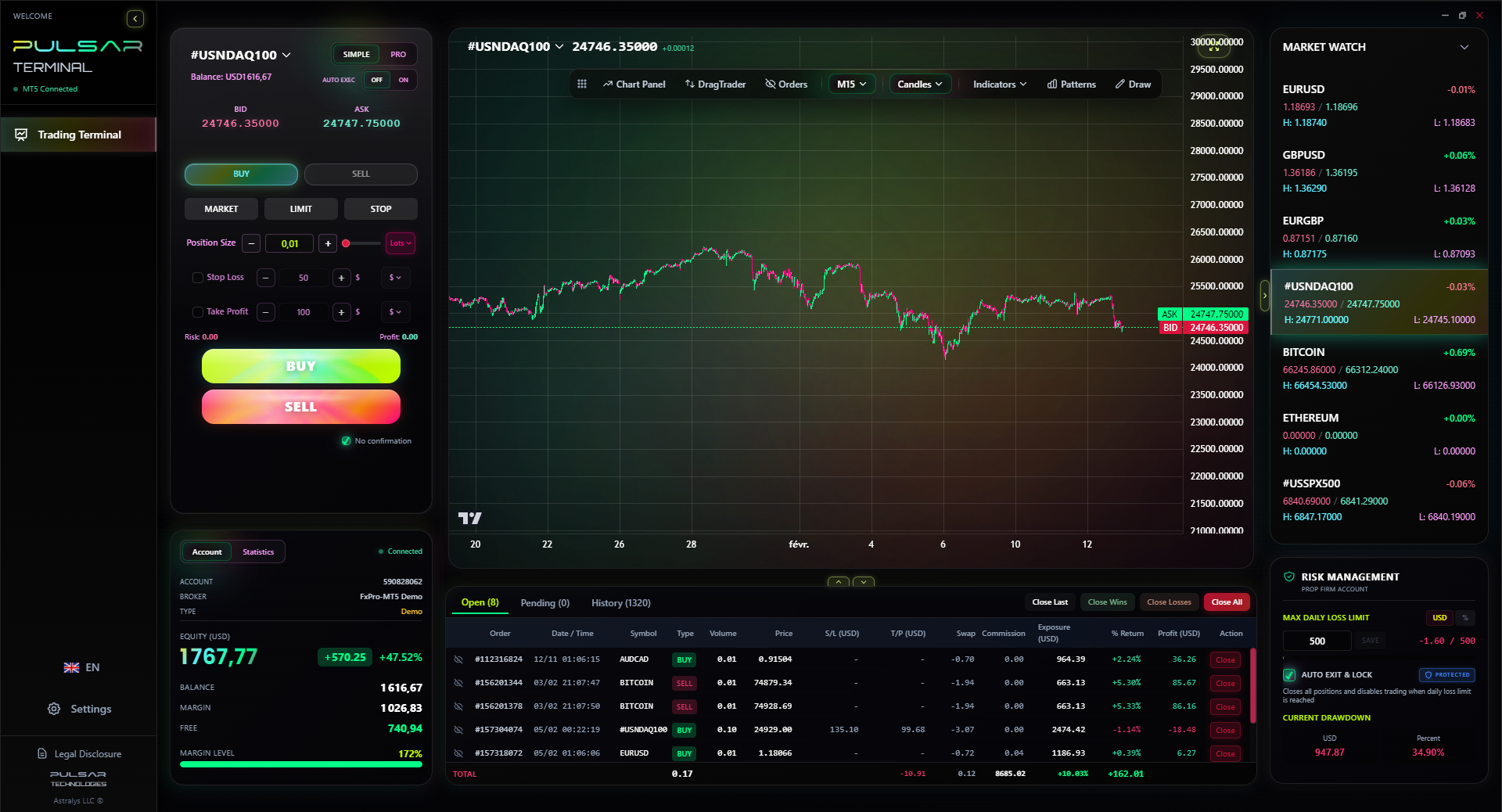
Managing the strict daily loss limits of a prop firm account is non-negotiable, and Pulsar Terminal's automated trade management tools enforce your rules directly on MT5 before your emotions can interfere.
Pulsar Terminal
La herramienta MT5 todo-en-uno: órdenes drag-and-drop, multi-TP/SL, trailing stop, grid trading, Volume Profile y protección prop firm. Usado por más de 1.000 traders diariamente.
“The straight to funded model banks on your impatience and overconfidence.”
Let me propose a different plan. It's less sexy, but it will make you a richer and better trader.
Step 1: Treat Your Own Capital as Prop Capital. Open a small live account with a reputable, well-regulated broker like Exness or XM. Fund it with $500-$1000 - the same amount you'd waste on an instant funding fee. Apply your own prop firm rules: a 5% max drawdown, a daily loss limit. Use a position size calculator for every single trade. Your goal is not to get rich, but to prove you can follow your own rules for 3-6 months without blowing up.
Step 2: Pass a Standard Evaluation. Once you've proven consistency with your own money, buy a standard eval from a top-tier firm. The pressure should now be familiar, not terrifying. Your risk management will be automatic. The cost is low, and you can reset if you make a rookie mistake.
Step 3: Get Funded & Scale. Pass the eval. Now you have a funded account with real profit potential. The firm's capital is at risk. You've spent a fraction of the cost, retained your discipline, and you own a verifiable track record. This path builds a real career. The straight to funded path often just builds dependency on a firm's sim account.
The tools you need for this path are free or cheap: a trading journal, a calculator, and discipline. You don't need to buy your way out of the learning curve. In fact, trying to do so is the single biggest predictor of failure I've seen. Mastering the basics of a pip definition and how spread definition affects your entries is more valuable than any instant account.
💡 Consejo de Winston
Your best prop firm evaluation is your own live account statement. Build that first, and the firms will come to you.

“Focus on building a real edge, not buying a fake badge.”
Here's my blunt take: Straight to funded prop firms are a business model that exploits a trader's two greatest weaknesses - impatience and the desire for status.
They sell the dream of being a "funded trader" without the hard, humbling work of actually earning it through a controlled evaluation. They monetize your fear of failure in the eval phase. But here's the dirty secret: If you can't pass a standard evaluation, you will almost certainly fail in a straight to funded account. The rules (daily loss, max drawdown) are usually identical. The only thing that's removed is the profit target, but if you can't hit a profit target, how exactly do you plan to make withdrawals?
The data doesn't lie. Industry figures suggest only about 7% of funded accounts ever see a payout. I'd wager the success rate for straight to funded accounts is even lower, because they attract traders who are overconfident and under-prepared.
Save your money. Invest it in your education, in a proper trading journal, or in a small live account. The path to sustainable funding is a marathon of discipline, not a sprint you can buy. If your strategy and psychology are truly ready for a funded account, passing a $150 challenge will be a formality. If they're not, no instant funding package in the world will save you from the inevitable margin call of your own making.
Focus on building a real edge, not buying a fake badge.
FAQ
Q1What's the main difference between a standard prop firm eval and a straight to funded account?
The standard eval has a profit target you must hit within a time limit to get funded. The straight to funded account skips that: you pay a much higher fee and get immediate access to a trading account with profit-split terms. However, you're usually in a simulated environment until your first payout, and the risk management rules (daily loss, max drawdown) are still strictly enforced.
Q2Are straight to funded prop firms legal in the USA?
They operate in a regulatory gray area. They are not registered brokers, so they avoid direct SEC/CFTC oversight by acting as firms trading their own capital or as educational services. This means your primary protection is their Terms of Service, not federal regulation. This landscape is under review and could change.
Q3What is a typical profit split with a straight to funded firm?
Splits are generally similar to traditional firms, commonly ranging from 80/20 to 90/10 in your favor. Some offer tiered plans that increase to 95/5 or even 100/0 after several successful payouts. Don't be dazzled by the top number; focus on the consistency of the payout process and any hidden caps.
Q4Can I withdraw my profits immediately from a straight to funded account?
Usually, no. Most firms have a "first payout" rule, requiring you to reach a minimum profit threshold (e.g., 1-2% of account size) and sometimes wait a minimum number of trading days (e.g., 14-30 days) before your first withdrawal is processed. This is their verification period.
Q5Is it better to try multiple standard evaluations or buy one straight to funded account?
Statistically and financially, multiple standard evaluations are almost always better. For the price of one instant account ($600-$1200), you can afford 4-8 standard eval attempts. This gives you multiple chances to learn and pass, whereas one mistake in the instant account loses your entire large fee.
Q6What happens if I hit the daily loss limit in my straight to funded account?
In the vast majority of cases, your account is immediately terminated with no refund. This is the core risk. There's no reset option like some standard evals offer. You break the rule, you're out, and your significant upfront fee is gone.
Q7Do straight to funded firms offer real money trading from day one?
Almost never. You are trading in a simulated environment. The firm typically only allocates real capital to your strategy once you've proven profitability through your first successful payout cycle. You are paying for access to their simulation and the opportunity to trade real capital.
Lección del Prof. Winston
Puntos clave:
- ✓Instant funding fees are 4-8x a standard eval, a poor expected value bet.
- ✓Only ~7% of funded accounts ever receive a payout; instant likely lower.
- ✓You trade simulated capital until first payout, not real money.
- ✓One rule violation typically terminates account with no refund.
¿Te resultó útil este artículo?
Haz clic en una estrella
Análisis Trading Semanal
Análisis y estrategias semanales gratis. Sin spam.
Sobre el autor
James Mitchell
Analista de Trading Sénior
Con sede en Nueva York y más de 9 años de experiencia en trading. Se enfoca en pares USD principales, desafíos de prop firms y el panorama regulatorio estadounidense.
Comentarios
Aviso de riesgo
El trading de instrumentos financieros conlleva un riesgo significativo y puede no ser adecuado para todos los inversores. El rendimiento pasado no garantiza resultados futuros. Este contenido tiene fines educativos únicamente y no debe considerarse asesoramiento de inversión. Siempre realice su propia investigación antes de operar.
También te puede interesar

Cara Trading Forex Sukses: 7 Prinsip dari Trader Profesional
Cara trading forex sukses dengan 7 prinsip trader pro: manajemen modal, disiplin, journal trading, backtest. Data nyata, bukan janji profit palsu.
Jam Trading Forex Terbaik untuk Trader Indonesia: Panduan Lengkap dengan Tabel Waktu
Panduan jam trading forex untuk trader Indonesia. Tabel 4 sesi dunia, jam emas 20:00-00:00, sesi mana yang harus dihindari. Data akurat + tips dari trader berpengalaman.
Top 5 Sàn Forex Uy Tín Nhất 2026: Review Jujur dari Trader Indonesia
Top 5 sàn forex uy tín 2026 untuk trader Indonesia. Review jujur: spread, deposit, withdraw, dukungan lokal. Exness, XM, IC Markets & lebih.
Obtener Pulsar Terminal
Todas estas calculadoras están integradas en Pulsar Terminal con datos en tiempo real de su cuenta MT5.
Obtener Pulsar Terminal