


I watched the USD/ZAR chart on October 12, 2025, as it spiked from 18.45 to 19.20 in under four hours.

David van der Merwe
Trader de Mercados Emergentes ·  South Africa
☕ 11 min de lectura
Lo que aprenderás:
- 1What 'The Forex Bar' Really Means (It's Not a Pub)
- 2The South African Market Structure & Real Costs
- 3How Most South African Traders Blow Up: The Classic Patterns
- 4Building a Survival Plan for the Bar
- 5Tools to Navigate the Chaos
- 6The Psychological Edge: Staying Sober in the Bar
- 7Putting It All Together: A Realistic Path Forward
I watched the USD/ZAR chart on October 12, 2025, as it spiked from 18.45 to 19.20 in under four hours. My phone buzzed with margin call alerts from three different clients. They'd all made the same mistake: treating the forex market like a predictable machine instead of what it really is - a chaotic, crowded bar where the biggest players elbow everyone else out of the way. That's 'the forex bar.' It's not some trendy spot in Sandton. It's the psychological and structural reality of where price actually gets made. And if you don't understand the layout, you're just buying drinks for the professionals.
When South Africans hear 'the forex bar,' they might picture a physical place. Maybe that spot in Cape Town where traders congregate. But in market terms, it's a metaphor for the liquidity pool - the noisy, crowded space where all buying and selling happens.
Think of it like the Long Street of finance. At one end, you've got the big banks and institutional traders (the 'VIP section'). They're placing massive orders that move the whole market. In the middle, you have the hedge funds and prop firms. At the crowded public bar, that's us: the retail traders. We get the prices they've already set, after the spread (the 'cover charge') has been taken.
The problem? Most local traders walk in thinking it's a quiet library. They plot their RSI and MACD indicators on a clean chart and expect orderly behavior. But the forex bar is all about noise, herd mentality, and sudden stampedes. Price doesn't move because your indicator turned green. It moves because a large player at the VIP section decided to buy a billion dollars worth of USD, and everyone else is scrambling to get out of the way.

Warning: Your broker's chart shows a smoothed-out version of reality. You're not seeing the thousands of tiny orders that get instantly swallowed or the liquidity gaps that appear during news events. That's like only seeing the dance floor from the bathroom line.
I learned this the hard way in 2018. I was short on EUR/USD during what looked like a perfect bearish setup. My MACD indicator was confirming, everything looked textbook. Then, out of nowhere, a 40-pip spike wiped out my stop loss before price immediately resumed its downtrend. That was my first real introduction to the bar's bouncer: stop-hunting liquidity grabs. The market didn't care about my analysis. It saw a cluster of retail stops and took them.
“The forex bar is all about noise, herd mentality, and sudden stampedes.”
Let's talk about the local rules of this bar. The FSCA caps use at 30:1 for retail clients. That's a good thing, but it doesn't make the bar any less dangerous. It just means your tab has a limit.
The True Cost of a Round
Your main cost is the spread. On USD/ZAR, the spread can be 50-80 pips during volatile hours. That's R500-R800 gone before you even start on a standard lot. Compare that to EUR/USD at 0.6 pips. You're paying a massive 'South African premium' for trading your home currency pair.
| Cost Factor | USD/ZAR (Typical) | EUR/USD (Typical) | Impact on R10,000 Account |
|---|---|---|---|
| Average Spread | 60 pips | 0.8 pips | You need 0.6% move just to break even |
| Commission (if applicable) | Often built into spread | $7 per round lot | Harder to calculate, but adds up |
| Overnight Swap | Can be huge (±R150/day) | Usually small | Can erase profits on held positions |
Then there's funding. Sending money to an international broker like IC Markets or Pepperstone costs you. A Capitec international payment fee is R250. If you're depositing R5,000, you're down 5% before you've placed a single trade. This forces many to start too small or chase unrealistic returns to cover fees.
The ZAR's Personality
USD/ZAR isn't just a pair. It's a mood ring for global risk sentiment. When commodities dip or US rates are discussed, the ZAR gets hammered. It's an emerging market currency, which means it's the first to get sold when the bar gets rowdy (risk-off) and bought when everyone's feeling good (risk-on). Trading it requires watching gold prices, the SA political news, and the US Dollar Index - not just your chart.

Example: Let's say you buy 1 standard lot of USD/ZAR at 18.5000. The spread is 60 pips, so you're in the red by R600 immediately (1 pip on USD/ZAR = ~R10 with a ZAR account at this rate). Price needs to hit 18.5060 for you to be at breakeven. That's a bigger hurdle than most realize.

💡 Consejo de Winston
If you can't articulate the exact reason for your trade in one sentence - including where you'll be wrong (your stop loss) - you have no business being in the market. Ambiguity is the enemy.
“You're paying a massive 'South African premium' for trading your home currency pair.”
After mentoring hundreds of local traders and seeing thousands of statements, the failure patterns are painfully consistent. It's not bad luck. It's a predictable series of mistakes rooted in misunderstanding the forex bar's mechanics.
Pattern 1: The Overtrader. They start with R2,000. The 30:1 use feels restrictive, so they use it all on one or two trades. A standard lot on USD/ZAR controls R1.85 million with R61,666 margin. A 35-pip move against them triggers a margin call. Account gone in hours. They never even paid the bar tab (spread); they got kicked out at the door.
Pattern 2: The Rand Patriot. They only trade USD/ZAR because 'they understand it.' They ignore the horrific spreads and extreme volatility. They treat it like a stock, holding for weeks, while the swap fees eat them alive. I once held a USD/ZAR short for 5 days in 2022. I made 120 pips on the move, but the negative swap was -R92 per night. Net profit was slashed by nearly 25%. I was right on direction but wrong on the cost of holding.
Pattern 3: The Indicator Junkie. They load 12 indicators on MT4, creating a rainbow of confusion. Every signal contradicts another. In the noisy forex bar, this is like trying to have a deep conversation during peak hour. Price action - the raw movement of the crowd - gets completely ignored. Simpler is almost always better. A clean chart with support/resistance and volume is often more telling.
These patterns all stem from the same core error: treating trading as a technical puzzle to solve, not a probabilistic game of risk management in a chaotic environment. Your edge doesn't come from predicting the crowd. It comes from managing your position so you survive when the crowd tramples you.
“You're paying a massive 'South African premium' for trading your home currency pair.”
Surviving means changing your entire approach. It's not about winning big. It's about not losing.
1. Position Size is Your Armor. This is non-negotiable. Use a position size calculator for every single trade. My rule: never risk more than 1% of your account equity on any one trade. For a R10,000 account, that's R100. On USD/ZAR with a 100-pip stop loss, that means you can only trade about 0.1 lots (a mini lot). It feels tiny. That's the point. You need to be small enough to withstand 10-20 losing trades in a row without panicking. Most traders can't handle the psychology of taking 15 small losses to find 3 big winners.
2. Choose Your Battleground. Do you really need to trade USD/ZAR? Start with the majors. EUR/USD, GBP/USD, USD/JPY have tighter spreads and more predictable liquidity. You're paying less to be in the game. Once you're consistently profitable there, then consider the local pair. I made this switch in 2020. My profitability didn't come from better analysis. It came from my costs dropping by 80%. This guide on EUR/USD explains why it's a better training ground.
3. Trade the Session, Not the Screen. The forex bar has quiet hours and happy hours. The 3 PM-5 PM SA time overlap with London and New York openings is when volume (and volatility) spikes. That's when big moves happen. It's also when spreads widen and stop runs are common. Either trade with extreme caution then, or avoid it altogether. I do my analysis in the morning, set my orders, and walk away. Watching the screen during high volatility leads to emotional decisions.

Pro Tip: Open a demo account with a broker known for raw spreads like Exness or IC Markets. Practice trading only during the first 2 hours of the London session. Your goal isn't profit. Your goal is to execute 20 trades with perfect 1% risk management, regardless of outcome. This builds the muscle memory you need.
💡 Consejo de Winston
Your first 100 trades should be about collecting data on yourself, not making money. The market will teach you who you are under pressure. Listen.
“Your edge doesn't come from predicting the crowd. It comes from managing your position so you survive when the crowd tramples you.”
You need the right gear. MT4 or MT5 is standard, but it's a basic tool. You need to enhance it.
Volume is Your Truth-Teller. The default MT4 volume indicator is often just tick volume. You need to understand where real buying and selling pressure is. Tools that show volume profile (where most trading happened at specific prices) reveal the bar's true layout. Where did the big players buy? That's a support zone. Where did they sell? That's resistance.
Order Management is Critical. The biggest psychological leak for new traders is moving stop losses. You need a system that takes the emotion out. Whether it's a hard rule ('I never move a stop loss further away') or using automated tools that trail your stop for you, this must be decided before you enter the trade.
Broker Choice Matters. A broker with tight spreads and fast execution is like having a good connection at the bar. You get served quicker and pay less. But remember, even the best broker is just giving you access to the chaos. They're not your friend. Do your due diligence with our XM review and others to find one that fits your style, especially for scalping strategies where costs are paramount.
The goal of tools isn't to predict the future. It's to create clear, unambiguous rules for entry, exit, and risk so that when the bar erupts into a frenzy, you're not making decisions. You're following a plan.
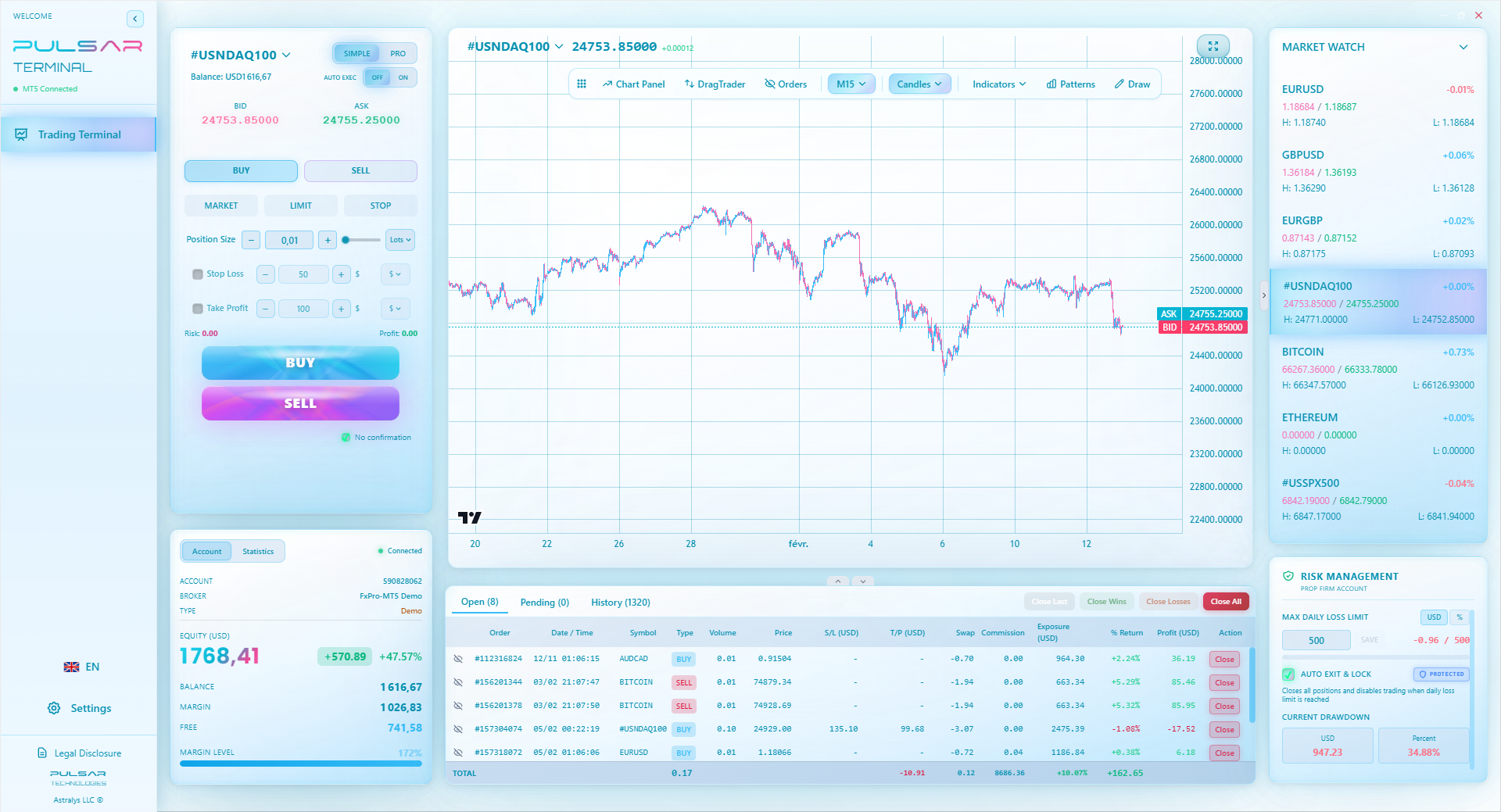
Managing multiple trades and emotions in a volatile market is hard; Pulsar Terminal automates your risk rules like trailing stops and partial closures directly on your MT5 chart, so you can't panic and break your plan.
Pulsar Terminal
La herramienta MT5 todo-en-uno: órdenes drag-and-drop, multi-TP/SL, trailing stop, grid trading, Volume Profile y protección prop firm. Usado por más de 1.000 traders diariamente.
“Your edge doesn't come from predicting the crowd. It comes from managing your position so you survive when the crowd tramples you.”
This is the final, hardest layer. The forex bar is designed to trigger every emotional response you have.
FOMO (Fear Of Missing Out): You see USD/ZAR ripping higher. You jump in late, near the top, because you can't stand watching profits you didn't make. The bar is loudest at the top and quietest at the bottom.
Revenge Trading: You take a R500 loss. Your brain wants it back immediately. You double your size on the next trade, breaking all your rules. This is the equivalent of drinking more to forget your hangover. I've done this. In 2019, after three losing trades, I revenge-traded GBP/JPY with 3x my normal size. I lost 17% of my account in 45 minutes. I had to shut down for two weeks.
Hope: Your trade is 50 pips in the red. Your stop loss is right there. You delete it, 'hoping' it will come back. This is refusing to leave the bar at closing time. You will get kicked out, and it will be ugly.
The antidote is a trading journal. Not just 'bought EUR/USD, won.' You need to log:
- Your emotional state before the trade (Stressed? Tired? Overconfident?)
- The exact risk (in Rands) you took
- The reason for the entry (e.g., '1H support bounce' not just 'looked good')
- A screenshot of the chart at entry
After 100 trades, you'll see your personal patterns. You'll see that you lose more on Fridays. Or that you're great at entries but terrible at exits. This self-awareness is your only true edge. Everyone has the same charts. No one has your specific psychological weaknesses.
💡 Consejo de Winston
The spread isn't a fee. It's the market's first opinion on your trade. If you're consistently fighting against a wide spread, the market is telling you you're in the wrong place.
“The goal isn't to predict the future. It's to create clear, unambiguous rules for entry, exit, and risk.”
So, what's the actionable plan for a South African trader right now?
Month 1-3: Education & Simulation.
- Read the FSCA's warnings about CFD trading. Understand this is high-risk.
- Fund a demo account with R100,000 virtual money.
- Pick ONE major pair (not ZAR).
- Practice the 1% risk rule on every trade. Your goal is to have 100 trades in your journal with perfect risk management, not to make fake profit.
Month 4-6: Micro-Live Trading.
- Deposit the minimum amount with a reputable broker - maybe R1,000 or R2,000. This is real money, so the psychology changes.
- Trade micro lots (0.01). Your goal is to make 20 live trades where the process feels identical to your demo trades. The P&L is irrelevant. The process is everything.
- Focus on the cost. Calculate your exact spread cost, commission, and swap for every trade. Become obsessed with reducing friction.
Month 7+:
- Only now, consider scaling your capital. If you've survived 6 months with disciplined micro-lot trading, you might have a process.
- Consider if swing trading suits your personality better than staring at screens all day.
- Re-evaluate your broker. Do you need tighter spreads? Better tools?
The forex bar isn't going away. The noise, the volatility, the costs - they're features, not bugs. Your job isn't to outsmart it. Your job is to build a system that allows you to sit in the corner, place your small, calculated bets, and walk out with your shirt still on when the inevitable fight breaks out. Most won't. The ones who do understand that the bar always wins if you try to beat it. You can only hope to pay for your drinks and leave quietly.
FAQ
Q1Is forex trading legal in South Africa?
Yes, it's legal for individuals. The Financial Sector Conduct Authority (FSCA) regulates local brokers and caps retail use at 30:1. However, you are not permitted to speculate against the South African Rand with a local broker. Many South Africans use international brokers, but the FSCA can't help if you have a dispute with them.
Q2What's a realistic starting amount for a South African trader?
Realistically, R5,000 to R10,000. Starting with less than R2,000 is very difficult because of transaction fees (R250+ per international transfer) and the need to trade micro lots to properly manage risk. Starting too small often leads to overtrading to 'make it worthwhile,' which is a fast path to a blown account.
Q3Why are spreads on USD/ZAR so high?
USD/ZAR is an emerging market currency pair. It has lower liquidity than majors like EUR/USD, meaning fewer buyers and sellers at any given moment. To compensate for this higher risk and lower volume, brokers and liquidity providers widen the spread. It's the 'South African risk premium.' You pay for the volatility.
Q4Do I pay tax on forex trading profits in South Africa?
Yes. SARS treats net profits from trading as income, not capital gains. You must declare it in your annual tax return, even if your broker is offshore. Keep detailed records of all trades, deposits, withdrawals, and statements. You can deduct certain trading-related expenses.
Q5What's the single biggest mistake South African traders make?
Using excessive position size relative to their account. They see 30:1 use on a R5,000 account and think they can trade a full lot. One bad move on USD/ZAR can wipe them out in minutes. They mistake use for opportunity instead of the risk multiplier it is.
Q6Should I use a local or international broker?
It's a trade-off. Local FSCA-regulated brokers offer legal protection but have stricter use (30:1). International brokers like IC Markets or Pepperstone may offer higher use and tighter spreads but operate under foreign regulation. Your funds may be further away, and currency conversion fees apply. Always check a broker's reputation with a detailed review first.
Q7What is a 'pip' worth on USD/ZAR?
The value changes with the exchange rate. A rough formula: (0.0001 / Current USD/ZAR Rate) * Lot Size. For a standard lot (100,000 units) at USD/ZAR 18.50, one pip is about (0.0001 / 18.50) * 100,000 = R10.81. Use a pip calculator to get the exact value before you trade.
Lección del Prof. Winston
Puntos clave:
- ✓Risk a maximum of 1% per trade. No exceptions.
- ✓Trade majors first. Avoid the ZAR's high-cost volatility.
- ✓Your trading journal is more important than your strategy.
- ✓Broker fees and spreads are silent account killers.
¿Te resultó útil este artículo?
Haz clic en una estrella
Análisis Trading Semanal
Análisis y estrategias semanales gratis. Sin spam.
Sobre el autor
David van der Merwe
Trader de Mercados Emergentes
Trader con sede en Johannesburgo con 11 años en divisas de mercados emergentes. Especialista en pares ZAR, trading regulado por la FSCA y análisis del mercado sudafricano.
Comentarios
Aviso de riesgo
El trading de instrumentos financieros conlleva un riesgo significativo y puede no ser adecuado para todos los inversores. El rendimiento pasado no garantiza resultados futuros. Este contenido tiene fines educativos únicamente y no debe considerarse asesoramiento de inversión. Siempre realice su propia investigación antes de operar.
También te puede interesar

Cara Trading Forex Sukses: 7 Prinsip dari Trader Profesional
Cara trading forex sukses dengan 7 prinsip trader pro: manajemen modal, disiplin, journal trading, backtest. Data nyata, bukan janji profit palsu.
Jam Trading Forex Terbaik untuk Trader Indonesia: Panduan Lengkap dengan Tabel Waktu
Panduan jam trading forex untuk trader Indonesia. Tabel 4 sesi dunia, jam emas 20:00-00:00, sesi mana yang harus dihindari. Data akurat + tips dari trader berpengalaman.
Top 5 Sàn Forex Uy Tín Nhất 2026: Review Jujur dari Trader Indonesia
Top 5 sàn forex uy tín 2026 untuk trader Indonesia. Review jujur: spread, deposit, withdraw, dukungan lokal. Exness, XM, IC Markets & lebih.
Obtener Pulsar Terminal
Todas estas calculadoras están integradas en Pulsar Terminal con datos en tiempo real de su cuenta MT5.
Obtener Pulsar Terminal