


Most traders staring at their charts are looking at a lie.

David van der Merwe
Trader de Mercados Emergentes ·  South Africa
☕ 10 min de lectura
Lo que aprenderás:
- 1What the Hell is Tick Volume, Really?
- 2Tick Volume vs. Real Volume: Why It Matters for Your ZAR Trades
- 3How to Actually Use Tick Volume: A Practical Framework
- 4The South African Context: ZAR, Liquidity, and Local Hours
- 5The Top 3 Tick Volume Mistakes (And How to Avoid Them)
- 6Leveling Up: Combining Tick Volume with Other Tools
- 7Setting Up Your Charts for Volume Success
Most traders staring at their charts are looking at a lie. The volume bar on your MT4 or MT5 platform for forex isn't real traded volume. It's tick volume, and if you don't understand the difference, you're basically driving with a blindfold on. Here in South Africa, where we're trading the often-volatile ZAR pairs and dealing with our own market quirks, this misunderstanding can cost you real money. I've seen it wipe out accounts. In this guide, I'll show you what tick volume forex actually is, how to use it properly to gauge real buying and selling pressure, and why it's the single most important tool for filtering out the noise in our local market.
Let's cut through the jargon. In the stock market, you see real volume: the number of shares traded. The forex market is decentralized, so we don't have a central exchange reporting that number. What your platform gives you is a proxy: tick volume.
Tick volume is simply a count of how many times the price changes (or 'ticks') within a given candle period. If the EUR/USD price updates 247 times during a 5-minute candle, the tick volume for that candle is 247. It's not telling you the total dollar value traded, but it is telling you something crucial: activity level.
High tick volume means lots of price changes, which usually indicates high participation and interest at that price level. Low tick volume suggests apathy. The critical mistake new traders make is treating it like absolute truth. It's a relative tool. You're not looking at the number 247 in isolation; you're comparing it to the volume on the previous candles. Is it higher or lower? That's where the signal is.

Warning: Never, ever use tick volume to confirm a breakout in isolation. I learned this the hard way early on. I saw USD/ZAR break a key level on what looked like soaring volume. I jumped in, only to get slaughtered when the price reversed. The 'volume' was just a flurry of tiny, meaningless ticks from algorithmic noise, not genuine institutional order flow. You need context, which we'll get to.
“Tick volume isn't telling you the total dollar value traded, but it is telling you something crucial: activity level.”
This distinction isn't academic. It's the difference between getting in with the smart money and being the exit liquidity for someone else's trade.
Real Volume (Exchange-Traded): Found in futures markets (like the CME's Euro FX futures) or equities. It's the actual number of contracts or shares. This is powerful, definitive data, but most retail forex traders aren't looking at futures charts.
Tick Volume (OTC Forex): Our reality on MT4/MT5. It's an indicator of activity, not total traded value. For South African traders, this has specific implications. Our beloved ZAR pairs (USD/ZAR, EUR/ZAR) are less liquid than majors like EUR/USD. This means:
- Wider spreads (check any XM review or IC Markets review for ZAR spread comparisons).
- More potential for 'gappy' price action.
- Tick volume spikes can be more dramatic but also more misleading.
A huge volume spike on USD/ZAR could be a major bank executing a large client order (real momentum), or it could just be erratic liquidity during our local lunch hour (a fakeout). You need other clues to tell the difference. The key is that tick volume, when understood as a measure of relative activity, becomes an excellent filter. It helps answer: 'Is anyone home for this price move, or is it just a ghost town?'

Example: Let's say USD/ZAR is in a tight range around R18.50. A candle pushes up to R18.55 on very low tick volume. That's a weak move. It's likely to fall back because there's no broad participation. Conversely, if it tests R18.45 support and bounces on exceptionally high tick volume, that's a strong sign buyers are defending that level. I used this exact setup in early 2024, buying USD/ZAR at R18.42 after a volume-backed bounce. I held for a 350-pip move because the subsequent pullbacks all happened on declining volume, telling me the trend was strong.

💡 Consejo de Winston
A quiet market whispering is often smarter than a noisy market shouting. Low volume at a key level tells you there's no conviction. Wait for the crowd to show up before you commit your capital.
“A breakout on low volume is a trap waiting to spring.”
Forget complex formulas. Here’s how I use tick volume every single day, boiled down to three actionable checks.
Confirming Breakouts and Reversals
This is the classic use. A price break above resistance is only valid if accompanied by above-average tick volume. It shows conviction. A breakout on low volume is a trap waiting to spring. The same goes for reversals. A hammer or bullish engulfing candle at a key support level means nothing unless the volume confirms it. I once ignored this and shorted a GBP/USD breakout that had mediocre volume. The price ran another 120 pips against me before I admitted defeat. The volume told me it was weak; my ego told me to trade anyway.
Identifying Exhaustion and Weakness
This is where you save money. In an uptrend, if price makes a new high but the tick volume on that high is LOWER than the volume on the previous high, it's a warning sign called a bearish divergence. The trend is running out of steam. It doesn't mean short immediately, but it does mean you shouldn't be adding to long positions. I use this with the RSI indicator for a powerful combo. If RSI is overbought and volume is diverging, the chance of a pullback skyrockets.
Spotting Accumulation and Distribution
Smart money doesn't buy at the top. They buy when no one is looking. Look for periods of consolidation or slow downtrends where the price action is boring, but the tick volume on up-candles is consistently higher than on down-candles. That's stealth buying (accumulation). The opposite is distribution before a drop. This is more relevant for swing trading setups over days or weeks.

Pro Tip: Don't just look at the current candle's volume. Compare it to a simple moving average of volume (like a 20-period SMA) plotted on your volume indicator. This gives you a clear visual baseline for what 'high' and 'low' volume really are for that instrument right now.
“A breakout on low volume is a trap waiting to spring.”
Trading from SA isn't the same as trading from London or New York. Our context changes everything, especially for volume analysis.
Trading the ZAR: Pairs like USD/ZAR and EUR/ZAR have their own rhythm. Liquidity dries up significantly during our late afternoon and evening (after European close and before US afternoon). A volume spike at 10 PM SAST might be one single institutional order, not a trend. I stick to trading these pairs during overlapping hours: when both London and Johannesburg are open (10 AM - 5 PM SAST). The volume readings are far more reliable.
Local Brokers and Data: Using an FSCA-regulated broker like Khwezi Trade or a global giant like Pepperstone with an FSCA license is non-negotiable. But remember, the tick volume data comes from your broker's liquidity feed. Some brokers have deeper liquidity pools than others. A 'high volume' reading on a broker with poor liquidity might be meaningless compared to the same reading on a top-tier broker. This is a hidden variable many forget.
Economic Data: SA data releases (CPI, SARB rates, budget speeches) cause massive, real volume spikes. These are tradable. But you must be already in your position or incredibly fast. The volume confirms the move's legitimacy instantly. Trying to jump in after the spike is a great way to get caught in the volatility trap. Always know the economic calendar, especially for ZAR pairs.
💡 Consejo de Winston
Volume confirms, but price pays. Never enter a trade based on a volume pattern alone. The price must be at a level that makes sense - support, resistance, a breakout. Volume is the supporting evidence for the price's story.
“Smart money doesn't buy at the top. They buy when no one is looking.”
I've made these. My friends have made these. Let's save you the tuition fee.
- Trading Low-Volume Breakouts: The #1 account killer. A price sneaking above a level on the 15-minute chart at 11 PM SAST? Ignore it. The move has no followers. Wait for volume confirmation during a active session.
- Ignoring Volume Divergences: You're in a nice long trade, price grinds higher, but each push up has less and less volume. You're feeling smart. That's the danger. The market is telling you the buyers are exhausted. Take profits or tighten your stop. Don't get greedy. Using a trailing stop can help lock in profits here automatically.
- Misinterpreting a Single Spike: A massive volume candle alone isn't a signal. It's an alert. You need to see what happens after. Does the price hold the new level (support/resistance) on subsequent candles? If that giant volume bar is followed by small-range candles with low volume, it often means the big move is over, and the market is pausing. Don't chase.
Your risk management must be tighter when volume is low. Your position size calculator should account for the fact that low volume often means wider spreads and more slippage. If your normal stop is 20 pips on EUR/USD, consider widening it to 25 on a low-volume session for the same trade, or just don't trade at all. Patience is a strategy.
“Smart money doesn't buy at the top. They buy when no one is looking.”
Tick volume is a supporting actor, not the star. Its power is unlocked when combined with other elements of your strategy.
Volume + Price Action: This is the foundation. A pin bar is just a shape. A pin bar at a key Fibonacci level with a 300% increase in tick volume? That's a high-probability trade setup. The volume validates the price action story.
Volume + Key Indicators: I pair volume with two indicators religiously.
- The MACD indicator: When MACD shows a bullish crossover in a support zone, and that crossover candle has a clear volume increase, the signal's weight doubles.
- Support/Resistance & Trendlines: A trendline break is a classic setup. A trendline break on surging volume is a setup you can actually trust with real money. I drew a descending trendline on Gold (XAU/USD) last year. The break happened on a candle with volume 4x the 20-period average. That was the only long entry I took, and it rode the entire bullish wave. You can read more about trading gold in our XAU/USD guide.
Volume Profile vs. Tick Volume: This is an advanced concept. Volume Profile (a feature in tools like Pulsar Terminal) shows you where volume was traded at specific price levels over time, creating a horizontal histogram. Tick volume is vertical and time-based. Volume Profile tells you where the market fought battles. Tick volume tells you when the battles were most intense. Using them together tells you a complete story: 'A huge fight happened here (Volume Profile) and the battle right now is getting fierce (tick volume spike).'
💡 Consejo de Winston
The most important volume bar is often the one *after* the big move. It tells you if the new trend has followers or if it was a one-hit wonder.
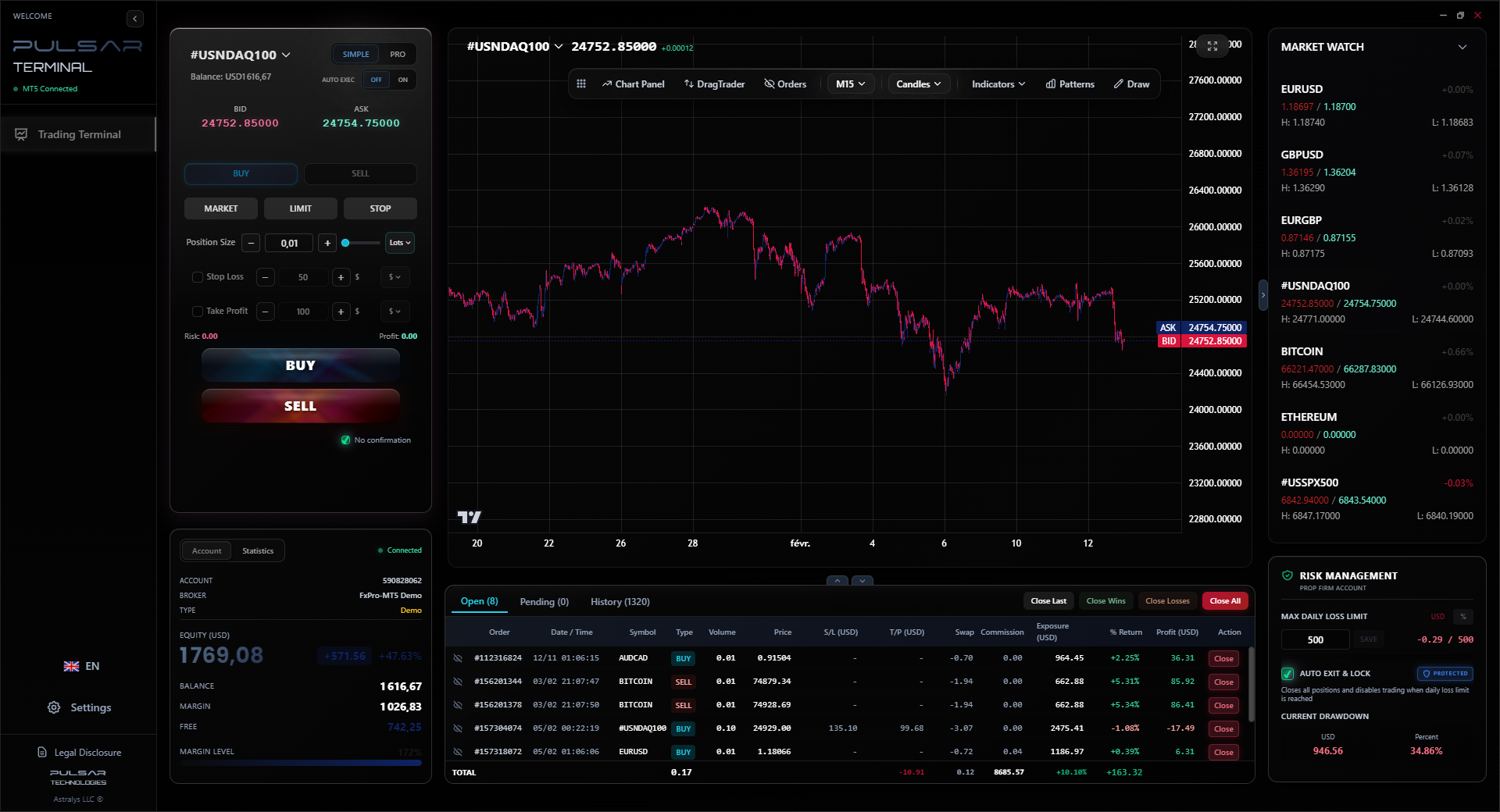
Manually drawing Volume Profile to find those high-volume trading zones is a chore; Pulsar Terminal plots it instantly on your MT5 chart, showing you exactly where the big battles were fought.
Pulsar Terminal
La herramienta MT5 todo-en-uno: órdenes drag-and-drop, multi-TP/SL, trailing stop, grid trading, Volume Profile y protección prop firm. Usado por más de 1.000 traders diariamente.
“Your risk management must be tighter when volume is low.”
A few minutes of setup will make volume analysis intuitive.
- Make it Visible: Don't hide the volume indicator at the bottom. I set my volume bars to a semi-transparent colour (like light blue) and stretch the subwindow so it's about 1/4 the height of my price chart. I need to see it without looking away.
- Add a Moving Average: Overlay a 20-period Simple Moving Average (SMA) on your volume bars. This instantly visualises whether current volume is above or below average. Colour it yellow or red for contrast.
- Colour Code for Quick Reading: Most platforms let you colour volume bars based on the candle. Green volume bar for a bullish candle, red for bearish. Use this. A tall green volume bar on a bullish candle is strong. A tall red volume bar on a bullish candle (high volume but the candle closed near its low) is a potential reversal sign - selling pressure within the up move.
- Multiple Timeframe Check: Before entering, zoom out. Is the volume on the daily chart supporting the overall trend? If you're buying a pullback on the 1-hour chart, but the daily chart shows declining volume on up moves, you're probably swimming against a fading tide.
This setup prevents analysis paralysis. At a glance, you can assess: Price level, candle pattern, and volume strength. That's 80% of what you need to know. The rest is managing the trade with a solid understanding of your spread costs and risk, so you never face a margin call.
FAQ
Q1Is tick volume accurate for forex trading?
It's not 'accurate' in the sense of reporting exact traded dollars, but it is a highly reliable and consistent proxy for trading activity. Its accuracy comes from its consistency on your broker's platform. If it shows a massive spike relative to recent bars, something significant is happening in the market's order flow, and that's what matters.
Q2What is a good tick volume indicator for MT4?
The built-in 'Volumes' indicator is perfectly fine. Don't overcomplicate it. Just apply it from the 'Volumes' section in your MT4/MT5 navigator. The goal is to see relative changes, and the standard indicator does this perfectly. Fancy custom indicators rarely add value for basic volume analysis.
Q3Can I use tick volume for scalping?
Absolutely, but with a caveat. For a scalping strategy, tick volume on very low timeframes (like 1-minute) can be extremely noisy. I prefer using it on a slightly higher timeframe (like the 5-min or 15-min) to gauge the overall intraday pressure, then using price action on the 1-min for entries. A scalp against the higher-timeframe volume trend is a low-probability trade.
Q4Why is volume low on my forex chart?
You're probably looking at a time outside major market overlaps (London/NY, London/Asia). The forex market sleeps. Low volume is normal during Asian midday or late US evening. It's a signal to reduce position size or avoid trading major setups until liquidity returns.
Q5How does tick volume work with the ZAR?
USD/ZAR and other ZAR pairs will show more erratic tick volume due to lower liquidity compared to EUR/USD. The spikes can be sharper, and the quiet periods can be deader. The key is to establish what 'normal' volume looks for that specific pair during your trading session and then watch for significant deviations from that baseline.
Q6Should I use tick volume or real volume?
For spot forex trading, you use tick volume because that's what you have. You can consult volume from the CME currency futures market for a 'real volume' reference, especially for majors like EUR/USD, but it's a related, not identical, market. For most retail traders, mastering the tick volume on your platform is more than sufficient.
Q7Can high tick volume indicate a reversal?
Yes, often at extremes. A massive volume spike after a long trend, especially if it creates a long wick (a pin bar or shooting star) can signal a 'blow-off top' or 'selling climax.' The huge volume shows a final frenzy of activity as the last buyers jump in and smart money sells to them. It's a powerful reversal clue.
Lección del Prof. Winston
Puntos clave:
- ✓Tick volume measures activity, not absolute trade value.
- ✓Use volume to confirm breakouts, not initiate them.
- ✓Watch for volume divergences at market extremes.
- ✓Adjust your strategy for ZAR's lower liquidity.
¿Te resultó útil este artículo?
Haz clic en una estrella
Análisis Trading Semanal
Análisis y estrategias semanales gratis. Sin spam.
Sobre el autor
David van der Merwe
Trader de Mercados Emergentes
Trader con sede en Johannesburgo con 11 años en divisas de mercados emergentes. Especialista en pares ZAR, trading regulado por la FSCA y análisis del mercado sudafricano.
Comentarios
Aviso de riesgo
El trading de instrumentos financieros conlleva un riesgo significativo y puede no ser adecuado para todos los inversores. El rendimiento pasado no garantiza resultados futuros. Este contenido tiene fines educativos únicamente y no debe considerarse asesoramiento de inversión. Siempre realice su propia investigación antes de operar.
También te puede interesar

Cara Trading Forex Sukses: 7 Prinsip dari Trader Profesional
Cara trading forex sukses dengan 7 prinsip trader pro: manajemen modal, disiplin, journal trading, backtest. Data nyata, bukan janji profit palsu.
Jam Trading Forex Terbaik untuk Trader Indonesia: Panduan Lengkap dengan Tabel Waktu
Panduan jam trading forex untuk trader Indonesia. Tabel 4 sesi dunia, jam emas 20:00-00:00, sesi mana yang harus dihindari. Data akurat + tips dari trader berpengalaman.
Top 5 Sàn Forex Uy Tín Nhất 2026: Review Jujur dari Trader Indonesia
Top 5 sàn forex uy tín 2026 untuk trader Indonesia. Review jujur: spread, deposit, withdraw, dukungan lokal. Exness, XM, IC Markets & lebih.
Obtener Pulsar Terminal
Todas estas calculadoras están integradas en Pulsar Terminal con datos en tiempo real de su cuenta MT5.
Obtener Pulsar Terminal